We are a commune of inquiring, skeptical, politically centrist, capitalist, anglophile, traditionalist New England Yankee humans, humanoids, and animals with many interests beyond and above politics. Each of us has had a high-school education (or GED), but all had ADD so didn't pay attention very well, especially the dogs. Each one of us does "try my best to be just like I am," and none of us enjoys working for others, including for Maggie, from whom we receive neither a nickel nor a dime. Freedom from nags, cranks, government, do-gooders, control-freaks and idiots is all that we ask for.
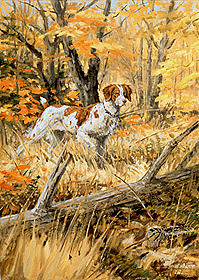
Somewhere in either Tolstoy or Dostoevsky there is a comment about the remorse of the hunter when holding a Woodcock in hand. You have noticed that our head image on Maggie's now is Woodcock hunting.
I have frequently felt something like remorse, when, on picking up a wounded
one, I have met the forgiving expression of its full and bright, yet soft hazel
orb. How many of the beauties who dazzle and enslave us would be proud of such
an eye.
Skinner's charming section on the Woodcock, written back before hunting seasons were instituted, is here.
The Woodcock is a fat little shorebird, fatter but not much larger than the American Robin, who renounced the shore and took up residence in our Eastern woods and swamps.
Like all shore birds, they are ground-dwellers and ground nesters, and do not perch. Because of their camoflage, their habit of feeding and being active at dawn and dusk, and their trick of freezing when approached, they are not commonly seen except in early spring, when the males perform their remarkable aerial mating dance at dusk.
Their long bills are hinged near the tip for capturing earthworms which they probe for in the soil and forest litter. They are thus necessarily migratory, to the Southern US.
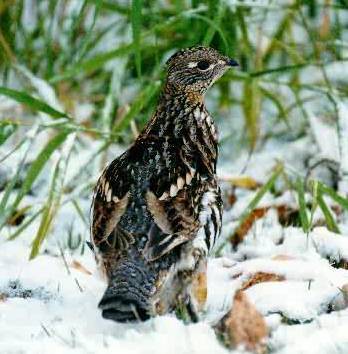
A few other details: Woodock is the only "shorebird" which is a legal game bird in the US today. They are not widely hunted, but they make excellent sport and their liver-flavored breasts are a rare gourmet treat. The French especially favor the brains, on toothpicks. People who don't like to eat them should not hunt them. Their habitat overlap with the Ruffed Grouse makes a typical mixed bag for Ruffie hunters. Because of their small size and cute appearance, many hunters will admit a mingled sense of dismay and pleasure when they bag a Woodcock. Unlike grouse, they cannot be hunted without dogs, because you would never find them. A decline in Woodcock numbers has been noted over recent decades, which may be due to habitat loss, but the cause is not certain. They are fond of overgrown fields and orchards, wetland edges, and transitional young woodlands, especially birch and aspen. The European Woodcock looks like ours, but is larger. Woodcock's heads are oddly-arranged: their brains are upside-down, and their ears are in front of their huge eyes.
In the course of our basement water pipe flood this summer, I seem to have lost my couple of pairs of light shooting gloves. I like to shoot with gloves even when it isn't too cold. Most of the hunting I do tends to be in cold weather so I like to get used to the feel of gloves on a trigger.
And I have a mild case of Raynaud's.
Glovemakers vary in what they mean by L,M, S, etc. Here's a great way to determine your numerical glove size when ordering online. Leather, of course, tends to stretch a bit with use.
The right gloves for hunting grouse in the snow or ducks in the sleet at 10 degrees F is another topic. The perfect gloves for those things do not exist, as best I have been able to determine. Heavy waterproof gloves, obviously, do not fit rapidly and easily inside a trigger guard, and if you are using a double-triggered old s/s, it's really a problem.
Ideas are welcome. I wonder what the Army uses in Afghanistan in the winter. Maybe things like this.
Tell us what hunting you have done this fall (not including pen-raised birds or half-trained farm Mallards - that isn't hunting - that is shooting. Not that there is anything wrong with it.)
We all must adapt! With Global Cooling hastening our certain death and doom by freezing to death, we offer this final post in our annual Winter in New England series. God willing and if we survive Climate Change, we will extend this series next fall with some new additions.
Let's face it: 4 WD is is for petite blond yuppie wives who do not know how to drive in snow and mud while chatting on their cell - and for hunters who like to take vehicles to gnarly places. There's a cheap solution.
Snow and mud tires are called "Winter tires" nowadays. They are made of a softer rubber (so as to provide better suppleness in cold temperatures), which is why they don't last as long as regular tires. That's the reason to put them on in November and to take them off in March or April (around here, anyway). At that rate, they will last 3-4 seasons at the minimum.
Important safety considerations with winter tires: Always put them on all 4 wheels and never replace just one: replace all 4 at the same time.
Decent snow tires will turn your old Chevette into the rough equivalent of a 4 WD. But how do you know whether you need them? In my opinion, if you need them, you will know it - but here's a piece on the subject. (fixed)
With global cooling picking up its pace, everybody may need them soon. 4 WD is good but, where you need them, winter tires are as good or better.
The recovery of the American Wild Turkey populations, like that of Egrets after the turn of the last century, has been a giant success of intelligent conservation.
Whether you want to shoot 'em and eat 'em, or just look at these huge birds (I like to do both), their resurgence is a great gift to America - thanks to conservation organizations.
The WTF has basically accomplished their goal. Turkeys are everywhere now, and huntable in most places. However, like government programs, non-profits rarely close up shop when their work is done. They tend to find something else to do, if only to keep their jobs. It's a sad fact that Ducks Unlimited still has much of their original mission to accomplish - wild duck populations, and the other wetlands critters that inhabit the habitats that DU protects and rehabilitates - remain far below where they were in years past.
There are a number of species of Wild Turkey in the New World. None native to the Old World.
Photo above: You all know that the males only display like that when they are overcome with love and/or horniness. Photo below: Our Editor-in-Chief Bird Dog (before he gained weight) with a bird in the hand.
Our occasional contributor Kondratiev posted this recipe as a comment the other day:
Cooked this one last night using venison backstrap (loin):
Seared Venison Steaks with Baked Pear and Red Wine Serves: 6
Ingredients 3 bosc pears (1/2 each) 1 small cinnamon stick, broken 5 black peppercorns ½ bottle red wine 1 tablespoon sugar 3 tablespoons olive oil 6 trimmed 6 oz. venison steaks Salt and ground black pepper 1 shallot, finely diced 1 tablespoon red currant jelly 2 oz. butter, plus extra for greasing
1. Preheat the oven to 350°F. Butter an ovenproof dish. Peel, core and halve the pears. Arrange snugly in the dish, hollow side up. Tuck in the cinnamon and peppercorns, then pour in half the wine. Sprinkle with sugar and dot with butter. Crumple up and wet a sheet of greaseproof paper, then lay it over the dish before covering with foil. Seal tightly and bake for 1 1/2 hours, or until the pears are tender. Turn the pears after the first hour. Keep warm. You will need their liquid for the sauce.
2. Pour the oil into a non-stick frying pan and set over a high heat. Season the steaks and fry for 2-3 minutes on each side for medium-rare. Remove the steaks and keep warm. Reduce the heat and gently fry the shallot before adding all the wine, including that with the pears. Boil vigorously, scraping the pan as you do so, until it has reduced by half. Microwave the jelly and, once it has melted, then stir it in, remove the pan from the heat and quickly whisk in the 2 oz. butter. Strain into a warm sauceboat and serve immediately with venison and warm pears.
Here's a simpler recipe for marinated loin steaks. (Loin is just tenderloin steak without the bone.)
When sitting in a duck blind or deer stand, standing on a ski slope watching your grandkids, and winter hiking, it's much more pleasant to have warm toes and fingers. I have had times in duck blinds when my fingers were too cold and numb to pull a trigger, but I have a touch of Raynaud's Syndrome.
Assuming that you wear things to keep toes and hands dry, hand and foot warmers can add plenty of comfort.
This site has aluminum-coated insoles and insoles ("footbeds") with inserts for 6-hour warmers.
As a nod to huntin' season, our current image on top is from Currier and Ives' American Field Sports series. I do not see Snipe too often anymore, but I do not know why. Last time I saw them in any numbers was in a Manitoba marsh.
It's the time of year when we re-link our world-famous Boots and Wellies opus as part of our series of All You Need to Know For Snow (and mud) season.
It's also a good time of year for another free advt for Sierra Trading Post. Good discount outdoor gear, plus sneakers, etc. Often, good deals on dress shoes and work shoes, too. Some folks collect knives, or guns, or knick-knacks. I collect boots because happy feet make for a happy man.
I also collect boots because, as many unhappy feet learned the hard way, your winter boot size is probably not your foot size. You will put your wool socks and maybe liner sox inside them if you plan to spend any real time in the cold.
You gotta size 'em for your socks and not for your feet, in the north.
The bill creates a new health entitlement program that the Congressional Budget Office (CBO) estimates will grow over the longer term at a rate of 8% annually, which is much faster than the growth rate of the economy or tax revenues. This is the same growth rate as the House bill that Sen. Kent Conrad (D., N.D.) deep-sixed by asking the CBO to tell the truth about its impact on health-care costs.
Sad but true: Everybody wants something from big government. I want a pony.
In the process of doing my Tuesday Winter in New England series, I am learning a few things. That's the whole point.
Today, I am doing layered winter clothing, which is only of interest if one is spending more than just a few hours out in the weather.
Dressing for spending hours out in cold weather is a tricky business, because it depends so much on what you are doing and how active you are. If you dress too warmly for a day of aggressive skiing in 10 degree (F) weather, you can easily get soaked with uncomfortable and chilling sweat. On the other hand, underdressing for a 6-hour stint sitting in a Maine duck blind can ruin the entire experience. When it's cold out, you want to be cool enough to enjoy the weather - and maybe just a little bit cold. It's all about layers.
I have spent many hours cold, wet, and happy in Yankee winters, but I have become more of a pussy as I get a bit older. It's impossible to get it right, because if you are hiking uphill at 15 degrees, you get too hot, and when you are sitting, you get too cold. But that's why you aren't being a sloth, sitting by the fire.
This is for Rodger (a commenter on my Muskrat photo). The game camera took 101 photos of this big Blacktail as he stood around a mineral spring between 1:10 am and 2:40 am on July 31:
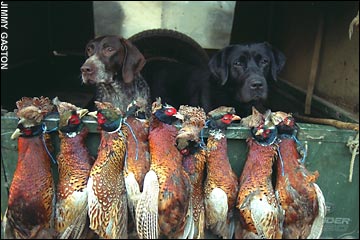
An email from a good pal, with photos (Harley is the Lab, Yankee is the Large Munsterlander with the white chest. I don;t know the name of the other Large Munsterlander.):
BD -
Enjoyed your posts on “Where I wasn’t”, and have very fond memories of the trip to Manitoba with you all. I just returned from a week in Saskatchewan for ducks/geese and then an upland hunt with my Large Munsterlander dog club. Attached is a photo of the Abby Hotel (built ca. 1913) where we stayed, and a couple of the dogs and birds. That’s Yankee with the Hun on the fence post. Harley probably made his last trip. Tired, but happy.
C.
PS On the “tailgate” picture, ignore the biodiesel bumper sticker. Truck belongs to a friend who is a bit liberal. Makes for some long road trips, until we agree to disagree.
Hey - I know what that is like. Been there. Gotta stick to other topics, like the meaning of life and shotshell loads.
Returning to the dock after an afternoon/evening shoot. A well-stocked bar awaits (always with the Spicey Clamato), with wild game hors d'oevres (like wild duck liver pate with cognac, stir-fried Coot breast with garlic, soy sauce and scallions, fried duck gizzards, or sweet and sour wild duck wings), then a great dinner. My favorite is the beer-batter fried Walleye, fresh from the lake. Afterwards, Port and Cuban cigars around the fire while telling lies and distinctly non-PC jokes. Not too bad.
Where is the electric from? Rented diesel generator on a trailer. Chugga chugga chugga.
Readers know that I like to hunt on the northern end of Lake Winnipegosis in the first week of October. Having just returned from a 2-week trip to Europe, I couldn't really do another week so soon. Thus Gwynnie and some other Maggie's Farm pals are up there without me.
Here's the old private duck hunting club where we stay. It's an old log structure with rough clapboard covering. Open only 6 weeks per year. Females not allowed except for the cook and housekeeper. It's 13 miles from the nearest "town," which consists of a tiny old general store (duct tape, chewing gum, cigarettes, batteries, work gloves, wool hats, rope, Coco Puffs, milk), a liquor store, and a gas station, all on one dirt parking area. Mostly Indians up there, and some Ukrainian farmers.
One of the equipment shacks - a 100 year-old log cabin:
Where I am not, but where I would love to be this week. Up in Manitoba, climbing out of a lumpy old bed into the frigid room, layering one's clothing, covering it all with camo, scarfing down a quick coffee and maybe a brandy and an apple or something, loading some ammo into the ammo boxes, and getting those duck boat engines running in the frosty morning and heading out onto Lake Winnepegosis to match wits with the migrating ducks (who are famously smarter than humans).
I think Gwynnie will retrieve some photos for us...
That's King Buck on the 1959 Federal Duck Stamp. A great champion, and the prize of avid sportsman John Olin's Nilo Kennels.
In 1931 the Olin chemical and ammo company bought the bankrupt Winchester Repeating Arms company, and still owns the trademark for the firearms and makes the ammo.
The story of Winchester is the sad story of manufacturing and unions in the Northeast. From the Wiki:
By the 60's the cost of skilled labor was making it increasingly difficult profitably to produce Winchester's classic designs, incorporating as they did considerable hand-work. In particular, Winchester's flagship Model 12 pump shotgun and Model 70 bolt-action rifle with their machined forgings could no longer compete in price with Remington's cast-and-stamped 870 and 721. Accordingly S. K. Janson formed a new Winchester design group to advance the use of "modern" engineering design methods and manufacturing principles in gun design. The result was a new line of guns which replaced most of the older products in 1963-64. Unfortunately the reaction of the shooting press and public was overwhelmingly negative: the popular verdict was that Winchester had sacrificed quality to the "cheapness experts,"[1] and market share continued to decline as Winchester was no longer considered to be a prestige brand. Gun collectors consider "post-64" Winchesters to be both less desirable and less valuable than their predecessors.
Labor costs continued to rise, and a prolonged and bitter strike in 1979-80 convinced Olin that firearms could no longer be produced profitably in New Haven. Therefore in December 1980 the plant was sold to its employees, incorporated as the U.S. Repeating Arms Company, together with a licence to make Winchester arms. Olin retained the Winchester ammunition business.
From 1981 until 2006, Winchester guns were made by the U.S. Repeating Arms Company. When U.S. Repeating Arms went bankrupt in 1989 it was acquired by a French holding company, then sold to an arms making cartel sponsored by the Belgian Herstal Group, which also owns gun makers Fabrique National (FN) and Browning.
On January 16, 2006 U.S. Repeating Arms announced it was closing the New Haven, Connecticut, plant where Winchester rifles and shotguns were produced for 140 years.[1] Along with the closing of the plant, the Model 94 rifle (the descendant of the original Winchester rifle), Model 70 rifle and Model 1300 shotgun would be discontinued.
On August 15, 2006, Olin Corporation, owner of the Winchester trademarks, announced that it had entered into a new license agreement with Browning to make Winchester brand rifles and shotguns, though not at the closed Winchester plant in New Haven. Browning, based in Morgan, Utah, and the former licensee, U.S. Repeating Arms Company, are both subsidiaries of FN Herstal. In 2008 FN Herstal announced that it would produce Model 70 rifles at its plant in Columbia, SC.
It's interesting to read the histories of companies. Here's the history of the Olin Corp, which still makes Winchester ammo. I had the pleasure of meeting some good folks from the company recently.
Postal socks! Letter carriers of the Postal Service have extreme needs for quality socks, and I found them by accident while looking for hiking socks on the Thor-Lo company website.
Got some before I left on my trip. I tend to walk a great deal.
This photo was on the morning of the 4th, before I got the rest of my hosed-down camo life jackets and my vast assortment of hosed-clean blaze-orange shooting stuff, some waxed and some not, hanging up on this thing to be dried and refreshed in the sunshine.
That basement flood was rough on my gear (much of which was on or near the floor), and it all needed a serious, high-powered hosing-down -not a washing machine. It got most of the mold and dirt out, but everything needed a good long sunshine treatment.
Maybe I need a real outdoor clothes line, like my Mom has. She hates to sleep on sheets that have not hung in the New England sun, summer or winter. That old Yankee gal believes that sun on your sheets gives you good dreams, and the thick scent of the Berkshire wild thyme helps.
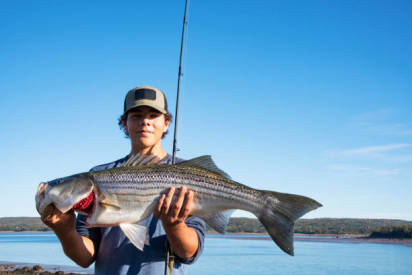
Bird Dog - Spent Friday morning fishing for striped bass with Pops and Mother's cousin. Caught our limit of six fish greater than 28 inches in about five hours. We fished out of Groton (and off Fisher's Island), aboard "The Otter" with Captain Bruce of www.captainbrucesportfishing.com.
The weather turned out fine, with moderate swells and no rain. Limited visibility kept most other boats in port. We trolled surgical hose with sandworms and our largest fish was 26 pounds, caught by Pops. We had three more striped bass, too small to keep and one bluefish, which Pops claims he will make into fishcakes.
With the 25+ pounds of filets, a great time was had by all.
People join PETA because they think they understand the relationship between man and nature better than a guy who goes out in a rice paddy, at night, with a spear, to kill the feral hogs that are trying to eat every last grain.
That's your hard-working Editor in the background, fishing in Connecticut in the Spring rain a couple of years ago. It's time to review some of our good trout posts from the past.
My pup knows "Go out", "Breakfast" (all-purpose word for food), "Go for a walk?", "Heel," "Sit", "Stay," "Fetch," "Find the bird," "This way" (with hand signal), "Back" (ie "retrieve it") and "Here (ie "come right now and sit down"), "Uh-uh...", "No", "Speak," "Jump," "Down" (ie lie down), "Kennel up," "No barkie," "Go to bed", "Careful" (meaning danger - good for snakes, and to keep him away from turtles, electric fences, and whatever else - that command was shock-collar reinforced), "Car", "OK" (meaning run all you want as far as you want), "Get the squirrel," "Too far", "Get off," "Get up," "Move over," "Good boy!" and "Drop it." Maybe a few more I can't think of right now.
He does not know "Fetch me a cold beer from the fridge," "Get the mail," "Pay the bills," or "Fetch me my slippers, my smoking jacket, and my pipe" - but neither does Mrs. BD.
Three whistles means "back." He also knows some hand signals, eg "Go left", "Go right."
At any given moment, he may decide to pretend to forget a command, like the time he realized a hunting field was over-seeded with pheasants. If I worked on it, he'd know plenty more, but, like the DC public schools, it's a conspiracy to keep him poor and stupid. And manageable.
I know it's a cheap shot which is beneath Maggie's dignity, but that photo (Caption This) from Wizbang isn't a person walking a dog: it's a dog walking a person. I just use the photo to make the point that, in general, it only takes about 3 hours (9 20-minute lessons at 2-3/day) to train a pup to heel (his nose at your left knee), and it will never forget with regular reinforcement of the lesson. Nobody wants to be seen in public with a dog that will not heel because it's a reflection on you, like a kid that throws food. Pinch collar and dog yummies. An untrained dog means you don't really care about the animal, same as an uncivilized kid. In the Obama's defence, that is a darn good-looking PWD (if a bit older than the ideal 6-9 weeks), but any dog can be easily trained. Obedience is what they are bred for. It just takes a few minutes and a little firmness. The training is the real bonding. Train that dog the way you train the Dems in Congress. Sit! Heel! Vote!
Government should bail out dying media. Brilliant! Just like Chavez. Or Pravda. Put 'em on the gummint payroll and they will play nice, like the BBC and the CBC.
Treasury "allows" bank to return TARP funds; bank complains about changing the rules. Duh. Take their money and you're on their plantation.
An old pro like Barack Obama has to be more amused by these protests than worried about them. The left is laughing for a reason.
If the right wants to succeed in civil resistance, it needs to study the tactics of the left and adopt the methods that are not incompatible with its own morality.
On the weekend before trout season opens, our hunting and fishing club Chairman, the Fishing Chairman, and our manager perform the annual ritual of walking the length of our stream checking the beats, the conditions of the pools and of the paths, and generally making sure that things are up to snuff. We have a mile of this stream in CT, with some larger ponds and beaver marshes in it.
This was Friday, on a narrow section of the stream -
The relationship of humans with dogs is an astonishing thing. Author Thomas McGuane understands and loves his dogs. A quote:
On a bright and cold October morning in Montana, my dogs Abby and Daisy, The Pointer Sisters, are in my closet helping me select my clothes. On the left end of the rack are everyday clothes; on the far right are coats and ties for the occasional urban jaunt; and in the middle, clothes for sport, especially hunting. Here sit the two girls, tails whisking the floor between the shoes. They moan, grumble and pant wishfully while my hand hovers over the coat hangers. I shouldn't do this as dogs don't enjoy being trifled with. They know where the thorn-proof pants hang, since the red suspenders dangle to eye level for them, but they watch my hand. I don't move; Abby turns to stare at my boots with such longing she must think they can scoop me up and take me into the hills. Finally, Daisy can't stand it and barks at me: I pull the hunting pants from their hanger and with a cry of triumph they scramble out of the closet to watch me dress. Let others withstand the elliptical trainer, the rowing machine and the NordicTrack. Mama wants two partridges for tonight's table and I will walk long miles hoping to get them.
Read the whole thing in the WSJ. (Photo from the article. Where's his blaze orange?)
It's Shad Season now in the Northeast. Many of us welcome this brief season when the Shad migrate from the ocean up the rivers to lay and fertilize the eggs, with the females filled with delicious Shad roe.
If you drive over the Hudson River, the Connecticut or Housatonic bridges, you will see the fishermen's nets spread out right now.
The roe, cooked with bacon, is as good as food gets. Do not overcook it - it is Shad caviar. But the meat of the Atlantic Shad (a large herring, I believe) is underestimated. It requires an expert Shad boner (ok, ok) which makes it expensive, but it's as tasty a fish as exists. The Shad is full of crazy bones.
It's a brief season for Shad, and there are Shad Festivals all over, such as this one.
When I was a kid, my babysitter would take me fishing for Blue Crabs off the dock. What it required was a string with a hunk of bacon tied to the end. When you gently pulled it up to just below the surface, you needed a crab net to scoop up the crabs clinging to the bacon. Otherwise, they would let go of the bacon.
My Mom was never disappointed to find a bucket of two dozen crabs when she got home.
We have posted, somewhat disparagingly, about the Blue Crab's natural history and the Blue Crab as dining material, (too much effort, basically) but we never have disparaged good Maryland crab cakes, especially when consumed in volume with volumes of bad beer in low-life Maryland tatoo pubs with dogs walking around, after a day of duck hunting.
The subject comes up because we noticed projects about the aquaculture of Blue Crabs. Very cool. Fresh water? Who would have thought it?
What a clever country we are. Speaking of clever people, Sippican sends this recipe:
CRAB CAKES 1/2 stick (1/4 cup) unsalted butter, melted and cooled 4 large eggs, beaten lightly 6 tablespoons sour cream 1/4 cup minced fresh parsley leaves (preferably flat-leafed) 2 tablespoons fresh lemon juice 1 teaspoon Worcestershire sauce 1 teaspoon paprika 1/2 teaspoon salt, or to taste 1/4 teaspoon cayenne, or to taste 2 pounds lump crab meat, picked over 2 cups fine fresh bread crumbs 1/3 cup cornmeal 1/2 cup vegetable oil
tarragon tartar sauce as an accompaniment lemon wedges as an accompaniment
In a bowl whisk together the butter, the eggs, the sour cream, the pa rsley, the lemon juice, the Worcestershire sauce, the paprika, the salt, and the cayenne and stir in the crab meat and the bread crumbs gently. Form 1/2-cup measures of the mixture into twelve 3/4-inch-thick cakes and transfer the crab cakes as they are formed to a baking sheet sprinkled with half the cornmeal. Sprinkle the crab cakes with the remaining cornmeal and chill them, covered with plastic wrap, for at least 1 hour or overnight.
In a large heavy skillet heat the oil over moderately high heat until it is hot but not smoking and in it sauté the crab cakes in batches, turning them once, for 3 to 4 minutes on each side, or until they are golden, transferring them as they are cooked to paper towels to drain. Keep the crab cakes warm on another baking sheet in a 200°F. oven. Serve the crab cakes with the tarragon tartar sauce and the lemon wedges. Makes about 12 crab cakes, serving 6.
I'd skip the bread crumbs. They dilute the crab meat.
And here's a post about Hoagy Carmichael Jr., who is apparently a great fisherman of the Grand Cascapedia, and who is responsible for the renaissance of the split-bamboo fly rod, at Never Yet Melted.
The photo of Amber is to highlight a fine site for fly fishermen, Bamboo Fly Rod. net. Nope, that site is defunct, but we hope Amber isn't. This site has good info on casting with, and the care of, bamboo rods.
(Trout season around here opens on the third Saturday in April. Fishing has a lull during the summer, and perks up again in the fall.)
“Fishing Bamboo” is the name of a wonderful book by John Gierach, a veritable fishing curmudgeon of the old school.
In reviewing the book, W. D. Wetherell said, “The split bamboo fly rod and the mystique that goes with it is a subject that deserves just the right mix of skepticism and reverence, and John Gierach is just the writer to supply this, in a fascinating book that explains what the excitement is all about.”
Yet like many wonderful things of the past, the bamboo rod is close to being on the endangered list.I took one of my late father’s wonderful E.C. Powell rods to Montana to fish the Bighorn (hated it – we were trolling downstream from a boat with the fly being swept ahead of us by the current).As I assembled the rod, the 20ish guide said “It just don’t look right, being yellow.”He had never seen a rod that wasn’t molded from green or brown-dyed synthetic petroleum by-products reverently referred to as “graphite”.A professional fishing guide, on the Bighorn, and he had never seen a bamboo rod.
Well, I have to wonder why not, and deal with the conclusions.Those of us who use bamboo are probably using our father’s or grandfather’s rods, because the values of these rods have gone from high to stupid.I lost my mother’s 2½ oz. 7-foot “baby Powell” on a transcontinental flight, and after two years of mourning and being unable even to contemplating fishing, I felt morally obligated to replace it.The 2½ oz. 7-foot Leonard “Fairy Catskill” I found on eBay cost me $3,600, and I fish it often, refusing to be terrified. It’s just Ma’s rod reborn, and it is meant to fish the 7”-9” wild trout we find where I fish in the Sierra Nevada Mountains.The tip, maybe one millimeter thick, is still composed of six long, incredibly slender, patiently-planed pieces of Tonkin cane spliced together, tied with dark red thread and then lacquered.There are precious few people alive today who can replicate or repair such artistry.
Orvis still sells bamboo, and there are still some fabulous rodmakers working today, like my friend Jim in Florida, a retired USAF Master Sergeant, who not only makes amazing bamboo rods, he also make all his own machine tools for the bamboo and also the metal fittings.
Well,where are the rods?I fear they have fallen into the hands of “collectors”, look-but-don’t-touch people with a lot of money and minimal fishing skills – much like Purdey shotguns.Have you ever seen a Purdey in the field in the US where it can get dinged on stone walls, fall in the mud, and run over by SUVs (except for those fancy-ass Hudson Valley corporate clubs)?
I have several old bamboo rods and may add one of Jim’s quad rods to my arsenal, and I have some English shotguns, but I follow – and leave the gentle reader with – my partner Tom’s advice.Be sure you can say that you have caught a fish with every rod you own, and that you have taken a bird with every shotgun; only then do you honor the rare skill of the maker.
(Image is an old Heddon 7-8 wt. 9' rod, for big fish - salmon and salt-water fishies. I never thought I'd see it, but salt-water fly-fishing has become all the rage these days.)
You can die of hypothermia when the temperature is well above freezing, and you will die of hypothermia after a while in 77 degree water. Many interesting facts at Freezing Persons Recollect (h/t, Cons Grapevine). All outdoorsmen should know this stuff. One example:
...many hypothermia victims die each year in the process of being rescued. In "rewarming shock," the constricted capillaries reopen almost all at once, causing a sudden drop in blood pressure. The slightest movement can send a victim's heart muscle into wild spasms of ventricular fibrillation. In 1980, 16 shipwrecked Danish fishermen were hauled to safety after an hour and a half in the frigid North Sea. They then walked across the deck of the rescue ship, stepped below for a hot drink, and dropped dead, all 16 of them.
I am thinking of making a game cassoulet for Christmas Eve supper, for after church. As you may know, cassoulet is basically French baked beans, with meat. It is country home cookin, but it can be great.
Any meat, but not beef or venison - red meat is too strong for cassoulet. We have, over time, used duck, snow goose, chukar, chicken, pork, and pheasant. Mix the meats - it only adds to the flavor. Always some venison sausage, or any sausage, because it is a traditional ingredient. The meat-to-bean ration is supposed to be fairly high - 30%- but I like beans and prefer a lower ratio. I think every village in southern France has its own recipe and method.
A couple of things about cassoulet: 1. Make it the day before. Like beef stew, it improves overnight. 2. Serve with salad, garlic bread, and a pile of stinky cheeses and fruit for dessert. And always a Cote Roti. 3. You need to use large white beans, preferably French haricot beans. They should be intact - not mush. 4. Make sure you push the breadcrumbs down into the mixture during baking. 5. Sprinkle chopped parsley on top when done - it looks better.