Friday, November 13. 2009
One of the best new features in Vista (it's also in Windows 7) is the Snipping Tool. I only started using Vista a month ago, so it took me a while to blunder my way across it. What a great find.
If you just want a grab a picture from the Web for your own use, you right-click on it and save it. The problem arises when you just want part of a picture, or part of a web page (or program) that's not a picture. The traditional method is to hit the 'Print Scrn' key on the keyboard, which puts a snapshot of the entire screen into memory, then paste it into a paint program and do your cropping. The Snipping Tool eliminates the entire process.
In Vista's Start Menu, the entry is in Programs/Accessories. In Win7, it'll either be on the main Start Menu list or buried somewhere. If you don't see the entry, open Control Panel, 'Programs and Features', click on 'Turn Windows features on and off' over to the left, then checkmark the "Tablet PC" entry and let it load. If it's already checked and you swear you can't find the entry on the Start Menu, uncheck 'Tablet', reboot, then put it back in. (Why it's tied in with the tablet's features is anybody's guess.)
Update: A commenter noted that the 'Tablet' feature isn't offered in his 'Home' edition, so if you don't see a 'Tablet PC' entry in the 'Features' box, check out the couple of free snipping tools available here.
To use Snipping Tool, just fire it up. It automatically goes straight into 'capture mode'. Grab the mouse, hold down the left button and d-r-a-g it over the area you want to snip. When you let go, a box pops open with the sniplet. Do a 'Save As' and there ya go.
There are a couple of other features in the sniplet box you might find useful, such as a 'pen' tool where you can manually write words or circle something, and a yellow 'highlight' tool. If you don't like what you circled or highlighted, click on the 'Eraser' tool and then the area you want erased. You can also send the snip directly to someone via email without even bothering to save it, another time-saver.
There are a couple of Options you might want to change:
— You can add it to the Quick Launch tool bar if you use it.
— The 'ink' color is the color of the border it puts around the snip, so you might prefer black or some dark color over the default red.
Kudos to Microsoft for an excellent time-saving tool that works perfectly.
We have asked our friend Capt. Tom Francis to share some photos and info about his home town of Woodstock, CT. (Maybe in April we'll invite him to write about trout fishing in New England, as he is a fresh and salt-water fishing guide.)
Here's his first offering -

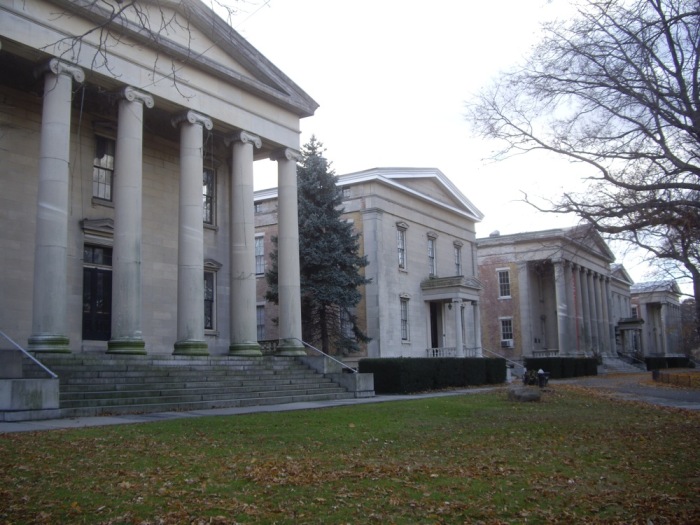
Roseland Cottage.
Built by Henry Chandler Bowen in 1846 - a local resident who made his fortune in New York City - Roseland Cottage, also known as "The Pink House", is located in Woodstock, CT. Designed by Andrew Jackson Dowling whose design concepts stressed the practical as well as the aesthetic. It's exterior design is called Gothic Revival. I wouldn't know Gothic Revival from Greasy Gravy, but that's what I've been told.
Roseland Cottage also has original Lincrusta wall coverings produced by Fredrick Walton of Walton Linoleum fame. The Lincrusta process produces embossed coverings made from linseed oil and wood flour on linen.
Bowen was an ardent abolitionist, Congregationalist, and Republican. He often entertained many of the heavy hitters of the day including Presidents - most notably President U.S. Grant who was enchanted by the in-home bowling alley. Bowen was known for his philanthropy and he had a huge impact on Woodstock and local towns. More on Bowen later in the series.
Thursday, November 12. 2009
While lesbian feminista Democrat Camille Paglia admires Pelosi's "grittiness" and "mettle" (but detests what Pelosi has produced. BTW, we like Paglia a lot. She is the kind of person it is pleasant and interesting to disagree with, and we appreciate grit in women), Dr. Laura has another view of the world at home: The Evolution of ‘Feminism' Saddens Me. One quote:
...it’s pretty easy to make men happy.
It is remarkable that each and every one of the women who has
called my show complaining about her husband, and who was then asked
the question, "Would you want to come home to you?" has said,
haltingly, no. There it is. When women disdain masculinity and their
own femininity, all is lost for the family.
These sorts of discussions, however interesting at times, are a bit off the point. Men need to be gentle sometimes, and women need to be tough sometimes. Both obviously have these capacities. However, I think that if a woman wants to have a happy marriage she would do well to at least give Dr. Laura a listen. She understands men pretty well, and likes them for what they are.
This morning I told a friend I often watch idiotic escapist movies. Those who make the better ones need to be creative wonders. A look behind the scenes at one of the more successful reveals that he needs also to be an idiot.
My local newspaper carries a wire service profile of the director of the upcoming $200-million special effects movie “2012.” This director, Roland Emmerich, from Germany, “has earned the unofficial title of ‘Master of Disaster’” for his prior hits, “Independence Day” (1996), “Godzilla” (1998), and “The Day After Tomorrow.” (2004) They were, indeed, fairly good idiotic escapist movies, to me.
His soon to be released topper will have “a collapse of the Earth’s crust, giant floods and hellish rains of fire (yet not enough to kill the main character, played by John Cusak).”
Wow! Can hardly wait. New York destroyed again. Been there, done that, you say.
Emmerich does more, but notice what he doesn’t do: "In fact, the man who rose to fame as a cinematic escapist is an activist in real life. In Germany, he’s a strong supporter of the environmentalist Green Party. He campaigns for gay rights, and he doesn’t hide his contempt for organized religion.” OK, he does fit in with Hollywood.
As the profile continues: “In 2012, the pope is buried under debris when St. Peter’s dome comes tumbling down, and peace-loving Tibetan monks are not spared by the great floods. No Islamic site is seen perishing, though. ‘We didn’t destroy Mecca because we didn’t want to have to deal with a fatwa,’ Emmerich says.” OK, he does fit in with the PCers who made the Ft. Hood massacre possible and the media community apologists for poor, misunderstood, stressed Hasan. Can’t wait for that Hollywood film version, huh? What courage it takes to trash Western civilization, and make the world safe for its destroyers!
Emmerich puts the idiot cherry on his half-baked cake of a mind with this one, why he “couldn’t make a patriotic feel-good movie like ‘Independence Day’ anymore: ‘These days I have a much more pessimistic outlook for our civilization, despite the good America can do for the world under Barack Obama.” OK, we’re waiting for his film about how Obama’s abandonment of oppressed peoples in Tibet, in Iran, in Honduras, in the growing list to include Afghanistan and maybe Iraq, will cheer shmuck Emmerich up. (Couldn’t resist the alliteration.)
BTW, I’d love to give you, dear reader, the url to see this profile in idiocy for yourself. But, due to the past triumphs of idiocy in media my local newspaper’s falling circulation cannot afford to pay extra anymore for the wire service reports in its dead-tree edition to also appear at its website, and the MCT wire service website – unlike AP's, even – doesn’t even steer the reader to a newspaper that does.
Wednesday, November 11. 2009
The legal costs to individuals and businesses are destroying the American economy. America, the most litigious nation and the most-lawyered nation (per capita) in the world is burdened by a broken, and crushingly expensive system of legal care.
Few Americans can afford high-quality legal care at $500-$2000/hour when needed, and end up in legal clinics or representing themselves. Few, if any, have legal coverage. Legal costs sap profits from business in ways that are entirely unproductive. The poor, minorities, and women are, of course, most hard hit by the difficulty finding justice in a money-driven legal system, while the Mafia, politicians, and Wall Streeters skate and the lawyers drive Lexi and Mercedes in their Valentino and Armani suits.
It costs more to contest a speeding ticket or a routine Maggie's Farm disorderly conduct ticket than to pay it. And when you die - forget it: You are forced to pay lawyers all over the place.
There is no affordable justice in America today, and God knows how many bankruptcies, heartaches, and ruined lives result. It's unfair, unjust and un-American. 10% of American African-American youth rot in jail for lack of legal care while rich white guys like Bill Ayers are walking the street and hosting cocktail parties for politicians.
Meanwhile, hordes of tort lawyers are watching for every time you fail to clear your driveway, and checking the lead levels in the toys and books you produce. Hungry divorce lawyers prowl around your home at night, waiting to hear an argument. They are everywhere, looking to either defend you or to prosecute you.
There are more laws up against you than there are diseases in this world.
Furthermore, unlike medical care, the US Constitution does concern itself with justice more than a little bit.
Just think about your annual direct and indirect legal care costs: they are included in your auto liability insurance, your homeowner's insurance, your tax guy, the guy you paid to get your kid reduced from a DWI to a DUI, the guy who managed the refinancing of your house, the indirect costs to your employer and in your town taxes for having to maintain a legal department, and the legal costs built into everything you buy in America - including doctors' malpractice insurance - which is basically legal insurance. Create a pension: you need a lawyer. Even your lawyer has to buy legal insurance, inflating his charges. And even your investments - every mutual fund has a legal team paid for with your fees. The list goes on and on.
Something must be done immediately to correct this drag on the American economy and on the American spirit. Short of killing all the lawyers (I am quite fond of a number of them), I suggest a government take-over of this broken, unjust system by 111 Federal bureaucracies, and with the help of our politicians, to solve this crisis.
And a 5% Federal tax increase to pay for it all.
This song, “Before You Go,” will be performed today at the National Celebration of Veteran's Day, 2009 at the Vietnam War Memorial Wall in Washington, DC. The song's authors Dr. Sam Bierstock and John Melnick have received the honor.
The "Before You Go" project now has a formal affiliation with "Veterans Helping Today's Returning Heroes", designed to directly benefit our returning heroes. Veterans Helping Today's Returning Heroes (VHH) is a charitable 501(c)3 organization providing support dogs and guide dogs to wounded, blinded and disabled veterans returning from the global war on terror. These dogs cost between $35,000.00 and $50,000.00 to raise and train, and are not funded by the government. To date, VHH has raised over $2,000,000.00 toward this worthy cause which allows our veterans disabled in war to enhance their quality of life with honor and the companionship of one of these wonderful dogs, each of which is trained to support the specific disability of each wounded veteran.
For that reason, Sam and John do not allow websites to post embedded videos of their song, so that purchases will be made at their site, and part of the funds go to VHH.
But, they do allow you to visit their site and see the videos for free that they’ve made to accompany the song.
For the WWII and Korean War version, click here.
For the Vietnam War version, click here.
Here’s some of the national TV features that have been made about this song-writing duo, how they came to do this, and why. As one says, “we’d have nothing without them,” our veterans. “Thank you, before you go.”
Here’s the letter President Bush and wife Barbara sent Sam Bierstock, and the “tears in our eyes.”:

Tuesday, November 10. 2009
I was offline reading a good book (as crazy as that sounds) when news of the Fort Hood tragedy broke. Luckily, hours later, my introduction to the story was a post on Hot Air, which had already discerned from the British press (since the American press was studiously avoiding the subject) that the perpetrator was Muslim.
My first reaction to a Muslim shooting up the place was, "Here we go again!"
(I was ever the cynical one.)
My second reaction was, "Stand by for all the 'Muslims fear reprisals' articles in the MSM."
(Practical, too.)
But my third reaction was, "Hey, wait a sec..."
Spot the incorrect word:
Ft. Hood Motive: Terrorism or Mental Illness? — ABC News
YOU DECIDE: An Act of Terror, or a Horrific Crime? — Fox News
Probe so far shows Fort Hood attack wasn't part of a broader terrorist plot — CNN News
A senior administration official told NBC News that the shootings could have been a criminal matter rather than a terrorism-related attack. — MSNBC News
It is not clear whether terrorism laws would apply or not. Evidence would have to show that the act was inspired by a terrorist group or influenced or directed by terrorists or terrorist ideology. — CBS News
Domestic terrorism: New trouble at home — USA Today
If reports about him are true, Maj. Hasan clearly was a terrorist. — Washington Times
Did Hasan commit his act of terror alone? — Ed Morrissey, Hot Air blog
But there are very, very strong warning signs here that Dr. Hasan had become an Islamist extremist and, therefore, that this was a terrorist act. — Senator Joe Lieberman
(etc)
And from yesterday's Best of the Web Today column by James Taranto:
In fact, this was not a terrorist attack. By definition, terrorism targets noncombatants. When an irregular force like al Qaeda attacks a military target, such as the bombing of the USS Cole, that is more accurately termed guerrilla warfare.
The real question here is not whether the attack was terrorism but whether it was an act of war as opposed to personal aggression. ABC News reports that "U.S. intelligence agencies were aware months ago" that the suspect "was attempting to make contact with people associated with al Qaeda," which if true certainly bolsters the case for the affirmative.
When a soldier attacks members of his own force in an act of war, it seems to us the most apt term is treason.
Agreed. It didn't take long before it occurred to me that, by definition, "terrorism" means killing civilians, not soldiers. Thanks to James for stating it perfectly.
And, by way of Instapundit, a couple of sharp quotes on the subject:
In regards to the liberal MSM's worry about the 'Muslim backlash', here's Michael Nehring writing on Facebook:
"What says more about America – that we always, ALWAYS manage to refrain from an anti-Muslim backlash, or that progressives are always, ALWAYS, convinced that one is on the way?"
And in regards to the American press doing its usual dance around the matter of the perpetrator's Muslim faith and its bearing on the event (as highly evidenced in a number of the above headlines and quotes), here's David Warren:
"For a person with old-fashioned values, and an old-fashioned sense of English word meanings, the reports of the Fort Hood massacre were almost as provoking as what happened there. In the larger view of things, they may be more consequential."

I am going to comment on some things our friend TigerHawk said here in his piece on government payment for abortions. Says he:
I do not believe that the Constitution can reasonably be read to confer a "right" to an abortion.
The US Constitution was not designed to "confer" rights: it was designed to circumscribe the power and jurisdiction of the Federal State by a group of independent states who, knowing human nature, were deeply suspicious about any expansion of Federal, centralized power after their experience with Britain. According to our founding documents, human freedom is conferred by God to us as individuals, not by man and not by government.
The "Bill of Rights" Amendments were not designed to confer rights either. They were added, on the insistence of the feisty New York delegation, just to make some of the implied meaning crystal clear (and I suppose they were wise to do so, but it makes it appear that unspecified freedoms - or "rights" - do not exist)... except for Amendments lX and X which were intended to cover almost all human actions:
The enumeration in the Constitution, of certain rights, shall not be construed to deny or disparage others retained by the people.
The powers not delegated to the United States by the Constitution, nor prohibited by it to the states, are reserved to the states respectively, or to the people.
Thus, in my view, abortion should have been ignored by the Supremes. Not a Federal case. It may be rightly a legal issue on the state level, and is certainly an individual moral issue.
The language of "rights" is tricky, easily abused and distorted, and I do not like it. As an American, I do not and should not need specified "rights" to anything - all I need is a clear delineation of the limit of the powers of government, and I will find a way to get on with it in life.
I can bear arms - and do a million other things that aren't listed. But that doesn't mean that the government should buy me guns. So the question of who pays is another issue entirely. Insurance plans vary widely in the elective things they cover. Most people prefer less expensive plans which do not cover elective procedures, and clearly most people do not want to pay for other peoples' elective abortions.
They don't want to pay for other peoples' IVF either.
Am I right or wrong about all this? Just to be clear, this is not a pro-abortion post...
Monday, November 9. 2009
Quoted in a piece at NYM on homicide:
By the time European states became democracies, the populace had
accepted the authority of the state. But the American Revolution
happened before Americans had got used to the idea of a state monopoly
on force. Americans therefore preserved for themselves not only the
right to bear arms—rather than yielding that right to a strong central
government—but also medieval manners: impulsiveness, crudeness, and
fidelity to a culture of honor. We’re backward, in other words, because
we became free before we learned how to control ourselves.
We Americans are so darned uncivilized. Heck, I shoot people anytime anyone bothers me. Like when somebody tries to sneak into the 15 items or less supermarket line with 16 items. We all shoot jerks like that, here in the back woods of Connecticut.
Europe has a long tradition of feudalism, and they still emotionally cling to it like small children while speaking condescendingly about the messy freedom we have in the US. I'll take our messy freedom anytime over "respecting the authority of the state."
The Euros still seem to think of themselves as serfs, at heart. "L'etat, c'est moi" says me, a proud American.
Sunday, November 8. 2009
Every once in a while a book comes along that reveals a startling gap in our understanding of the world, our passions and desires, and ourselves. Start-Up Nation: The Story of Israel’s Economic Miracle is such a book.
The 236-page (plus copious footnotes) book is written in layman’s ease while delving in Harvard case-study depth, based on over 100 interviews of those who made it happen, into the question of how a tiny, imperiled nation with a relatively miniscule population came to be a leader in international hi-tech and a leading prosperous economy.
As I literally devoured the book, heavily highlighting its insights, I kept wondering why I, a student of Israel, hadn’t seen this before. The authors themselves, one an editor of the Jerusalem Post and the other a senior fellow at the US Council on Foreign Relations and member of global investment firms, finally answer: “We assumed there must be some book that explained what made the start-up scene so vibrant and seemingly impervious to the security situation. There wasn’t. So we decided to write one.” Thank you Saul Singer and Dan Senor.
Continue reading "Start-Up Nation"
I posted on the AMA's initial support of the Dem bill in the House, last week. I cannot imagine how a doc could support that thing if they care about their patients, their practices, and the huge advances American medicine has produced for the world over the past two generations. Not to mention the freedom factor which, for me, is right up there with high quality medicine in importance. Come to think of it, I hold freedom higher.
As I read it, the Dem's bill is a five-ten year plan to get the entire population on the government plan, which combines aspects of HMOs and of Medicaid - and to make docs essentially government agents. Treatments will need to be government-approved, and the whole thing will be cost-driven. (If you thought dealing with your HMO was bad, try dealing with 111 government agencies.) Furthermore, it contains the seeds (mainly punitive taxes) of destruction of medical innovation. Betsy McCaughey has some of the insidious details.
Well, the AMA members are rebelling. One quote:
Support for Pelosi's reform bill is by no means unanimous in the medical community. On Friday, the American Association of Neurological Surgeons and the Congress of Neurological Surgeons (CNS) announced their opposition to the House bill.
“Overall," CNS President Dr. Gerald E. Rodts stated, in announcing the organization's opposition, "we believe this legislation will ultimately limit patient choice by putting the government between the doctor and the patient, which will interfere with vital patient care decisions. As it stands, this House bill could amount to a complete government takeover of healthcare.”
That's true. It will. The bill is cleverly back-loaded so that some of the positive things (like coverage of preexisting conditions) go into effect immediately, but the things people will hate go into effect after the next pres election. The Lefty Dems have always been long-distance runners on the road to Socialism and government control and planning. ("The deep swimmers of the Left," as I recall, was David Horowitz's term for it. I suspect that is what Obama and his team are.)
The hubris is astonishing. They want all of us working on their plantation - and they seem to believe that they are smarter than we, the people. Which they are definitely not.
As I have been saying, government is the most worrisome, powerful and dangerous special interest group in the country. In the end, all that we Conservatives have to offer voters is liberty. Many voters prefer their bowl of lentils (photo). It is a shame.
Update: AMA wimps out. Those docs sold their souls - and their patients' well-being - in exchange for protection of their paltry Medicare reimbursements. Pathetic.
Friday, November 6. 2009

November 9 marks the 20th anniversary of the fall of the Berlin Wall, put up by the communist rulers in 1961 to stem the drain from behind the Iron Curtain of those to whom freedom meant everything. There was widespread shock throughout the West at the end of the Cold War, which seemed endless, costly and perhaps unwinnable, and the fall of the existential threat of communism and its terrible toll on mankind, which to some seemed impervious or even eventually triumphant.
Roger Kimball, editor of The New Criterion, writes about “Tyranny Set In Stone: Why We Must Not Forget The Lessons Of Berlin.”
As we look around the world today, a melancholy spectacle greets our gaze. The Soviet Union is no more, but a minatory if diminished Russia has taken its place. A possibly nuclear Iran. A confirmed nuclear North Korea and Pakistan. Preposterous anti-American strongmen like Hugo Chávez in Venezuela. An increasingly rampant threat of Islamofascism. The enemies of freedom and the West are more numerous than ever. It is here that the two deepest lessons of the Berlin Wall lie. First, that tyranny frankly confronted can be defeated. But, second, that the victory of freedom is never final: it must always be renewed not only through our willingness to acknowledge and struggle against evil, but also through a forthright proclamation of our own founding principles. It is this last requirement of freedom that seems most difficult for Western intellectuals. To quote Kolakowski once more, there is “one Great Cause that has persisted more or less intact throughout the past decades in the Leftist mentality: the loathing of democratic countries. Allegiances changed, but if there was something enduring in Leftist politics, it was this: in any conflict between a tyrannical and democratic country, the tyrants were right and democracy wrong.” One would have thought that the admonitory tale of the Berlin Wall would provide an incontrovertible disabusement. Alas, it is a lesson we have yet to absorb.
President Obama is too disinterested, and occupied accomplishing nothing, to attend the 20th anniversary celebration in Berlin.
P.S.: Here's another rumination on 1989 and another fall.
Those who don't remember, or who never learned about communism, might want to read this short essay.
I don't care too much about people's energy use, and, if people want to live in McMansions two hours from work, so be it.
However, I do object to the subsidization of urban and suburban sprawl by tax-supported highways. I also object to the public subsidization of home ownership via the mortgage tax deduction. (I am a flat-taxer.) From the Globe:
Nathaniel Baum-Snow of Brown University found that each “new highway passing through a central city reduces its population by about 18 percent.’’ The home mortgage interest deduction further encouraged suburbanization, because rental units are disproportionately in cities while owner-occupied homes are disproportionately distant from city centers.
I have been thinking about the wishes we have about ourselves, and about how we deal with our disappointments in ourselves and our perceived shortcomings.
Here are some of the things I have heard from people:
I wish I were...
taller shorter more beautiful and sexy stronger more handsome richer blonde blue-eyed green-eyed more outgoing more inner-directed more charismatic a better athlete smarter better at math more popular more disciplined less fearful better at memorization better at focusing less neurotic more confident more courageous more authoritative skinnier able to relax more energetic more knowledgeable less naive less cynical less of a manipulator more interesting less of an asshole less self-centered more self-interested more adventurous less reckless and impulsive less boring darker-skinned lighter-skinned bigger smaller bigger-breasted smaller-breasted bigger-penised quicker to orgasm (women) slower to orgasm (men) younger bigger-assed smaller-assed better at (fill in the blank)
The list could go on and on. It is not human to be too pleased with oneself unless one is delusional on some level. God, and our Moms, and Mr. Rogers might like us just as we are, but we generally do not.
Why would we? Love would not be as special, as miraculous, otherwise.
What would the world be like if we could all design ourselves - besides being filled with rich 6'3" guys with 3-foot johnsons and rich 5'6" skinny blondes with perfect - but generously so - boobs? All with 160 IQs and charming personalities.
Thursday, November 5. 2009

There could be many titles for this post.
What Goes Around Comes Around
Turn of the Screw
The Circle of Time
Day of Reckoning
In 1605, Robert Catesby, Community Organizer, figured "enough was enough" and decided to blow up the British Parliament, up to and including the king.
You have to admire a man for being thorough.
He tasked ace henchman Guy Fawkes for the job because of his military background and explosive personality. Alas, some pansy-ass liberal peacenik clued in the authorities and the plot was foiled. Fawkes was hanged, and ever since then November 5th has been celebrated as 'Guy Fawkes Day' in Britain, where everyone spits on his grave and thanks the heavens above that such a terrible tragedy was averted. That's why the above poem was written. As a reminder.
At least, that's how it used to be.
But with the continuing corruptness and atrocities conducted by every government in the world since that day, and with it only getting worse and worse and worse, the tides are slowly turning.
And now, the poem is a reminder of something else. Click on the symbol on the player's tool bar to display full-screen
The above is from the 2005 movie, V For Vendetta. The fear he speaks of is also the centerpiece of Michael Crichton's book on the global warming hoax, the appropriately-named State Of Fear.
So here's to Guy Fawkes. ("clink!") Or, as one wag called him, "The last man to enter Parliament with honorable intentions."
More notes, chit-chat, and other meaningless drivel below the fold.
Continue reading "Happy Guy Fawkes Day"
Wednesday, November 4. 2009
The Associated Press screwed the pooch*, in multiple ways, in its reporting of the release by the JFK Presidential Library of previously classified recordings of President Kennedy's meetings in 1963 with advisors about Vietnam. The discussions involve the unauthorized cable from the State Department lending support to a coup against South Vietnam’s President Diem.
1. The JFK Presidential Library, administered by the National Archives, expressly admonishes in its press release: “Members of the media are cautioned against making historical conclusions based on the sound clips and transcript alone.”
The AP’s report, instead, leads with, “Newly released White House tapes from the Vietnam War era portray President John F. Kennedy wrestling over the fate of South Vietnam's strongman in a situation that appears to mirror President Barack Obama's quandary today in dealing with Afghanistan's shaky government.” The AP’s headline: “Tapes show Kennedy was conflicted over Saigon coup” My local newspaper one-upped the AP by changing the headline to “Like Obama with Afghanistan, Kennedy had issues with an ally.” (Sorry, the website for the San Diego Union-Tribune is still down, but once up you can find the link there.)
2. The AP report concludes with a sheer ignorance by its reporter, Barry Schweid: “The battlefield situation gradually worsened for South Vietnam and the United States, and the conflict drew to a close under President Richard M. Nixon. All U.S. ground troops were gone by March 1973, and the United States evacuated Saigon in April 1975.”
In fact, the battlefield situation, after the governing and combat chaos spawned by the US backed 1963 coup against Diem, stabilized and, indeed, markedly improved after the almost total decimation of the Viet Cong during and after Tet ’68, then under President Nixon’s turning command over to General Abrams (see here) whose direction reduced the North Vietnamese forces to barely subsisting across the borders in sanctuaries, then with US logistics and airpower backing it up the South Vietnamese Army roundly defeating the North Vietnamese invasion of 1972. It was the post-Watergate abandonment of US pledges to supply airpower and arms to South Vietnam, perpetrated by the liberal majority that got control of the US Congress, that led to the downfall of South Vietnam to the massive invasion from North Vietnam in 1975.
3. In between, the AP doesn’t bother to mention that JFK’s Ambassador to Vietnam, Frederick Nolting, in the recordings released says, “my view is that there is no one that I know of who can – who has a reasonably good prospect of holding this fragmented, divided country together except Diem.” Many careful scholars of Vietnam have documented that Diem was falsely portrayed by some influentials in the media and within the US government’s advisors. The coup unleashed years of governmental instability and weakness within Vietnam, requiring heavier US commitment of troops to hold and reverse the unleashed downslide in South Vietnam’s defenses. (See, for example, here.)
4. President Kennedy, in the period in these tapes, is not in favor of the coup unleashed by his State Department. In effect, though, he at least ultimately acquiesced.
In no substantive way does the situation in Vietnam during the 1960’s parallel that in Afghanistan today, except in the muddled thinking within our White House and Congress, poor MSM reporting, and the American people’s declining confidence in and tolerance for unsuccessful half-way measures.
After my morning prayers, and thanks for Republican victories in yesterday’s elections that may help stop the ObamaCare obomination in its tracks, I picked up my morning newspaper and on page 3 read the article, “Move to put spiritual care in health bill.” (Sorry, my local newspaper’s website is down for overhaul, but here’s the complete wire service dispatch.)
This is exactly one of the absurdities that argues against ObamaCare or most further government takeover of healthcare. Special interests intrude their mandates, and costs, on us all, even with little justification outside their mustered political power.
One of the battles in Congress is over a provision of the House ObamaCare bill that would require insurers to pay for prayer treatments as for other medical treatments. It was proposed by a Republican congressman, whose district includes Principia College, a Christian Scientist school.
There’s some evidence that a patient’s morale affects their recovery. There’s some evidence that prayer can improve a patient’s morale. There’s, also, much more evidence that prayer will not cure most ailments and, indeed, there are sufficient studies that substituting prayer for proven scientific medicine can prolong or worsen serious ailments that otherwise could be alleviated or cured.
I, personally, like the saner holistic approach to medicine, to add proper diet, exercise, some vitamins, and yoga to one’s health regimen. And, I pray. But, to require that medical insurance cover these is insane, and costly, crowding out the core scientific medicine that is essential. Many who are uninsured are, thus, priced out of coverage due to the costs of mandates for usually lesser effective treatments, like chiropractry or acupuncture or massage, being added into insurance. Further, adding in very expensive in vitro fertilization, as desirable as it may be for those infertile to enjoy having children, is similarly counterproductive to our main concerns about improving health care. If they want children, pay for it, or accept your fate. There is not a legal nor moral obligation for taxpayers or others who buy insurance to buy children for them.
This argument in Congress over whether to include insurance coverage for prayer is an absurd but indicative example of what we can expect when special interest government runs health care.
Addendum: The above are just a few more examples of some of the points that The B made in his Insurance Freedom post this week. It is, indeed, insane. Furthermore, I never heard of paying for prayer. Prayer is one of the few things that remains free and untaxed.
Addendum: Christian Science practioners do charge. Other "clergy" may and will, as well, if they can get paid by insurance.
BTW, see my comment below about which "mandate" I'd like to have in my insurance!
Tuesday, November 3. 2009
What they have in common is that they are two pieces of a giant puzzle. Put together, they place the government in the position to regulate or control almost every detail of our daily lives.
In democratic systems, the taking of freedom is always cloaked in a patronizing, slaveowner-style benevolence.
From Steyn's Green Totalitarianism:
In the name of “the environment,” the state gets to regulate everything you do. The cap-and-trade bill recently passed by the U.S. House of Representatives, for example, is a bold assault on property rights: in order to sell your home—whether built in 2006 or 1772—you would have to bring it into compliance with whimsical, eternally evolving national “energy efficiency” standards, starting with a 50 per cent reduction in energy use by 2018. Fail to do so and it would be illegal for you to enter into a private contract with a willing buyer.
And Lindzen:
MIT climate scientist Dr. Richard Lindzen has warned: "'He who controls carbon controls life. It is a bureaucrat's dream to control carbon dioxide." Washington, D.C., and the U.N. are in a field of dreams right now as they envision one of the most massive expansions of controls on human individual freedom ever contemplated by governments.
Same idea applies to government medicine which, it is estimated, would create 111 new bureaucracies. Even an Office of Administrative Simplification (not kidding). As Mike Pence said yesterday:
As President Ronald Reagan said: “Since the American founding, we have been a people with a government, not the other way around.”
Now comes the Pelosi plan for a government takeover of health care. It is a freight train of runaway spending, bloated bureaucracy, mandates and higher taxes. If the liberals in Washington have their way, they will forever change the relationship between the government and “we the people.”
If the Pelosi plan for a government takeover of health care passes, we will each become dependent on the political class in Washington for the provision of services of the most urgent and personal nature.
Illness, our own, or more importantly the illness of a parent, or a spouse, or a child, has the capacity to suspend our priorities.
What was important before the crisis grows dim in the harsh light of disease affecting a loved one.
The Pelosi health care plan targets us when we are most vulnerable.
The Pelosi health care plan makes us dependent on the state at the most urgent moment in the life of our family.
Their hope: that little by little, we’ll yield our freedoms and our resources to the ever-growing appetite of the federal government.
One commenter on Althouse's piece on constitutionality, mandated insurance, and the Commerce Clause observes:
Debate this all you like.
I have a message for the Supreme Court and the Congress: Put me in fucking jail.
I will not be forced by you to purchase health insurance.
Period.
And if you try to force me to, you'll reckon with me.
As the Monty Python song goes:
Then the villeins and the ploughmen got to have the loooord's consent. Yeah, yeah, Then the villeins and the ploughmen got to have the lord's consent Then the villeins and the ploughmen got to have the lord's consent Then the villeins and the ploughmen got to have the lord's consent Then the villeins and the ploughmen got to have the lord's consent Then the villeins and the ploughmen got to have the lord's consent (na na na na) Then the villeins and the ploughmen got to have the lord's consent (na na na na) Then the villeins and the ploughmen got to have the lord's consent (na na na na) Then the villeins and the ploughmen got to have the lord's consent Then the villeins and the ploughmen got to have the lord's consent...
Monday, November 2. 2009
Re Bruce's post below, I'd like to point out that the government-designed medical insurance is not really insurance at all. It's just payment for medical services, at government-determined rates.
In fact, it's insurance only in the same sense that Social Security is insurance - you are forced to pay into it, and you are forced to take it.
I like to have freedom of choice in selecting my coverage, just as with my auto insurance. I have a relatively high-deductible ($10,000 over 2 years - 100% thereafter) Major Medical insurance. What I save in premiums with this comes close to my deductible - plus I have a Medical Savings Plan. It's all quite inexpensive. It does not cover aromatherapy, massage therapy, chiropractors, homeopathy, addiction treatment, experimental treatments, abortions and other elective procedures like sex-change operations, routine check-ups, and tons of other things that politicians, under pressure from interest groups, will squeeze into the government-designed plan.
The insurance I have today, which is designed to keep you out of financial catastrophe if you get really sick, would not be permitted under the Baucus plan.
Why the heck should anyone care about how health insurance agents will fare under ObamaCare?
Under the House bill, for example, the Small Business Administration will help businesses and individuals figure out how to obtain affordable coverage. (The bill provision is titled, “Assistance for Small Employers.”) Health insurance agents are not precluded from providing advice. But, the SBA will be allowed to bypass agents.
A health insurance agent is required to complete initial and regular formal training courses in the subject (including ethics), pass initial and periodic tests, and are screened by their state and by insurance companies for criminal or personal conduct (including declaring bankruptcy) that may negatively affect their reliability to be licensed to provide agent services. In addition, through professional associations, through insurer education programs, through self-study, and through competitive pressures, health agents stay current on the latest laws and offerings from various insurers. Furthermore, almost all health insurance agents are independent businesses or work for independent agencies, not beholden to the insurers but to their customers. Importantly, individuals, small and larger businesses have priorities more important and pressing than becoming experts in health insurance or its interactions with other laws or aspects of their primary concerns, and heavily depend upon qualified, trusted health insurance agents. Lastly, many health insurance agents have extensive credentials and experience. For example, I attained earned, tested, rigorous certifications – Chartered Financial Consultant (ChFC), Registered Employee Benefits Concultant (REBC), Registered Health Underwriter (RHU), Chartered Life Underwriter (CLU) – that, along with other experiences outside health insurance (I was a senior financial and business operations exec for Fortune 100 and small companies for 15-years before becoming a health insurance agent) and years of experience as a health insurance agent (I’ve been at it for two-decades). This delivers wide-ranging values to my clients and of the interactions of their health insurance with their broader business, regulatory and financial affairs.
Does anyone expect the staff hired or created by the SBA to have this independence, experience or training? If so, get real!
Surely, there are some health insurance agents who are lesser or incompetent, or who are crooked, or who steer some business toward favored insurers for added volume bonuses. However, the less competent exist in a highly competitive market, where they lose business to the more energetic and competent in delivering value to clients. The crooked or shady are winnowed out similarly plus by stiff regulations and prosecutions.
This is just another aspect of the losses that individuals and businesses will suffer under ObamaCare.
A leading expert and opponent of Obamacare, Grace-Marie Turner, writes in the New York Post:
The 1,990-page bill the House leadership unveiled Thursday would impose a dizzying barrage of new regulations on employers, and force them to either provide government-specified health insurance or pay a penalty of up to 8 percent of their payroll.
Even firms that now provide health benefits get slammed -- since that coverage may not meet the government's definition of "acceptable." …
The head of the National Federation of Independent Business, Dan Danner, said the reform bill's huge cost "will ultimately come out of small business owners' pockets and prohibit them from growing, investing in their business and hiring new employees." …
The pain continues: The bill would also subject businesses and employees to a bigger, hidden tax -- a shifting of costs from public to private payers.
The legislation would expand Medicaid -- the joint federal/state program designed to insure low-income Americans -- to cover another 15 million people. But Medicaid payments to doctors and hospitals are well below market rates -- and often below their costs of providing care.
A study by the independent actuarial firm Milliman Inc. concluded that families with employer-based health insurance already pay $1,788 a year in hidden taxes to compensate for underpayments by government programs. That figure will plainly grow under the House bill.
For a final blow, the bill imposes surcharges on high-income individuals that will certainly hit many small business owners -- who pay business taxes through their personal-income tax forms.
Also, read The Worst Bill Ever.
For disclosure, I’m nearing retirement, and have shrunk my successful business. I am not going to directly suffer as a health insurance agent or small businessman, although I will as a taxpayer and as someone who cares about quality health care for myself and others if ObamaCare passes.
In the final analysis, there are basically two types of people who use the computer.
On one hand, there are those who use the computer as they do the TV or stereo. They turn it on, they do what they intended to do, they turn it back off. It ultimately doesn't make any difference what version of Windows they're using as long as their favorite programs run.
On the flip side are those who take the whole thing seriously, learning about Windows and its features, as well as programs in general, how to troubleshoot the system when things go awry, and how the various devices hook together inside the tower.
To these people, a change in Windows is a very big deal because it means a large learning curve; not only figuring out the new operating system, itself, but dealing with individual programs and the problems that arise. And arise, they do.
As such, rather than pull my usual routine of hauling out my digital scalpel and slicing things to ribbons, I'm going to direct this review specifically to these two types of people.
To the first group:
Whether you're currently running XP or Vista, you're going to like Win7. It's snappy, quick, good-looking, and isn't bogged down with needless programs like the Sidebar and transparent windows as in Vista. If you're currently a Vista user, all of the usual stuff (Start Menu, Control Panel, etc) looks about the same so you won't have that 'lost' feeling when it first boots up.
The bad news is that Win7 won't 'overinstall' on a current system, so all of your own programs will have to be reinstalled. But as long as you have things like registration numbers written down, it shouldn't be that big a deal. Plus, if you're installing Win7 on a Vista system, the installation will take all of your personal folders and put them in a "windows.old" folder, so you can paw through that if you forgot something.
On the subject, I would recommend you use the True Image backup routine and make a backup of your Vista system first. Then make one of your new Win7 system after it's installed. That way, should you desperately need something from the old system (and chances are you will), you can write the Vista image file to the hard drive, boot up into your old system, recover what you need, then write the Win7 file back to the drive.
The actual installation is very straightforward. There aren't any real choices to make. Selecting the time zone is as tough as it gets.
If you run into an error while installing one of your programs, right-click on the Setup icon and 'Run as administrator'. If it still doesn't install, right-click on the Setup program, open 'Properties', click on the 'Compatibility' tab and set it to 'XP'. If it still doesn't install, reboot the computer and hold down the F8 key about ten seconds into the bootup (before the 'loading Windows' graphic appears). Select 'Safe Mode' and do the 'Run as administrator' bit. If it still doesn't install, the program's probably toast. At that point, go to the program's web site and see if there's a Win7 upgrade, or at least a note about it. You can also do a Google search and see if others are talking about it in the forums.
If you get an error message when running or closing down a program, try setting the main program's Compatibility Mode to 'XP'. If the program works fine otherwise, just ignore the message.
Finally, if there's something you don't like about Win7, like the way it adds that daffy "- Shortcut" to shortcut icons, many of the tweaks on the Vista Tweaks page also work with Win7.
Summation
Again, I'm addressing those who just use the computer for specific tasks (email, browsing), but little more.
Two points to make:
— If you (A) are using an XP system and it's working just fine, or (B) running Vista and (hopefully) did most/some of the Vista Tweaks and everything's just dandy, don't upgrade. It won't gain you a thing, and the potential (especially if upgrading from XP) for some of your fave programs to not run is very real.
— If you're running an old, sluggish XP or a bloated Vista (and the tweaks were over your head, or you did them and they didn't do any good), then, by all means, upgrade. The time, effort, and possibly money if you have to replace a program that won't install, will be worth it to know you won't have to worry about this silly situation again for years.
For the second group (techies, tinkerers, nerds, geeks, societal rejects, social misfits, etc), the story is below the fold.
It isn't pretty.
Continue reading "Doc's Computin' Tips: Windows 7"
Sunday, November 1. 2009
It was reported earlier today, here and here, that the machine-picked liberal Republican candidate whose poor polling -– and lack of support from Republicans -- led to her withdrawal from the race threw her support to the Democrat instead of to the Republican who challenged her – Doug Hoffman. Hoffman is polling neck-and-neck with the Democrat for this upstate New York Congressional seat. The outcome of this race will send an important signal to Washington waverers about what should be their upcoming congressional votes affecting the course of our country.
Congressman Darrel Issa just sent out an interesting and telling email about how important Obama sees this election:
Astonishingly, the Republican nominee in the special election has dropped out, and endorsed the Democrat! Just hours before she endorsed the Democrat, she received calls from Barack Obama's chief of staff Rahm Emanuel. She also received calls from the Chairman of the Democratic Senatorial Campaign Committee, Senator Chuck Schumer. Was Scozzafava promised something in return for her endorsement of the Democrat? Time will tell.
Issa says,
Volunteers continue to pour into upstate New York, but we are short of funds to pay for their transportation, lodging and meals. This race has turned into an all out battle between the White House and the conservative base of the Republican Party. Apparently all tactics are on the table.
Issa asks that urgent contributions be made via his own Political Action Committee to help elect conservative Republican Doug Hoffman, send the White House and Congressional Democrats the message that we’ve had enough of their ruinous tax-and-spend-and control our lives, send Republican hacks in Washington the message that truer Republican principles and support are required, and not let Obama and Emanuel run the Republican Party.
Instead of sending your contributions via Issa, send them directly to Doug Hoffman’s campaign. The link is here to donate and to learn more about Hoffman.
We already know that Obama-style politics is payola politics, trying to buy off votes and power with our taxes and earnings. Say ENOUGH!

We posted about Tarte Tatin last week, and there is no need to post about Apple Pie because everybody makes it the way their Mom did. Here are more favorite apple desserts, all quick and easy to make (except for the Apple Tart), and all as American as Sarah Palin (except for the Apple Tart):
Apple Brown Betty (a classic American colonial dessert - a "betty" is a pudding)
Apple Cobbler (I think it's better with a few cranberries added)
Apple Crisp (a Dr. Bliss standard, with ice cream)
Apple Dumpling
Baked Apples
Apple Tart
Apple Pan Dowdy
I also like to make Apple Pancakes for breakfast. I just throw thin slices into the batter. A good pancake combo is some apple and a handful of cranberries. (Every fall I throw a dozen or so bags of cranberries in the freezer. They seem to last 10 months easily without any deterioration.)
Our Editor tells me his family refers to all of these apple desserts generically as "Apple Town Upside-down Dowdy Betty Bow Wow," and reminds our readers that, in Yankeeland, Apple Pie is traditionally for breakfast, not for dessert.

Roxbury (pop. 2300) in southern Litchfield County is one of the most pleasant exurban towns (among many) in CT. It's far enough north to be beyond NYC commuting distance, but it's a good distance for a weekend home - and every wealthy American urban Lefty deserves his dacha.
Roxbury has plenty of old farmhouses, barns, and well-maintained horsey estates with white-painted fences, but even it has been contaminated by some grandiose new construction over the past 20 years. Marilyn Monroe lived there during her hook-up with Arthur Miller. He may have suited her for a little while, but I doubt that Roxbury, or the Roxbury Congregational Church, were her cup of tea. Not that she ever knew what she needed...
The 1850 farmhouse pictured above on 4.5 acres is asking 1.9 million. (I would be inclined to get rid of that big old Norway Spruce on the front corner. People always planted those gloomy trees too close to their houses.)
More Roxbury listings here.
When I left New York City in 1968, after graduating college, I like many of my fellow graduates from working and lower middle-class families sought our opportunities elsewhere, and most metropolitan elsewheres were better than NYC. The job market was still strong in NYC, but opportunities for advancement better elsewhere, the costs of living and taxes lower, the public services better, public safety higher.
Today, the New York City disease has spread more widely around the country. Most major metropolitan areas, the hub of most states, have seen their infrastructure serving the upward mobility and the financial and personal security of their upward-striving or holding-on working and middle class deteriorate over the past 40-years.
Still, there’s striking differences among the states, and the results show.
William Voegeli writes in today’s Los Angeles Times, "The Golden State isn't worth it." Voegli compares California to Texas, “Our high-benefit/high-tax model no longer works, especially compared with low-tax states like Texas.” Voegeli says, “These alternatives, of course, define the basic argument between liberals and conservatives over what it means to get the size and scope of government right….[T]he superior public goods that supposedly justify the high taxes just aren't being delivered.”
It’s not ideologues who are moving. For example, I recently ran into a couple I was friendly with in San Diego during the ‘90’s, he a French doctor-scientist and she a Dutch-Indonesian. They compared San Diego favorably in all respects (except cuisine) to living in Europe, and were happy to be here. Then they moved to a better job in Silicon Valley, where despite higher income they could afford a house half the size and they felt surrounded by selfishly aggressive strivers. Then they moved to Austin, Texas, where they could afford a much larger house for their family, in an excellent neighborhood with top schools, the cultural life is vibrant, and the daily courtesies among residents are welcoming and provide good role models for their children. These products of Europe are a reality test of America.
Voegeli continues: “Overall, the Census Bureau's latest data show that state and local government expenditures for all purposes in 2005-06 were 46.8% higher in California than in Texas: $10,070 per person compared with $6,858.” Between 2000 and 2007, “16 of the 17 states with the lowest tax levels had positive "net internal migration," in the Census Bureau's language, while 14 of the 17 states with the highest taxes had negative net internal migration.”
Why?
The high-benefit/high-tax model can work only if things are demonstrably not equal -- if the public goods purchased by the high taxes far surpass the quality, quantity and impact of those available to people who live in states with low taxes.
Today's public benefits fail that test, as urban scholar Joel Kotkin of NewGeography.com and Chapman University told the Los Angeles Times in March: "Twenty years ago, you could go to Texas, where they had very low taxes, and you would see the difference between there and California. Today, you go to Texas, the roads are no worse, the public schools are not great but are better than or equal to ours, and their universities are good. The bargain between California's government and the middle class is constantly being renegotiated to the disadvantage of the middle class.
How?
None of this happens by accident. California's interlocking directorate of government employee unions, issue activists, careerists and campaign contributors has become increasingly aggressive and adept at using rhetoric extolling public benefits for all to deliver targeted advantages to itself. As a result, the political reality of the high-benefit/high-tax model is that its public goods are, increasingly, neither public nor good. Instead, the beneficiaries are the providers of the public services, and certain favored or connected constituencies, rather than the general population.
What to expect?
The recession will eventually end, and California's finances will get better. Given its powerful systemic bias against efficient and effective public services, however, the question is whether the state will ever get well. California's public sector has pinned its hopes for avoiding fundamental reform on increased federal aid to replace dollars the state's fed-up taxpayers refuse to surrender. In other words, residents in the other 49 states -- the new 49ers? -- would enjoy the privilege of paying California's taxes. Their one consolation will be not having to endure its lousy public services.
If, on the other hand, America's taxpayers (and China's bond buyers) succumb to bailout fatigue, California may reach the point at which, after every alternative has been exhausted, it is forced to try governing itself competently.
It’s not just California, or New York City, but throughout much of America today that we’re seeing the hollowing out of the infrastructure and services and opportunities that built America’s uniqueness and success compared to the rest of the world. And, big-government advocates are clamoring for yet higher taxes. The New York Times reports today that “Faced with anxiety in financial markets about the huge federal deficit and the potential for it to become an electoral liability for Democrats” the White House and congressional Democrats are seeking some way to reduce the huge federal deficits they have created, and that more taxes are their prescription.
Government workers and their unions are prime beneficiaries of our heavy taxes. Most of even the made-up stats recently released about jobs saved or created by the federal appropriation of the near $1-trillion “stimulus” show relatively few and most of those among government workers. The $1-trillion, likely to be much more, cost of the wholesale upheaval of 1/6th of the US economy in health care – which really only serves about the 25% of those who truly need it who don’t have insurance at the expense of the 85% of Americans who do have coverage -- will fall heavily upon the working and middle class. The $trillions of indirect and direct taxes of the “cap-and-trade” illusory environmental bill will also add $thousands each year to each American's costs of living, to the economic benefit of profiteering fat cats and their politicos who garner contributions.
At root this may be an ideological battle, as Voegeli says. But, it is really a practical battle between those who aspire and work for a better life and those relatively few who would squander its underpinnings for their own greedy benefits. The real populist revolt is already shaking Washington and state capitals, and much more is to come.
Friday, October 30. 2009
Democratic Congressmen and Senators should think twice about whether they'd rather have an angry wife by lining up for Pelosi and Reid.
In a recent poll of women, Obamacare is rejected by most women. This is important because there are more female than male voters, because women are usually more involved with and sensitive to medical coverage, and because women are most influential in making decisions about medical coverage.
Although John Hinderaker’s conclusion is telling that the various ObamaCare proposals from Congressional Democrats all add up to socialized medicine, the rejection of ObamaCare in this poll is even high among Democrat women. The poll identifies political leanings, but the questions are not ideological. Practical and personal concerns are polled, and are primary over ideology.
After several decades of experience in health insurance brokerage and consulting, I can tell you that women are far more concerned and demanding as to their coverage. At least before middle-age, women have more health care issues and make more visits to their doctors. Women are most often the decisive influence on the choice made in the workplace, including that most HR people are female, and the wives of the senior executives or owners make their desires quite clear to their husbands. For example, try to separate a woman from her favored gynecologist or their children from their favored pediatrician and the broker usually faces a fight, the women willing to even pay higher premiums to retain their favorite personal doctors.
A conservative-leaning organization, The Independent Women’s Forum, hired an independent pollster to question in depth what appears to be a representative national sample of female voters about their preferences in the health care legislation debates. The poll analysis is here, and more details of the questions and responses are here.
Some of the key poll results:
75% want few to no changes to their own healthcare (40% ‐‐ be modified, but mostly left as is; 35% ‐‐ be left as‐is) while 19% want it to undergo dramatic overhaul.
67% of women agree with the following statement: “I would prefer that United States Senators and Member of Congress not support poorly‐crafted or rushed healthcare legislation. It is more important to get it done right than to get it done fast.”
When asked how much should be spent on healthcare reform, most put the acceptable amounts in the thousands (16%), millions (24%), or billions (16%). Only 10% say that $1 trillion (5%) or more than $1 trillion (5%) should be spent on healthcare reform.
66% of women describe the quality of their health insurance as “excellent” or “good.” 74% use the same terms to describe the quality of their healthcare. 29% say their health insurance is “fair” or “poor” while 24% say the same of their healthcare.
By a margin of 64%‐27% of women would “rather have private health insurance than a government‐run health insurance plan.”
55% think that the CBO projection of $829 billion is an underestimation of how much will ultimately be spent on healthcare reform. 17% think the figure is too high and 12% think the guess is about right.
46% of women predict that “increased federal involvement in healthcare” will result in more doctors leaving the practice of medicine while 12% think it will cause more to join; 34% think the ranks will remain unchanged.
58% disagree and 29% agree that “more federal involvement in healthcare will improve the relationships members of my family have with their doctors.”
51% of women think more federal involvement will cause declines in the quality of healthcare they and their families receive; 15% feel it will lead to improvements; and 28% believe the quality will remain unchanged.
Among Independents, 73% would be less likely to support a “candidate for Congress knowing he or she favored moving people from their private healthcare plans to government‐run healthcare plans.”
Among Independents, 47% would be less likely to support a candidate “knowing he or she supports this new $829 billion healthcare bill,” 31% would be more likely.
Among small business owners, 65% trust that the private sector does a better job of providing choice in healthcare; 25% think the federal government does.
Among small business owners, 56% believe the private sector can offer lower costs while ensuring high quality healthcare; 36% give the federal government the advantage.
Majorities of voters in all age, regional, and educational attainment cohorts believed the private sector to be superior when it comes to providing choice in healthcare. Pluralities of selfidentified Democrats (45%) and liberals (49%) agreed, as well as majorities of self‐identified Independents (64%), Republicans (81%), moderates (54%), and conservatives (74%).
Two‐thirds of women objected to government paying for abortions in the healthcare bill, including majorities of women of all ages, races, regions, marital and parental statuses, and political parties (55% of self‐identified Democrats, 66% of Independents, and 84% of Republicans). Even 39% of “prochoicers” qualified their views with their unwillingness to pay for it.
When informed that “one of the reasons why the deficit is expected to decrease is because the federal government is going to decrease how much it spends on Medicare,” 77% of women deemed this tactic a “mostly bad” one. Just 13% considered this approach a “mostly good” idea. Majorities of women of all ages, races, regions, marital and parental statuses, incomes, educational attainments, political parties, ideologies, and regions considered these cuts to Medicare to be a “bad idea.” At least 70% of women in every age cohort not benefitting from Medicare rejected this.
The Englishman has, as have many of our friends.
Tell us what hunting you have done this fall (not including pen-raised birds or half-trained farm Mallards - that isn't hunting - that is shooting. Not that there is anything wrong with it.)
Thursday, October 29. 2009
It's fun to check in with HawkCount and to explore their site to see what people are seeing during our wonderful raptor migration season.
Image is one of my favorites: The rugged, late-migrating Rough-Legged Hawk.
Wednesday, October 28. 2009
The road out to our village in the Berkshires. It is indeed over the river and through the woods. Woods, fields, and swamps:

View from the upper barn. Trout stream down there in the valley. Those are our woods up on the hills too - insofar as anybody can "own" woods. The hawks, owls, deer and and bears own them, really. Well, God owns them, but I can harvest firewood there. You can see the White Pine infestation in the upper meadow. We have been at 'em, but it's a lot of work to cut them down. It's a shame that you cannot really burn White Pine in the fireplace. Too much resin, burns too hot.
Continue reading "Photos from the Farm"

We all must adapt! With Global Cooling hastening our certain death and doom by freezing to death, we offer this final post in our annual Winter in New England series. God willing and if we survive Climate Change, we will extend this series next fall with some new additions.
The prior posts in this annual series were:
Winter in New England, Part 1: Lamp and Lantern Season
Winter in New England #2: Keeping the humidor humid in winter
Winter in New England, #3: Jump Starters
Winter in New England #4: Wood and Pellet Stoves
Winter in New England #5: Layers
Winter in New England #6: Boots and Wellies
Winter in New England #7: Hand and Foot Warmers
Let's face it: 4 WD is is for petite blond yuppie wives who do not know how to drive in snow and mud while chatting on their cell - and for hunters who like to take vehicles to gnarly places. There's a cheap solution.
Snow and mud tires are called "Winter tires" nowadays. They are made of a softer rubber (so as to provide better suppleness in cold temperatures), which is why they don't last as long as regular tires. That's the reason to put them on in November and to take them off in March or April (around here, anyway). At that rate, they will last 3-4 seasons at the minimum.
Important safety considerations with winter tires: Always put them on all 4 wheels and never replace just one: replace all 4 at the same time.
Decent snow tires will turn your old Chevette into the rough equivalent of a 4 WD. But how do you know whether you need them? In my opinion, if you need them, you will know it - but here's a piece on the subject. (fixed)
With global cooling picking up its pace, everybody may need them soon. 4 WD is good but, where you need them, winter tires are as good or better.
We owe it to King Camp Gillette for making it easy to be a well-groomed gentleman without cutting your head off, or having to visit the barber.
He was a clever tinkerer and, apparently, an equally good marketer of his "safety razor."
Since his invention, razors have seen many modifications to Gillette's basic idea - not to mention electric razors (do any guys use those anymore?).
When the Gillette products got too expensive for my taste, and I couldn't keep track of each new type of razor and the costly blades that went with them, I opted for buying cheap disposable razors in bulk. The one pictured is $10.49 for 100.
Depending on your testosterone level, one is good for a week - at least. Longer if you can put up with minor discomfort.
Added benefit: No problem if a daughter borrows your razor. Who cares?
Tuesday, October 27. 2009

No, this is not about the national WTF? health care bill. While our Editor tends to focus on supporting Ducks Unlimited and the Nature Conservancy, both highly worthy volunteer organizations, I have been a supporter of the National Wild Turkey Federation for many years.
The recovery of the American Wild Turkey populations, like that of Egrets after the turn of the last century, has been a giant success of intelligent conservation.
Whether you want to shoot 'em and eat 'em, or just look at these huge birds (I like to do both), their resurgence is a great gift to America - thanks to conservation organizations.
The WTF has basically accomplished their goal. Turkeys are everywhere now, and huntable in most places. However, like government programs, non-profits rarely close up shop when their work is done. They tend to find something else to do, if only to keep their jobs. It's a sad fact that Ducks Unlimited still has much of their original mission to accomplish - wild duck populations, and the other wetlands critters that inhabit the habitats that DU protects and rehabilitates - remain far below where they were in years past.
There are a number of species of Wild Turkey in the New World. None native to the Old World.
Photo above: You all know that the males only display like that when they are overcome with love and/or horniness. Photo below: Our Editor-in-Chief Bird Dog (before he gained weight) with a bird in the hand.
It's a simple matter of incentive. With government medicine, you are a cost unless you are still paying plenty of taxes - which is around only 10% of the population, or less. If you are sick or disabled, you become even more of a burden to "the common good."
With private insurance, they want you alive to pay your premium.
Anybody who believes in government benevolence is in dreamland: as we have been saying here, government is just another powerful special interest group. A doc's committment is quite the opposite.
And nobody wants their doctor worrying about "the common good."
Monday, October 26. 2009
The other night I became distracted by reading the series on radio soap operas which James Thurber wrote for The New Yorker in 1948. "Soapland" is in Thurber's The Beast in Me and Other Animals.
I envy Thurber's clarity, simplicity, and directness of writing, whether he is doing humor or regular reporting. Liked him better than EB White, with whom Thurber collaborated in writing the spoof on self-help books, Is Sex Necessary?, in 1929.
If you have never read Thurber, you are missing a real delight. Start with The Thurber Carnival. I could not find any of his toons on line, but I didn't spend much time searching.
Here's a good summary of the history of the radio soaps. Thurber's piece on the topic is a masterpiece of straightforward New Yorker-style reportage; the kind that can make any random topic fascinating because it is so well-written.
Check out the stuff we posted over the weekend. Some fun stuff, I think.
Did a bit of driving around this weekend. Took some lousy photos. We did drive past a doctor's office in Norfolk, CT: Dr. Ralph Emerson. We all agreed we'd be glad to go to him. (In some areas the leaves were wonderful, and in some spots not so good, but we were not looking for leaves.) This is Canaan, CT:

The Housatonic Valley, Route 7 in Western MA:

More random road photos below the fold:
Continue reading "Driving around Southern New England"
Sunday, October 25. 2009
The pup who works in NYC is studying for her GMAT. It sounds like a rightly demanding and discriminating exam.
She says the grammar correction sections are extremely subtle aspects of complex sentences, and that the two-part interactive math problems only give you two minutes each if you want to finish them. If you get one right, the computer gives you a more challenging one. It ramps up fast, she says, to try to find your limits. That's a great idea, like an automated oral exam where they can push each line of questioning until you are totally stumped and crushed with humility. The two-part math questions involve something like Which of the following additional pieces of information do you need to solve this problem? A,B, Both, Neither.
Brain swirls. These sorts of logical challenges quickly separate the men from the boys.
There are two essays also. Sounds like good fun to me, but I like exams. No. I love exams, whether offered by schools, institutions or, most importantly, by real life every darn day.
The pup does too: she is busy re-memorizing her exponent and square root tables to save time on the exam. She has great fun doing it, and says "It will never hurt you in life to have 9 to the 5th on the tip of your tongue." She began with 1-12 to the third and is working her way up.
No calculators allowed for this exam. Good on them for that.
I am in the middle of Conroy's new book, South of Broad, which is set in Charleston.
Being a Yankee, I had no idea what Benne Wafers were. Here's the recipe.
It's nice to know that there are still places in America where ladies routinely have teatime with homemade tea cookies. It is civilized and civilizing, like so many old Southern habits.
Regarding other low-country foods, She-Crab Soup is fine and dandy, but this summer I discovered how much I enjoy Shrimp 'n Grits (and I don't even love shrimp. I like it with the smaller shrimp).
This is a re-post of an NJ piece from a couple of years ago -
There are people living "deviant" lifestyles in the Northeast, and, sadly, they are frequently invisible and marginalized. After much searching to locate the most deviant family your reporter could find in western Massachusetts, we decided to interview Jim and Sarah D. We summarize our interview with this extremely deviant, euphemistically-termed "traditional family," here:
Social deviant Jim D. 42, leads what we might best term a paleo life, largely out of touch with modern reality and seemingly oblivious to the exciting opportunities of modern lifestyle choices. Married for 21 years, with three kids, Jim drives 25 minutes to work each morning in his 8 year-old Subaru sedan. A college grad, Jim, on his fourth job, is CFO of a medium-sized manufacturing corporation based in Pittsfield, MA, making around $120,000 per year, not including generous benefits.
"I worked my way up the ladder to reach my level of incompetence," he laughs. "The job is a daily challenge, so I try to meet it each day determined to have some fun with it, and to rise to the challenges with a can-do spirit, corny as that sounds. I go to work every morning wondering what sort of pitch will be thrown to me, and hoping at least to hit a single. When I get stuck and confused, I call Sarah to talk it over." Really? "She's my partner, in every way. We joke that by combining the two of us, we add up to one barely competent human."
Jim claims his wife is "great to me and for me" and says "I love my kids to death." They go to their Presbyterian Church together every Sunday, and they tithe. "Budgeting our tithing is a blessing to us," says Sarah. Jim and Sarah have a date night every Thursday night, and family Sunday dinner with his in-laws.
They have lived modestly, and have accumulated over $500,000 in their 401-K savings. Jim says "Business hasn't been loyal to its employees for 20 years, so you have to take care of yourself. That's fine with me. My Dad did it by always living below his means, which were minimal for a long time, and I do the same. Unlike my Dad, though, I doubt anyone will let me continue working as long as I want to."
What did his Dad do? "He quit high school to join the Army. Hated school. They stuck him in the Corps of Engineers. Then worked up to a construction supervisor as a civilian, which he still does. He will never quit work, although he could retire now if he wanted to. He owns three houses; rents two and lives in one. The job gives him something to grouse about, and gets him out of the house and out into the world."
When asked what were the most important things in his life, Jim answers "Knowing God and being a responsible adult male. Working hard, paying my bills, being a good parent and husband, a good citizen and a good friend." For hobbies, Jim and Sarah enjoy gardening, jogging in the Berkshire Hills, and cooking together. When their first child was born, they gave their TV away and have been without one since. "Brain rot," says Sarah. "It interferes with family time, and we didn't want the kids to be passive zombies."
Sarah was a grammar school teacher until the kids came. "I would never have married a woman who wanted to work while we had young kids," Jim says. "That's an experiment with human nature I would not want to subject them to." As the kids enter high school, Sarah is planning to return to teaching high school English this time, having made herself "an amateur expert" in Medieval and Renaissance literature over the past 15 years. "I polished up my French, and learned Italian." What's her dream job? "Teaching Beowulf and Dante."
"Unlike Sarah, I was the first kid in my family to ever go to college," Jim says. "My first day at UMass, my Mom insisted I wear a jacket and tie. That is how traditional - or out to lunch - my parents were then. Mom baked a huge layer cake when I got my admission letter. They were both children of immigrants, my Dad's parents from Romania and my Mom's from Ireland." He says "UMass set me up for a fine career, but I had no big dreams. I just wanted to be able to support my family, and to find a way to have a fairly good time doing it. Math was easy for me, so I majored in it, but I made sure I got myself educated as widely as I had time for, while staying on the Rugby team and without too many drunken nights. I took some accounting classes to be practical about the future, but I met Sarah in a Chaucer class. She was cute as hell, and I said to her after class 'I don't think I belong in this class.' She said 'Let's discuss it.' The rest is history."
Politics? As Sarah says "We go to every Town Meeting, and we speak up when an issue is important to us. We don't obsess too much about national politics. We are local." When pressed on the issue, they confessed "Well, we do listen to Rush when we have the chance, but we are usually too busy."
Saturday, October 24. 2009
Our occasional contributor Kondratiev posted this recipe as a comment the other day:
Cooked this one last night using venison backstrap (loin):
Seared Venison Steaks with Baked Pear and Red Wine Serves: 6
Ingredients 3 bosc pears (1/2 each) 1 small cinnamon stick, broken 5 black peppercorns ½ bottle red wine 1 tablespoon sugar 3 tablespoons olive oil 6 trimmed 6 oz. venison steaks Salt and ground black pepper 1 shallot, finely diced 1 tablespoon red currant jelly 2 oz. butter, plus extra for greasing
1. Preheat the oven to 350°F. Butter an ovenproof dish. Peel, core and halve the pears. Arrange snugly in the dish, hollow side up. Tuck in the cinnamon and peppercorns, then pour in half the wine. Sprinkle with sugar and dot with butter. Crumple up and wet a sheet of greaseproof paper, then lay it over the dish before covering with foil. Seal tightly and bake for 1 1/2 hours, or until the pears are tender. Turn the pears after the first hour. Keep warm. You will need their liquid for the sauce.
2. Pour the oil into a non-stick frying pan and set over a high heat. Season the steaks and fry for 2-3 minutes on each side for medium-rare. Remove the steaks and keep warm. Reduce the heat and gently fry the shallot before adding all the wine, including that with the pears. Boil vigorously, scraping the pan as you do so, until it has reduced by half. Microwave the jelly and, once it has melted, then stir it in, remove the pan from the heat and quickly whisk in the 2 oz. butter. Strain into a warm sauceboat and serve immediately with venison and warm pears.
Or for a stew, this sort of thing is good - if you use red wine instead of water. We would use shank, or any haunch or shoulder meat for this.
We hope all of our hunter readers have begun to accumulate some meat in the freezer. Please send us your favorite venison recipes in the comments -
When sitting in a duck blind or deer stand, standing on a ski slope watching your grandkids, and winter hiking, it's much more pleasant to have warm toes and fingers. I have had times in duck blinds when my fingers were too cold and numb to pull a trigger, but I have a touch of Raynaud's Syndrome.
Assuming that you wear things to keep toes and hands dry, hand and foot warmers can add plenty of comfort.
This site has aluminum-coated insoles and insoles ("footbeds") with inserts for 6-hour warmers.
They also sell Grabber Hand Warmers for your gloves - or for your pocket.
One of the biggest disappointments with Windows Vista is that they dropped the 'Identities' feature from Outlook Express, now renamed "Windows Mail". The 'Identities' allow you to have completely separate email accounts, each with their own Inbox, Outbox, settings, etc. This way you can have one account using your real name for friends and family, one with an anonymous handle for Internet stuff, maybe one for business and a fourth acting as a 'throwaway' address that you use for online transactions, just in case some unscrupulous dealer sells it to the spam merchants.
It was, in short, an invaluable feature, and there's no reason on God's Green Earth why they should have removed it. The only way it can be done with Windows Mail is to actually log off the entire system and then log back on as a different 'identity'. That's friggin' ridiculous.
So, the hunt was on to find an email program that supported multiple identities. Two days and about a dozen programs later, I found the answer. It costs $35, but if you want true multiple identities, it's the only program I found that does the trick.
More info + setup tips below the fold.
Continue reading "Doc's Computin' Tips: Multiple email identities in Vista"
Friday, October 23. 2009
To get a taste of central Ohio, we stayed at the very pleasant Honey Run Inn outside Millersburg in Holmes County, the heart of Ohio Amish country where every other name seems to be Yoder. Excellent dinner menu there, but pricey.
If you don't get lost, it's only a 45-minute beautiful country drive down to Gambier in Knox Co. Gotta watch out for your turns, though, on those nice two-lane county roads or you can end up far from your destination with no gas station anywhere.
When I visit a new area, I like to get a close-up feel for the woodlands and their outdoors, so I took a couple of early morning hikes up there in Holmes Co. I'd say the bird life and the tree life are similar that of southern New England, and the woodlands are similar hardwood forest - except that the density of nut and mast trees is remarkable: Walnut, Beech, various oaks, Hickory, Shagbark Hickory, Butternut, Ash. When you walk through the woods in late Oct. as I did, you hear the startling thunk of walnuts falling constantly. Also different - I saw no pines and no birch. Plenty of majestic Tulip Trees as one sees in southern New England, and Maples all over.
You cannot have familiarity with a woodland without knowing each tree, and I try to do so. Was mann weiss, mann sieht.
4000 years ago much of Ohio was short-grass prairie and full of Bison. A cooler, wetter climate since then has made possible the hillside woodlands of today (everything flat seems to be farmed) - plus there are no more Indians to burn the prairies to suppress woodland growth.
From the size of the trees, this patch of hilly woodland below was pasture 40 or 50 years ago. Why I did not see or hear lots of Wild Turkeys I do not know, but these woods definitely hold plenty of deer.
A few more snaps from my hikes in the morning drizzle below the fold -
Continue reading "Ohio Central Highlands #4: The Woods"
Thursday, October 22. 2009
Almost 20 years ago I bought my expensive recliner-from-heaven. I’m almost always in it to watch the 19-inch 30-year old TV in my office. (I only go into the other room to watch thunderous soundtrack action movies on the 60-inch TV hooked up to speakers that rock the house. The house actually vibrated when I cranked up Godzilla stomping through NYC.)
Now I’ve got a new hero, and possible hobby.
The Duluth [Minnesota] News Tribune reports:
A Proctor man driving a motorized La-Z-Boy lounge chair hit a parked vehicle while under the influence of alcohol.
Dennis LeRoy Anderson, 62, pleaded guilty Monday in St. Louis County District Court to DWI in connection with the Aug. 31, 2008, incident in Proctor. There were no injuries.
According to the criminal complaint, Anderson drove his motorized chair into a vehicle parked near a Proctor bar. Anderson told police he was traveling from the Keyboard Lounge after consuming approximately eight or nine beers. His blood-alcohol content was measured at 0.29 percent, more than three times the legal limit to drive.
Anderson claimed he was driving the chair fine until a woman jumped on it and knocked the chair off course. He has one prior DWI conviction. He couldn’t be reached for comment Wednesday.
Proctor Deputy Police Chief Troy Foucault said the chair was powered by a converted lawnmower with a Briggs & Stratton engine. It has a stereo, cup holders and other custom options, including different power levels.
A National Hot Rod Racing Association sticker is posted on the chair’s head rest. The chair had a small steering wheel, about a third of the size of a golf cart’s, coming straight up from the middle of the La-Z-Boy.
Proctor City Prosecutor Ronald Envall said he charged Anderson under the portion of Minnesota law that makes it a crime to operate a self-propelled motor vehicle while impaired by alcohol or drugs. He declined further comment.
Anderson had to forfeit his motorized chair to Proctor police, who plan to auction it with other forfeited items, Foucault said.

This is the motorized La-Z-Boy chair that Dennis Anderson of Proctor was operating when he hit a parked vehicle in 2008. Anderson pleaded guilty to a DWI charge on Monday. (Submitted photo)
Here’s another photo I found of this hobby.
Just think of the pit groupies to co-enjoy this sport!

I like my kids to get out of the Northeast for at least some part of their education, and they all have done so. I am delighted to have a pup at Kenyon College. She loves it, and I am pleased and relieved about that because through secondary school she spent every free moment banging around NYC, going to theater, museums, concerts, street fairs, theater internships, pubs, etc. I had come to think of her as a city girl.
My overall impression of the Kenyon kids is clean-cut, bright-eyed and bushy-tailed, cheerful, studious, not overly Maoist, and very engaged in all of the activities of the school. For one example, the pup tells me that she does not know one kid who is not involved in some musical activity, and that the intro Theater course is the most heavily subscribed, with four large sections.
Small liberal arts colleges in the countryside tend to feel like Prep Schools to me, and Kenyon does have that feeling. If a kid went to school in the relatively isolated countryside or to a place like Exeter, Andover, Hotchkiss, Choate or Deerfield, I don't think they would find Kenyon to be an exciting change of pace. (With around 1600 kids, Kenyon is half the size of the BD pup's high school.)
Kenyon was founded as an Episcopalian seminary and college by Dartmouth grad Philander Chase in 1824 when Ohio was pioneer country. It remains, technically anyway, an Episcopalian school.
Kenyon grad Paul Newman built them a wonderful new athletic center with pool, gyms and work-out rooms (which are shared with people in the town). He didn't need to build them a theater, because they already have three: a black box, a small theater, and a high tech large theater - plus a large music performance auditorium in Rosse Hall. That's enough for 1600 kids.
I took some snaps of the cozy campus, of course.
The pup's favorite classroom, in Ascension Hall:

Lots more snaps of the Kenyon campus below the fold -
Continue reading "Central Ohio #3: Kenyon College"
Wednesday, October 21. 2009
It's the time of year when we re-link our world-famous Boots and Wellies opus as part of our series of All You Need to Know For Snow (and mud) season.
It's also a good time of year for another free advt for Sierra Trading Post. Good discount outdoor gear, plus sneakers, etc. Often, good deals on dress shoes and work shoes, too. Some folks collect knives, or guns, or knick-knacks. I collect boots because happy feet make for a happy man.
I also collect boots because, as many unhappy feet learned the hard way, your winter boot size is probably not your foot size. You will put your wool socks and maybe liner sox inside them if you plan to spend any real time in the cold.
You gotta size 'em for your socks and not for your feet, in the north.
Tuesday, October 20. 2009
It’s time for Jimmy Carter to take on Barack Obama on the issue of human rights. I don’t expect that to happen but it is clearly called for. Even Jimmy Carter doesn’t deserve for Barack Obama to be called the most incompetent president since Jimmy Carter. Barack Obama is worse.
I often surprise critics of Jimmy Carter’s presidency by reminding them he returned US foreign policy to an emphasis on human rights, and that laid a foundation for Ronald Reagan’s successes in reaffirming American dedication and actions to support those who fought to stay freer and to ultimately dismantle the Soviet Union and its Iron Curtain.
Skipping Carter’s own excesses of idealism and grave mistakes in executing foreign policy, which led to many considering his presidency a disaster and voters rejecting him in 1980, and his descent into outright extremism since, read Jimmy Carter’s commencement speech at Notre Dame in 1977, for example.
I believe we can have a foreign policy that is democratic, that is based on fundamental values, and that uses power and influence, which we have, for humane purposes. We can also have a foreign policy that the American people both support and, for a change, know about and understand.
I have a quiet confidence in our own political system. Because we know that democracy works, we can reject the arguments of those rulers who deny human rights to their people….
First, we have reaffirmed America’s commitment to human rights as a fundamental tenet of our foreign policy. In ancestry, religion, color, place of origin, and cultural background, we Americans are as diverse a nation as the world has even seen. No common mystique of blood or soil unites us. What draws us together, perhaps more than anything else, is a belief in human freedom. We want the world to know that our Nation stands for more than financial prosperity….
In the life of the human spirit, words are action, much more so than many of us may realize who live in countries where freedom of expression is taken for granted. The leaders of totalitarian nations understand this very well. The proof is that words are precisely the action for which dissidents in those countries are being persecuted.
Nonetheless, we can already see dramatic, worldwide advances in the protection of the individual from the arbitrary power of the state. For us to ignore this trend would be to lose influence and moral authority in the world. To lead it will be to regain the moral stature that we once had.
The great democracies are not free because we are strong and prosperous. I believe we are strong and influential and prosperous because we are free.
Throughout the world today, in free nations and in totalitarian countries as well, there is a preoccupation with the subject of human freedom, human rights. And I believe it is incumbent on us in this country to keep that discussion, that debate, that contention alive. No other country is as well-qualified as we to set an example. We have our own shortcomings and faults, and we should strive constantly and with courage to make sure that we are legitimately proud of what we have.
Compare that to Barack Obama’s virtual abandonment of human rights and to any pride in a generation of costly and brave resistance to the Soviet Union, and at least to most others who trampled human rights who weren’t necessary to that primary mission during the Cold War.
Brett Stephens summarizes Barack Obama’s abandonments, in China, Sudan, Iran, Burma, and now not even attending Germany’s celebration of the fall of the Berlin Wall, “a high-water mark in the march of human freedom.” Obama’s dwindling defenders say he looks forward, not back, or that his vision of a humble US in harmony with other nations will encourage those hostile to be more cooperative. So far, there’s been exactly the opposite result, as those determined to preserve and extend their despotism and influence are encouraged by US reticence and retreat-after-retreat from Obama’s prior pledges to be firm and resolute. Stephens concludes:
It also takes a remarkable degree of cynicism—or perhaps cowardice—to treat human rights as something that "interferes" with America's purposes in the world, rather than as the very thing that ought to define them. Yet that is exactly the record of Mr. Obama's time thus far in office.
In the early days of the Cold War it was the moral courage of stout liberals, indeed many being former allies of socialism or communism, who defined the stark difference between the West’s essential core virtue and worth against those who continued to defend or kowtow to its enemies. These men and women of integrity and grit were my early mentors, and led the free world's resistance to tyranny and repression.
Again, it is time for those with a sincere belief in their primary humanist motivations to stand and dispute the wayward Obama and those who are misled.
An example is the founder and former 20-year president of Human Rights Watch, critical of HRW’s one-sided myopia regarding the Middle East, who writes:
At Human Rights Watch, we always recognized that open, democratic societies have faults and commit abuses. But we saw that they have the ability to correct them — through vigorous public debate, an adversarial press and many other mechanisms that encourage reform.
That is why we sought to draw a sharp line between the democratic and nondemocratic worlds, in an effort to create clarity in human rights. We wanted to prevent the Soviet Union and its followers from playing a moral equivalence game with the West and to encourage liberalization by drawing attention to dissidents like Andrei Sakharov, Natan Sharansky and those in the Soviet gulag — and the millions in China’s laogai, or labor camps.
When I stepped aside in 1998, Human Rights Watch was active in 70 countries, most of them closed societies. Now the organization, with increasing frequency, casts aside its important distinction between open and closed societies….
Only by returning to its founding mission and the spirit of humility that animated it can Human Rights Watch resurrect itself as a moral force in the Middle East and throughout the world. If it fails to do that, its credibility will be seriously undermined and its important role in the world significantly diminished.
Obama isn’t about to listen to conservative critics, indeed he seeks to stifle them. Perhaps he and his acolytes inexperienced in the great moral battles and sacrifices of the Cold War might listen to allies who know better. These former liberal leaders owe that to their own integrity and legacy, or else cooperate in its demise.

Plenty of Amish on the roads with their lively, quick-trotting rigs.
Lots more road snaps and scenic vistas below the fold, including cornfields by the mile (why no pheasants?) -
Continue reading "Ohio's Central Highlands #2: On the road"
Monday, October 19. 2009

I had never spend any time in Ohio, except passing through to other places like most people do, but I just spent a few days banging around Knox and Holmes counties, and found it to be like a larger-scale New England - but the New England of three generations ago. This area is thoroughly agricultural; most of the places are very well-maintained and the farms are well-manicured and appear prosperous; it's hillier than I expected; the autumn foliage matches that of Vermont and New Hampshire, and the towns resemble New England towns minus the old mills.
But that figures: most of the settlers of Ohio came from back east for better farming land - and found it.
It's the kind of place that feels like the real heartland of America. We were there for Parent's Weekend at Kenyon College (about which more, later) in Gambier, which is a few miles outside the fine town of Mount Vernon, Ohio and a little more than an hour or so from Columbus, if you drive 80 mph on 71 - which everybody does.
Yes, this area is Amish Country to a degree. Plenty of them moved to central Ohio and up in Holmes County they do a lot of funiture business and wood-working, along with horse-breeding, farming, and the making of jams, preserves, baskets, etc.
Most of America is appealing in its own way, but the feel of central Ohio is strong for me in the comfortable, undramatic hominess of the towns and landscapes.
I will post lots more snapshots over the next few days, as I find the time.

Sunday, October 18. 2009

From scholar Richard Rubenstein's The Religion of Sacrifice and Abraham, Isaac and Jesus:
Judaism never entirely rejected the idea that God demands the sacrifice of the first-born son. However we evaluate the existence of child sacrifice in ancient Judah, Israel, Canaan, and the colonies of Canaan-Phoenicia, it is evident that we are dealing with a God who demands the death of children. In reflecting on the issue of child sacrifice in Judaism and Christianity, Levenson comments, “…the mythic-ritual complex that I have been calling ‘child sacrifice’ was never eradicated; it was only transformed."
A prime example of that transformation is the pidyon ha-ben ritual in fulfillment of the commandment already noted: “You shall redeem all the firstborn of your sons. None shall appear before Me empty-handed.” (Exodus 34:20) In this ceremony, the father presents his first-born son to a cohen or hereditary priest on the thirtieth day after his birth whereupon the priest asks the father, "Which do you prefer, your son or your money?" The father declares that he prefers his son and presents the cohen with five silver dollars, the symbolic equivalent of five biblical shekels, in order to "redeem" his son. The priest accepts the coins with the ritual formula, "This (the coins) in place of that (the child). This in exchange for that."
Read the whole thing. We Christians often refer to Christ as "the lamb of God;" "Lamb" because a "spotless lamb" was one of the ritual Jewish sacrifices of the time, used as a symbolic substitute for human sacrifice like Abraham's ram in the thicket.
Christians view the sacrifice of Christ - God's "son" - as the final and essential sacrifice needed to redeem a fallen mankind. Thus the ancient themes of blood and human sacrifice endure and give deadly serious substance to our worship today.
My August photo of the stone urns in Carthage which contained the ashes of firstborns sacrificed to Baal:
Saturday, October 17. 2009

You may have seen these photos of Hitler and the Nazi era when first published by LIFE.com, but I missed them.
I think seeing these photos in color makes them more ominously ordinary - the banality of evil and all that. In other ways, they look more like a WW2 movie. What's your view?
Here's the story of the photos, from LIFE:
Between 1936 and 1943, German photographer Hugo Jaeger was granted unprecedented access to Adolf Hitler, traveling and chronicling, in color, the Fuhrer and his confidants at small gatherings, public events, and, quite often, in private moments. Here, and in several other galleries on LIFE, we present never-before-published photographs from Jaeger's astonishing -- and chilling -- collection.
... in 1945, when the Allies were making their final push toward Munich, Jaeger found himself face to face with six American soldiers in a small town west of the city. During a search of the house where Jaeger was staying, the Americans found the leather suitcase in which Jaeger had hidden thousands of his color negatives. He knew he would be arrested (or worse) if the Americans discovered his film and his close connection to Hitler. But what happened next astonished him.
Inside the suitcase that held the Hitler images, Jaeger had also placed a bottle of cognac. Happy with their find, the soldiers proceeded to shared the bottle with Jaeger and the owner of the house. The suitcase was forgotten.
After the Americans left, Jaeger packed the slides into 12 glass jars and buried them on the outskirts of town. In the years following the war, Jaeger occasionally returned to his multiple caches, digging them up, repacking, and reburying them. He finally retrieved the colllection for good--2,000 transparencies, all of them, amazingly, still in good shape -- and in 1965 sold them to LIFE.

Many of the photos can be seen at LIFE.com.
We have a few more below the fold - more of LIFE's stash can be found at various places online.
Continue reading "Hitler in color"
|