|
Maggie's FarmWe are a commune of inquiring, skeptical, politically centrist, capitalist, anglophile, traditionalist New England Yankee humans, humanoids, and animals with many interests beyond and above politics. Each of us has had a high-school education (or GED), but all had ADD so didn't pay attention very well, especially the dogs. Each one of us does "try my best to be just like I am," and none of us enjoys working for others, including for Maggie, from whom we receive neither a nickel nor a dime. Freedom from nags, cranks, government, do-gooders, control-freaks and idiots is all that we ask for. |

Our Recent Essays Behind the Front Page
Categories
QuicksearchLinks
Blog Administration |
Sunday, February 7. 2010Villa Medici at FiesoleI do not know how many of Lorenzo di Medici's country villas are extant, but he helped design a few of them, one of which was an architectural inspiration for Palladio. This one, sitting on the hills overlooking Florence, was built by Cosimo for his second grandson Giovanni, and came into Lorenzo's hands after his brother was assassinated by a cabal which included the Pope. It became one of Lorenzo's favorite hangouts with his philosopher, artist, and poet pals (and girlfriends). (By the way, we recommend staying in Fiesole when visiting Florence, and it's just a 15-minute bus ride down the hill. November and May are good months.)
Posted by Bird Dog
in History, The Culture, "Culture," Pop Culture and Recreation
at
16:10
| Comments (2)
| Trackbacks (0)
Saturday, February 6. 2010A re-post: Andrea Palladio (1508-1580)In the (now, sadly, defunct) New York Sun:
Read the whole thing. Here's Wiki on Palladio. Below is a photo of Villa Capra, aka Villa Rotunda, in Vicenza.
Posted by Bird Dog
in History, The Culture, "Culture," Pop Culture and Recreation
at
14:02
| Comments (0)
| Trackbacks (0)
Thursday, January 28. 2010A miserable species, Homo sapiensWe have it pretty good these days. From Gene Expression:
Friday, January 22. 2010Lies, Myths, and the Leftist Bias of History
H/t to Tiger for this list of corrective books at Amazon
Friday, January 15. 2010Author du jour: Marta HillersPart of an extraordinary long quote from A Woman in Berlin in a piece at Never Yet Melted:
Posted by Bird Dog
in History, The Culture, "Culture," Pop Culture and Recreation
at
14:35
| Comments (0)
| Trackbacks (0)
Wednesday, January 13. 2010Children & MonstersIdentify the perpetrators of atrocities upon children as sociopaths or whatever (see Dr. Joy Bliss' post below), and the words don't come near the horrors they commit, which are monstrous, whether during the Holocaust or today in many countries. Here's a photo from a group of 41 children, ages 3-13, plus ten adult staff the Nazis tore from their refuge near Lyon, France on April 6, 1944. The children were sent to Auschwitz and murdered, as were the staff.
Up to 1.5-million children were murdered in the death camps, about 1.2-million of them Jews, the others Roma or handicapped. Holocaust by Barbara Sonek We played, we laughed we were loved. We were ripped from the arms of our parents and thrown into the fire. We were nothing more than children. We had a future. We were going to be lawyers, rabbis, wives, teachers, mothers. We had dreams, then we had no hope. We were taken away in the dead of night like cattle in cars, no air to breathe smothering, crying, starving, dying. Separated from the world to be no more. From the ashes, hear our plea This atrocity to mankind can not happen again. Remember us, for we were the children whose dreams and lives were stolen away. Here's a photo of a few of the very few children who survived to liberation.
We see similar photos today of children elsewhere in the world who suffer. Remember and do more than repeat the mantra "Never Again." More info about the once happy children in the first photo at this site. HT: My good friend "Charlite", a righteous Gentile. Monday, January 11. 2010What I'm reading
What are y'all reading? Sunday, January 3. 2010Remembering Henry Hudson
Given what a careful exploration he did, I am surprised he never ventured up the St. Lawrence, which Cartier had discovered in 1535 and which Champlain was exploring during the same time as Hudson's trip. Also, I am reminded that the English Jamestown settlement existed a couple of years before his Dutch-sponsored 1609 trip, and that the West Indies, South America, and even Peru had been settled by Spanish long before, in the 1500s. The Spanish knew where the gold was, and it wasn't in New England. Monday, December 28. 2009Israel and the JihadistsTo set the record straight, a brief photo history of Israel. Related, Michelle on The myth of the poor, oppressed jihadist Monday, December 21. 2009The winter solstice from the world's oldest known buildingThursday, December 17. 2009London street scenes, 1903Tuesday, December 8. 2009How China Won and Russia LostTwo approaches to transitioning economies, by Gregory and Zhou at Hoover's Policy Review Saturday, December 5. 2009What I'm reading
The Island at the Center of the World: The Epic Story of Dutch Manhattan and the Forgotten Colony that Shaped America, by Russell Shorto (2005). A wonderful story. The Dutch colony of New Amsterdam, owned and run by the Dutch West India Company, was a quickly growing and boisterous commercial settlement of over 200 when the Pilgrims landed in Massachusetts. When the Dutch sent a friendly delegation up to Plymouth in 1624 or so with goodies and gifts of sugar, William Bradford sent a letter back with the delegation saying that he was sorry that he had nothing desirable to offer to return the favor. On quote from the book re the Wickquasgeck Trail:
The Customs House was the site of the original Dutch fort to protect them from the Indians. The Lenape Indians turned out to be friendly to the Dutch (believing them to be potential allies against other tribes), so the fort was never well-maintained. Hence the Brits had no problem taking the town in 1664. Today the Customs House is the home of the Museum of the American Indian. Worth a visit. Related, years ago I read Beverly Swerling's City of Dreams: A Novel of Nieuw Amsterdam and Early Manhattan, which does a great job evoking the times - and the medical care of the times. Many would argue, I think, that NYC remains more of a Dutch heritage city than an English one. Image: New Amsterdam, c. 1660 Saturday, November 14. 2009McDonald's and the Berlin Wall Even freedom of food is easy to lose and difficult to regain. Lots of folks around the world like to eat McD's when they are hungry. I do not care for it much (I like Subway for on-the-road fast food if there is no local seafood or redneck joint in view), but what does what I like have to do with anything - except me? I do not give a darn what other people eat. Food has become a fetish for some people. (For the French and the Italians, I will make excuses, however.) Monday, November 9. 2009The Wall Walker at Am Thinker begins:
Funny how Leftist utopias always require walls, thought police, machine guns and barbed wire. And thuggish dictators in control of everything. Read the whole thing. Photo from this site. Sunday, October 18. 2009Human sacrifice
From scholar Richard Rubenstein's The Religion of Sacrifice and Abraham, Isaac and Jesus:
Christians view the sacrifice of Christ - God's "son" - as the final and essential sacrifice needed to redeem a fallen mankind. Thus the ancient themes of blood and human sacrifice endure and give deadly serious substance to our worship today. My August photo of the stone urns in Carthage which contained the ashes of firstborns sacrificed to Baal:
Posted by Bird Dog
in History, Our Essays, Religion, The Culture, "Culture," Pop Culture and Recreation
at
10:55
| Comments (11)
| Trackbacks (0)
Saturday, October 17. 2009Hitler in color
You may have seen these photos of Hitler and the Nazi era when first published by LIFE.com, but I missed them. I think seeing these photos in color makes them more ominously ordinary - the banality of evil and all that. In other ways, they look more like a WW2 movie. What's your view? Here's the story of the photos, from LIFE:
Many of the photos can be seen at LIFE.com. We have a few more below the fold - more of LIFE's stash can be found at various places online. Continue reading "Hitler in color" Monday, October 12. 2009Columbus
This Italian (Genoa) adventurer in the employ of Spain didn't discover the New World but, with the help of people like Vespucci, he sure did help put it on the map. That is one heck of a world-changing achievement. The Morison bio is a fine read. Saturday, October 10. 2009Blame it all on Bismarck
Read the whole thing about how it all went wrong. This site reminds us of Bismarck's role in the creation of the modern Fascist-Welfare state. Wednesday, October 7. 2009Sicily The Model (for the history of the West)Wrote this early in August, before my trip, but forgot to post it - I am studying up as I gradually learn about the places I am scheduled (by my tour planner, Mrs. BD) to visit over the next couple of weeks. I regret that our contributor, Roger de Hauteville, King of Sicily, cannot accompany us because I am sure he would have some good historical reminiscences. The Mediterranean world went through some or most of these cultural phases (or empires) which you can mix and match according to location: Native folks Sicily experienced pretty much every bit of that sequence, which is how the Norman Roger de Hauteville became King of Sicily. Best as I can tell thus far (I have a pile of books I am getting through), Sicily's high point was around 200 BC when it was still a Greek culture (Syracuse was considered the finest city in Magna Graecia), when the Syracusan Archimedes was busy discovering and inventing things in the old Greek way. It's been downhill for Sicily since the kingdoms were abolished in the 1860s during the unification of Italy as a nation. But never unified, really. The "maffia" filled the power vacuum, and today they basically run the island. (Most people in Sicily speak Sicilian, if not Italian also. "Maffioso" is Sicilian for an entrepreneurial braggart or bully. It has been estimated that 80% of Sicily's businesses pay protection money to the Mafia, and Sicily's main exports are oranges, lemons, population (impossible to build a new biz there due to the mob "tax", so energetic people leave for the US and northern Italy and Europe) - and organized crime. Despite their Greek history (genetically, Sicilians are a mix of European, Greek, and African), most Europeans to the north (which is all of them) look down on them just as the Romans look down on the Neapolitans, and the Italian Swiss look down on Romans - and even the Tuscans. It's a lovely island, with around a 5 million population. The rural areas, the active volcanoes, and the well-preserved Greek ruins are the main attractions, and I plan to explore them. Photo: Mount Etna -
Posted by Bird Dog
in History, Our Essays, The Culture, "Culture," Pop Culture and Recreation
at
12:14
| Comments (5)
| Trackbacks (0)
Tuesday, October 6. 2009Excavating Portus
With a video too. Giant docks, warehouses, and a man-made harbor. (h/t, Jungleman)
Sunday, October 4. 2009The timeliness of the Magna CartaAt First Principles. Just one quote:
Saturday, October 3. 2009Winter in New England, Part 1: Lamp and Lantern SeasonWe are re-posting this series from last year, each Saturday -
When we bought this house, we found a couple of old Victorian oil lamps in the attic, similar to this blue one. Perfect for a whorehouse, we feel. This site sells repro oil lamps. And I have one just like this Kosmos Lamp in my study:
Here's the history of the R.E. Dietz Company. Its fortunes track the electrification of America. When I was a kid in CT, we kept a spouted barrel of kerosene in the garage. It had many uses (including for burning the garbage in the garbage pit - think Hell).
Posted by The Barrister
in History, Our Essays, The Culture, "Culture," Pop Culture and Recreation
at
14:31
| Comments (16)
| Trackbacks (4)
Wednesday, September 30. 2009King Buck, Olin Corp, Winchester, and Nilo Kennels
In 1931 the Olin chemical and ammo company bought the bankrupt Winchester Repeating Arms company, and still owns the trademark for the firearms and makes the ammo. The story of Winchester is the sad story of manufacturing and unions in the Northeast. From the Wiki:
It's interesting to read the histories of companies. Here's the history of the Olin Corp, which still makes Winchester ammo. I had the pleasure of meeting some good folks from the company recently. Thursday, September 24. 2009Treasure troveHuge treasure trove of 1400 year-old Anglo-Saxon gold found in Staffordshire. Looks like things a king would have owned. h/t, Synthstuff
Tuesday, September 22. 2009Sat-navPrehistoric sat-nav in England. Gwynnie tells me that our western Indians did the same with petroglyphs, but I do not have the links. Amost everybody likes to go places without getting lost. I got lost in Barcelona, but it's not like really being lost when there's a cafe and tapas joint nearby. Monday, September 14. 2009Puccini in LuccaManaged to find my way to the delightful town of Lucca two weeks ago, the home of the beloved Jack Puccini and his illustrious musical ancestors. More than a tunesmith - but what a tunesmith. Here's his family church in which he first performed:
and here's the house he grew up in (second one in from the right corner):
More Lucca photos later...plus lunch, of course. Saturday, September 12. 2009My summer trip: Agrigento, with almond groves and a fine lunch at Baglio della LunaWhy did we schlepp all the way down to Agrigento last week? To see the Valley of the Temples (and to get a good lunch). Why they call it "valley" I do not know, because this assembly of Doric Greek temples were built along a ridge - an acropolis, as always - within view of the busy harbor. It must have been quite a sight. These were built before the Parthenon, around 460 BC - by Carthaginian slaves. The Temple of Zeus was five times the size of the Parthenon. The old Greek-era town was large (200,000 in 500 BC) and prosperous. Empedocles (the four elements, etc) lived there. Most of the temples are in ruins either from earthquakes or use of the stones for other building purposes. The so-called Temple of Concord is in good shape, and was in use as a Christian church until the 1700s:
That's limestone. No marble around. You cannot really make good sculptures with limestone. To make the temples white, they were covered with a layer of plaster - some of which remains. The proscenia were painted bright colors, as the Greeks always did. More about Agrigento, and lunch, below: Continue reading "My summer trip: Agrigento, with almond groves and a fine lunch at Baglio della Luna" Friday, September 11. 20091500 years ago (roughly)
The world went crazy after the fall of Rome. Read the rest. It's about the Olde.Anglosphere. As far as I know, basic English is still Frisian (except for the added Viking, Frenchy, Greek and Latinate stuff). From Palermo to AgrigentoA fun post to put together, and a fun drive from Palermo on the northwest tip of Sicily on the Tyrrhenian Sea down to southwestern Agrigento on the Med last week. Why begin with a lousy gas station halfway through the 160 km trip? Read below.
Continue reading "From Palermo to Agrigento"
Posted by Bird Dog
in History, Our Essays, The Culture, "Culture," Pop Culture and Recreation
at
11:39
| Comments (2)
| Trackbacks (0)
2000 years ago todayThe historic Battle of Teutoberg Forest. It stopped the Romans in the same way that Lepanto stopped the Moslems. Thursday, September 10. 2009My summer vacation: The BardoIf and when you visit Tunis, you will go to the Bardo Museum. The buildings themselves are a 13th Century Ottoman (technically, Husseinite) palace which has been a museum since 1888. It contains the world's largest collection of Roman mosaics, but the buildings are wonderful too. This Mom and daughter were boat friends.
More Bardo photos below - Continue reading "My summer vacation: The Bardo" Wednesday, September 9. 2009My summer vacation: CarthageMost of Roman Carthage (which was the third largest Roman metropolis in the 200-400 era, after Rome and Alexandria - the population was around 300,000) is buried beneath the modern town of Carthage, but some that is accessible has been excavated. After the Third Punic War in 146 BC, very little remained of the old Phoenician Carthage - except things like these boxes. The Phoenicians worshipped Baal, who required that everybody's first-born be sacrificed. The ashes of these kids were buried in these sad little stone boxes. More of my photos of cool Roman Carthage ruins below - Continue reading "My summer vacation: Carthage" Saturday, September 5. 2009Connecticut Valley TobaccoMy grandfather was a duck trapper I had 'em once though, I suppose, to go along - Lyrics from Bob Dylan's Floater The story of tobacco and the history of the Americas are intertwined.
The Spanish were responsible for bringing tobacco to Europe on the mid-1500s, and cultivated tobacco rapidly became a major export of the Spanish islands (especially Cuba) and of Brazil. Thus began the era of tobacco use in southern Europe, as snuff or smoked, and especially smoked with pipes. It was variously regarded as a wonderful new medicine, as a pleasant habit, or as something to be forbidden. The route to England was famously initiated via Sir Francis Drake via Sir Walter Raleigh around 1565. By 1620 40,000 lbs. of Virginia tobacco were sent to English markets, and lonely colonists could buy a wife for 120 lbs of it, and have her shipped over.
More fascinating details of tobacco history here, with the development of snuff, pipe-smoking, cigars and cigarettes. But to get to the point, English settlers first cultivated tobacco in the Connecticut River Valley around 1630 (in Windsor, CT). The lucrative crop spread rapidly up the fertile valley to Massachusetts.
As cigars became popular in the 1800s, CT growers gradually specialized in the more valuable shade-grown leaf which was dried and shipped to Cuba and elsewhere for cigar wrappers. The fields with their special drying barns remain a familiar sight in the CT valley.
Yes, it was Gen. Israel Putnam who brought the good Cuban seed to CT. Photos: 1. Shade tobacco on a Massachusetts farm
Posted by The Barrister
in History, Our Essays, The Culture, "Culture," Pop Culture and Recreation
at
12:00
| Comments (9)
| Trackbacks (0)
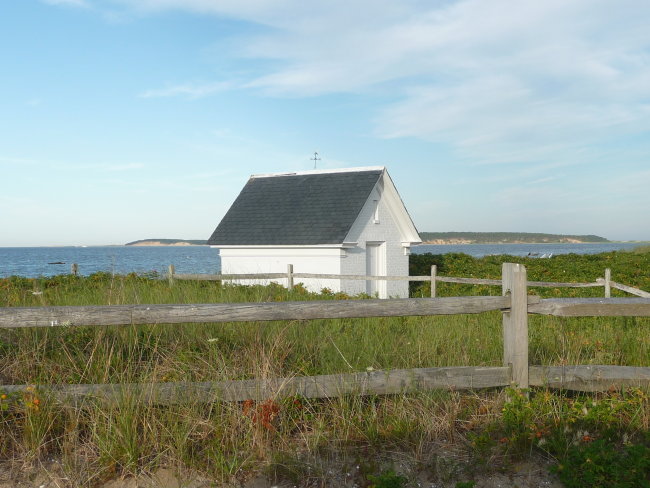
Friday, September 4. 2009Wellfleet architecture, Part 1Reposted from August, 2008 I like to walk. I used to love to run, but now I prefer walking. During hunting season, I like to walk in the woods and fields with a shotgun, but the rest of the time I like to walk armed with a camera. Here's one of the few inns in town:
Here's what I think is a classic 18th Century colonial - rare on the Cape - with the typical later additions on the back: And here it is - a true antique Cape, uncorrupted by dormers:
more on continuation page below - Continue reading "Wellfleet architecture, Part 1"
Posted by Bird Dog
in History, The Culture, "Culture," Pop Culture and Recreation
at
12:25
| Comments (2)
| Trackbacks (0)
Wednesday, September 2. 20091491 and primeval AmericaA re-post -
Human fantasies about the Garden of Eden, like human utopian fantasies, just never give up. You might almost think we all wish we were back in the womb. I ordered the book, but here's a quote from Charles Mann's 2002 essay in The Atlantic on the subject:
It's a fascinating subject to me. Here's the whole essay. Image: An early version of Edward Hicks' Peaceable Kingdom
Posted by Bird Dog
in History, Natural History and Conservation, Our Essays
at
13:16
| Comments (17)
| Trackbacks (0)
How The Scots Invented The Modern World
Read the whole post. We have always been interested in the Scottish Enlightenment. See this old post, The Hurricane of '38
The older folks are still talking about New England's '38 hurricane. No, I do not remember it myself.
Sunday, August 16. 2009Billings FarmA snap of the Billings Farm in Woodstock. Yes, it's a museum farm, but they do a good job with their Jersey cows. Are mixed farms museums now? My pal and I stole a couple of apples off their trees from over the fence during a morning hike last weekend: very good Macintosh apples - cold and crisp and spicey at 7 am. (This free ad is our in-kind payment.) That's their cornfield in the background, and some hayfields behind that. I thought to myself that no real farmer and orchard-keeper would have such meticulous lawns around their apple trees:
Posted by Bird Dog
in History, Our Essays, The Culture, "Culture," Pop Culture and Recreation
at
07:04
| Comments (5)
| Trackbacks (0)
Saturday, August 15. 2009The Woodstock Generation? We were in Nam.I’ve nothing against the
The VFW Magazine tells the tale of the 109 Americans killed in
Vietnam Veterans Memorial in Rennselaer, NY A college professor friend who is authoring a book about those from NYC who did serve in
Posted by Bruce Kesler
in History, Our Essays, The Culture, "Culture," Pop Culture and Recreation
at
13:45
| Comments (11)
| Trackbacks (0)
Thursday, August 13. 2009Woodstock, VT architecture, Part 2If you missed Part 1, it's here (with a little bit of Vermont history). In the early 1800s, few towns had architects. They did have builders. And they had Pattern Books. Pattern books were like blueprints, produced by well-known or entrepreneurial archtects in the big cities, just the same as builders' development houses of today are built from patterns. I like this one. People up there tend to their front gardens with loving care for their own pleasure and for the delight of passers-by: More fun photos below the fold - take a minute to feast yer eyeballs. Continue reading "Woodstock, VT architecture, Part 2"
Posted by Bird Dog
in History, Our Essays, The Culture, "Culture," Pop Culture and Recreation
at
12:48
| Comments (4)
| Trackbacks (0)
Tuesday, August 11. 2009Woodstock, Vermont info and architecture, with some thoughts about old-time New England, Part 1Vermont was settled later than most of New England, in the late 1700s by people from Connecticut, Massachusetts, and Rhode Island. Pioneers, attracted by cheap land. You could cut down all the trees and raise sheep, and the rivers provided endless power for mills. Woolen mills, stone-cutting marble and granite mills, lumber mills, etc. You could transport stuff down the rivers to the big Connecticut River. They did cut down all the trees: by 1850 most of Vermont was denuded of forest, whether for lumber, grazing, charcoal, or firewood. (In the 1700s, Vermont was considered part of the New York colony, but New Hampshire had claims on it. For a few decades, Vermont was the independent Republic of Vermont until they joined the union in 1792.) After producing the woolen garments for World War 1, Vermont's mills slowly closed down, the Vermont wool biz (Big Wool moved west) dried up and was replaced by dairy for the distant cities when the trains came through. Now, with factory dairy, there isn't even much of that any more, and the trees have grown back (and so have the Moose, Black Bear, and White-Tailed Deer). The milk cows today spend all day in sheds until their productivity drops and they are turned into Mcdonalds burgers. The wealth evident in the fine houses built in Woodstock from roughly 1800-1840 (replacing shacks, log cabins, and other humble dwellings) was a combination of its being a Shire town - a county seat with court and jail and lawyers - and the woolen mills. Those businesses attracted tradesmen and farmers, roads spread out, and the town thrived for a while. In 1830, this town of 3000 souls (then, and 3000 now!) had five newspapers. Today, Woodstock is all about tourism, with endless interesting summer and winter events, and skiing, of course, in the winter. The village is preserved in amber by a fierce architectural review board and its designation as a National Historic District. Laurence Rockefeller had a lot to do with that (his Woodstock home is among the photos below the fold). And, today, Vermont has the distinction of having the lowest per capita income in the US, having surpassed Mississippi a few years ago. The poorer they get, the further to the Left they move. It is not rational and it is utterly self-created (taxes and regs) and self-defeating, but it's a free country and, here at Maggie's Farm, we value the freedom of people to do stupid things if they want to. (I just hate it when people make obviously predictable mistakes on my nickel.) The Wiki on Woodstock, VT here. Worth a visit. Bring camera. I took the photos below early on Saturday morning. The temp was 48 degrees F at 5:30 when I typically go out to begin my exploring of a place (hence no people around in some of my photos). By mid-day, the temp got up to a balmy global warming crisis of 73 degrees. I offer no architectural comments on the details of these structures. I don't have the time, and I lack the eye for detail that Mrs. BD has. My brain tends towards weight, balance, harmony, and emotional comfort - and only notices detail when it intrudes. However, I do know and believe that God is in the details. More on that later (maybe).
Many fun photos below the fold. All of these buildings are in town - Continue reading "Woodstock, Vermont info and architecture, with some thoughts about old-time New England, Part 1"
Posted by Bird Dog
in History, Our Essays, The Culture, "Culture," Pop Culture and Recreation
at
10:24
| Comments (16)
| Trackback (1)
Saturday, August 8. 2009Cahokia
We are fascinated by Cahokia, and posted on the topic last year. The review of a new book on the subject. Saturday, August 1. 2009The Era of the Small TownIs the era of the small town over in America? Bookslut thinks so. I'm not sure how "small" is defined. As readers know, I work in a city (Hartford), sleep in exurbia. Everybody needs places to be a bit anonymous - but not too anonymous. At the least, you want your regular shopkeepers, bartenders, and maitre d's to know your name - but you can do that in both city and country when you find the places you like. Photo: A small town in NH, c. 1890. Note the large scale elimination of trees from the hillsides, typical of the 1800s in New England. Firewood, charcoal, and lumbering, thus creating hillside pastures and driving the bear and moose up to Maine. Also note the fine streetside Elm trees, now all gone due to the Elm Tree Blight. No CVS or Dunkin Donuts in evidence: how did people survive?
Posted by The Barrister
in History, Our Essays, The Culture, "Culture," Pop Culture and Recreation
at
12:07
| Comments (5)
| Trackbacks (0)
Wednesday, July 29. 2009TR
I am not ready for a new one after having read Edmund Morris' multi-volume bio, but Douglas Brinkley's new one looks to be a big seller: The Wilderness Warrior: Theodore Roosevelt and the Crusade for America. Our pet theory is that Americans snap up history books because they get no serious history in school. Monday, July 27. 2009And that’s the way it wasn’tMy friend and fellow Nationally syndicated columnist Diana West, also, examines Cronkite’s “offensive history.” West says, admittedly harshly, “No, the Cronkite post-mortem that's needed is for the zombies who conjured up the hollow rapture and the living dead who fell for it.” If you really don't remember, and before you start arguing from ignorance, you might refresh your knowledge of the facts with reading the comprehensive The Big Story by the Washington Post's Chief of the Saigon bureau during Tet '68, Peter Braestrup. Braestrup doesn't ignore media bias but emphasizes structural, staffing and experiential limitations of the mainstream media of that time, and that these problems "persist to this day." No kidding! P.S.: Another old friend, Cliff Kincaid of Accuracy In Media delves deeper into the wider range of Cronkite illusions, such as the Soviet threat being exaggerated and that President Carter was the brightest president Cronkite knew. The StingDino's reminder of the Newsweek comment that the O "is sort of a god" reminded us of this post from one year ago:
Obama's got the Big Con going. Beran at City Journal gets it. One quote:
Thursday, July 16. 2009Today in 1779
(Page 1 of 8, totaling 366 entries)
» next page
|