We are a commune of inquiring, skeptical, politically centrist, capitalist, anglophile, traditionalist New England Yankee humans, humanoids, and animals with many interests beyond and above politics. Each of us has had a high-school education (or GED), but all had ADD so didn't pay attention very well, especially the dogs. Each one of us does "try my best to be just like I am," and none of us enjoys working for others, including for Maggie, from whom we receive neither a nickel nor a dime. Freedom from nags, cranks, government, do-gooders, control-freaks and idiots is all that we ask for.
The main idea behind complex systems is that the ensemble behaves in way not predicted by the components. The interactions matter more than the nature of the units. Studying individual ants will never (one can safely say never for most such situations), never give us an idea on how the ant colony operates. For that, one needs to understand an ant colony as an ant colony, no less, no more, not a collection of ants. This is called an “emergent” property of the whole, by which parts and whole differ because what matters is the interactions between such parts. And interactions can obey very simple rules. The rule we discuss in this chapter is the minority rule.
Mostly lazy glib people who want to feel important in jobs with no heavy lifting. The real non-career pols (Trump is an example) are the ones I admire. Give a few years of public service and go back to the farm.
In general, the kinds of men and women attracted to politics are precisely the kinds of men and women who disdain the reciprocities required for success in the market. Market relationships are inherently co-equal: Because I can buy my car from Toyota or Ford, General Motors has no power over me. When I walk into an automobile dealership (or a supermarket, or a department store, or a restaurant, or a bank, or a brokerage firm, or a hardware store, or any private firm that enjoys no government privileges) I walk into an establishment that has no power to coerce me. The consequence is that the owners of that establishment treat me with respect, for if they don’t, I spend my money elsewhere...
Socialist W. E. B. Du Bois—Harvard’s first black Ph.D., a founder of the National Association for the Advancement of Colored People and editor of its magazine, Crisis—wanted no part of American industrial capitalism. Redistribution, not production, was his focus. Let white America wallow in the world of grubby accumulation; “We black folks is got the spirit,” says a character in one of his novels. So while he valued education, like Washington, its goal was political power, not economic advancement, and he urged blacks not to let their education dilute their sense of a separate, special group culture.
That proved fatal advice, especially given Dattel’s interesting account of Du Bois’s cultural premonitions. However much he disdained bourgeois economics, Du Bois sensed the necessity of conventional morality for a people’s rise. He worried that, by his estimate, a quarter of black births in 1900 were out of wedlock, and only half of blacks observed “monogamic sex mores,” as opposed to whites’ 2 percent and 90 percent, respectively. He also worried that black preachers were too interested in making money to “adopt a new attitude toward rational amusement and sound moral habits.” He saw, in other words, that black cultural mores had a self-destructive streak, and that the one indigenous black institution that could preach a moral message was shirking its principal duty...
One of the most refreshing things about Trump’s address—it is characteristic of his speeches—was his frankness. At the U.N., this had a positive as well as a critical side. On the positive side, I found it a breath of fresh air to hear an American president celebrate the achievements of America.
“The United States of America,” Trump said, “has been among the greatest forces for good in the history of the world, and the greatest defenders of sovereignty, security, and prosperity for all.” This is the simple truth, but I do not recall hearing such sentiments from the White House in recent years.
For the first time in our history, Americans have to be fearful of what they say, of what they write, and of what they think. They have to be afraid of using the wrong word, a word denounced as offensive or insensitive, or racist, sexist, or homophobic.
We have seen other countries, particularly in this century, where this has been the case. And we have always regarded them with a mixture of pity, and to be truthful, some amusement, because it has struck us as so strange that people would allow a situation to develop where they would be afraid of what words they used. But we now have this situation in this country. We have it primarily on college campuses, but it is spreading throughout the whole society. Were does it come from? What is it?
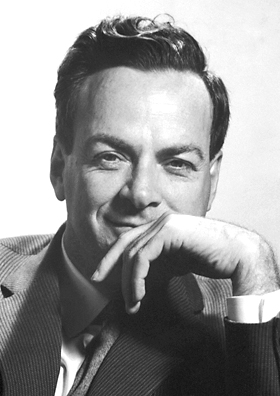
I first learned about Feynman from his Feynman Lectures on Physics.This was, and maybe still is, scripture for undergrads curious about Physics. What undergrad is not?
Nobel prize and all that, but what Feynman could do best was to communicate, and he could communicate in humorous, self-deprecating, and humble ways. I believe that he truly believed that he wasn't too smart, just curious and persistent.
Here's Feynman's speech titled What Is Science? delivered to the National Science Teachers Association, 1966, in New York City. He talks a lot about how his father inspired his curiosity. Read it. One quote:
I listened to a conversation between two girls, and one was explaining that if you want to make a straight line, you see, you go over a certain number to the right for each row you go up--that is, if you go over each time the same amount when you go up a row, you make a straight line--a deep principle of analytic geometry! It went on. I was rather amazed. I didn't realize the female mind was capable of understanding analytic geometry.
She went on and said, "Suppose you have another line coming in from the other side, and you want to figure out where they are going to intersect. Suppose on one line you go over two to the right for every one you go up, and the other line goes over three to the right for every one that it goes up, and they start twenty steps apart," etc.--I was flabbergasted. She figured out where the intersection was. It turned out that one girl was explaining to the other how to knit argyle socks. I, therefore, did learn a lesson.
This hyperindividualism of “teach the child, not the subject” came into American schooling only gradually in the early twentieth century, taking over completely only in the 1950s and ’60s. It was a fundamental shift. Current political correctness in education is an updated variation on the theme of individualism. The social version of “teach the child, not the subject” became “respect the home ethnicity of the child; don’t impose an Anglo culture that is alien to his or her background and personality.” And the psychological version of individualism became: “Adjust the subject matters to the child’s interests and abilities.” Both multiculturalism and multiple-intelligence theory caught on like wildfire in recent decades. More recently, one’s individuality has become conceived through “intersectionality.” A child is to be understood as an intersection of multiple essential groups and tribes—“Hispanic and gay,” for example—not as an “American,” which is assumed to be a nonessential trait...
Federal failure is a critical issue because the government controls so many aspects of our lives. Federal spending represents more than one-fifth of the nation's economic output, and federal regulations infiltrate many state, local, and private activities. When the government fails, it can create widespread harm. This essay examines structural features of the executive branch that are generating frequent failures in federal policies.
,,,instruction is the least important part of education. Most information is accessible from books and the media. Basic literacy and numeracy are important, but many if not most skills used by adults in daily life are picked up on the job. The main objective of education in every enduring society is to transmit authoritative cultural, political, and ethical traditions from one generation to the next. We can speak of the major purposes of education as the Four I’s: Initiation, Indoctrination, Inculcation, and Instruction.
Probably an inbred trait of human nature renders the attraction of censorship perennial. Most people (the highly literate are among the worst) believe that what is good for them will be good for others. Besides, a regime of censorship must claim to derive its authority from settled knowledge and not opinion. Once enforcement and exclusion have done their work, this assumption becomes almost irresistible; and it is relied on to produce a fortunate and economical result: self-censorship. We stay out of trouble by gagging ourselves. Among the few motives that may strengthen the power of resistance is the consciousness of having been deeply wrong oneself, either regarding some abstract question or in personal or public life. Another motive of resistance occasionally pitches in: a radical, quasi-physical horror of seeing people coerce other people without having to supply reasons. For better or worse, this second motive is likely to be mixed with misanthropy...
Another:
Margaret Thatcher declined to prosecute The Satanic Verses for blasphemy; and once the fatwa was issued Rushdie was accorded police protection from the extraordinary threat. Still, the cravenness of the early reactions has not yet been forgotten. The novel was initially banned in Canada, and US bookstores were slow to risk the title on their shelves. Cautionary words about the need for sensitivity were uttered by academic as well as priestly authorities. ‘We respect each other’s religious beliefs,’ wrote Syed Shahabuddin, who led the campaign to ban The Satanic Verses in India. ‘We do not intentionally outrage the religious feelings of others or insult their religion or ridicule the personalities to whom we are emotionally attached or mock our religious susceptibility.’ The chief rabbi of England, Immanuel Jakobovits, emphatically concurred: it was wrong to ‘tolerate a form of denigration and ridicule which can only breed resentment’. In an essay on ‘Religious Anger and Minority Rights’, Tariq Modood, the director of Bristol University’s Centre for the Study of Ethnicity and Citizenship, wrote that ‘the group which feels hurt is the ultimate arbiter of whether a hurt has taken place.’ On this view, to experience the feeling is to suffer the injury.
Rushdie’s defenders were on solid ground when they invoked his right to publish a book that could elicit a plausible charge of blasphemy. Christopher Hitchens spoke early and courageously on those lines. ‘Behind the use of bleating words like “offensive”,’ he wrote in his Nation column on 13 March 1989, ‘one can sense abject trahison: the ecumenicism of the philistines’; as for conciliation or compromise, ‘it would be suicidal to suppose that any concession made to the superstitious will ever be the last.’ But the odd appearance of the word ‘philistine’, in such a strictly political context turned the argument from a libertarian defence of publication to an aesthetic defence of the contents of the book – a sign of things to come. On the cable network C-Span, on 21 February 1989, Hitchens broadened his criticism:
"Tomorrow, shopping malls of the United States, which contain now one third of the book outlets in this country, will, of their own volition, not sell that book, because they are scared of a foreign despot … To be scared of a crazy foreign tyrant in this way is a really serious challenge to what we think of as the safe assumption of free speech and free inquiry, free expression and the necessity to defend it."
Haunting this year’s presidential contest is the sense that the U.S. government no longer belongs to the people and no longer represents them. And this uneasy feeling is not misplaced. It reflects the real state of affairs...
Myron Magnet summarizes the history of the decay of the US Constitution. Even the founders thought that might be inevitable, given their wisdom about human nature, but they did their best to provide roadblocks. Securing the blessings of liberty (from government, of course) and securing defense from exterior powers...
There is always the excuse of a reason: Security, or To Do Good.
... we had better understand just what happened. There’s no single villain. As these books show, all branches of government conspired over more than a century to turn the Constitution that the Framers wrote in 1787, plus the Bill of Rights that James Madison shepherded through the first Congress in 1789 and the Fourteenth Amendment ratified in 1868, into something their authors would neither recognize nor endorse.
Humans love stories. "Mom, read me/tell me a story." Fiction is/was written for entertainment. Before movies, there was mostly music, theater and fiction. There are well-told stories and poorly-told. There are revelatory stories, life-contaminating stories, and everything in between. There are stories which vary in their demands on the reader.
One quote:
I once delivered a paper in Norway on Anna Karenina, and a prominent scholar replied: “All my career I have been telling students not to do what you have done, that is, treat characters as real people with real problems and real human psychology. Characters in a novel are nothing more than words on a page. It is primitive to treat fictional people as real, as primitive as the spectator who rushed on stage to save Jesus from crucifixion.” Here is the crux of it: Characters in a novel are neither words on a page nor real people. Characters in a novel are possible people. When we think of their ethical dilemmas, we do not need to imagine that such people actually exist, only that such people and such dilemmas could exist.
Universities exist to provide students with the knowledge, skills, and culture that will prepare them for life, while enhancing the intellectual capital upon which we all depend. Evidently the two purposes are distinct. One concerns the growth of the individual, the other our shared need for knowledge. But they are also intertwined, so that damage to the one purpose is damage to the other. That is what we are now seeing, as our universities increasingly turn against the culture that created them, withholding it from the young.
The years spent at university belong with the rites of initiation studied by the Victorian anthropologists, in which those born into the tribe assume the burden of perpetuating it. If we lose sight of this, it seems to me, then we are in danger of detaching the university from its social and moral purpose, which is that of handing on both a store of knowledge and the culture that makes sense of it...
Partly because of our temperamental skepticism, and partly from knowing the history of science (consisting of one discarded theory after another), we are interested in thinking about the idea (or is it a religion) of Scientism.
This is a challenging essay, The Folly of Scientism, but worth two or three readings. It begins:
When I decided on a scientific career, one of the things that appealed to me about science was the modesty of its practitioners. The typical scientist seemed to be a person who knew one small corner of the natural world and knew it very well, better than most other human beings living and better even than most who had ever lived. But outside of their circumscribed areas of expertise, scientists would hesitate to express an authoritative opinion. This attitude was attractive precisely because it stood in sharp contrast to the arrogance of the philosophers of the positivist tradition, who claimed for science and its practitioners a broad authority with which many practicing scientists themselves were uncomfortable...
One more quote:
Is scientism defensible? Is it really true that natural science provides a satisfying and reasonably complete account of everything we see, experience, and seek to understand — of every phenomenon in the universe? And is it true that science is more capable, even singularly capable, of answering the questions that once were addressed by philosophy? This subject is too large to tackle all at once. But by looking briefly at the modern understandings of science and philosophy on which scientism rests, and examining a few case studies of the attempt to supplant philosophy entirely with science, we might get a sense of how the reach of scientism exceeds its grasp.
...such a religious frame of mind, Scruton continues, amounts to a ‘reaching out from subject to subject; it searches for a relation that is close, intimate, and personal, with a being who is present in this world though not of this world; and in this reaching out, there is a movement towards sacrifice, in which both self and other might give themselves completely and thereby achieve a reconciliation that lies beyond the reach of ordinary human dialogue’. We experience this searching in love, and we hear it in music. Thus, the atheists’ argument that they can find no evidence of God’s existence is as insufficient as attempting to explain love in terms of reproduction or music in terms of vibration. After all, God may only reveal Himself to those who love Him. Or maybe God is simply not to be found in the universe that He created. Or Maybe God is like the number one: ‘outside space and time… [with] no causal role to play in the physical world.’ But if this is true, and it is the central question of Scruton’s book, then we cannot expect to encounter God anymore than we can expect to meet the number one. But how, then, is it possible for God to ‘be a real presence in the life of His earthly worshippers’? And how is it possible for us to be in love?
The strength of the populists consists in a certain naïveté. They actually believe in “democracy.” And they are all mystical “nationalists” within their respective statist domains. They think that the nature of the modern State can be changed; that it would be possible, for instance, to downsize it, to reduce taxes, to maybe pay down some debt, to make the agencies of the State responsive to their individual customers, more reflective of human decency, &c. In power, they confront the reality, of machinery vastly large and complex, regulations fantastically detailed and comprehensive, all backed by the power of written law, to be enforced when necessary by violence. And being crass, the best they can do is empty their chamberpots into the machine, here and there. They prove rank amateurs, and upon their removal from office, the “natural party of government” returns, to make some minor sloppy repairs, then resume the mission of Nanny Statecraft — with ambitious new programmes and departments to reward dependency, and crush the spirit of liberty and enterprise; focusing their efforts to make sure that trouble does not arise from the same quarter again.
The citizen of every modern Nation State is fully integrated with that machinery: strapped into place and identifiable by serial number. There is nothing voluntary in his participation: the definition of an “outlaw” has been amended over time, to mean specifically failure to cooperate with any government agent, or to surrender immediately to his demands. (I laugh, bitterly, when a media smartie proposes e.g. mandatory voting, as if adding more idiots to the electorate will improve anything. And yet I welcome it as a frank admission that democracy is a totalitarian creed.)
Bloom’s work is no mere exercise in horripilation. He provides a wonderful and hopeful corrective to the bottomless mendacity of the Left. Bloom explained that Marcuse was mistaken, dreadfully mistaken, because he had not understood another important German thinker, Max Weber. For Weber, like Nietzsche, had identified values to be key to any society. There must be a notion of right and wrong. Weber saw the rise of Capitalism, which filled Marx with such loathing, as the triumph of what he called the ‘protestant ethic.’ A particular group of Christians applying the four cardinal virtues of prudence, justice, temperance, and fortitude (each of which has a significant emotional component) had changed the face of the earth. Marcuse simply thought Weber was condemning religion, in the same (wrong) way Marxists thought Nietzsche had. But Weber was making a very profound point. Weber was referring to the ascendancy of spirit over matter. Man creates his culture. In every important respect, men and women are free. This is nothing less than a huge, devastating rebuttal of Marxism. More complete than the collapse of the Berlin Wall, which we now see had been merely the fall of bricks and mortar.
Ethics are the key to the de-marxification and de-toxification of our society.
It is not yet clear why adults should find perceptual play fun. Aren’t we done learning how to perceive? Everyone achieves a certain basic level of skill in characteristically human activities: walking, talking, looking, listening, and singing. We do this by pleasurable play when young, and we maintain these skills with practice well into adulthood. But with each of these activities, the human body affords us the capacity to improve – to become extraordinarily skilled. Spontaneously developed language and motor skills are adequate for most purposes, but they are far below those of the most accomplished performers. An accomplished poet or playwright has a command of language that comes from repetition, practice, and instruction. She comes to this level of expertise with great difficulty. The same goes for somebody who appreciates poetry with hard-won knowledge of context and allusion.
I'll give the essay an A- for Effort, but trying to discuss such topics as Truth and Beauty in reductionistic terms is certain to be disappointing in the end. I would argue that the human soul has no adaptive value at all. It's a gift and a curse.
What is the best-adapted and largest class of animals on earth in terms of population, biomass, range, and overall success? Class Insecta. Bugs. Or maybe it's bacteria, but I think I recall that it's bugs. Might have that wrong. It's definitely not the higher apes despite our love of music and our pleasant clothing.
From Scruton's The great swindle - From pickled sharks to compositions in silence, fake ideas and fake emotions have elbowed out truth and beauty:
Faking depends on a measure of complicity between the perpetrator and the victim, who together conspire to believe what they don’t believe and to feel what they are incapable of feeling. There are fake beliefs, fake opinions, fake kinds of expertise. There is also fake emotion, which comes about when people debase the forms and the language in which true feeling can take root, so that they are no longer fully aware of the difference between the true and the false. Kitsch is one very important example of this. The kitsch work of art is not a response to the real world, but a fabrication designed to replace it. Yet both producer and consumer conspire to persuade each other that what they feel in and through the kitsch work of art is something deep, important and real.
Anyone can lie. One need only have the requisite intention — in other words, to say something with the intention to deceive. Faking, by contrast, is an achievement.
It addresses the mystery in science, medicine, economics, predictions, and history. One quote:
One of the things I have found interesting about Taleb is the way he extends what I had in my own thinking thought of as ‘mystery’ to areas of human life I had not previously considered. My list of the ‘mysterious’ had included life: what is it, where did it come from and why; consciousness, morality and free will. Emotion too is mysterious because it is implicated in a proper existential attitude to the world and yet it is not fully intelligible. Emotion complements reason but by definition is not simply reason itself. Thus its workings and logic has to be intuited and felt rather than fully explicated.
Taleb extends mystery to include historical events, the workings of medicine and the future. We simply cannot predict the future and certainly not from extrapolating from current trends. If we can’t explain the past nor predict the future, then it may seem as though life is just a little too mysterious. But, like Socrates, Taleb’s starting point is that much of wisdom consists in acknowledging what we don’t know. Plato's Socrates thinks that, having discovered our ignorance, we should seek to remedy the situation. Taleb probably has a more modest idea about how far we really do this.
"Science has become an international bully." I doubt that I will change my mind about this being the best essay of 2014, by Yale's computer scientist David Gelernter: The Closing of the Scientific Mind.
It's about subjectivity, mainly - being human, and a defense of Nagel in part. The essay is so rich and deadly-serious that it cannot really be taken in in one reading, and it is difficult to select a representative quote so I'll post a random one:
The dominant, mainstream view of mind nowadays among philosophers and many scientists is computationalism, also known as cognitivism. This view is inspired by the idea that minds are to brains as software is to computers. “Think of the brain,” writes Daniel Dennett of Tufts University in his influential 1991 Consciousness Explained, “as a computer.” In some ways this is an apt analogy. In others, it is crazy. At any rate, it is one of the intellectual milestones of modern times.
How did this “master analogy” become so influential?
Well, because we derive our metaphors from the world around us. Freud's first metapsychology was modeled on the steam engine. The essay deserves study. Take a Ritalin and dig into it.
Another:
Many scientists are proud of having booted man off his throne at the center of the universe and reduced him to just one more creature—an especially annoying one—in the great intergalactic zoo. That is their right. But when scientists use this locker-room braggadocio to belittle the human viewpoint, to belittle human life and values and virtues and civilization and moral, spiritual, and religious discoveries, which is all we human beings possess or ever will, they have outrun their own empiricism. They are abusing their cultural standing. Science has become an international bully.
Nowhere is its bullying more outrageous than in its assault on the phenomenon known as subjectivity...



 I first learned about Feynman from his
  From a brief, important, and depressing essay