We are a commune of inquiring, skeptical, politically centrist, capitalist, anglophile, traditionalist New England Yankee humans, humanoids, and animals with many interests beyond and above politics. Each of us has had a high-school education (or GED), but all had ADD so didn't pay attention very well, especially the dogs. Each one of us does "try my best to be just like I am," and none of us enjoys working for others, including for Maggie, from whom we receive neither a nickel nor a dime. Freedom from nags, cranks, government, do-gooders, control-freaks and idiots is all that we ask for.
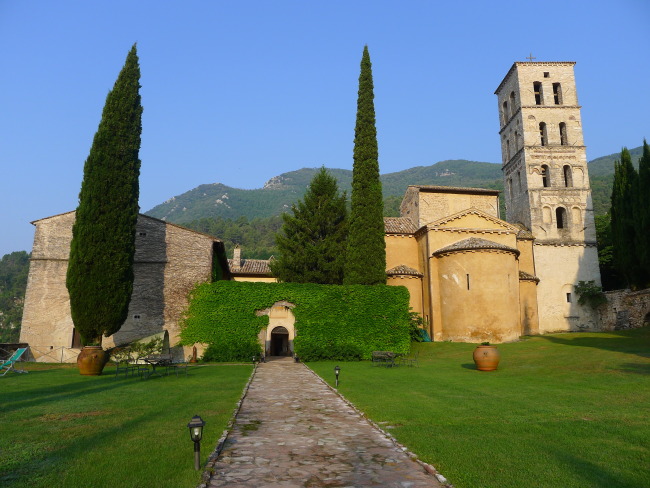
Actually, it is now a small hotel in the Valnerina (the Nera Valley in the Appennines). We stayed here last week. There is a cross hanging over every bed, and the rooms are (converted) monks' rooms (Yes, each room or suite has a bath). This is the Abazzia San Pietro in Valle. It began as a Benedictine monastery in the 5th C., established by converted Lombard invaders, the lords of Spoleto.
In fact, the Lombard Lord of Spoleto gave up his lordship to become one of the early humble monks there, and his bones rest in an old (recycled) and beautifully-carved pagan Roman sarcophagus next to the altar. I guess they threw out some old Roman's bones to make room for him.
Their chiesa is old, but, like most things in Italy that have been around for over a thousand years, things have been re-done and re-decorated. We were told that the cheisa, in some places, has five layers of frescoes on the walls. Sort of like old wallpaper, but, as Mrs. BD observed, any one of those layers would make for a blockbuster show at the Metropolitan Museum of Art.
This wealthy and politically-powerful monastery was sacked by the Saracens - the marauding Moslems who held parts of Europe in terror for hundreds of years during the Dark Ages, and who specialized in collecting infidels for the Middle Eastern slave trade - around the year 900, but it came back. It was abandoned by the Benedictines in the 1800s and was used as stables and sheep shelters until some rich guy from Rome bought it in the 1920s and began semi-converting it into his country villa. Mussolini himself visited the Abazzia to celebrate the restoration of Italian history and culture.
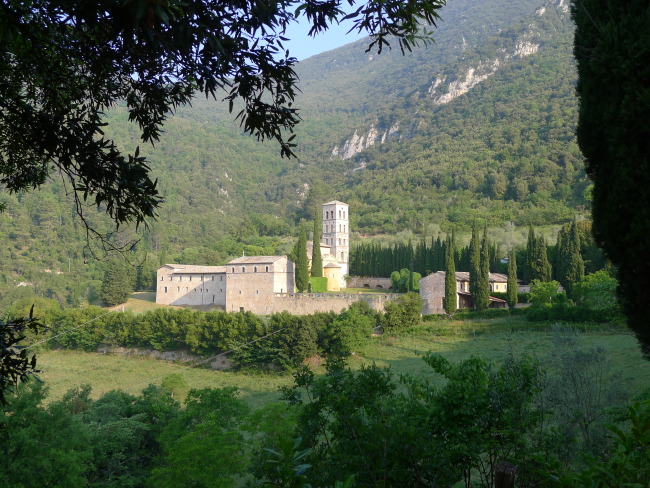
One of the most photogenic places I have ever been to. Impossible for even a lousy pic-taker like me to take a bad photo. Felt unreal to be staying there, stunned by the romance of history but mainly by the beauty and glory of creation, just like when you are on a horse in the Montana Rockies, or on skis at the top of Whistler in a snowstorm. The times when the glory of God gets so much in your face you cannot deny it no matter how much of a curmudgeon you might want to be.
See what I mean about Mrs. BD being a good trip-planner? She plans, I just do the driving and go where I am told - except when I don't... More pics from around there later in my ongoing travelogue.
This is inside the walls, in the garden, facing the inner cloisters and the rear of the chiesa with its bell tower:
View from the long, steep dirt entry road, lined with small farms and olive groves. The place is halfway up the mountain. Everywhere, the tinkling of sheep bells, the occasional barking of the sheep dogs, and the crazy horn-like braying of mules. (I don't know why they keep mules, but I do know they make a popular sausage out of them, called "Mulo." Not kidding.)
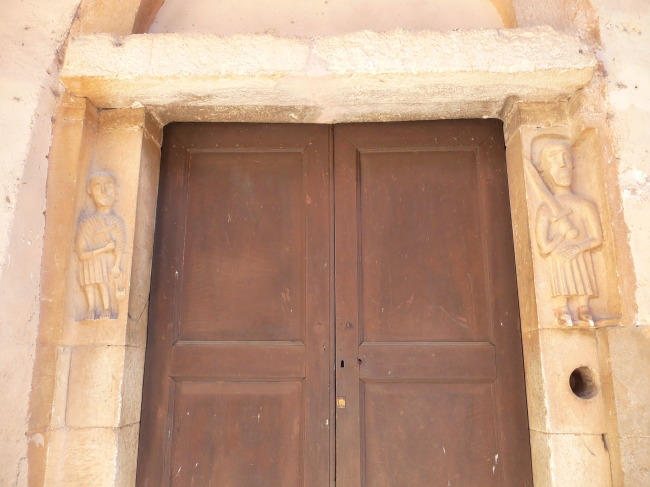
Lombard-era carvings of Peter and Paul (with the sword) at the monk's side entrance to their chiesa from the inner cloister. You could write a thesis on these "paleo-Christian" things if you wanted to:
Who was staying here? A group of jolly Aussies, and two delightful Dutch couples. The rest were from Rome on getaways with wives or girlfriends. (We had a good chat with a Roman fellow, a young 30s internet entrepreneur, who was there with his dazzling and seductive-looking fiance. They have a 4 year-old daughter. They were planning their honeymoon trip to NYC, San Francisco, and then Kauai, and wanted names of good NYC restaurants and shows to see. What a world! Except for their paranoia, the Italians can teach us all how to really live.)
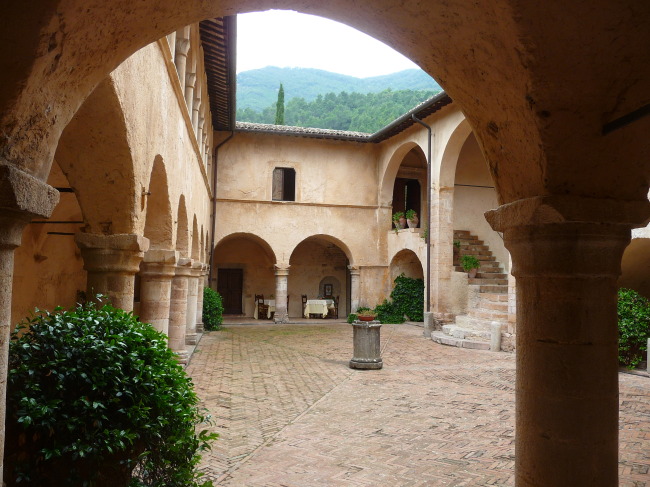
As I said to Mrs. BD, this ain't no Motel 6. The have only around 12 rooms and suites. The inner cloister, with a couple of outside breakfast tables:
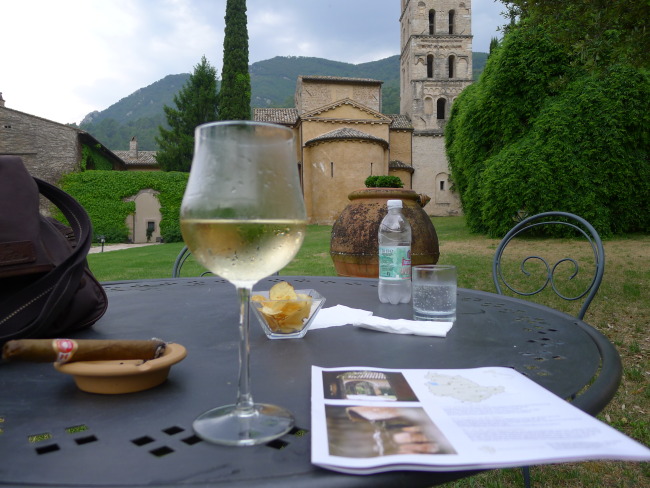
Monks loved their wines. That's my refreshing post-mountain-hiking, pre-dinner Orvieto - the classic white wine of Umbria:
They're the ultimate Sherlock Holmes mysteries. You're given mere scraps of information, the wreckage is usually twisted beyond recognition, and you're faced with the knowledge that nine times out of ten you're looking for a chain of failures, not just a single part that suddenly went kaflooey.
And unless it's an actual bomb, which is fairly easy to detect afterward because of the micro-pitting that takes place during an explosion, the one thing that modern airliners almost never, ever, do is suddenly just go poof and drop off the radar screen without a peep from the crew.
As Air France Flight 447 did two years ago, taking 228 people to a watery grave.
Below the fold I'll present a 1-hour video on the mystery and an update on the recent findings. Unlike normally, where the black boxes provide the vital clues that solve the enigma, this time around the complete opposite occurred.
We stumbled by accident into a little ristorante in the dreary (and definitely not touristy) medieval hilltop village of Amelia around 2 pm, and found the place in the otherwise dead town packed with jolly Italians chowing down and drinking wine. We were the only foreigners there. The Hosteria dei Cansacchi. A simple neighborhood place with a simple menu: you order either the Mare or the Terra. I ordered the Mare, Mrs ordered the Terra, and halfway through lunch we had to "stop the menu." However delicious, it was just too much. That's when we decided we needed to share meals.
Here's their menu - no choices - they just bring it all, one course after another. The English translations in the fine print are imperfect, eg "Wild Board."
I've lived all over the US, and traveled all over Italy. The gold standard of pizza is New York's, developed by its Neapolitan immigrants to perfection. At least it used to be before all those fu-fus moved in with their taste buds permanently deformed by the chain crap elsewhere, and then added more fu-fu crap on top. Jon Stewart takes Donald Trump to task for taking Sarah Palin to a chain pizzeria, and proves Trump is another fu-fu crapper. If Trump ever visits Alaska, I hope Palin feeds him a mooseburger made from veggies.
The one mistake that you'll see in this video is that Stewart's slice is not dribbling hot olive oil down his arm, olive oil being one of the secrets to good pizza. At least, get your notepad ready, Stewart points out some of the good places in NYC to go for pizza. They used to be on almost every block, but the fu-fuers have chased them out. -- After decades, I found a place in San Diego that was almost up to snuff, but that neighborhood became yuppified and its pizza fu-fued.
When you drive around the northeastern US in late May-early June, the blooming Black Locust trees are everywhere. Their white flower bunches put on a good show and stand out strongly from the green background - the locust trees are a big puff of white.
As a tree which is not native to the northeast, it is often considered a weed tree. An illegal alien, as it were. The are fast-growing, and tend to form stands which crowd out native trees. Pleasant glades, however.
Black Locust was transplanted to the north because locust makes the best, longest-lasting fence posts and fence rails. 50 years. It still does.
Snap above is on the country road in the hilly Tiber Valley driving from Todi to Montefalco, with the charming town of Todi in the distance, on the hill. Italy is good about having a sharp distinction between town and country. Little-to-no sprawl. Except in the big cities, you go from urban density directly to vineyards, olive groves, or forests full of deer, cinghiale, eagles, even wolves and, best of all, the ferocious and dangerously-expensive Wild Black Truffle. People like to live in towns, where they can walk to work and shop, and can say bon giorno to their neighbors.
Bit of history
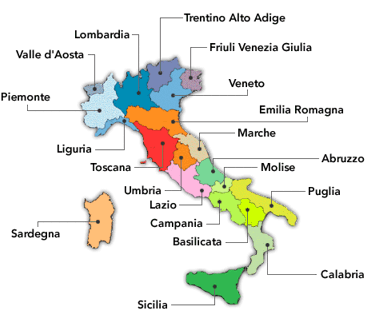
A quick history and geography of Umbria in central Italy, northeast of Rome, to put my forthcoming travel pics in context. It is generally similar to the history of the entire area we now term Italy.
Central Italy was the prehistoric land of the Etruscans (hence "Tuscany" - land of the Etruscans) and of the less-known Umbri. They were, relatively speaking, peaceful and prosperous farmers and traders. When Rome began its imperial expansion around 250 BC, Umbria up along the old trading route to the Adriatic (which the Romans later termed the Via Flaminia) seemed like an obvious target.
The Romans did their Roman thing there for 600 years until the empire began to unwind and Goths and Lombards moved into Tuscany and Umbria both by immigration and by arms in the 400s-500s. In many ways, these waves of invasion became sort of Romanized and Christianized, in time. The Byzantines were in the mix then, too.
Warring feudal duchys and kingdoms dominated the dark ages in this part of Italy, during a time when the declining Roman regions were also set upon by piratical Saracens (mainly seeking slaves for the Middle Eastern slave trade) and Normans (seeking adventure), until Papal power exerted itself and built an authoritarian, theocratic peace by the 1100s and 1200s. They were big on building castles with which to assert their powerful churchly presence, but from the days of the late empire people were building their own keeps and walls to defend themselves from foreigners and also from their neighboring towns. The Roman Legions had previously made walls and keeps unnecessary: the Roman armies had been the wall. The Pax Romana.
The Papal State pretty much controlled central Italy, perhaps to its detriment, until the Italian nation was invented 150 years ago. Roman Catholicism was pretty much corrupted by money and politics, during that era, including the Benedictines.
2011 is the 150th anniversary of that political event. Garibaldi, etc.
Geography
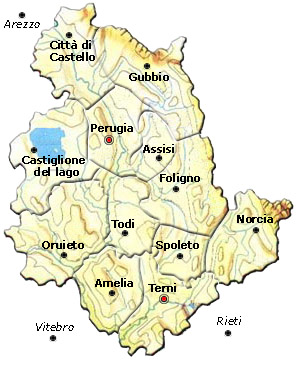
Geographically, southern Umbria divides itself into three regions: The north-south-running Tiber Valley where the Tiber flows south towards Rome, the fertile north-south running Valle Umbra which is like a mini version of California's Central Valley, and the eastern Valnerina which is the area in the majestic Appennines where the river Nera flows down to eventually join and magnify the Tiber.
We visited and stayed in incredible hotels in each of those three areas of Umbria. As in Roman times, rural and quaint Umbria is a popular Roman getaway place, full of bikers, motorcyclists, foodies, and hikers. It's only a 2 or 3 hour drive from Rome, and it is packed with "unspoiled gems."
Most of the towns were Umbrian first, Roman later, and then Medieval-Renaissance. Except for towns damaged by the war (like Terni) or by earthquakes (like Foligno), there is a lot of Renaissance, generally built on Medieval town footprints.
Except for Assisi with its bus-loads of pilgrims, we saw few non-Italian tourists and only one American couple - friendly folks from Montgomery, Alabama! Some Brits, Aussies, Austrians, and Dutch. We tend to meet people when we travel. That's part of the fun.
Todi, Amelia, Orvieto, Montefalco, and Perugia are on hills in the Tiber Valley. Towns in Umbria tended to be built on hills for defensive purposes, which is why exploring Italy is such a good physical workout. Assisi, Spoleto, Spello, and Terni are along the western edge of the Apennines where they rise from the plain. Norcia, and our monastery hotel, are in the mountains themselves near where the Nera emerges from the mountains.
Weather
Best times for Italy or any Mediterranean travel are Spring and Fall. May and October are perfect. Italy climate here.
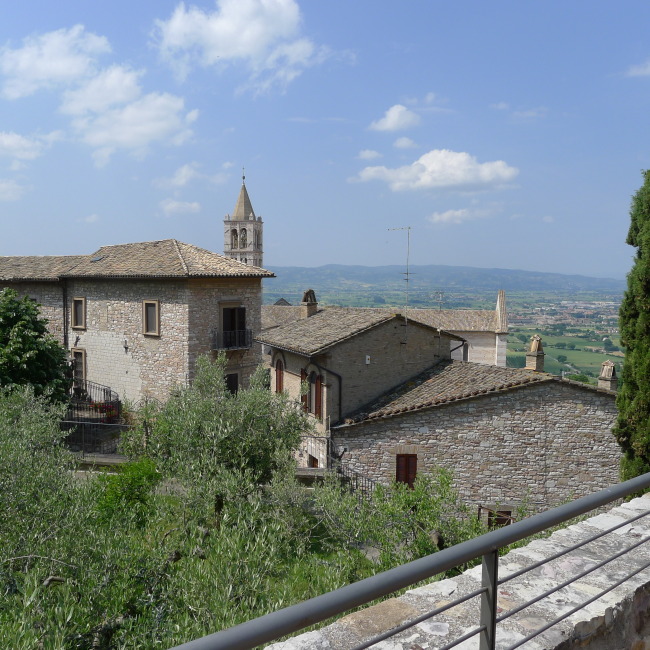
I will have lots more fun travel pics soon - Pic below of the Valle Umbra, looking west from the Assisi hillside:
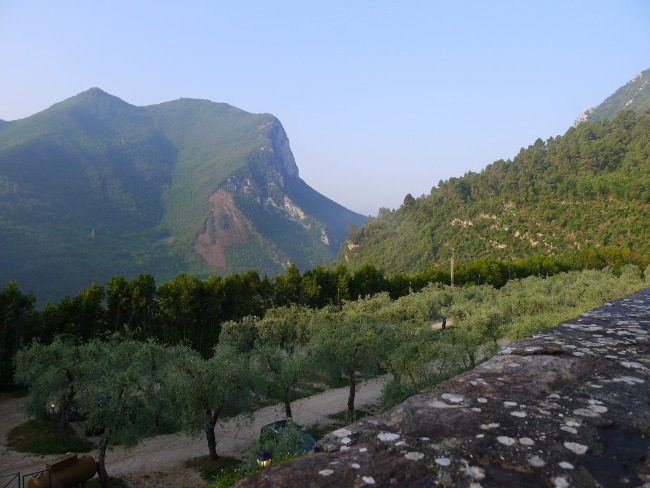
Pic below from the garden of our 6th C. Benedictine monastery hotel in the Valnerina in the Apennines, with a small hillside olive grove (doubling as parking area) below the wall. It is no wonder that people love to visit Italy: it has the food, the history, the scenery, the quaintness, the vino, the art and architecture, and the delightfully tough and fashionable Italian gals.
One of the problems facing the United States is deteriorating infrastructure. Everything from highways, byways, airports and freight facilities are in need of some sort of repair, renovation or downright replacement.
Recently at the launch/commissioning ceremony for the USS William McClean (part of the Navy’s Prepositioning Program) Fred Harris President and CEO of General Dynamics NASSCO (NASSCO is a large shipbuilding complex outside of San Diego) spoke of the need for a National Marine Highway System . Mr. Harris made the case that vital part of the national transportation is being neglected – mainly the Maritime Coastal routes and facilities.
What Harris is talking about is using what used to be called “coasters” – basically small ships to handle freight movementalong coastal routes. His point addresses a larger issue – that our maritime industry has fallen on some hard times.As a nation that relies on sea power to extend our military and diplomatic reach across the world, we have basically relegated our Merchant Marine to other nations to build ships and transport goods.Our Maritime tradition not only extended from the Merchant Marine through the Navy and Coast Guard, but at one time, the world’s second largest Navy was the United States Army!
The problems, of course, are simple – we just aren’t competitive in terms of labor costs and building/maintenance facilities. Our Merchant Marine is highly unionizedwith the attendant costs associated with union shops – including feather bedding.We’ve lost our ability to produce the tons and tons of high quality steel needed for a vibrant ship building industry.And the same infrastructure problems facing our highway and railway system also affect the Maritime routes that already exist.Our intracoastal waterways system is seeing less and less dredging needed to keep it open and traffic flowing.While the Gulf system seems to be fairly stable in terms of maintenance, the Atlantic system is in dire need of dredging and width repair in several places along it’s length. The last time I brought a boat down that route (a53 foot Viking sport fisher) there where places in the Atlantic system where we were plowing through the sand and silt – not a good thing for raw water cooled engines. Tugs and barges are also restricted in certain parts of the Atlantic system.
There are otherchallenges facing a new, bigger and better maritime system.NIMBY is a huge factor in the placement of facilities to off load or on load goods and raw materials. The recent contretemps in Narragansett Bay over the LNG facility is a good example.“Honest” Dick Blumenthal when he was Attorney General of Connecticut killed the Long Island Sound LNG/oil platform facility with misinformation and downright lying about the facilities impact on both the LIS ecosystem and it’s financial impact. Last, but certainly not least, access to distribution points are almost not existent due to the sale of port facilities to real estate developers to build hotels, convention centers, sports stadiums and private marinas. Harbor real estate is expensive and the competition is fierce to obtain and develop it.
Mr. Harris has the right idea – a strong national maritime system able to move cargo, goods and materials using our long seacoasts and river systems should be a priority.I’m certain private investors would welcome the opportunity to be involved in building small ships, tugs, barges and facilities – as long as the government and the Maritime and Port labor unionscan be kept at bay.
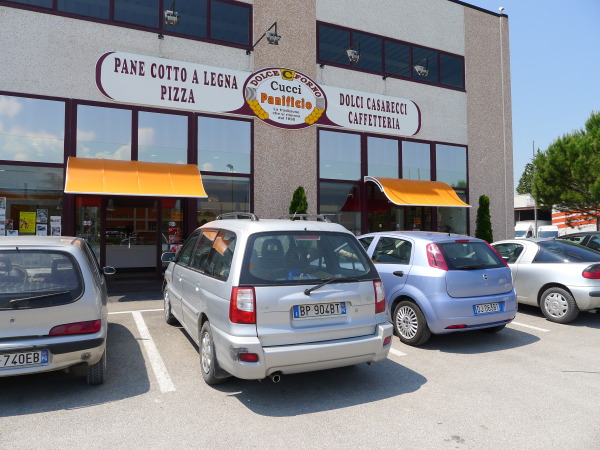
We stumbled onto this joint last week while taking a flyer down local roads en route from Bevegna to Spoleto. Wonderful drive on narrow winding roads through olive orchards, vineyards, small farms with patches of wheat, fava bean, and lentil, and tiny antique villages. But, of course, in Italy, when you stop for a coffee, a "coffee" means a 1/2 inch of intense espresso at the bottom of a tiny cup. A delicious half-mouthful if you add a bit of sugar, but nothing to linger over or to put in your car's cup holder.
If you request a cafe Americano, they just add some hot water to it.
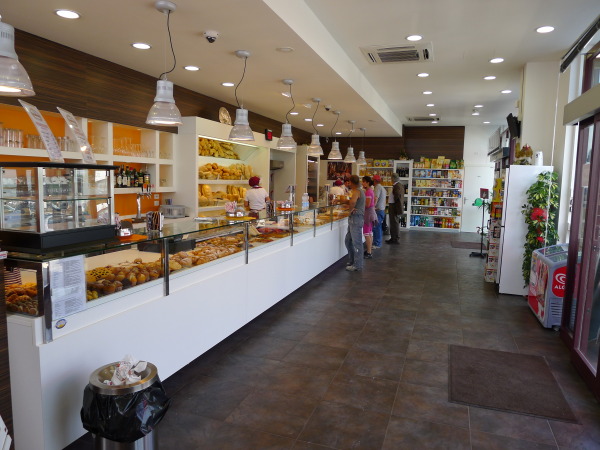
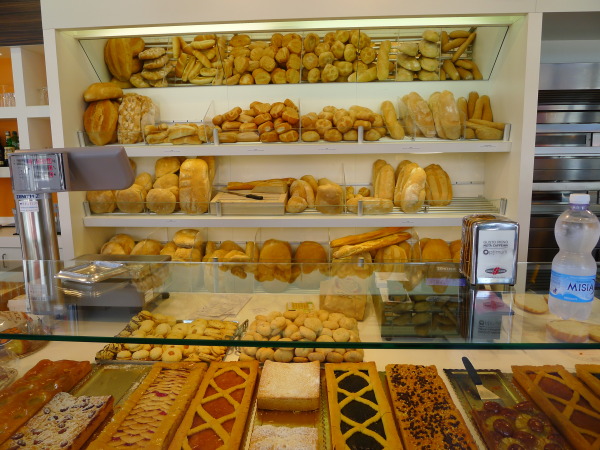
This roadside charmer, like most such places in Italy, offers Italian pastries, beer, wine, cocktails, breads, sandwiches made to order, rustic pizzas, etc., to go or to eat there on plastic chairs in the A/C. Yes, you can have a smoke inside. Everybody does. Often, the serving people fix up your order with a cigarette hanging out of their mouths like the good old days, and I do not think they care deeply about what the EU or anybody else thinks about that.
Dunkin Donuts does not offer beer or wine, and you cannot smoke in there. We stopped for some water (water with "gas" - always - that evil CO2) and a quick cafe.
Never order pizza in Italy - it's terrible stuff. It was the Neapolitan immigrants to America who made it into a tasty treat - and the Italians have little interest in learning about the gastronomic arts from Americans.
I would remind the Italians of these facts: Tomato, from the New World. Potato, from the New World. Squash, from the New World. Polenta, from the New World. Pasta, from China. Risotto, from China. What did they eat before all of that?
Watched this movie on my flight from Paris to the USA earlier today (or yesterday?). Not a great boxing movie, but it does capture elements of the Irish (or could just as easily be Italian) blue-collar world of New England.
The movie is set in Lowell, MA, a rough working-class town outside of Boston. My olde New England contains a disappearing old Yankee breed, a disappearing semi-old multi-ethnic farming contingent (especially Poles from the later 1800s), and, in urban and semi-urban areas, large Irish and Italian-origin populations which stick to many of their old ways. Increasing numbers of Mexicans are appearing, too - some in the illegal drug biz and the better ones are masons or in the army of unskilled laborers.
I was surprised to stumble upon the fact that the common earthworm, the gardener's friend, is not native to the US and Canada: most worm species are "invasive" introductions from Europe, and have been spread across the country in plant material.
A few more interesting facts:
- The earthworm has been very destructive to several types of forest habitat by consuming deep forest litter (leaves). Ecologists consider them invasive pests in some habitats.
- Earthworms are killed by most pesticides. Fertilizer doesn't seem to bother them.
- Darwin calculated that earthworms can recycle and refresh the surface soil to the tune of 10 tons of soil per acre per year. Count me as a skeptic on that number, but they do churn the soil.
- Yes, some species of earthworm can regenerate lost body segments. No need for tears when you chop one with the shovel.
- Worms need food. For a wormy lawn or garden, it needs to be top-dressed or mulched with organic material. I do a generous top-dressing of peat moss or well-rotted cow manure once or twice twice a year, and after the heavy spring lawn growth, I leave the grass clippings where they fall. I like to mulch up the early autumn fallen leaves with the mowers, too.
A green lawn treated with pesticides, nurtured solely with inorganic fertilizers, and with automatic irrigation, is little more than a corpse with make-up.
No man loves marshes and bogs more than I do. The variety of life they contain, protect, and support, from protozoans to minnowsto bass to amphibians to snakes to deer to woodpeckers to geese and ducks to eagles to bears is astonishing, and feels primeval.
Except for river-fed or run-off-fed marshes, though, most sizeable fresh-water marshes are ephemeral geographical features. In the northern US, most are the remnants of post-glacial ponds and lakes, gradually filled in with plant detritus and, just before they become the damp meadows that the Moose enjoy so much, the sphagnum bogs which, in Canada, are the source of most of our soil-enhancing peat moss.
The only sources of new marshes in the US are man (who is more inclined to fill them for building lots than to create them or rehabilitate them - except for Ducks Unlimited), and the Beaver:
And that is one reason we appreciate the remarkable beaver so much. He not only creates marshes, but he recycles them. I doubt that there is a single beaver marsh in the US which has not been used, on and off (until they have eaten or cut down everything they can find) over the several thousands of years since our last Ice Age buried Manhattan under a mile of ice.
Here are some of the critters I see (or hear) most often in the immediate vicinity of our small (8 acre) beaver marsh in western MA over the past few years - off the top of my head and probably omitting some:
Beavers (of course) Otter Black Bear Raccoon White-tailed Deer Red Fox Coyote (alas)
Wood Duck (nesting) Black Duck (nesting) Mallard (nesting) Canada Goose (nesting) Pileated Woodpecker Downy Woodpecker Hairy Woodpecker Red-bellied Wodpecker Ruby-Throated Hummingbird Veery Wood thrush E. Phoebe Wood Pewee Great Blue Heron Green Heron Tree Swallow Barn Swallow Kingfisher Swamp Sparrow Grasshopper Sparrow Song Sparrow Barred Owl Screech Owl Great Horned Owl Baltimore Oriole (Northern Oriole) Marsh Wren Turkey Goldfinch (nesting) Warblers of all sorts (during migration) Turkey Vulture Red-Tailed Hawk Sharp-Shinned hawk Red-shouldered Hawk Broad-winged Hawk Sparrow Hawk (Kestrel) E. Bluebird E. Kingbird Ruffed Grouse Cedar Waxwing Catbird
Wood Turtle Eastern Painted Turtle Snapping Turtle Garter Snake Eastern Water Snake Black Snake
Bullfrog Eastern Newt (and their Red Efts by the trillions in the adjacent woods) Leopard Frog Green Frog American Toad Wood Frog Spring Peeper E. Gray Tree Frog
I like to keep track of our wildlife. It is one way of loving and embracing this world.
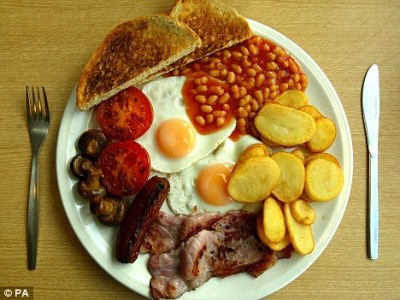
There are two sorts of people: those who love breakfast, and those for whom breakfast is nothing more than coffee and a cigar or, some days, a glass of OJ and five aspirins.
Breakfast is my favorite meal, but I rarely bother with it beyond a couple of cups of coffee. If I had breakfast every morning I would weigh 30 lbs. more than I do.
What are my favorite breakfasts?
- Home-made fresh cut-up fruit in a bowl - including Pineapple - Creamed Chipped Beef on toast. Or grits with biscuits 'n gravy - Kippered herrings with (white) toast and grilled tomatoes - 2 eggs sunny side up with bacon, sausage, home fries and white toast. And ketchup. - Blueberry pancakes with sausage and bacon. - Codfish cakes with toast - Smoked salmon on a toasted bagel with cream cheese, with capers - Eggs Benedict - Leftover pizza
I cannot pick a single favorite. Love 'em all.
Please post your favorite breakfasts in the comments.
"It is thus necessary that the individual should come to realize that his own ego is of no importance in comparison with the existence of his nation; that the position of the individual ego is conditioned solely by the interests of the nation as a whole ... that above all the unity of a nation's spirit and will are worth far more than the freedom of the spirit and will of an individual. .... This state of mind, which subordinates the interests of the ego to the conservation of the community, is really the first premise for every truly human culture .... we understand only the individual's capacity to make sacrifices for the community, for his fellow man."
Adolph Hitler, 1933. There is no doubt that the Nazi movement was, at its core, a Socialist movement. The only thing about it that could be construed as at all "rightist" was its ardent nationalism.
My question is this: If the National Socialist Party had left the Jews alone, would the Nazis have been heroes of the Left, as Stalin was?
If you are one of those folks who keep the house at 55 both summer and winter, you can ignore this post. Otherwise, you may be grateful for this reminder about the ideal serving temperatures for red wines - 55-62 degrees F.
That is cellaring temperature, not room temperature. In the summertime, you will enjoy your reds much more if they are chilled a bit, rather than drinking them at 85 degrees. Yuk.
The Washington Times has the straight skinny on the downstream effects of our porcine federal government's expenditures. There's the usual stuff about billion dollar toilet seats without holes in them and so forth, but there's one gem hidden among the awful offal that makes the annual three trillion spree worth it. Oh, yeah. Shrimp on a treadmill!
Well, that's cooler than a HUD block grant, I'll say that much for it. But I gather everything the government does isn't nearly as essential as that.
Is "jello wrestling at the South Pole" a euphemism for something actually naughty? Or is it just dull, useless, ugly people wrestling in jello at great expense, in between bouts of fudging statistics about how hot it is in the Antarctic because I drive a four-door car? I'm sorry, it's hard to keep up with these hipsters. Next thing you know, you're going to tell me Pabst Blue Ribbon is popular again.
I was fortunate to recently hear a noted quartet play one of Brahms' masterpieces, his Piano Quartet in G Minor, Op.25, in an intimate setting. I am fortunate to live where there is plenty of live chamber music, and I am always happy to go listen.
I love chamber music as much or more than orchestral (too bad chamber music didn't have drum sets, though) but, with my tin ear and my slow brain, it takes me several hearings to get the structure, intent, and the direction of a composition unless I have studied it in advance. (Folk, blues, and pop are easy for my brain.) I mentioned this disability to Mrs. BD in reference to the G minor, and she replied "What do you mean? This is as clearly structured, developed, and disciplined a chamber piece as I have ever heard. The structure is transparent."
Listen to the whole piece for a day or two, if you need that as I do. It's a musical journey.
Here's just the familiar Finale, Movement 4 - the Rondo alla zingarese - a dance piece if there ever was one:
Mrs. BD and I have been taking the William and Mary course in Medieval History (with the delightfully Asperger's-ish Prof. Daileader via The Teaching Company) and we are enjoying it immensely. I do not like to sit unless I am at work, but this course gets me into a chair after work. (We live and thrive on the Teaching Company courses at my cottage, as readers know.)
The Prof says that the wealth of the Middle Ages came from a combination of trade and the renewal of currency in the form of the Italian Florin, the introduction of the heavy plow, the replacement of slavery with serfdom, a doubling of Europe's population - and the Medieval Warm Period which made it possible to grow better crops much further north than in the Dark Ages - and further north than today. Greenland was farmland.
The Warm Period was far warmer than the world today. People benefited. That's why we pray for Global Warming (but also doubt that humankind will be so lucky. With our luck, we'll get the next Ice Age and all be screwed except for Dr. Merc).
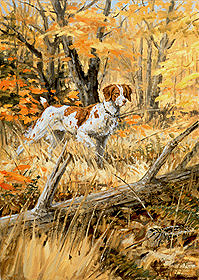
Well, so are all dog breeds, until someone gives them a breed name. But Brittanys aren't really true Spaniels (here are the main spaniel varieties - more of 'em than you might have thought), which is why we call them plain Brittanys. They are more pointers, or setters, or something. A mix of various random things that happened to come together well.
Who cares what you call them. In our neck of the woods, Brittanys are the best all-purpose dog for the field, and maybe the most popular gun dog. They point birds, they retrieve, they do not mind water retrieves; they are bundles of energy and affection, and they are easy to train - a cross look is usually enough to get your point across to these emotionally-sensitive critters. The larger American version can handle the large spaces.
But you need at least two of them. One Brittany isn't a fully happy dog. They need the exercise and the company they can give each other. Every hunter, or every human, can use a few sweet Brittanys around the place.
We know, for example, that when a patient goes to his primary-care physician with a very common problem like lower back pain, the physician will deliver the right treatment with real clinical benefit about half of the time. Patients with the same health problem who go to different physicians will get wildly different treatments. Those physicians can't all be right.
Overall, physicians are said to get it wrong around 50% of the time. I suppose that is possible. I get it wrong on a regular basis. Dr. DB says he trusts no-one in medicine, including himself.
More from the Scientific American article:
Give surgeons a written description of a surgical problem, and half of the group will recommend surgery, while the other half will not. Survey them again two years later and as many as 40 percent of the same surgeons will disagree with their previous opinions and change their recommendations. Research studies back up all of these findings, according to Eddy.
All health care will be delivered by this method soon. Requests for chest X-rays will entail sending you an application to work at a Japanese power plant with a film shirt. Deafness will be treated by ordinances requiring that everyone yell at you -- not just the clerks at the Department of Motor Vehicles. Instead of glasses, those suffering from vision loss will be supplied with an even uglier spouse, because what difference will it make, anyway? At this point, with all our light fixtures filled with CFL bulbs, you can barely tell if you're living with a mammal, never mind a hottie. Good-looking spouses will be re-assigned to those with good eyesight, but who want Viagra, which doesn't grow on trees, you know.
Would you like to know more? Put in another quarter, and press pound. Your pound key generates all the electricity for your house, too, so press it a lot, really fast.
Read about the good old eastern US Red-Shouldered Hawk, the lover of wetlands and swamps, at Cornell Lab of Ornithology. Like the Barred Owl who keeps the little wetland critters on their toes at night, this bird likes the kinds of places I like. Wild, wooly, and wet.
I regularly get calls for consultations from people seeking disability for emotional complaints. If I fill out the lengthy state form, it's pretty much guaranteed that they will get some sorts of government checks forever.
I tell them to call somebody else. I won't do it. In the charity clinic at which I volunteer my time we have a blind fellow, a guy with no legs, and a paranoid schizophrenic lady working. They all get the admin work done. At my supermarket, my bags are packed by a gal with Down's. She is a sweetie.
The calls I get about this are, like, I have bad Bipolar or bad OCD, or bad drug addiction, or chronic depression with fibromyalgia. Being a Psychiatrist, I fortunately do not get calls from the people who say they can't work because their back hurts. Whose doesn't?
Giving up on a productive life means giving up on life and giving up on dignity. A colleague of mine will not work with anybody on any form of disability. His view is "If they have given up hope for themselves, why should I bother?" I tell him it's all about getting the money, not about hope. Scamming the system, or reverting to dependency.
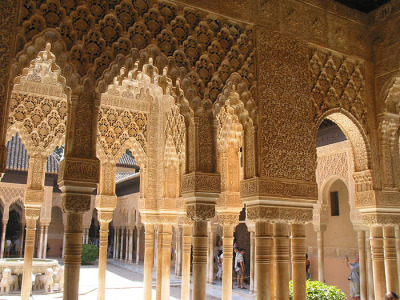
My seating companion at a very pleasant dinner last night engaged me in a conversation about the Moslems - the Moors - in Spain. My friends tend to be people with many interests and pursuits. Luckily for me, my aging brain remembered some of the history, but I wanted to quickly review it today. This was a good quick source: Muslim civilization in Spain (711-1492)
She knew all about it, and is taking a course in Ottoman art and design at Yale. We wondered what had happened to to Moslem civilization, and how and why it deteriorated to the point of its apparent current barbarianism. I speculated that perhaps it was not Islam, but the Ottoman Empire which had a civilization relatively independent of religion, as the Romans had, but I was just trying to maintain the level of the conversation.
Photo: One does not tend to associate the culture of the Alhambra with the current Middle-Eastern Islamicists who seem more focused on destruction than creation.
The president just finished speaking to a packed convention room at the AIPAC policy conference. He was not booed when he entered; most stood and offered brief applause. Still, the crowd during the speech had long periods of stony silence, and audible boos were heard when he brought up his plan to base an Israeli-Palestinian peace deal on the 1967 border lines. President Obama took nothing back from his foreign policy speech on Thursday and blamed the press for any controversy. He doubled down, making this upcoming presidential election a time for choosing for friends of Israel....This president once again has proved an apt negotiator on behalf of the Palestinians and a thorn in Israel’s side.
Conveniently, chief Palestinian negotiator Saeb Erekat has now released a statement, transforming Obama’s border guidelines into preconditions for renewed talks. Until recently the Palestinians had no problem negotiating without those preconditions. It was widely recognized that the Palestinians were trying to get to Obama’s position—a final status agreement structured around the 1949 lines plus land swaps—but that they would have to negotiate to it and make concessions along the way. Now Erekat is insisting that “there is no point talking about a peace process” unless Israeli Prime Minister Netanyahu accepts the final Palestinian position as everyone’s starting position. Since that’s not going to happen under any circumstances—nor should it—we are again in a situation where President Obama’s de-facto advocacy for the Palestinian cause has made peace more difficult to achieve.
Me:
Obama to Israel, "Let's agree to disagree, and you'll pay for it later, out of sight of this audience."
Netanyahu replies: "My audience will hear from me tomorrow, and the next day, and the next, and the next, despite your sellouts."


 I must confess before God and a jury of my peers: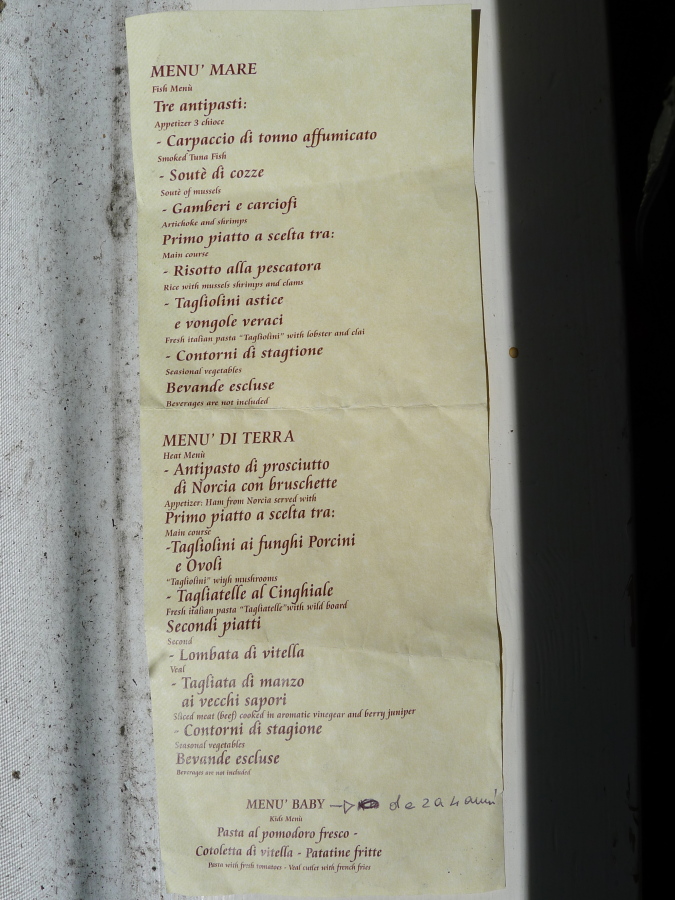
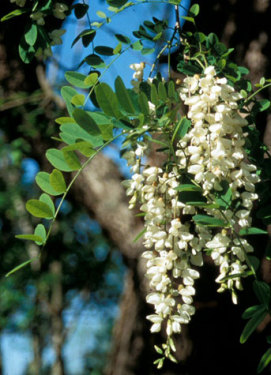 When you drive around the northeastern US in late May-early June, the blooming Black Locust trees are everywhere. Their white flower bunches put on a good show and stand out strongly from the green background - the locust trees are a big puff of white.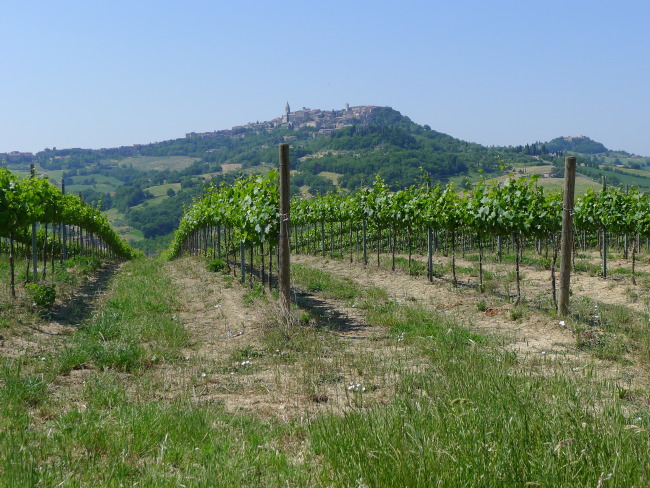
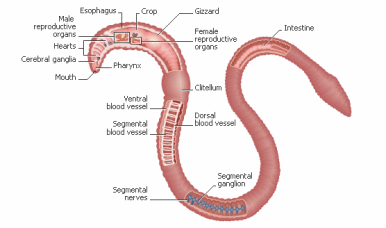 I was surprised to stumble upon the fact that the common earthworm, the gardener's friend, is not native to the US and Canada: most worm species are "invasive" introductions from Europe, and have been spread across the country in plant material.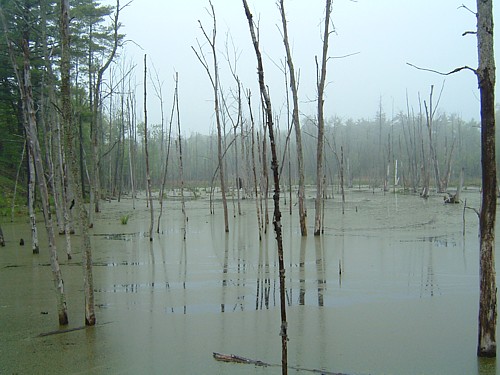
 There are two sorts of people: those who love breakfast, and those for whom breakfast is nothing more than coffee and a cigar or, some days, a glass of OJ and five aspirins.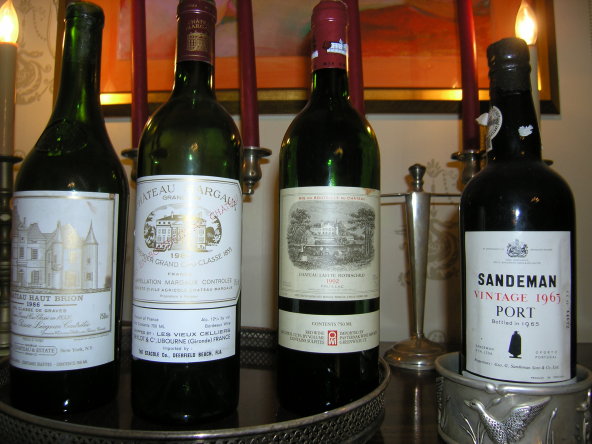
 Well, so are all dog breeds, until someone gives them a breed name. But Brittanys aren't really true Spaniels (here are the
 My seating companion at a very pleasant dinner last night engaged me in a conversation about the Moslems - the Moors - in Spain. My friends tend to be people with many interests and pursuits. Luckily for me, my aging brain remembered some of the history, but I wanted to quickly review it today. This was a good quick source: