Thursday, January 1. 2009
From 2006, with the above title. Linda Kimball begins: There are two misconceptions held by many Americans. The first is that communism ceased to be a threat when the Soviet Union imploded. The second is that the New Left of the Sixties collapsed and disappeared as well. “The Sixties are dead,” wrote columnist George Will (Slamming the Doors, Newsweek, Mar. 25, 1991) Because the New Left lacked cohesion it fell apart as a political movement. However, its revolutionaries reorganized themselves into a multitude of single issue groups. Thus we now have for example, radical feminists, black extremists, anti-war ‘peace’ activists, animal rights groups, radical environmentalists, and ‘gay’ rights groups. All of these groups pursue their piece of the radical agenda through a complex network of subversive organizations such as the Gay Straight Lesbian Educators Network (GSLEN), the American Civil Liberties Union (ACLU), People for the American Way, United for Peace and Justice, Planned Parenthood, Sexuality Information and Education Council of the United States (SIECUS), and Code Pink for Peace.
Read the whole thing.
And no, they don't include globalistical warmening. At American Scientist
Wednesday, December 31. 2008
A re-post, for Gramsci Week: Re-Taking the University: A Battle Plan Kimball's 2005 piece in the New Criterion has been previously posted here, but it deserves a second go-round, if not a third. The author of "Tenured Radicals" goes beyond the subject of academia in this essay which succinctly exposes the tactics and strategies of the now-greying but still revolutionary 60s radicals. Some sample paragraphs: The old Marxist strategy of “increasing the contradictions”—a strategy according to which the worse things get, the better they really are—is a license for thuggery. It excuses all manner of bad behavior for the sake of a revolution that will (so it is said) finally transform society when all the old allegiances have finally collapsed. If one or two tottering institutions require a little push to finish them off, so be it. Shove hard: You cannot, as comrade Stalin remarked, make an omelette without breaking eggs. Tenured Radicals is a frankly polemical book. In some ways, however, it underestimates if not the severity then at least the depth of the problem. What happened to the universities was part—a large part—of that “long march through the institutions” that the Italian Marxist Antonio Gramsci recommended and whose American lineaments I chronicled in The Long March: How the Cultural Revolution of the 1960s Changed America (2000). “The Age of Aquarius,” I wrote in the Introduction to that book, “did not end when the last electric guitar was unplugged at Woodstock. It lives on in our values and habits, in our tastes, pleasures, and aspirations. It lives on especially in our educational and cultural institutions, and in the degraded pop culture that permeates our lives like a corrosive fog.” Since the 1960s ...colleges and universities have more and more been home to what Lionel Trilling called the “adversary culture of the intellectuals.” The goal was less reflection than rejection. The English novelist Kingsley Amis once observed that much of what was wrong with the twentieth century could be summed up in the word “workshop.” Nowadays, “workshop” has been largely replaced by the word “studies.” Gender Studies, Ethnic Studies, Afro-American Studies, Women’s Studies, Gay, Lesbian, and Transgender Studies: these are not the names of academic disciplines but political grievances. They exist not to further liberal education but to nurture the feckless antinomianism that Jacques Barzun dubbed “directionless quibble.”
Read the whole essay.
Tuesday, December 30. 2008
This is reposted from Sept, 2007 for Gramsci Week -
 Yesterday's handy summary of Gramsci put me ta thinkin'. I realized that when I am in the mood to be appalled by a pure strong dose of Gramsci thought, I check out what insanity our friend Van Helsing at Moonbattery has to offer. Yesterday's handy summary of Gramsci put me ta thinkin'. I realized that when I am in the mood to be appalled by a pure strong dose of Gramsci thought, I check out what insanity our friend Van Helsing at Moonbattery has to offer.
Top of his blog right now - Bloomberg compares US in Iraq to Brits during the Revolution. Perfect Gramscian confusion. The amoral elements of New York love to create moral equivalents because it makes them feel sophisticated. Of course, Bloomberg is the embodiment of the intrusive Nanny State too: it's miraculous that he is one of the world's most successful and exuberant Capitalists.
And then next I happened to stop by David Warren for my weekly visit and read Reconstructing the Family. Yes, it's about Gramsci again.
This stuff is everywhere. Am I a victim, a pitiful captive of counter-revolutionary Bourgeois Thought which causes me to believe that this stuff is utter, malevolent nonsense designed to mess with your mind?
Photo: The Minuteman in Lexington, MA, who is the moral equivalent of an Al Qaida Jihadist.
Tiger begins: ...do not let this happen to your state. New Jersey is functionally bankrupt, and there is no sign that the state's political class is going to do a damned thing about it. The state has been waging war against employers for years, and the result is that 93% of the jobs created in the state from 2000 to 2007 were in the public sector. That is an extraordinary statistic for the United States, and it includes a period of long economic expansion elsewhere. I suspect that if the number were recalculated to include 2008 and then 2009 results, government jobs would account for more than 100% of total growth in employment.
Joe Skelly at NRO remembers O'Brien, who died a week ago at 91, and linked O'Brien's 1990 essay in the national Review, A Vindication of Burke. It's a rich historical essay, and would serve as a fine intro to Burke's work. Just one quote from it: 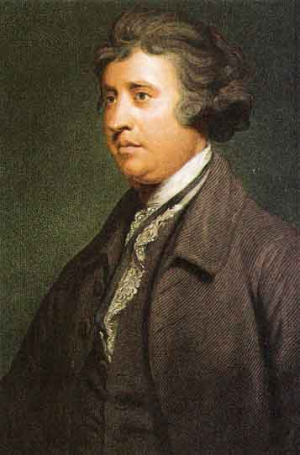 The grand distinguishing feature of the Reflections is the power of Burke’s insight into the character of the French Revolution, then at an early stage. This insight is so acute as to endow him with prophetic power. He sees what way the Revolution is heading. No one else seems to have done so at the time. The spring and summer of 1790 — the period in which Burke wrote the Reflections — was the most tranquil stage, in appearance, in the history of the Revolution. It was a period of constitution-making, of benevolent rhetoric, and of peaceful jubilation, as in the Déclaration de Paix au Monde on May 21, 1790, or the Fête de la Fédération on July 14, 1790, celebrating the first anniversary of the fall of the Bastille. The grand distinguishing feature of the Reflections is the power of Burke’s insight into the character of the French Revolution, then at an early stage. This insight is so acute as to endow him with prophetic power. He sees what way the Revolution is heading. No one else seems to have done so at the time. The spring and summer of 1790 — the period in which Burke wrote the Reflections — was the most tranquil stage, in appearance, in the history of the Revolution. It was a period of constitution-making, of benevolent rhetoric, and of peaceful jubilation, as in the Déclaration de Paix au Monde on May 21, 1790, or the Fête de la Fédération on July 14, 1790, celebrating the first anniversary of the fall of the Bastille.
Contemplating that attractive scene, in the spring and summer of 1790, most people seem to have assumed that the French Revolution had already taken place, and that all that remained was to reap its benign consequences. Burke sensed that the Revolution was only beginning. In the penultimate paragraph of the Reflections, Burke warned that the French “commonwealth” could hardly remain in the form it had taken in 1790: “But before its final settlement it may be obliged to pass, as one of our poets says, ‘through great varieties of untried being,’ and in all its transmigrations to be purified by fire and blood.”
Monday, December 29. 2008
At vacation times, we like to re-post old material. The Dyl has proclaimed this week Gramsci week, so we'll re-post old Gramsci-related stuff daily. This from a couple of years ago - It is difficult to understand what has been happening politically in the US and in Europe for the past 30 years without understanding the influence of Gramsci (1891-1937) on Western Leftist thinking and strategizing. Gramsci was a clever Italian neo-Marxist who realized that the West, due to its prosperity, its increasingly-wide access to education and opportunity, social mobility, and its readiness to repair injustices (due to its Judeo-Christian morality), would never be amenable to a violent proletarian socialist revolution. So he came up with Plan B, which is often termed "Gramscian tactics." These were based on the idea, as the good Wiki entry says:  Capitalism, Gramsci suggested, maintained control not just through violence and political and economic coercion but also ideologically, through a hegemonic culture in which the values of the bourgeoisie became the 'common sense' values of all. Thus a consensus culture developed in which people in the working-class identified their own good with the good of the bourgeoisie, and helped to maintain the status quo rather than revolting. Capitalism, Gramsci suggested, maintained control not just through violence and political and economic coercion but also ideologically, through a hegemonic culture in which the values of the bourgeoisie became the 'common sense' values of all. Thus a consensus culture developed in which people in the working-class identified their own good with the good of the bourgeoisie, and helped to maintain the status quo rather than revolting.
Thus Western "hegemonic culture" became the enemy - even more so than "the ruling class," which was simply a reflection of bourgeois culture. And defeating that enemy could not be done with guns. It required a "long march through the culture" to slowly discredit and undermine its institutions, values, and foundations. This was a brilliantly destructive idea. Eventually, the society would fall apart, opening the way to totalitarian socialism to rescue the mess. Thus the nihilistic flavor of the Western Left which is always seemingly-incomprehensively mingled with extreme Statism. One might well ask why he wasn't satisfied with the remarkable outcome of Western regulated markets, the growth of the welfare state, unionization, etc. - but he wasn't. He was determined to remain true to Marx and to find a non-revolutionary path to economic totalitarianism. A central component of the culture war he envisioned was the war on religion (also Wiki): Gramsci stated that, in the West, bourgeois cultural values were tied to Christianity and therefore much of his polemic against hegemonic culture is aimed at religious norms and values. He was impressed by the power Roman Catholicism had over men's minds and the care the Church had taken to prevent an excessive gap developing between the religion of the learned and that of the less educated. Gramsci believed that it was Marxism's task to marry the purely intellectual critique of religion found in Renaissance humanism to the elements of the Reformation that had appealed to the masses.
I hope I do not sound paranoid when I soberly say that much of the wacky, upside-down, right-is-wrong, black-is-white stuff we see in the news these days is directly or indirectly inspired by Gramsci: the attacks on Christianity, the family, individual freedom, morality and moral judgements; multiculturalism; the cult of victimhood, "tolerance," political correctness, the replacement of the roles of family, religion, individual responsibility and choice with government rules, laws, and regs; the expansion of the State and the Welfare State and the Nanny State; anti-tradition, anti-capitalism, anti-success, anti-nationalism, anti-Americanism and anti-Westernism, etc - all the stuff that makes me echo Bob Grant with "It's sick out there, and getting sicker." I am sure Antonio never anticipated that a Green movement would emerge to become an ally of the slow, incrementalist and thus less-alarming Gramscian revolution. Yes, it is all ultimately about suppression of the individual soul and spirit - his freedom, autonomy, initiative and self-definition - the highest and most noble notions of Western Civilization - in pursuit of a collectivist utopia run by "them." In short, it's about the location of power and money. OK. This is getting too long-winded for Maggie's ADD writers and readers and Editor. This Town Hall post from last year, The New Left, Cultural Marxism, and Psychopolitics Disguised as Multiculturalism is a nice little piece on the subject. I am sure our readers have many more, better links and commentary.
 Is "small government Republicanism" a fantasy? Are libertarian ideals silly utopian fantasies? Is "small government Republicanism" a fantasy? Are libertarian ideals silly utopian fantasies?
It's a good debate, and it would be fun if enough readers are home or working this week to join in via comments. We have three fine pieces on the topic today: Jennifer Rubin: How do you fight Obama's New New Deal? The GOP must reject big government: LAT Where should Conservatives draw the line? Am Thinker
Friday, December 26. 2008
An important essay: Obama’s Job-Creation Program Flunks Basic Math by Caroline Baum at Bloomberg. One quote: There’s nothing like a crisis to play on the public’s insecurity and expand the reach of government. There’s nothing like a serious financial crisis to get economists of all persuasions on board. Opportunity in Crisis “In this crisis lies an opportunity to create the jobs that America needs, doing the work that America needs,” said Larry Summers, Obama’s top economic adviser, at a press conference yesterday. The best intentions face a stark reality: There may be more money than opportunities. It’s one thing to spend money to improve and update crumbling infrastructure. It’s quite another to find projects on short notice. There’s a limit to how fast even our profligate politicians can get money out the door.
What is defined as a "crisis" is quite subjective, if not entirely trumped up and manipulated for political purposes. The "opportunity in crisis" is, indeed, to expand the reach and control of government, whether it's war, recession - or manufactured crises like "health care." That's been the Statist tactic since FDR, and I resent it.
Monday, December 22. 2008
Bjorn Lomborg thinks the earth is warming, but he's rational about it (h/t, Samiz):
Freedom is always in peril.  Regular readers know that, here at Maggie's, we hold individual freedom from the power of the State as the highest political value. Regular readers know that, here at Maggie's, we hold individual freedom from the power of the State as the highest political value.
We figger that's why we had a revolution. Other countries seem to rate other values more highly, and seem more willing to put their lives in the oily, arrogant, and mediocrity-ridden hands of the political and power classes - as plenty of Americans seem to be willing to do these days. That's fine for those other nations if that's what they want, but we are meant to be special in the freedom way - and an example for others to follow if they can. Two quotes from Freedom Imperilled at The New Criterion: How is freedom faring in the United States today? Peter Robinson, a scholar at the Hoover Institution at Stanford, provided a melancholy précis in “The Loss of Individual Liberty,” a column that appeared in Forbes last month. Mr. Robinson recalled a dinner he shared with Milton Friedman several years ago. He complimented the venerable economist on his role in transforming the intellectual landscape, especially in fostering widespread appreciation of the inextricable connection between free markets and individual liberty. Friedman refused the compliment. “We may have won the intellectual battle,” he said, “but in practical politics, it’s difficult to see that we’ve had any effect at all.” Even a few years ago, it would have been easy to react as did Mr. Robinson at the time: to think that Friedman was responding with false modesty. After all, had not the power of the free market been demonstrated beyond cavil in America’s triumph over the Soviet Union, its unparalleled prosperity, its culture of political freedom?
and As Hume saw, it is generally not lost all at once, but step by step: government program by government program, regulation by regulation, entitlement by entitlement, until finally, as Tocqueville put it, we find ourselves “nothing more than a herd of timid and industrious animals of which the government is the shepherd.”
Wednesday, December 17. 2008
Liberal Catholicism and Liberal Protestantism at Inside Catholic, by David Carlin, author of The Decline and Fall of the Catholic Church in America. He begins: Catholic liberals (by which I mean theological liberals, not political liberals) never cease to amaze me. On the one hand, they appear to have a sincere devotion to their religion. On the other, they campaign for moral and theological changes that, if carried into effect, would tend to destroy their Church. Why do I say this? Because the history of Protestantism has made it perfectly clear what happens when a Christian church turns liberal or modern. Unless a Catholic is quite unfamiliar with the sad history of liberal Protestantism, he would not call for the theological liberalization or modernization of Catholicism. In America, liberal Protestantism has always had three characteristics: (1) It is an attempt to find a compromise or via media between traditional Christianity and the fashionable anti-Christianity of the day. (2) In seeking this compromise, it drops certain traditional Christian beliefs as so much excess baggage. (3) To atone, so to speak, for this weakening of doctrine, it intensifies its moral commitments. Three great "moments" in the history of American liberal Protestantism illustrate what I mean here. The first was the emergence of Unitarianism in the first quarter of the 19th century. The fashionable anti-Christianity of the day was Deism -- as found, for instance, in one of the writings of Tom Paine (The Age of Reason). So Unitarianism, in pursuit of a via media, dropped the Trinity, the Divinity of Christ, Original Sin, and a few other Christian doctrines. To make up for these discards, it strongly committed itself to the anti-slavery cause.
Monday, December 15. 2008
 Watt's Up notes: Watt's Up notes:
This is almost enough to make me turn in my Skeptic union card, but increased CO2 warming the earth makes some sense to me, the magnitude is in question. The fact that polar sea ice not melting is not an insignificant point. It is also important to realize that the changes are too small to fit with IPCC statements about the trend. Unlike trees, ice does make a good thermometer. I can’t say this strongly enough— This is a strong indication of substantial errors in the computer models and temperature data which needs to be addressed before we throw what’s left of our global economy to the wind. How would Earth’s total sea ice ignore such substantial warming? It’s a good question which deserves an answer.
Computer models aren't facts: far from it. Despite Al Gore's recent hysteria, there has been no loss of Arctic ice. I agree with others who observe that, as climate data fail to conform to computer models, the fearmongers become more shrill and desperate. This over-the-top AP story contains so many inaccuracies that it hardly counts as a news story. It's shameful climate propaganda, and satirizes itself by concluding that any global cooling is due to global warming. John at Powerline does a good job with it. Our position is that we are open to facts, but that the topic of climate has become politicized - which is never helpful to scientific endeavors. Furthermore, we suspect that some warming would be good for mankind, but unfortunately the data show that we have experienced ten years of climate cooling, with 30 years more of cooling predicted. So I think everybody should just chill. Photo: Last week's New Hampshire ice storm from No Looking Backwards
Sunday, December 14. 2008
Thanks to our pal Dr. Bob for finding this. Apparently Edward Feser and Heather (who we also like very much) have been having an exciting correspondence about religion and politics. Feser more or less begins thus: The source of my dispute with you is the criticism that you (like Kathleen Parker and others) have been making of religion – not of this or that kind of religion, and not of this or that individual religious believer, but of religion per se – to the effect that it is irrational, and that this irrationality has something to do with its purported lack of scientific grounding.
Read the whole thing (link above).
Thursday, December 11. 2008
We hate dealing with the concept of race, mainly because race does not exist in any meaningful way. It's a socio-cultural concoction, we feel, born of the natural (and not evil) human tendency towards tribal affiliation. Still, we must deal with it sometimes because it seems to matter so much to people, despite MLK Jr's insistence on categorizing people on their characters. I am 1/16th Iroquois. Am I an Indian? Can I open a casino and get rich ripping off Whitey? The Arkansas Times takes a look at From Octoroon to Other.
 Well, probably soon if global cooling continues. Well, probably soon if global cooling continues.
Here's the real story: Among Scientists, Resistance to Global Warming Hoax Spreads Image from Moravec's cool Prehistoric World Images of Wooly Bullies in New Jersey, not very long ago. As we always say here, we should all pray for Globalistical Warmening and maybe it will happen.
Wednesday, December 10. 2008
 Why? Because there is no accountability, no escape, and nobody who bothers to understand you and what your life is about. You are as helpless as a Frenchman. Just look at Oceania, or the EU - or even at Washington. That's why I am a member of The Federalist Society. Why? Because there is no accountability, no escape, and nobody who bothers to understand you and what your life is about. You are as helpless as a Frenchman. Just look at Oceania, or the EU - or even at Washington. That's why I am a member of The Federalist Society.
Freedom, not control, is our goal here at Maggie's. Mega-governance is Imperialism gone wild. Rachman at FT looks at World Government.
A quote from JR Nyquist on Negative Numbers and the Road to Serfdom: The only way the economy can heal is through the market. However painful the healing process, only the market can bring about full recovery. Government cannot do it. Friedrich Hayek offered a remarkable explanation of this in The Fatal Conceit. He wrote: “The creation of wealth is not simply a physical process and cannot be explained by a chain of cause and effect. It is determined not by objective physical facts known to any one mind but by the separate, differing, information of millions, which is precipitated in prices that serve to guide further decisions.” In other words, wealth is created by the market. Hayek further warned: if you do not trust the market, then you no longer believe in freedom or capitalism. In that event you are a socialist on the road to serfdom.
Tuesday, December 9. 2008
This from our guest poster Bruce Kesler, who has a long history of writing about Vietnam: The election of Vietnamese refugee Joseph Cao as a Republican in the most heavily Democrat congressional district in America (11% Republican), drawn to elect a Black (2/3rds Black population), comes as a surprise to some. Reasons given center around his community service record in post-Katrina New Orleans, the utter corruption of incumbent William Jefferson, and the reduced turnout of Blacks in this ballot postponed because of Hurricane Gustav. Various lessons are being proposed: Republican leadership call it an example of the results of a broader ethnic base and better ethics, calling for more. BlackVoices blog says a new generation of Black politicians cannot just count on racial solidarity but must demonstrate better ethics and effectiveness. Democrats expect a better candidate to reclaim the district in 2010, but expect a fight. While probably just a temporary balm to bashed Republican egos, this election of the first Vietnamese to Congress is notably ignored in all the state-run Vietnam news agencies which usually never miss an opportunity to herald the many accomplishments of refugee Vietnamese as if its own. Like refugees from communist oppression in Cuba or Russia, the Vietnamese in the US lean heavily Republican, the Vietnamese by 2-1. The lesson they’ve learned is that American ideals and policies are more to be valued than among many US natives who take them for granted or, even, denigrate the US compared to tyrannical regimes and ideologies. I’m probably unique among bloggers in writing many dozens of detailed, well-documented blog posts over the past few years about the ongoing political and religious repression in Vietnam and its ethnic cleansing brutality toward its minorities. And, probably nothing else I’ve written about has generated less interest. I won’t belabor the reader here with a repetition, but point those interested to a few good, brief introductory sources: Human Rights Watch “Speaking Up for Vietnam,” (many, many reports and analyses at HRW’s website); Former USAID worker and POW in Vietnam, tireless human rights advocate Mike Benge’s latest summary; the Montagnard Foundation’s report on ethnic cleansing (and ongoing tracking of it); and denuding of its and neighboring Laos and Cambodia’s rainforests.
The Bush administration, focused on the Middle East imbroglio, has been relatively weak in challenging Vietnam’s oppression, while encouraging the import trade from Vietnam that generates a $10+ billion deficit but enriches some US firms and entrenches the political rulers of Vietnam by creating a more prosperous, mostly quiescent urban class. Still, some in Vietnam are not so easily bought off, leading to labor strikes against more exploitive wages and conditions than even in China and the majority Buddhists and the Catholics refusing to buckle under to the state churches that are allowed. Tensions will increase as the international economic tanking slows Vietnam’s export-driven growth.

Returning to Joseph Cao, he has been heavily involved in Boat People SOS, founded to help Vietnam’s refugees. One would expect him to be a voice in Congress for Vietnam’s oppressed. But, one should expect him to concentrate more upon his district’s domestic concerns, especially if he is serious about an uphill re-election in 2010.
The new Obama administration, looking to relax US pressure on another communist relic in Cuba, is not likely to take up Vietnamese human rights more strongly. If Cao’s voice on Vietnam’s suffering population is to be magnified, it will require more Americans and Congressmen taking an interest in Vietnam’s oppression. The Vietnam Human Rights Network has easy links to most every international report on Vietnam, including from Amnesty International, Human Rights Watch, Freedom House, the US Commission on International Religious Freedom, Reporters Without Borders, and many more, all condemning Vietnam’s continuing oppression.
Another worthy cause is the Vietnam Healing Foundation run by my good friend R.J. DelVecchio, former Marine combat photographer in Vietnam and frequent visitor since. It is the only one that tries to aid severely wounded and destitute former South Vietnamese soldiers who continue to be denied basic food or medicine by Vietnam’s regime.
Whether Joseph Cao’s election promises any lasting relief to the US from more ethical Republicans or Black politicians is open to serious question. More important to Americans’ ethical relief would be more support for Vietnam’s long-suffering people.
 From a piece at Moonbattery: From a piece at Moonbattery:
Democrats have learned their lesson from the HillaryCare debacle: don't give the voters time to figure out what you're doing to them.
Precisely. It's the same old story: Manufacture a crisis, create noise for gummint to step in, and before you know it you have lost more freedom and choice. And money, too.
Monday, December 8. 2008
From Weekly Standard's review of Yuval Levin's Science and American Democracy, a quote: Levin shows that the Joe Friday ideal of science-"Just the facts, ma'am"-overlooks the woods for the trees. It ignores the reality that science, as we take it for granted, is a relatively new phenomenon in human history and was brought about by men who saw science and healthy politics as inextricably linked. Modern science came into being in the 17th century through the thought and action of a handful of great thinkers, foremost among them Francis Bacon and René Descartes. They successfully sought to change the character of scientific activity for distinctively human and political ends. Ancient science was contemplative: It sought to understand nature, but was content to let it run its course. The scientific project founded by Bacon and Descartes saw nature as hostile to human prosperity, as penurious and arbitrary. Far from being a source of guidance on how to live, nature was something to be overcome or conquered. Science was, in Bacon's famous phrase, to be put in the service of "the relief of man's estate." A new order was to emerge in which science would progressively conquer poverty and disease and hold out the prospect of the indefinite extension of human life. Empirical science was to be the means of political reformation. Levin nicely sums up the less sober aspirations born of the modern scientific project in this way: From the very beginning, the modern worldview has given rise to peculiar utopianisms of various stripes, all grounded in the dream of overcoming nature and living, free of necessity and fear, able to meet every one of our needs and our whims, and able, most especially, to live indefinitely in good health. This brand of utopianism generally begins in a benign libertarianism, though at times it has ended in political extremism, if not the guillotine.
We're far from the guillotine, but you only have to think about the relative capacities of smoking, on the one hand, and blasphemy, on the other, to generate indignation and see precisely to what extent this peculiarly modern moralism has taken hold. To be sure, Levin is not the first to observe the hidden political foundations and aims of modern science, but you would be hard pressed to find a treatment that is equally accessible, engaging, and precise. What is new here is the manner in which he uses his scholarly knowledge to illumine the character of our contemporary (and future) political life.
Sunday, December 7. 2008
S,C&A considers many of the things that bug the heck out of us in a piece of the above title. One quote: Leftists today hate freedom and democracy because those ideas have created the environment for success. Assistant Village Idiot recently noted in a comment that Arabs don’t hate us because we have succeeded, but rather, because they have failed. The same is true for the leftists - their burning hatred of democracy stems from their failure to create a single instance of a functioning society that isn’t a least a generation behind our own. Not even the redistribution of wealth can make up for the values and freedom that create an environment that allows for the creation of wealth.
Saturday, December 6. 2008
via Dr. X. I'd be more interested in knowing how our American readers' kids do on this test than on how our readers do.
Friday, December 5. 2008
"In politics today, intention, symbolism, and rhetoric are everything; facts, nothing." A must-read. VDH: Parallel Lives. Barrister emails: Forget politics. Politics is a power and money game, of course, because many humans get a kick out of those things. But how does Rangel keep his chairmanship, much less remain in the darn House, after these revelations? Or am I naive as hell?
Thursday, December 4. 2008
Is "success" luck or pluck? Volokh considers Gladwell's book. Luck or pluck? Well, we all know that we make our own luck...but bad luck is never our fault. I think it's one of those black-and-white pseudo questions, like Nature vs. Nurture. Life is more complicated than that, and everybody has his own definition of success in a free country. And everybody fails, to some degree, in meeting his life goals whatever they may be. (My life goals happen to be to have a relationship with God, to be honest and honest with myself, to be close with my family and to give them a hand when needed, to read lots of books, to pay my hefty bills, to have some pals I can count on, to have a pleasant and civilized environment to live in, to make some efforts for the things I care about, and to have some good recreation - which includes guns, horses, golf, Scotch whiskey, ceegars, and posting on Maggie's - among other things. That's about it. I am a happy and frequently unhappy product of my culture. Saving the world is above my pay grade narcissism quotient.) Some people equate being rich (defined how? Some would term me prosperous, and some not) as success. I do not. Anyway, Wilkinson also takes a look at Gladwell and income inequality. One quote: If you understand that prices convey information about supply and demand, and that a wage is a price, then you understand that differences in wages for different kinds of labor convey information about the supply of different kinds of labor relative to demand. Wage inequalities are how people can know what’s a “high-value profession” and what isn’t. It guides our choices about the kinds of skills to seek. We need that guidance because effort isn’t enough. You can work as hard as you like in a low-wage job, and you’ll still be in a low-wage job.
|