Sunday, December 7. 2008
S,C&A considers many of the things that bug the heck out of us in a piece of the above title. One quote: Leftists today hate freedom and democracy because those ideas have created the environment for success. Assistant Village Idiot recently noted in a comment that Arabs don’t hate us because we have succeeded, but rather, because they have failed. The same is true for the leftists - their burning hatred of democracy stems from their failure to create a single instance of a functioning society that isn’t a least a generation behind our own. Not even the redistribution of wealth can make up for the values and freedom that create an environment that allows for the creation of wealth.
 How Orson Bean found God: Powerline How Orson Bean found God: Powerline
The Coming of Love: Anchoress
Sunday, December 7, 1941 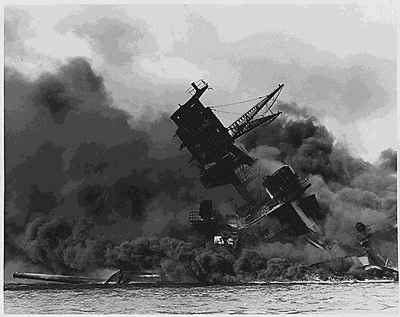
Saturday, December 6. 2008
via Dr. X. I'd be more interested in knowing how our American readers' kids do on this test than on how our readers do.
From Dan Ford: ...on December 7, Asahi News in Tokyo will broadcast a "Scoop Special" about how the US planned to bomb Japan from China, thus proving that the Pearl Harbor attack was purely in self-defense. Tomoko Nagano, meet Richard Barthel! You two will have much to talk about.
Does the average person really lie three times per ten minutes of conversation? If so, I may too trusting, or too gullible, for this world. Psychologist Paul Ekman studies emotions and deception, and has Evaluating Truth training seminars. He is the expert on micro-expression of emotion. Some of his online training programs are here. Cool stuff. Useful, too. A new FOX TV show based on Ekman's work, Lie to Me, will begin airing in January. From the clip below, it looks to be darn interesting:
Vanderleun addresses one of our perennial topics, The Religion of the Left. One quote: The Religion of the Self teaches, as its first and last precept, that there is nothing in this world greater than the self and -- beyond this world, out beyond even the unimaginable edges of the universe -- there is... well... nothing at all; "purposeless matter hovering in the dark."
We're on the same page, Mr. V. Often, if not always. This subject goes to the core of the worldview gap we are experiencing.
Best email I received yesterday (from a bow hunting pal): "We've got four deer hanging in the garage. Can you come over tomorrow around two to help cut em up and have some beers?" My reply: "You betcha."
Advice to Himself Sad Catullus, stop playing the fool,
and let what you know leads you to ruin, end.
Once, bright days shone for you,
when you came often drawn to the girl
loved as no other will be loved by you.
Then there were many pleasures with her,
that you wished, and the girl not unwilling,
truly the bright days shone for you.
And now she no longer wants you: and you
weak man, be unwilling to chase what flees,
or live in misery: be strong-minded, stand firm.
Goodbye girl, now Catullus is firm,
he doesn’t search for you, won’t ask unwillingly.
But you’ll grieve, when nobody asks.
Woe to you, wicked girl, what life’s left for you?
Who’ll submit to you now? Who’ll see your beauty?
Who now will you love? Whose will they say you’ll be?
Who will you kiss? Whose lips will you bite?
But you, Catullus, be resolved to be firm. . (I don't know who did that translation.) Here's the original:
Ad se ipsum
Miser Catulle, desinas ineptire,
et quod uides perisse perditum ducas.
fulsere quondam candidi tibi soles,
cum uentitabas quo puella ducebat
amata nobis quantum amabitur nulla.
ibi illa multa cum iocosa fiebant,
quae tu uolebas nec puella nolebat,
fulsere uere candidi tibi soles.
nunc iam illa non uult: tu quoque impotens noli,
nec quae fugit sectare, nec miser uiue,
sed obstinata mente perfer, obdura.
uale puella, iam Catullus obdurat,
nec te requiret nec rogabit inuitam.
at tu dolebis, cum rogaberis nulla.
scelesta, uae te, quae tibi manet uita?
quis nunc te adibit? cui uideberis bella?
quem nunc amabis? cuius esse diceris?
quem basiabis? cui labella mordebis?
at tu, Catulle, destinatus obdura.
Friday, December 5. 2008
I have skied quite a bit and have had my share of fun/dread with some reckless things and silly drops, but never experienced these drops of 210, 230, and 245 feet (h/t, Theo). If I had, I would not be here to post this:
-
 One of my personal rules since my formal education ended has been to make sure I learn a minimum of ten interesting things per day. One of my personal rules since my formal education ended has been to make sure I learn a minimum of ten interesting things per day.
I learned about CD rot today. Indeed nothing is permanent except (we, or some of us, believe) God. The Second Law of Thermodynamics says that our whole universe gizmo-thingy is set up that way. As it happened, last night, at a dinner out, a hunting buddy mentioned re-reading St. Augustine's chapter in The Confessions about time. My confession was that I did not remember that chapter at all. I do recall learning that God is a timeless entity and that God's time is not our time - but not in Augustine. And I also confess that the entire subject of time is a mystery to me. Anyway, here's a short essay on Augustine on the subject of time: Time as a Psalm.
 Ever hung out in a duck blind? 24/7 live feeds from a duck blind in Mississippi. (Thanks, C.) Ever hung out in a duck blind? 24/7 live feeds from a duck blind in Mississippi. (Thanks, C.)
You just might want to keep the feed running all day, especially if you are stuck in the office.
Thursday, December 4. 2008
From guest writer Bruce Kesler, who seems to have found a comfortable new place to pitch his tent at Maggie's -  Economics fails us in the current economic travails, because of its inherent limitations and because it doesn’t deal with a root distortion of the factors considered. Economics fails us in the current economic travails, because of its inherent limitations and because it doesn’t deal with a root distortion of the factors considered.
Traditional economic theory has advanced over the past two hundred years, from simpler unifocal causation to multicausal, usually seen to operate mechanistically, which lends itself to mathematic modeling. In various ways, the emphasis is on rational decision making. Time lags are introduced to approximate learning and reaction curves. Neoclassical microeconomics has been aggregated in Keynsian macroeconomics, both lending themselves to feelings of efficacy in prescribing governmental actions. More recent behavioral economics adds that the process, at the individual or societal level, is less than perfectly rational measured choices, and often irrational. Stated, real or perceived self-interests are imperfectly or not pursued, and experiential feedback is imperfectly or not heeded. Experiments, data manipulation and controlled observations of inputs and results extend the testing and understanding of the many various approaches to economics. But, they still result in confusion, both by their battling contentions and lack of adequate predictability. Still, governments and their advisors continue to argue for one course or another, largely based on these theories, and all of us are affected. This isn’t to argue that such efforts at understanding and guidance are misplaced or unnecessary. It is to argue that more humility is needed in charting such courses. It is also to argue, now even more importantly, that a major element is missing from current economic thought: some segments of society have grown so large or powerful they are treated as too big to either challenge or fail, which grossly distorts the operations of the economy and results in grossly excess costs that create greater lasting harms.
Continue reading "The Economics of Too Big to Fail"
"A fad or heresy is the exaltation of something which even if true, is secondary or temporary in its nature against those things which are essential and eternal, those things which always prove themselves true in the long run. In short, it is the setting up of the mood against the mind." G.K. Chesterton (h/t, reader, in one of a number of good comments on our Watermelon Man and Hippie Totalitarianism). As we always say here, "Reality Rules...eventually."
Our reader Buddy recommends perusing J. R. Nyquist's Global Analysis site. Check out some of his older - and newer columns. As Buddy says, the guy is prescient.
Wednesday, December 3. 2008
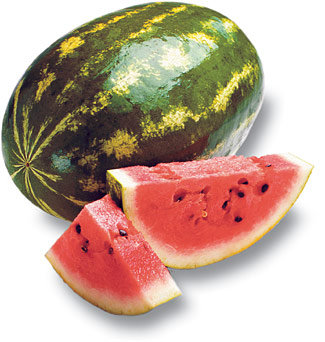 We use the term "Watermelon" to refer to those who are green on the outside and red on the inside. (We at Maggie's are ardent Conservationists and nature-lovers and studiers, but have never bought into the "Green" thing.) We use the term "Watermelon" to refer to those who are green on the outside and red on the inside. (We at Maggie's are ardent Conservationists and nature-lovers and studiers, but have never bought into the "Green" thing.)
Jonathan Adler (himself a global cooling denier) takes a look at Gus Speth and his new book. Speth is as green as they come, and Dean of the Yale School of Forestry. The piece in The New Atlantis, Green Bridge to Nowhere, is quite revealing. I'll just offer one quote: Speth’s agenda is not confined to economics and the environment, however. He believes his sustainability agenda is intertwined with broader social concerns. “Sustaining people, sustaining nature—it is one cause, inseparable.” Thus he wants to replace the traditional focus on economic growth, as measured by GDP, with “good growth,” which he defines as “growth with equity, employment, environment, and empowerment.” While ostensibly focused on our environmental crisis, and calling for a “post-growth” society, the bridge he seeks to build is to a far broader and more ambitious progressive agenda: Perhaps the most important prescriptions challenging unbridled growth come from outside the environmental sector...they include measures such as more leisure, including a shorter workweek and longer vacations; greater labor protections, job security and benefits, including retirement and health benefits; restrictions on advertising; new ground rules for corporations; strong social and environmental provisions in trade agreements; rigorous consumer protection; greater income and social equality, including genuinely progressive taxation for the rich and greater income support for the poor; major spending on public sector services and environmental amenities; a huge investment in education, skills, and new technology to promote both ecological modernization and sharply rising labor productivity to offset smaller workforces and shorter hours. People deserve more free time, more security, and more opportunity for companionship and continuing education. They deserve to be free of the growth-at-all-costs paradigm and the ruthless economy [of capitalist societies].
This agenda, Speth claims, is not only the key to sustainability, but also to greater human “well-being.” So too are limits on consumerism and consumption. The measures he outlines are the “hallmarks of a caring community and a good society” and must be imposed by government diktat. The role civil society and non-governmental civic institutions might play in this regard receives not a single mention. Capitalism and its attendant freedoms are not only bad for the environment, in his view, they are bad for people as well, and must therefore be controlled, if not eliminated.
Read the whole piece for full insight into this totalitarian movement. Power grabs used to be "for the children," then they were "for the greater good," and now they are "for the planet." I guess any excuse will do for those who imagine that they know better than us regular benighted people. And as far as my "well-being" goes - if I want advice, I will ask for it.
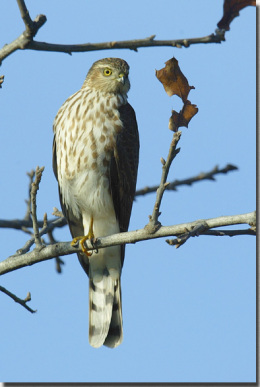
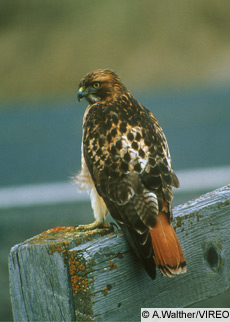 Thus far this morning, the bird feeder outside my office window has been dive-bombed by a Red-Tail Hawk - on right - after a squirrel (he missed), and by a Sharp-Shinned Hawk - below - after an English Sparrow (he got it by pursuit, crashing through the shrubs). Not my photos, obviously. Thus far this morning, the bird feeder outside my office window has been dive-bombed by a Red-Tail Hawk - on right - after a squirrel (he missed), and by a Sharp-Shinned Hawk - below - after an English Sparrow (he got it by pursuit, crashing through the shrubs). Not my photos, obviously.
Tuesday, December 2. 2008
 Miss World Update, at Powerline. We feature Miss Dominican Republic - Miss World Update, at Powerline. We feature Miss Dominican Republic -
Funny: The incredibly stupid thoughts of Deepak Chopra. Rick begins thus: There are few human beings on planet earth more annoying than Deepak Chopra, the touchy-feely, New Age Guru whose fetid, gooey, and completely banal nostrums regarding health and healing have reached a new low in the history of civilized thought.
Our lying, cheating, stealing teens Lovely Venice sinking beneath the waves. Visit now, or later with scuba gear. I don't know how we overlooked this site, but Whited Sepulchre has a good bit on The Richardson Snub. We add this Texan to our Blogroll of Honour.
This is from our guest poster Bruce Kesler - What if Peter, or Paul, is your son? If Peter is your child, then you might think at least twice about robbing Peter to pay Paul. Indeed, if Paul is your child, you might think twice about when Peter runs out of money to rob. Today, we’re moving beyond robbing to literally looting Peter, and Paul will face standing on his own. Our older, unionized industries centered around the domestic auto companies are yammering for federal tens of billions to keep them breathing a while longer. Meanwhile, their smothering, very generous retirement pension and healthcare benefits are, at best, likely to be hardly trimmed. Our states, whose heavily unionized employment has grown faster than in private companies, face almost $2 trillion of future payments on retirement benefits for which they don’t have funding. Add in localities and the unfunded debts climb even higher. Meanwhile, our governors clamber for hundreds of billions from the federal government to keep their mini-welfare states going with, at best, small temporary spending cuts. Our federal government faces the imminent bankruptcy of Medicare and Social Security under the weight of trillions of unfunded benefits. Meanwhile, nothing is done, while the remedies become more severe. Add to this the trillion dollars or so, hidden behind misleading titles like “stimulus” or “growth”, already committed and more to come to briefly cushion the shock to some politically favored sectors. Where is all this money to come from? It can only come from four sources: It can come from increasing taxes or cutting future government benefits, both of which land on our child Peters, and the latter on our Pauls, to reduce their standard of living and their incentives to excel and produce. It can come from foreign and domestic lenders, the debt payments mounting and interest costs increased by the reduced credibility of repayment in non-inflated dollars. It can come from speeding up the currency printing presses, devaluing investments and savings. It can come from our Pauls learning to more care for themselves. At a point in the not too distant future our Peters may well no longer have enough resources left to be robbed for the Pauls. Our Pauls better learn, fast, how to be more productive and care for themselves. We have a pretty clear choice: The first choice is we can continue the fiscal and moral insanity of robbing Peter to pay Paul, of the impossibility of sustaining our heavy subsidies of so many currently over-benefited adults. Or, we can redouble and redirect our efforts to provide a practical education to our Pauls. That means several things. It must be made clear, throughout our society, which includes our Hollywood and Times Square dream factories, that there is no free ride, but that an individual is dependent upon his own work and ethics. It must be made clear that diligent attention to skill-enhancing education is the road to self-sufficiency. It must be made clear that any individual, company or government which doesn’t live within its means has no other choice but to do so, at whatever adjusting discomfort to oneself, owners, employees or clients. The first choice, of fairly blithely continuing on the current path, downward, will soon hit a dead, self-destructive end. The second choice will then not be a choice to be managed but the only harsher way remaining. The sooner we head toward the second path, the easier the way will be. The first step is to recognize that both Peter and Paul are our sons, to be cared about enough to be set on the right path.
Monday, December 1. 2008
Soros' Move-On is still in business. This is post-election, on Manhattan's Upper West Side. Free medical care seems to be one of their goals, but I think they want lots of free stuff from what others produce. It's quite evident that they do not know how to produce anything themselves. It's hard to see how such feckless people can be effective, but there is no doubt that they now feel individually "empowered" by Obama. How nice for them. (h/t, Moonbattery). These people are "the useful idiots," as Lenin termed them. It's a fund-raising scam. Not that they need it, if Soros is really paying for the thing... The potty-mouth blond is kinda hot:
 During the past couple of months, I have noticed our bunny rabbit (Cottontail Rabbit) population taking a sharp decline. During the past couple of months, I have noticed our bunny rabbit (Cottontail Rabbit) population taking a sharp decline.
Then we saw the fox. They must have moved in recently. The diminutive Red Fox is the most widely distributed predator in the world, from Asia through Europe and North America. (Yes, he is a Fox and she is a Vixen.) While our American Red Fox is likely a descendent of foxes imported from England for hunting, there was a pre-existing Red Fox here which inhabited boreal regions of North America. In the US, they are hunted with horses and hounds, but I don't know anyone who shoots them for fun. In the UK, our cousin Mr. Free Market loves to blast them, but he is a deeply disturbed individual (like all Capitalist gun-lovers), and he also tries to protect his pheasants. I tend to feel happy when I see one, which is not often, at dawn, trotting across a meadow. I think I have liked them since Roger and the Fox was a favorite of mine around age 6. They are increasingly semi-suburban, but are basically a rural animal. These nocturnal handsome bushy-tailed guys are mainly mouse, fruit, and bug-eaters, but they have been known to steal a chicken or young pheasant. Both coyotes and wolves will kill foxes. A bit about their range and natural history here. More here.
Sunday, November 30. 2008
No man’s life, liberty, or property is safe while the legislature is in session. Mark Twain (h/t, LGF)
|