Tuesday, December 9. 2008
This from our guest poster Bruce Kesler, who has a long history of writing about Vietnam: The election of Vietnamese refugee Joseph Cao as a Republican in the most heavily Democrat congressional district in America (11% Republican), drawn to elect a Black (2/3rds Black population), comes as a surprise to some. Reasons given center around his community service record in post-Katrina New Orleans, the utter corruption of incumbent William Jefferson, and the reduced turnout of Blacks in this ballot postponed because of Hurricane Gustav. Various lessons are being proposed: Republican leadership call it an example of the results of a broader ethnic base and better ethics, calling for more. BlackVoices blog says a new generation of Black politicians cannot just count on racial solidarity but must demonstrate better ethics and effectiveness. Democrats expect a better candidate to reclaim the district in 2010, but expect a fight. While probably just a temporary balm to bashed Republican egos, this election of the first Vietnamese to Congress is notably ignored in all the state-run Vietnam news agencies which usually never miss an opportunity to herald the many accomplishments of refugee Vietnamese as if its own. Like refugees from communist oppression in Cuba or Russia, the Vietnamese in the US lean heavily Republican, the Vietnamese by 2-1. The lesson they’ve learned is that American ideals and policies are more to be valued than among many US natives who take them for granted or, even, denigrate the US compared to tyrannical regimes and ideologies. I’m probably unique among bloggers in writing many dozens of detailed, well-documented blog posts over the past few years about the ongoing political and religious repression in Vietnam and its ethnic cleansing brutality toward its minorities. And, probably nothing else I’ve written about has generated less interest. I won’t belabor the reader here with a repetition, but point those interested to a few good, brief introductory sources: Human Rights Watch “Speaking Up for Vietnam,” (many, many reports and analyses at HRW’s website); Former USAID worker and POW in Vietnam, tireless human rights advocate Mike Benge’s latest summary; the Montagnard Foundation’s report on ethnic cleansing (and ongoing tracking of it); and denuding of its and neighboring Laos and Cambodia’s rainforests.
The Bush administration, focused on the Middle East imbroglio, has been relatively weak in challenging Vietnam’s oppression, while encouraging the import trade from Vietnam that generates a $10+ billion deficit but enriches some US firms and entrenches the political rulers of Vietnam by creating a more prosperous, mostly quiescent urban class. Still, some in Vietnam are not so easily bought off, leading to labor strikes against more exploitive wages and conditions than even in China and the majority Buddhists and the Catholics refusing to buckle under to the state churches that are allowed. Tensions will increase as the international economic tanking slows Vietnam’s export-driven growth.

Returning to Joseph Cao, he has been heavily involved in Boat People SOS, founded to help Vietnam’s refugees. One would expect him to be a voice in Congress for Vietnam’s oppressed. But, one should expect him to concentrate more upon his district’s domestic concerns, especially if he is serious about an uphill re-election in 2010.
The new Obama administration, looking to relax US pressure on another communist relic in Cuba, is not likely to take up Vietnamese human rights more strongly. If Cao’s voice on Vietnam’s suffering population is to be magnified, it will require more Americans and Congressmen taking an interest in Vietnam’s oppression. The Vietnam Human Rights Network has easy links to most every international report on Vietnam, including from Amnesty International, Human Rights Watch, Freedom House, the US Commission on International Religious Freedom, Reporters Without Borders, and many more, all condemning Vietnam’s continuing oppression.
Another worthy cause is the Vietnam Healing Foundation run by my good friend R.J. DelVecchio, former Marine combat photographer in Vietnam and frequent visitor since. It is the only one that tries to aid severely wounded and destitute former South Vietnamese soldiers who continue to be denied basic food or medicine by Vietnam’s regime.
Whether Joseph Cao’s election promises any lasting relief to the US from more ethical Republicans or Black politicians is open to serious question. More important to Americans’ ethical relief would be more support for Vietnam’s long-suffering people.
 From a piece at Moonbattery: From a piece at Moonbattery:
Democrats have learned their lesson from the HillaryCare debacle: don't give the voters time to figure out what you're doing to them.
Precisely. It's the same old story: Manufacture a crisis, create noise for gummint to step in, and before you know it you have lost more freedom and choice. And money, too.
Monday, December 8. 2008
Some say the finest split bamboo rods in the world. I did not know that Morgan has MS. Anybody can be productive if they want to be.
Obscurity and competence: That is the life that is worth living. Mark Twain (h/t, LGF)
A comment from an active-duty SEAL in our comments section, on our post about Jason Redman's Sign on the Door last week: For those of you who don't know Jason Redman, he was shot twice in the face and once in the arm while serving in western Iraq. He is making an amazing recovery undergoing his 4th surgery for facial reconstruction. His arm is slowly returning to full functionality. My name is Carl Higbie. I am a Navy Seal and had the opportunity to serve with Jason and have him as a close friend for the last 5 years. He is a model of how the teams work, and how we WILL NOT fail the American people. All we ask in return is that you support for what we are doing, and spread the support to those around you for that is what makes it worth it for us to hang our ass on the line for those of you how love this great nation. Thank you.
True American
Carl Higbie IV
Thanks for writing, Carl. And God Bless you and your buddies.
Bloomberg. I agree that they are smart to block withdrawals and, lucky for them, it's their prerogative. Big gains entail big risks.
Sunday, December 7. 2008
S,C&A considers many of the things that bug the heck out of us in a piece of the above title. One quote: Leftists today hate freedom and democracy because those ideas have created the environment for success. Assistant Village Idiot recently noted in a comment that Arabs don’t hate us because we have succeeded, but rather, because they have failed. The same is true for the leftists - their burning hatred of democracy stems from their failure to create a single instance of a functioning society that isn’t a least a generation behind our own. Not even the redistribution of wealth can make up for the values and freedom that create an environment that allows for the creation of wealth.
 How Orson Bean found God: Powerline How Orson Bean found God: Powerline
The Coming of Love: Anchoress
Sunday, December 7, 1941 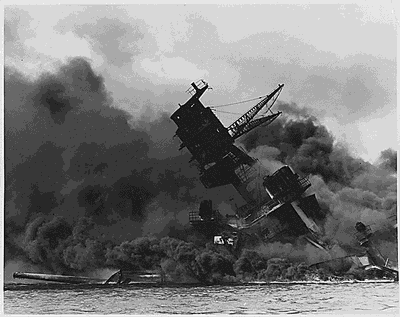
Saturday, December 6. 2008
via Dr. X. I'd be more interested in knowing how our American readers' kids do on this test than on how our readers do.
From Dan Ford: ...on December 7, Asahi News in Tokyo will broadcast a "Scoop Special" about how the US planned to bomb Japan from China, thus proving that the Pearl Harbor attack was purely in self-defense. Tomoko Nagano, meet Richard Barthel! You two will have much to talk about.
Does the average person really lie three times per ten minutes of conversation? If so, I may too trusting, or too gullible, for this world. Psychologist Paul Ekman studies emotions and deception, and has Evaluating Truth training seminars. He is the expert on micro-expression of emotion. Some of his online training programs are here. Cool stuff. Useful, too. A new FOX TV show based on Ekman's work, Lie to Me, will begin airing in January. From the clip below, it looks to be darn interesting:
Vanderleun addresses one of our perennial topics, The Religion of the Left. One quote: The Religion of the Self teaches, as its first and last precept, that there is nothing in this world greater than the self and -- beyond this world, out beyond even the unimaginable edges of the universe -- there is... well... nothing at all; "purposeless matter hovering in the dark."
We're on the same page, Mr. V. Often, if not always. This subject goes to the core of the worldview gap we are experiencing.
Best email I received yesterday (from a bow hunting pal): "We've got four deer hanging in the garage. Can you come over tomorrow around two to help cut em up and have some beers?" My reply: "You betcha."
Advice to Himself Sad Catullus, stop playing the fool,
and let what you know leads you to ruin, end.
Once, bright days shone for you,
when you came often drawn to the girl
loved as no other will be loved by you.
Then there were many pleasures with her,
that you wished, and the girl not unwilling,
truly the bright days shone for you.
And now she no longer wants you: and you
weak man, be unwilling to chase what flees,
or live in misery: be strong-minded, stand firm.
Goodbye girl, now Catullus is firm,
he doesn’t search for you, won’t ask unwillingly.
But you’ll grieve, when nobody asks.
Woe to you, wicked girl, what life’s left for you?
Who’ll submit to you now? Who’ll see your beauty?
Who now will you love? Whose will they say you’ll be?
Who will you kiss? Whose lips will you bite?
But you, Catullus, be resolved to be firm. . (I don't know who did that translation.) Here's the original:
Ad se ipsum
Miser Catulle, desinas ineptire,
et quod uides perisse perditum ducas.
fulsere quondam candidi tibi soles,
cum uentitabas quo puella ducebat
amata nobis quantum amabitur nulla.
ibi illa multa cum iocosa fiebant,
quae tu uolebas nec puella nolebat,
fulsere uere candidi tibi soles.
nunc iam illa non uult: tu quoque impotens noli,
nec quae fugit sectare, nec miser uiue,
sed obstinata mente perfer, obdura.
uale puella, iam Catullus obdurat,
nec te requiret nec rogabit inuitam.
at tu dolebis, cum rogaberis nulla.
scelesta, uae te, quae tibi manet uita?
quis nunc te adibit? cui uideberis bella?
quem nunc amabis? cuius esse diceris?
quem basiabis? cui labella mordebis?
at tu, Catulle, destinatus obdura.
Friday, December 5. 2008
I have skied quite a bit and have had my share of fun/dread with some reckless things and silly drops, but never experienced these drops of 210, 230, and 245 feet (h/t, Theo). If I had, I would not be here to post this:
-
 One of my personal rules since my formal education ended has been to make sure I learn a minimum of ten interesting things per day. One of my personal rules since my formal education ended has been to make sure I learn a minimum of ten interesting things per day.
I learned about CD rot today. Indeed nothing is permanent except (we, or some of us, believe) God. The Second Law of Thermodynamics says that our whole universe gizmo-thingy is set up that way. As it happened, last night, at a dinner out, a hunting buddy mentioned re-reading St. Augustine's chapter in The Confessions about time. My confession was that I did not remember that chapter at all. I do recall learning that God is a timeless entity and that God's time is not our time - but not in Augustine. And I also confess that the entire subject of time is a mystery to me. Anyway, here's a short essay on Augustine on the subject of time: Time as a Psalm.
 Ever hung out in a duck blind? 24/7 live feeds from a duck blind in Mississippi. (Thanks, C.) Ever hung out in a duck blind? 24/7 live feeds from a duck blind in Mississippi. (Thanks, C.)
You just might want to keep the feed running all day, especially if you are stuck in the office.
Thursday, December 4. 2008
From guest writer Bruce Kesler, who seems to have found a comfortable new place to pitch his tent at Maggie's -  Economics fails us in the current economic travails, because of its inherent limitations and because it doesn’t deal with a root distortion of the factors considered. Economics fails us in the current economic travails, because of its inherent limitations and because it doesn’t deal with a root distortion of the factors considered.
Traditional economic theory has advanced over the past two hundred years, from simpler unifocal causation to multicausal, usually seen to operate mechanistically, which lends itself to mathematic modeling. In various ways, the emphasis is on rational decision making. Time lags are introduced to approximate learning and reaction curves. Neoclassical microeconomics has been aggregated in Keynsian macroeconomics, both lending themselves to feelings of efficacy in prescribing governmental actions. More recent behavioral economics adds that the process, at the individual or societal level, is less than perfectly rational measured choices, and often irrational. Stated, real or perceived self-interests are imperfectly or not pursued, and experiential feedback is imperfectly or not heeded. Experiments, data manipulation and controlled observations of inputs and results extend the testing and understanding of the many various approaches to economics. But, they still result in confusion, both by their battling contentions and lack of adequate predictability. Still, governments and their advisors continue to argue for one course or another, largely based on these theories, and all of us are affected. This isn’t to argue that such efforts at understanding and guidance are misplaced or unnecessary. It is to argue that more humility is needed in charting such courses. It is also to argue, now even more importantly, that a major element is missing from current economic thought: some segments of society have grown so large or powerful they are treated as too big to either challenge or fail, which grossly distorts the operations of the economy and results in grossly excess costs that create greater lasting harms.
Continue reading "The Economics of Too Big to Fail"
"A fad or heresy is the exaltation of something which even if true, is secondary or temporary in its nature against those things which are essential and eternal, those things which always prove themselves true in the long run. In short, it is the setting up of the mood against the mind." G.K. Chesterton (h/t, reader, in one of a number of good comments on our Watermelon Man and Hippie Totalitarianism). As we always say here, "Reality Rules...eventually."
Our reader Buddy recommends perusing J. R. Nyquist's Global Analysis site. Check out some of his older - and newer columns. As Buddy says, the guy is prescient.
Wednesday, December 3. 2008
 We use the term "Watermelon" to refer to those who are green on the outside and red on the inside. (We at Maggie's are ardent Conservationists and nature-lovers and studiers, but have never bought into the "Green" thing.) We use the term "Watermelon" to refer to those who are green on the outside and red on the inside. (We at Maggie's are ardent Conservationists and nature-lovers and studiers, but have never bought into the "Green" thing.)
Jonathan Adler (himself a global cooling denier) takes a look at Gus Speth and his new book. Speth is as green as they come, and Dean of the Yale School of Forestry. The piece in The New Atlantis, Green Bridge to Nowhere, is quite revealing. I'll just offer one quote: Speth’s agenda is not confined to economics and the environment, however. He believes his sustainability agenda is intertwined with broader social concerns. “Sustaining people, sustaining nature—it is one cause, inseparable.” Thus he wants to replace the traditional focus on economic growth, as measured by GDP, with “good growth,” which he defines as “growth with equity, employment, environment, and empowerment.” While ostensibly focused on our environmental crisis, and calling for a “post-growth” society, the bridge he seeks to build is to a far broader and more ambitious progressive agenda: Perhaps the most important prescriptions challenging unbridled growth come from outside the environmental sector...they include measures such as more leisure, including a shorter workweek and longer vacations; greater labor protections, job security and benefits, including retirement and health benefits; restrictions on advertising; new ground rules for corporations; strong social and environmental provisions in trade agreements; rigorous consumer protection; greater income and social equality, including genuinely progressive taxation for the rich and greater income support for the poor; major spending on public sector services and environmental amenities; a huge investment in education, skills, and new technology to promote both ecological modernization and sharply rising labor productivity to offset smaller workforces and shorter hours. People deserve more free time, more security, and more opportunity for companionship and continuing education. They deserve to be free of the growth-at-all-costs paradigm and the ruthless economy [of capitalist societies].
This agenda, Speth claims, is not only the key to sustainability, but also to greater human “well-being.” So too are limits on consumerism and consumption. The measures he outlines are the “hallmarks of a caring community and a good society” and must be imposed by government diktat. The role civil society and non-governmental civic institutions might play in this regard receives not a single mention. Capitalism and its attendant freedoms are not only bad for the environment, in his view, they are bad for people as well, and must therefore be controlled, if not eliminated.
Read the whole piece for full insight into this totalitarian movement. Power grabs used to be "for the children," then they were "for the greater good," and now they are "for the planet." I guess any excuse will do for those who imagine that they know better than us regular benighted people. And as far as my "well-being" goes - if I want advice, I will ask for it.
|