We are a commune of inquiring, skeptical, politically centrist, capitalist, anglophile, traditionalist New England Yankee humans, humanoids, and animals with many interests beyond and above politics. Each of us has had a high-school education (or GED), but all had ADD so didn't pay attention very well, especially the dogs. Each one of us does "try my best to be just like I am," and none of us enjoys working for others, including for Maggie, from whom we receive neither a nickel nor a dime. Freedom from nags, cranks, government, do-gooders, control-freaks and idiots is all that we ask for.
Northern Italy has long been a major manufacturer of silk fabric. Marco Polo, the Silk Road, the crusades, etc. Later, Italians migrated to operate the great silk mills in towns like Paterson, NJ.
In Florence, the Antico Setificio Fiorentino since 1786. Their warp technology invented by Leonardo. Two cool videos.
All humans are thought to be descendants of one woman, Mitochondrial Eve, who lived around 140,000 years ago - 4600 generations ago - in West Africa. Our cellular mitochondria follow the female genetic line.
In the linked piece, our Berkshire friend also notes, interestingly, in a quote:
Do the math as you count generations into the past. Two parents, four grandparents, eight great grandparents, sixteen great-great-grandparents, and so on through the centuries. Soon you reach a point where the number of ancestors in a given generation is larger than the population of the Earth at the time. (This is possible because as you move back, a single individual may occupy a large number of slots on your family tree, which is known as pedigree collapse.)
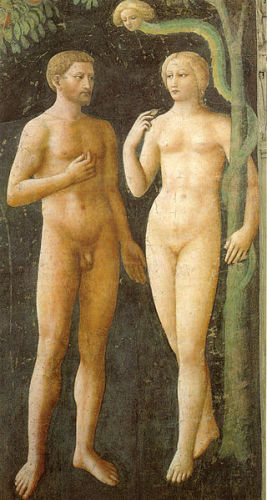
Pic is by Masolino, c 1426, in the Brancacci Chapel, Florence
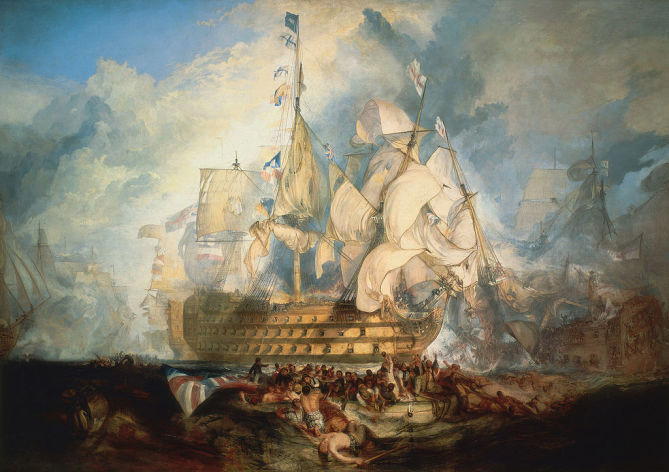
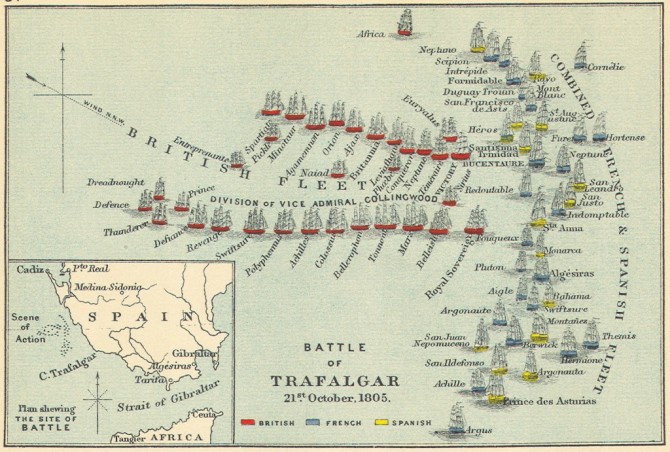
The Battle of Trafalgar established Britannia as the ruler of the waves for over a century and shaped the face of Europe today. The Wiki write-up on it is an excellent summary.
While the Federalists advocated for a strong central government, Jeffersonians argued for strong state and local governments and a weak federal government.
Self-sufficiency, self-government, and individual responsibility, were, in the Jeffersonian worldview, among the most important ideals that formed the basis of the American Revolution. In Jefferson's opinion, nothing that could feasibly be accomplished by individuals at the local level ought to be accomplished by the federal government. The federal government would concentrate its efforts solely on national and international projects. Jefferson's advocacy of limited government led to sharp disagreements with Federalist figures such as Alexander Hamilton. Jefferson felt that Hamilton favored plutocracy and the creation of a powerful aristocracy in the United States which would accumulate increasingly greater power until the political and social order of the United States became indistinguishable from those of the Old World.
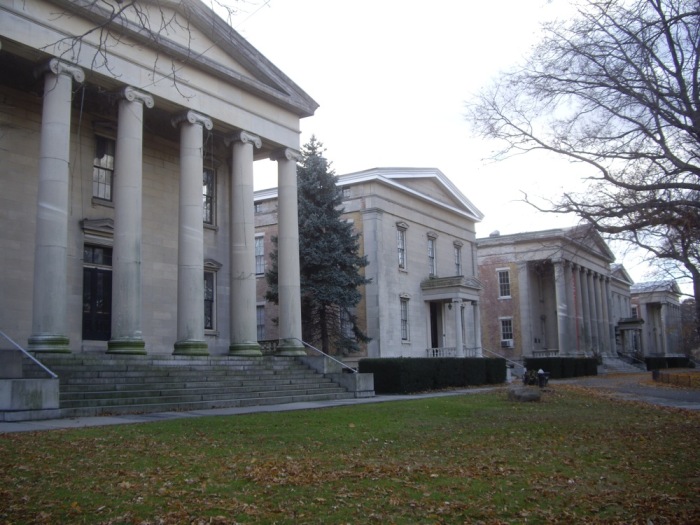
Now on 83 acres with some imperfectly-maintained gardens, the place has little use. It would make a fine campus. We had dinner with friends last night who love to explore the more obscure corners of NYC. They found the place to be fascinating, but Staten Island itself not so much.
When you visit Vienna, pick out, in advance according to Bird Dog's Museum Rules, what you want to see in a museum in one hour - and then leave and go to a cafe for a vino or a Vienna caffe, and walk around.
Last time we went, we just saw the Peter Breugel rooms in the Kunsthistorishes Museum. Worth the trip to Vienna and the climbs up the marble stairs. The wealthy Viennese loved those Dutch painters. Me, Mrs. BD, and lad. Another day, a daughter and I did the Belvedere while others did other things. We two had a fine day together, as she had figured out the train system in minutes and is loads of fun to explore with. Adventurous. We even visited Freud's apartments. Nice.
(My wife and kids are so adventurous, I just tie my sneakers and follow them. I love their company, but I think I am naturally more of a lazy cafe person. I rely on them all to enrich my life.)
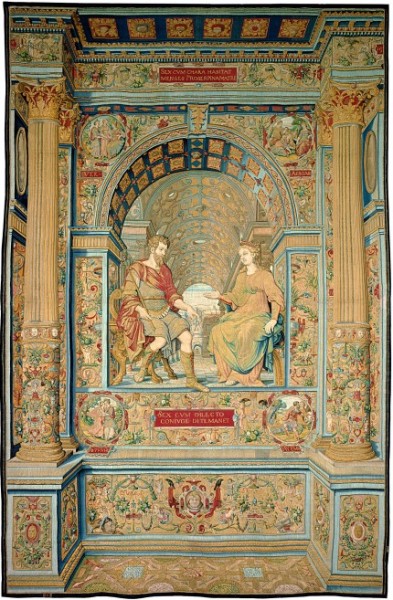
Now they have a show of their 16th C tapestries. Faden der Macht. I'd like to see it but Vienna again is not on our 2-year Master Plan. We need to plan one or two more total-family parental trips before we grow old. Cape Cod, Tuscany, Provence.
Man, do we find NYC endlessly interesting and stimulating. To each his own, I guess, but we all know how to try to extract the most from this most amazing venue in the USA without being rich. Having a place too far from it would make me feel socio-culturally deprived and isolated. I know some readers feel otherwise, but they have not been properly introduced by us.
BTW, Bulldog and I are planning a second Maggie's NYC Urban Hike for September. Details when ready. Different route this time, different sights, probably on the West Side including the High Line and Clement Moore's Chelsea. That link does not make it clear that all of Chelsea was the Moore family farm/estate which was called "Chelsea". Wow. Serious real estate.
Happy Independence Day! If you're like me, you're with your family and being independent together (h/t to Rudolph the Red Nosed Reindeer).
If you're like me, you're probably having hot dogs and hamburgers, potato or macaroni salad, soda or beer, or other kinds of foods which were purchased at a store after being shipped from some other part of the U.S. or even another nation.
If you're like me, you probably don't spend time worrying about the details of how your food reached your table. But you may know people, as I do, who think the whole "eat local' idea will save our health and economy. We have a restaurant here which is excellent, but very expensive, and always booked. We need to make reservations several months in advance to get a table. They only serve locally grown foods (I believe it's a 50 mile radius), and it's BYOB (so I guess they're OK with bringing French wine to go with the Jersey Tomatoes).
Normally I don't go in for faddish trends, and I really don't buy the whole "local food" movement. But this is a good restaurant and just because I don't agree with it doesn't mean I'll avoid a good meal. Good food is good food. There are reasons why I don't necessarily think the local food movement is ever going to change how we live, and it certainly is not going to make our lives better.
As this video (45 minutes long - so be prepared) points out, most nations with small farms have economic problems. This doesn't intrinsically mean small farms are impoverishing those nations, but there's no doubt being a food exporter (and the U.S. is by far the largest) is an indication of economic strength through size. This video also points out the hypocrisy of our nation's politics and its 'solutions' to perceived problems. We have deemed some banks "Too Big To Fail" and willingly subsidize their moral hazard, while at the same time pointing to large agricultural firms and saying they are "Too Big To Succeed" and impose excessive regulations on them while subsidizing failing small farms. So the policy of the U.S. that we subsidize failure, and engage double standards wherever we see fit.
The Jungle is often touted as an example of what would happen if we did not support regulation of the food industry. Unfortunately, this novel was a work of fiction designed to draw attention to the plight of the working man. It was the lies of Upton Sinclair about the Chicago Packing District that stick in people's memory, however. By and large, most food businesses provided healthier foods than smaller firms. It was in their best interest to do so. One does not win new consumers by killing or injuring those you have. In fact, most of these businesses wanted regulation as a means to raise barriers to entry against their smaller competitors, and to prevent foreign foods, which had raised trade barriers, from being too competitive.
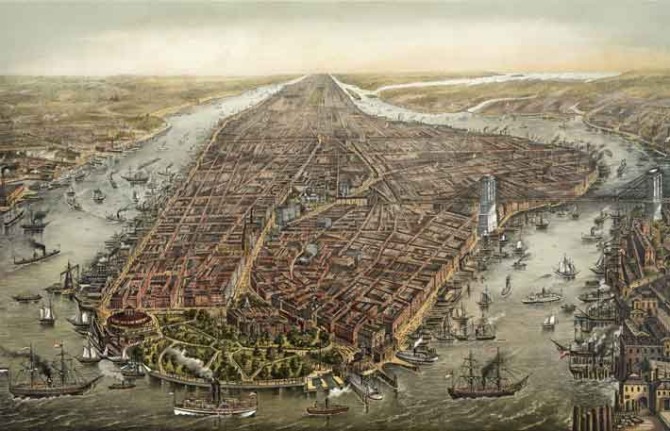
A wonderful book, The Island at the Center of the World: The Epic Story of Dutch Manhattan, has done a lot to rebalance the early history of America. It is rarely recalled that the Pilgrims were headed to the New Amsterdam area - already a busy and growing Dutch settlement - but got stuck in Plymouth due to weather climate change and made the best of it.
A bad bad war, crazy. I mostly blame Lincoln but, in general, the northern Republicans. Any union ought to be voluntary. Slavery? That was going away anyway in the Western world. Today, we would say "negotiate." Result? 600,000 Americans dead, and a federal government with more power than it was ever intended to possess.
Tragic, all around. Liberia was a good solution and a good recompense, but I am glad for most of the African-American influence in American culture. Better off here than slaves of Moslems in Africa, but better if none of it ever happened.
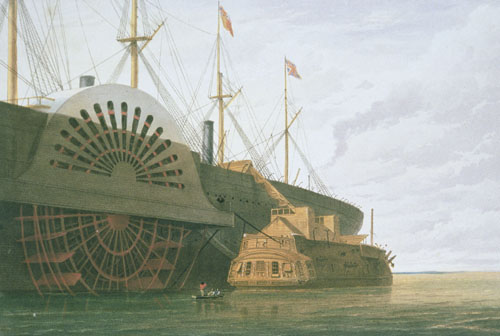
An 1866 lithograph by Robert Dudley shows the HMS Agamemnon, one of the first ships to attempt to lay a transatlantic telegraph cable, dwarfed by the SS Great Eastern, the ship that eventually accomplished the task, and the first one large enough to carry the entire cable length by itself.
The story here: A Wire Across the Ocean - The first telegraph cable to span the Atlantic revolutionized communication, but it also transformed business, politics, and even language.
I feel sad to be reaching the end of this book, packed as it is with the history and culture of the rowdy Jacobean England which was the context for what is considered the finest work ever written in English. My ditto on that.
The translating committee members needed to know Hebrew, Aramaic, and Greek. Their instructions from King James were to produce a book majestic and poetic in tone but simple enough for an illiterate plowman to comprehend. James' goal was to have one bible for one people, and he even included Separatists on the committees. (The two Bibles in English at the time were neither majestic nor poetic. Those Separatists who became the American Pilgrims used the Geneva Bible which was a dry tome.) The King James has a few notorious mistranslations (eg camel and needle), but that's niggling.


 A repost -
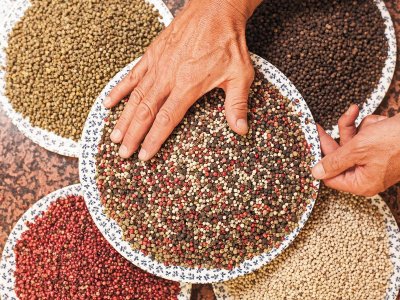 Pepper, especially.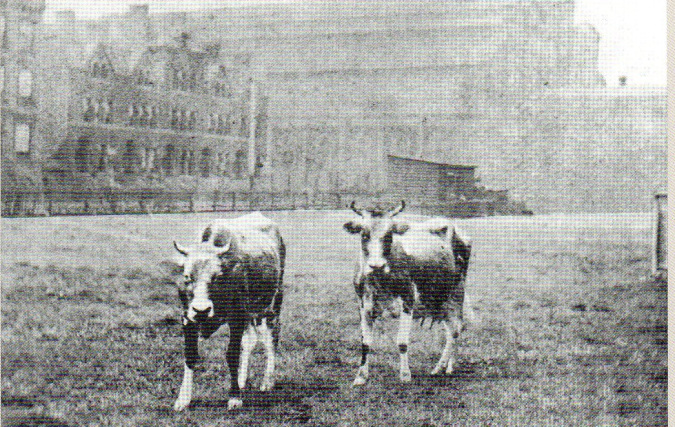
 When you visit Vienna, pick out, in advance according to Bird Dog's Museum Rules, what you want to see in a museum in one hour - and then leave and go to a cafe for a vino or a Vienna caffe, and walk around.