Monday, March 24. 2008
Roger Kimball on the 60s - Tariq Ali: Fool of '68. A quote: “Passion,” like “idealism,” is a nostrum that the Left prescribes in order to relieve itself from the burdens of moral accountability. In a subtle essay called “Countercultures,” the political commentator Irving Kristol noted that the counterculture of the 1960s was in part a reaction against a society that had become increasingly secular, routinized, and crassly materialistic. In this respect, too, the counterculture can be understood as part of our Romantic inheritance, a plea for freedom and transcendence in a society increasingly dominated by the secular forces of Enlightenment rationality. Indeed, revolts of this tenor have been a staple of Romanticism since the nineteenth century: Dostoevski’s “underground man,” who seeks refuge from the imperatives of reason in willful arbitrariness, is only one example (a rather grim one) among countless others. The danger, Kristol notes, is that the counterculture, in its attack on secular materialism, “will bring down—will discredit—human things that are of permanent importance. A spiritual rebellion against the constrictions of secular humanism could end up … in a celebration of irrationalism and a derogation of reason itself.” At a time when the radical tenets of the counterculture have become so thoroughly established and institutionalized in cultural life—when they have, in fact, come more and more to define the tastes, habits, and attitudes of the dominant culture—unmasking illegitimate claims to “liberation” and bogus feats of idealism emerges as a prime critical task. To an extent scarcely imaginable thirty years ago, we now live in that “moral and cultural universe shaped by the Sixties.” The long march of the cultural revolution of the 1960s has succeeded beyond the wildest dreams of all but the most starry-eyed utopians. The great irony is that this victory took place in the midst of a significant drift to the center-Right in electoral politics. The startling and depressing fact is that supposedly conservative victories at the polls have done almost nothing to challenge the dominance of left-wing, emancipationist attitudes and ideas in our culture. On the contrary, in the so-called “culture wars,” conservatives have been conspicuous losers.
Read the whole thing.
Saturday, March 22. 2008
The snow and ice are melting fast.  Spring must be here! Spring must be here! It's the time of year when the rich and famous seek riches from alarmism. My friends and I were starting up a company to sell palm trees to the Eskimos, but unfortunately recent satellite data indicate that warming stopped a decade ago. Dang! Our investment is OK though - we shorted Palm Tree Futures as a hedge, and might get filthy rich with those. Plus the government will pay us handsomely not to grow Palms on our experimental Massachusetts Palm farm. (No problem - all of our seedlings died this winter under three feet of snow.) But even if the earth isn't warming anymore, no warming jokes please - it still isn't funny to those who really care. I am doing my part to save the planet: I will alternate between paper and plastic bags until the experts reach a consensus and the science is settled.
Wednesday, March 19. 2008
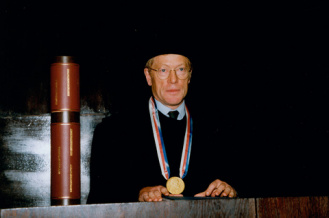 Roger Scruton's 2003 New Criterion essay on discovering Burke, which we re-post annually, begins thus: Roger Scruton's 2003 New Criterion essay on discovering Burke, which we re-post annually, begins thus:
I was brought up at a time when half the English people voted Conservative at national elections and almost all English intellectuals regarded the term “conservative” as a term of abuse. To be a conservative, I was told, was to be on the side of age against youth, the past against the future, authority against innovation, the “structures” against spontaneity and life. It was enough to understand this, to recognize that one had no choice, as a free-thinking intellectual, save to reject conservatism. The choice remaining was between reform and revolution. Do we improve society bit by bit, or do we rub it out and start again? On the whole my contemporaries favored the second option, and it was when witnessing what this meant, in May 1968 in Paris, that I discovered my vocation.
Read the whole thing.
Tuesday, March 18. 2008
This G.K. Chesterton essay seemed related to our piece on Deontological Ethics, and AVI touches on the same topic today: From a report of a talk titled "The Need for a Philosophy" by Chesterton in 1923, which is introduced thus: ...the sometimes lightly described 'Philosopher of fun' produces a powerful attack on two modern 'isms' that he accuses of being profoundly un-philosophical. If utilitarianism, ('brutaliarianism',) and relativism are allowed to become the modern way, "It means full steam in the darkness with lights out."
A quote: There was a famous American who said that England had no weather, only samples. That is true today of modern views about life. They are scrappy. Now what is excellent as regards weather is not excellent as regards the things of the mind. Modern England has no thinking, only thoughts. Thoughts can be brilliant and suggestive - journalism, literature and fiction are full of random thoughts on human life - but thinking is something different and it is extraordinarily rare. Some people, especially those who do not think, imagine that thinking is a painful process, but to my mind it is the best game in the world, and connected thinking of some kind - knowing what you mean and not following catchwords - is necessary for us all.
and ...what began as free thought has now developed into freedom from thought. All through history, there have been broad conceptions of the aims of life, tests of morality which masses of men have held and applied with certainty; but in the modern world these various systems have been abandoned and what is left of them is nothing but debris - a collection of broken bits, the ruins of past philosophies. There are some, like myself, who hold a mystical philosophy, a belief that behind human experience there are realities, powers of good and evil, and the final test for things is their influence for good or evil. The good power intends us to be happy and we are justified in being happy, but the real question is not whether we are happy, but whether, behind the things wherein we seek our happiness lies the, power of good. Are they parts of the good or of the evil?
Read the whole summary here.
Monday, March 17. 2008
Best essay I have read on the subject, and it goes far beyond the story of the day. A quote: One can argue (unconvincingly, in my view) that Christian morality and teaching mandate government and political efforts to aid the poor and oppressed — as opposed to our individual responsibilities along such lines, or those facilitated collectively through the church. What one can not do is square such a constricted, monotone theology with Christianity’s vast octaves of orthodox teaching and history. If Christianity is nothing more than do-good government social programs which require no personal moral transformation, which frequently cause more harm than good to their intended beneficiaries, and require no personal sanctification or sacrifice — then who needs Christianity at all? Wrapping social programs in Scripture verses and Jesus-talk does not make them “Christian” any more than putting mascara on a pig makes her Miss Universe.
and another: The problem with ministers like Reverend Wright and others, who wrap their political and social agendas in Christian facades and Bible-talk, is that they are partly right. That social justice, concern for the poor and the underprivileged, and the mitigation of hatred and racism are — and have always been — emphatic teachings and priorities for Christianity is indisputable. But Christian opposition to injustice and oppression is not its sole and central doctrine, but rather a manifestation of the personal deliverance of the individual from the slavery and oppression of sin which Christianity offers. The half-righters have interchanged cause and effect — and thereby have guaranteed that the results of such efforts will be harmful rather than healing. For to be partly right is to be totally wrong — when the part in error is core truth about the nature of man and his relationship to God. Good deeds arising out of the darkness of the unredeemed heart invariably foster repression and dependency rather than deliverance and liberty. As Ratzinger points out, speaking of the natural evolution and outcome of liberation theology as a solution to oppression: … the overthrow by means of revolutionary violence of structures which generate violence is not ipso facto the beginning of a just regime. A major fact of our time ought to evoke the reflection of all those who would sincerely work for the true liberation of their brothers: millions of our own contemporaries legitimately yearn to recover those basic freedoms of which they were deprived by totalitarian and atheistic regimes which came to power by violent and revolutionary means, precisely in the name of the liberation of the people.
Read the whole thing.
Thursday, March 13. 2008
Quoted from Dr. Bob's The Advent: In these 40 years, we have learned many things. We have learned that slogans about change are the same as change. We have learned that “do your own thing” is a principal worth inculcating into the very fabric of our lives. We have learned that how we feel is more important than what we do. We have learned that ideas do not have consequences — but are themselves consequences. We have learned that our government is not to be trusted, that our country is not to be loved. We have learned that what our country can do for us is more important than what we can do for our country. We have learned that the government always lies; that the media is always truthful; that corporations are evil; that unrestricted license is good. We have learned to be green, and to relish the obscene. We have learned that religion is patriarchal and oppressive; that social mores and morality are to be challenged and rejected; that “freedom of speech” means burning the flag, smearing Madonna with feces; immersing the crucifix in urine; being obnoxious, abusive, and vicious while never entertaining criticism or rebuttal. We have learned not to think, but to feel; not to reason but to react; not to dialogue but to detest; not to take responsibility but to accuse. We have learned to bolster our self-esteem, and worship our self-gratification. We have learned that someone else should always pay; that we are entitled to whatever we want; that wealth and happiness are our birthright. We have learned that god is within; that our existence is a cosmic coincidence; that our purpose is self-aggrandizement and acquisition of money and power. We have learned that only the material is true; that spiritual principles and practice are but opinions; that there is no truth anyway, only narrative. There is much we have not learned during our long advent...
Read the whole thing.
If you decide to revisit the now-famous Mamet Village Voice essay, read the comments too. I value his essay for two reasons: first, because he put into words something close to what I experienced many years ago and, second, because Mamet's cultural status might offer some folks "permission" to take a fresh look at their views.
Wednesday, March 12. 2008
Politicians have so many ways to get rich. Quoted from Bloomberg: March 11 (Bloomberg) -- Al Gore's Generation Investment Management Ltd., a fund that invests in companies that follow socially responsible guidelines, plans to close its main Global Equity Fund to new money as assets approach a $5 billion target.
Monday, March 10. 2008
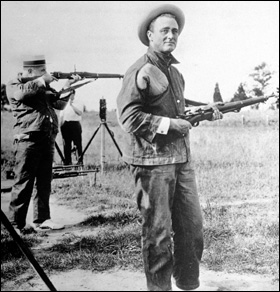 We have written several times about the destructive effect of the FDR presidency, most recently here, so there is no need to repeat ourselves. We have written several times about the destructive effect of the FDR presidency, most recently here, so there is no need to repeat ourselves.
However, it is good to see that Burt Prelutsky has come around. He begins: Growing up, as I did, in the home of Russian Jewish immigrants, it figures that I’d start out thinking that, by all rights, Franklin D. Roosevelt belonged on Mount Rushmore. But, all these years later, I have concluded that most of America’s woes can be traced back to his presidency, and that the best reason for him being up there along with Lincoln, Jefferson, Washington and Teddy Roosevelt, is that his head was already made of stone. Although FDR is often, mistakenly, credited with bringing the Great Depression to an end, as Amity Shlaes made clear in her book, The Forgotten Man, his policies, which can best be described as socialistic and anti-business, in reality prolonged America’s misery. The mere fact that he and his economic advisors thought it made perfect sense to keep raising taxes during the 1930s suggests that their primary motive wasn’t to lift the country out of its economic morass, but to take advantage of the situation to inflate the power of the federal government. The end result of his 12 years in the White House is a hodge-podge of Washington bureaucracies and an economy that finds the federal government being far and away the single largest employer in the U.S. Couple that with his personal fondness for Joseph Stalin, his filling his administration and the State Department with like-minded people, and you have a perfect blueprint for disaster. For as Thomas Jefferson recognized, “A government big enough to give you everything you want is strong enough to take everything you have.”
Burt sounds like a Maggie's Farm contributor. Read the whole thing. Photo: FDR around 1917.
Quoted from Mankiw: Since 1998, the U.S. population has increased by over 20 million. Nearly half of that growth has come from immigration, legal and illegal. Overwhelmingly, these immigrants enter at the lowest rungs on the income ladder. Statistically, this immigrant surge not only reduces the income of the "average" household, but also changes the occupants of the lowest income classes. To understand what's happening here, envision a line of people queued up for March Madness tickets. Individuals move up the line as tickets are purchased. But new people keep coming. So the line never gets shorter, even though individuals are advancing.
I think that is true. We are an economically mobile nation, with no permanent underclass. People here rise and fall economically depending on their age, life choices, desires, capacities, and luck. Related: The poor in Europe do the same as in the US - but they lack the American outlets for any ambition they might have because their governments sit on their heads. If you define poverty as the lowest 10% in income, American poor do just fine. Worstall. And, of course, if you define it as the lowest 10% in income, you will always have them, even if they have two cars and wide-screen TVs (and do not include govt assistance as income).
From the WSJ (h/t, Buddy): What is it about Democrats and Hugo Chávez? Even as the Venezuelan strongman was threatening war last week against Colombia, Congress was threatening to hand him a huge strategic victory by spurning Colombia's free trade overtures to the U.S. This isn't the first time Democrats have come to Mr. Chávez's aid, but it would be the most destructive. The Venezuelan is engaged in a high-stakes competition over the political and economic direction of Latin America. He wants the region to follow his path of ever greater state control of the economy, while assisting U.S. enemies wherever he can. He's already won converts in Bolivia and Ecuador, and he came far too close for American comfort in Mexico's election last year.
Is it possible that people like Chavez and Fidel (and Stalin) really are ideal leaders in some peoples' eyes? Why? Read the whole thing.
From Herbert Meyer, The Four Transformations and their Implications for America. He is referring to the war in Iraq, the emergence of China, shifting demographics in the West, and the restructuring of American business.
Sunday, March 9. 2008
Burston in Haaretz. It begins: Spare us the explanations.
Spare us the learned, sociology-drenched justifications. Spare us the reasons why you "get" Palestinians when they gun Jews down in cold blood.
Spare us the chapter and verse on how the plight of the Palestinians is at the root of Islamic terrorism the world over, and if the Palestinians were to receive full justice, Islamic terrorism would pass from the world.
Spare us.
Read the whole thing.
Jeffrey Bell at Weekly Standard wonders how the Repubs might deal with the aftermath of a "failed presidency." It's a worthwhile piece, but I am far from sure that Bush has been a failure - unless the measure of failure is the popularity poll of the week. Few presidents remain popular towards the end of 8 years, because everything they have done annoyed somebody.
Saturday, March 8. 2008
EU to Ireland: Drop dead. Ireland and the EU. (h/t, Gates) The passivity of Europe in the face of the EU's power grab is utterly beyond my comprehension. It must be the same people who were "Better Red than dead," because they have been subjected to an imperial conquest without a shot being fired.
Friday, March 7. 2008
This is cool. I don't know whether it is true, though. Now out to dinner.
 "What is Endangered: Climate or Freedom? And Just How Sensitive is the Climate Anyway? A final dispatch from the International Climate Change Conference" "What is Endangered: Climate or Freedom? And Just How Sensitive is the Climate Anyway? A final dispatch from the International Climate Change Conference"
From Bailey at Reason, with quotes from Vaclav Klaus. One bit: Klaus noted that ideological environmentalism appeals to the same sort of people who have always been attracted to collectivist ideas. He warned that environmentalism at its worst is just the latest dogma to claim that a looming "crisis" requires people to sacrifice their prosperity and their freedoms for the greater good. Let me quote Klaus at length. "Future dangers will not come from the same source. The ideology will be different. Its essence will, nevertheless, be identical—the attractive, pathetic, at first sight noble idea that transcends the individual in the name of the common good, and the enormous self-confidence on the side of its proponents about their right to sacrifice man and his freedom in order to make this idea reality," warned Klaus. "What I have in mind [is], of course, environmentalism and its currently strongest version, climate alarmism."
Photo: Our favorite photo of tennis fan and freedom's champion Vaclav Klaus
Thursday, March 6. 2008
 A quote from a piece on Mayor Bloomberg at Pajamas: A quote from a piece on Mayor Bloomberg at Pajamas:
Since he took office six years ago, Mike Bloomberg’s record is, among other things, a study in finicky prohibition. Not only is Bloomberg certain of what’s best for you, he knows you to lack the good sense to choose it. In order to ensure the well being of his charges, the Mayor has instituted a few laws about which he has said, “People will adjust very quickly and a lot of lives will be saved.” Has an American politician ever expressed a more vitally un-American sentiment? Dubious claims of life-saving aside, American citizens aren’t to be schoolmarmed into compulsory purification.
This connects with a piece from Wilkinson linked at Overcoming Bias. A quote: I say, again and again, that it is an embarrassing non-sequitur to argue that people are "irrational" and then leap to the conclusion that they need benevolent paternal guidance from the state. After all, if people are irrational then voters are irrational, politicians are irrational, bureaucrats are irrational, etc. ... There is no way to wriggle out of the fact that people who win elections are just like the rest of us. ... I don't doubt that non-terrible policies are sometimes successfully enacted. To doubt that would be a bit like a market skeptic doubting that anyone ever succeeds in buying a candy bar. That would be terrifically dense. What I doubt, very strongly, is that the discovery of "irrationalities" undermines the authority of market institutions more than it undermines the authority of government institutions.
Well said. Serious adult people are not interested in controlling other adult people (unless they're married, of course).
Tuesday, March 4. 2008
The Washington Post is mocking the climate conference in NYC this week. Here at Maggie's we are skeptical about APW, as we are skeptical about most scientific claims (although we do accept the notion of a spherical earth). The only reason we write as often as we do about climate is because the subject has been hijacked by people with socio-political agendas. Were it not for that, we'd only be mildly curious. In any event, we suspect that some warming would be a boon to the world economy and food production, and we suspect that the coming Ice Age will be the real threat to humanity in the northern hemisphere. A graph from Powerline's piece on the conference, which does not extend back to the last Ice Age 10,000 years ago: 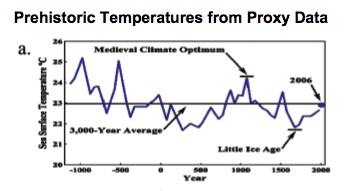
And, just for fun, here's the big picture. As the graph shows, we remain in an extended cold spell, historically - in a tiny little interglacial which doesn't even make a dent on a graph with this time scale. As every money manager knows, the way to lie with graphs is to select your time frame. The earth is shivering (graph reads right to left in time): 
From Mediocracy: Steven Pinker has become a bit of a hero for those not entirely seduced by the mediocratic project. He is perhaps the only prominent academic prepared to trumpet the idea that ability is at least partly inherited. This idea has, apparently, become highly controversial, a fact which a visiting Martian might find rather bizarre. When the Financial Times reviewed The Blank Slate, it treated Pinker as some kind of firebrand radical, referring to his "dangerous work", and that it "would be best if it didn't get into the hands of those who would use it to terrifying ends".
and ... if people's sense of well-being comes from an assessment of their social status, and social status is relative, then extreme inequality can make people on the lower rungs feel defeated even if they are better off than most of humanity ... The medical researcher Richard Wilkinson, who documented these patterns, argues that low status triggers an ancient stress reaction ... Wilkinson argues that reducing economic inequality would make millions of lives happier, safer, and longer. (ibid) An example of pseudo-rationality: in this case, an incomplete analysis that looks cogent but is actually biased. What it leaves out is (a) that we can only reduce ex post (= after the event) inequality by changing the rules of the game, and (b) that this is certain to have its own associated costs, which are left out of the equation. The need to compete for status is no less likely to be an important human drive than the need for status itself. If you make it harder for people to win, that may also generate stress. While there is plenty of research purporting to show the stressful effects of inequality, I doubt there is much (if any) looking into the stressful effects of intervention, restrictions, red tape, or deselection on ideological grounds (the flip-side of affirmative action).
Mediocracy thus presents an excellent case of pseudo-rationality in which the human costs of an intervention are ignored. In my experience, failure to enter these costs into calculations generally results in further problems which also end up begging for another government intervention to try to correct. Thus governments and agencies grow, on the fertile soil of their own manure.
 The link to neoneo this morning about the religious-like fervor of the Obama "movement" led me to this link: How can I recognize a false teacher? It says it all, but unfortunately does not link to the scriptural quotes. The link to neoneo this morning about the religious-like fervor of the Obama "movement" led me to this link: How can I recognize a false teacher? It says it all, but unfortunately does not link to the scriptural quotes.
Uncentered souls are often attracted to "movements" - but I think some of Obama's appeal is simply to Dems who dislike and distrust Mrs. Clinton. The promise of heaven on earth will gain no traction with me because I have been around the block once or twice. If Obama fails, it will be because he will be exposed as a phony: it's beginning to happen. And speaking of phonies, here's one more of these fake memoirs. Why don't these folks just label their books as fiction?
Monday, March 3. 2008
Reposted from 2005 Everything is so scary. You can drown in the bathtub, you can cut yourself with a chain saw, you can choke on a steak, you can spill hot coffee in your lap, you can slice your finger with a paring knife, you can get fat from eating bread, you can get hit by an SUV, you can get heart disease from french fries, you can get blinded by a tennis ball, you can get brain-death from watching TV, you can catch mono from kissing a girl, you can fall down the stairs, you can get hit by lightning playing golf, you can lose your sense of reality by studying astronomy, you can get Lyme disease from weeding the garden, you can get a rusty hook in your scalp while fishing, you can get skin cancer from going outdoors, you can get a papercut from copy-paper. Given how treacherous ordinary life is, it should be no wonder that all medical treatments, including medicines, have side-effects too. The recent pulling of Viox and Celebrex from the market puzzle me, because ordinary aspirin seems far more dangerous due to its frequent ability to cause gastric bleeding. Still, every MD I know takes an aspirin a day, not to combat paperwork headaches but to prevent heart attack. My point is not to specifically discuss medical care - I think almost everyone assumes that physicians know how to balance risk, and, nowadays, how to discuss these with patients. When people exercise judgement in life, they not only balance the risks and rewards of choices of action, they also balance the risks and rewards of action vs. inaction. Inaction always has its own cost - opportunity cost. Every fellow who ever contemplated asking a girl out knows what I mean. Or vice versa. My point is to talk about the expectation that life should be safe, and that someone (the gummint?) could or should magically protect us from that reality. That, I think, is part of the infantile impulse behind the wish for the Nanny State. Or the Mommy and Daddy State. This is not to promote a radical libertarian viewpoint. I like the Pure Food Act, and I am glad kids can't buy guns and dynamite. And I don't want to have to caveat emptor in everything I use or buy...but you kinda sorta have to anyway, don't you? Still, the endless seeking to be made safe from risk is a psychological state - a wish that reality be a certain way - and, as such, it is not amenable to correction by adjusting reality. It can only be corrected by growing up ...and by hamstringing the tort lawyers who have fed off, promoted, and exploited, these childish wishes that sometimes lurk even in the most mature people, including me.
Saturday, March 1. 2008
 Free advice for the NYT and the Boston Globe, if they wish to survive, from Jeff Jarvis. Darn interesting ideas. One quote: Free advice for the NYT and the Boston Globe, if they wish to survive, from Jeff Jarvis. Darn interesting ideas. One quote:
As for the New York Times itself, I’d cut bait and turn it into a national newspaper — international in their dreams. The Times is not now and has not been for sometime a New York paper. So I’d either spin off or kill metro coverage. It could become a new local online collaborative journalistic network in the mold of the new Globe. Or it could die and I firmly believe a new and more nimble local network can emerge and take up the slack left. With that spinoff goes the Times production and distribution arms, in the Morgan model.
If these large newspapers can think outside the proverbial box, as Jeff suggests, they might have a fine future despite their Leftist views. Gee whiz, they're just newspapers - not God's gift to mankind. There is no shortage of interesting stuff to read - like Maggie's Farm, for one modest example. At the NYT, some integrity and some balance wouldn't hurt, but is not their solution. Just don't dumb it down: the world does not need another USA Today targeted towards curious 3rd grade drop-outs. They need prosperous middlebrow readers like me, who look forward to the Book Review. (NYC, by the way, has tons of newspapers, from countless neighborhood papers like Chelsea Now, The Staten Island Advance, and The Village Voice, to city-wide papers like The Daily News, The NY Post, The NY Sun, The New York Observer, and Newsday - and more. It's the ultimate newspaper town, and every suburb has at least one local rag. The complication is that the whole country is interested in what goes on in NYC and, nowadays, in our imperial state, Washington too. Alas, because I wish that what those bozos did in DC had no importance to me.) I love newspapers, and worked on one during summers as a lad (The Hartford Courant, in the typewriter and linotype era), but now I only read online stuff (not including magazines and the local rag, which covers purely local matters and which is required for fire-starting, and for gun- and game-cleaning - and to find out which of your bonehead neighbors has been arrested for burglarizing a hardware store in Torrington). Confession: I enjoy most of the Sunday NYT, and, between the wife and I, we pretty much give at least a glance at every page of the darn thing. It's their political spin and bias that give us migraines: "Can you believe they said this, honey?" (We cancelled the daily years ago, in a fit of disgust.)
|