Wednesday, August 13. 2008
 As we have been saying for over two years now. This quote via Surber: As we have been saying for over two years now. This quote via Surber:
The Belfast Telegraph has reported: “Based on the past Armagh measurements, this suggests that over the next two decades, global temperatures may fall by about 2 degrees C — that is, to a level lower than any we have seen in the last 100 years. Of course, nothing in science is certain. Perhaps (though I doubt it) Armagh’s old measurements are wrong or perhaps there are now other factors, such as CO2 emissions, which may change things somewhat. However, temperatures have already fallen by about 0.5 degrees C over the past 12 months and, if this is only the start of it, it would be a serious concern.”
Be very afraid. Image via Moravec's cool illustrations.
 David Brooks says that the economic rise of China demonstrates that collectivist societies can prosper. David Brooks says that the economic rise of China demonstrates that collectivist societies can prosper.
I think he is wrong. Seems to me that the unleashing of individual enterprise and free markets (combined with free markets for labor, lower business taxes than the US, and globalization) are what have unleashed China's belated industrial revolution. In other words, individualism. But I am no expert on the subject (and neither is Brooks). There is still one Path to Prosperity. Furthermore, I wonder whether this whole subject of Asian collectivism is a myth. Police state-enforced collectivist "harmony" can give the appearance of a collectivist ethos - but only the appearance.
Monday, August 11. 2008
From Chantrill in American Thinker, one of the best short essays of the year: The Politics of the Social Safety Net. One quote: But the real problem is that the expansion of the safety net has led to increase in government power and the rise of the beauracracy. This combined to diminish individual responsibility which diminishes ones productivity and accumulation of wealth. With less wealth, it's easier to be dependent. With more people jumping in the net, taxes go up to maintain benefits, which cuts savings, which increases the demand for the safety net as more people retire destitute from taxation in furtherance of its support. Let's be real - we are never going to see a change in the safety net for too much political power is invested in, and generated by it. Also, its very existence has enabled our population to grow as those who would have otherwise died from disease, exposure or starvation due to lack of wealth have been spared by it (sorry for the cruelty). It's not going away. Any safety net, no matter how modest, who provides it, or what name you give it will mature into a welfare state.
Read the whole thing.
Thursday, August 7. 2008
Well, historic Marburg, Germany, is giving it a try. One quote: The town council took the significant step in June of moving from merely encouraging citizens to install solar panels to making them an obligation. The ordinance, the first of its kind in Germany, will require solar panels not only on new buildings, which fewer people oppose, but also on existing homes that undergo renovations or get new heating systems or roof repairs. To give the regulation teeth, a fine of 1,000 euros, about $1,500, awaits those who do not comply.
Read the whole thing, and consider the possible effectiveness of solar panels in Germany. These folks are insane. Truth be told, it's probably more sensible just to pay the fine, and then throw the rascals out. It sounds like the politics of Seattle (h/t, Junk Science), or like the Massachusetts government medical plan. The world is full of sanctimonious jerks who want to tell other people how to live.
Wednesday, August 6. 2008
What sorts of idiots think that plug-in cars are any less CO2-producing than gas cars? (No, I am not calling Insty an idiot.) Where do they think electricity comes from? Unless you have tons of nuke power, of course. No evil, evil CO2 from nukes. nb: I think this is all a tempest in a teapot anyway, and doesn't matter one bit. In a year or two, we'll all be laughing about the AGW scams and frenzies.
Mark Helprin takes a long look at China, Rich Country, Strong Arms. One quote: China's success in amplifying its power is due in part to what may be called "the gift of the Meiji." That is, the transformation of the Japanese slogan fukoku kyohei—rich country, strong arms—into the Sixteen-Character Policy: "Combine the military and the civil; combine peace and war; give priority to military products; let the civil support the military." After humiliation and occupation by the West closely parallel to what also befell China, predominantly agricultural Japan rapidly transformed itself into an industrial state that could successfully wage war with modern arms against Russia, a second-tier European power, and then, not that many decades later, offer a mortal challenge to the world's leading naval power, the United States. It was able to vault with preternatural speed into the first ranks of the leading nations because it understood the relation of economic growth to military potential. Unlike the United States, which, almost unconsciously, governs itself reactively and predominantly for the short term, China has plotted a long course in which with great deliberation it joins growth to military expansion.
Tuesday, August 5. 2008
 Stanley Fish in The NYT. (h/t, Right Wing Prof). One quote: Stanley Fish in The NYT. (h/t, Right Wing Prof). One quote:
Last week, I confessed to being a bad traveler. This week, I confess to something much worse. I resist and resent the demands made on me by environmental imperatives. I don’t want to save the planet. I just want to inhabit it as comfortably as possible for as long as I have. Things reached something of a crisis point a few days ago when my wife asked me to read a communique from Greenpeace. (She thought, she told me, that if I read it rather than hearing about it from her, my unhappiness would be directed at the organization.) It said that Kimberly-Clark, the maker of the paper towels, facial tissue and toilet paper we buy, does not use recycled fiber and instead “gets its virgin wood fiber clear-cut from . . . the North American Boreal . . . one of the world’s most important forests.” And that meant, she told me, that we would have to give those items up and go in search of green alternatives. But we had already done that once before when it turned out that the manufacturer of the paper products we used to buy — Procter and Gamble — engaged in research on animals. That’s when we found Kimberly-Clark. So it seems that the pure were not so pure after all, and who’s to say that the next corporation won’t have an ecological skeleton in its closet, too?
At The Corner. Ditto, Jonah.
The Opinion Journal's piece on Solzhenitsyn begins like this: "The hammer banged reveille on the rail outside camp HQ at five o'clock as always. Time to get up. The ragged noise was muffled by ice two fingers thick on the windows and soon died away. Too cold for the warder to go on hammering." Thus did Alexander Solzhenitsyn begin "One Day in the Life of Ivan Denisovich," his reveille for the world about totalitarianism. Published in 1962, in the brief post-Stalinist thaw under Khrushchev, the novel about a prisoner in a Soviet prison camp made Solzhenitsyn at first a Russian sensation and later the country's most famous dissident after the Kremlin reverted to brutal form.
And as quoted by Vanderleun, "When all of the rest of the civilized world, as well as the Marxist world, was tossing God into the dustbin of history, Solzhenitsyn realized that only God really matters. He chided the West for embracing materialism and forgetting God, a lesson that is just as true today as thirty years ago." -
Monday, August 4. 2008
 "Why Do So Many Westerners Refuse to “Get” That We Are At War?" That's the title of a piece by Phyllis Chesler. One quote: "Why Do So Many Westerners Refuse to “Get” That We Are At War?" That's the title of a piece by Phyllis Chesler. One quote:
Westerners are in denial. And, the deniers are even more afraid of Jihad and terrorism than those of us who are crying out against it. Thus, like battered women, they seek to appease the violent offender; they also engage in self-blame in the misguided belief that if they do not “offend” their batterer that he will not batter them.
The raw cheese protest. Reason I'm conservative, but don't tell anybody. Am. Thinker Babies don't do better in countries with socialized medicine. Pajamas John Voight: We were used and manipulated during Vietnam The Utopia of Relativism. Dr. Bob Bill Clinton says he isn't a racist. Inside Obama's OODA Loop, via Insty, at Classical, a quote: McCain, the fighter pilot, has gotten inside Obama's OODA loop. Something the Navy teaches fighter pilots to do. The OODA Loop, often called Boyd's Cycle, is a creation of Col. John Boyd, USAF (Ret.). Col. Boyd was a student of tactical operations and observed a similarity in many battles and campaigns. He noted that in many of the engagements, one side presented the other with a series of unexpected and threatening situations with which they had not been able to keep pace. The slower side was eventually defeated. What Col. Boyd observed was the fact that conflicts are time competitive. Elections are nothing if they are not time competitive. Evidently the "freezing of the opponent" that Alinsky recommends has not worked on McCain. He was not frozen. Once that happened McCain was operating inside Obama's decision loop. Evidently Boyd is beating Alinsky. Or to put it another way. The fighter pilot is beating the community organizer. As a Navy man myself, I'm not surprised.
Related: Obama is a jet crash Image: I guess we were down for quite a while yesterday, and nobody let our Blogmeister know. And I can assume that he was sailing, and had no clue.
What did it do? A quote from Pakistan Picaresque in The Wilson Quarterly: The year was 1992, and Lucymemsahib and I were helping the government of Pakistan prepare a grant proposal for the country’s Social Action Program (SAP)—a comprehensive effort to renovate Pakistan’s health, education, and water sanitation systems that the World Bank and a consortium of other multinational development organizations had pledged to support. Specifically, we were looking into ways to attract more women to provide midlevel health services in rural areas. As head of the Pakistan Nursing Council, Mrs. S. presided over the governmental organization responsible for the recruitment, training, and certification of nurses at Pakistan’s 60 civilian nursing schools and a handful of specialized military institutions. The SAP we helped prepare, which ran from 1993 through 1998, turned out to be a dismal failure, as was the one that followed in 1999–2003. Subsequent programs, especially since 9/11, show every indication of being as unsuccessful. The critical indicators of maternal and child health tell it all. Estimates of Pakistan’s maternal mortality ratio since 1990 range from 300 to 800 maternal deaths per 100,000 live births; even the low end of this range is unacceptable. By contrast, Sri Lanka, another South Asian country, with an income per capita that was roughly comparable to Pakistan’s at the beginning of the 1990s, saw its maternal mortality ratio fall from 92 per 100,000 in 1990 to below 50 today. The infant mortality rate in Pakistan in 2003 was 76 per 1,000 live births, as compared with 11 in Sri Lanka. In the developed countries, the infant mortality rate is only about five per 1,000 live births. Beyond the health care sector, the story is much the same.
It's a good case study of what really happens in the real world, despite the best of intentions.
Ronald Bailey at Reason calculates the cost of "re-powering America." Cost is one thing, but I don't see the purpose anyway. We have centuries of good fossil fuel here, and VA, oddly enough, is full of uranium.
Friday, August 1. 2008
Our friend Jonah Goldberg on Prosperity and It's Discontents. Poverty and trouble is, indeed, man's default condition. One quote: The interesting question isn’t “Why is there poverty?” It’s “Why is there wealth?” Or: “Why is there prosperity here but not there?”
At the end of the day, the first answer is capitalism, rightly understood. That is to say: free markets, private property, the spirit of entrepreneurialism and the conviction that the fruits of your labors are your own.
For generations, many thought prosperity was material stuff: factories and forests, gold mines and gross tons of concrete poured. But we now know that these things are merely the fringe benefits of wealth. Stalin built his factories, Mao paved over the peasants. But all that truly prospered was misery and alienation.
A recent World Bank study found that a nation’s wealth resides in its “intangible capital” — its laws, institutions, skills, smarts and cultural assumptions. “Natural capital” (minerals, croplands, etc.) and “produced capital” (factories, roads, and so on) account for less than a quarter of the planet’s wealth. In America, intangible capital — the stuff in our heads, our hearts, and our books — accounts for 82 percent of our wealth.
Any number of countries in Africa are vastly richer in baubles and soil than Switzerland. But they are poor because they are impoverished in what they value.
He nails it. Read the whole fine thing.
Thursday, July 31. 2008
A quote from Herb Meyer via Am Thinker: Let me put this as starkly as I can: What's going on today in our country isn't normal politics. In normal politics honorable people will disagree, sometimes fiercely, about how best to deal with the issues that confront us - national security, border control, healthcare, education, energy, the environment, and all the rest. What's going on today is a kind of domestic Cold War -- a seemingly endless standoff, with the occasional hard skirmish -- between those of us who see the US for what it really is, and those of us who are seeing the US through a prism. And remember, unlike real prisms these intellectual prisms -- or, if you prefer, these political prisms -- are invisible. If you're looking at the US through a political prism, you don't know you're seeing through a prism and you won't believe anyone who tries to tell you that you are. This is why Americans who see our country and the world through a prism are impervious to facts.
Read the whole, excellent thing.
Monday, July 28. 2008
A quote from AVI: I was a theater and literature major in the 70's, with a contempt for Southerners, fraternity guys, all things military, hunters, and business majors. No matter how smart any of them might be individually, those groups were known to be generally closed-minded, uncurious, and shallow.
Not like Me. I was deep, you see. And sensitive. I was a socialist, not because I actually thought through whether it fed more people, but because it seemed generous, and the free market seemed selfish. I was against The War, not because I had any clear foreign policy ideas, but because I was convinced that liberals wanted to understand different cultures and get along, while conservatives just wanted to shoot people they didn't like.
Yes, read the whole thing. It's short and to the point.
Thursday, July 24. 2008
A re-post from our archives: Excellent piece in the CS Monitor on the condition of religion in Europe by Peter Ford. In it he quotes Grace Davies, who notes that the Enlightenment led in different directions in the US and Europe - here, we tend to view, as did the Founding Fathers, religious belief and practice as something that needed protection from State power, while in Europe they tended to see the State as protecting the people from powerful religious institutions. It's an interesting difference in the role of the State in relation to religion, and I wonder whether it reflects a larger difference in the view of individual rights in general - whether they are seen as being provided by the State, as if from a King, or whether they belong to the individual by virtue of being human, in other words, granted by God or by Natural Law rather than by the State. I wonder whether different expectations of the State derive from this. If the State is seen as the provider of rights, then why not a provider of everything? After all, you can contort the concept of freedom rights and label anything a "right" if you want to, including a right to watch TV in jail, a right to a driver's license, or a right to a stress-free life. But if the State is an organization we have created to protect the freedoms we own anyway, will we not be less inclined to view the State as a benevolent, loving, parental provider in general? The liberals/progressives have already transferred their dreams and hopes and faith to the State. Their fascistic/statist undercurrent has been apparent for a long time - there will never be enough government to satisfy them. The piece is a good update on European attitudes towards God, with some surprising findings: What place for God in Europe? | csmonitor.com
Wednesday, July 23. 2008
Tim Blair: Global warming panic celebrates its 50th Birthday. Well done, old chap. You still haven’t killed a single human, bug or plant, but at least you’ve made these two change their lightbulbs.
Monday, July 21. 2008
A quote from Myron Magnet's piece of the above title at City Journal: With a 50 percent high school dropout rate and a 70 percent illegitimacy rate, with African-Americans committing half the nation’s murders though only 13 percent of the population, black America—especially the poorer part of it—is in trouble. “We cannot blame white people,” Cosby asserted in his incendiary speech commemorating the 50th anniversary of the Brown v. Board school desegregation decision. “It’s not what they’re doing to us. It’s what we’re not doing.” As Jesse Jackson used to say, Cosby recalls, “No one can save us from us but us.” Sure, racism hasn’t vanished, Cosby acknowledges in his 2007 book Come On People, a follow-up to his speech written with Harvard psychiatrist Alvin Poussaint. “But for all the talk of systemic racism and governmental screw-ups, we must look at ourselves and understand our own responsibility.” Even with lingering discrimination, “there are more doors of opportunity open for black people today than ever before in the history of America,” and “these doors are tall enough and wide enough” for just about all black people “to walk through with their heads held high.” So while “there are forces that make the effort to escape poverty difficult,” African-Americans are by no means merely the playthings of vast forces and helpless victims of racism. “When people tell you, ‘You can’t get up, you’re a victim,’ ” Cosby warns, “that’s when you know it is the devil you’re hearing.”
Read the whole thing. There are few things I would welcome more than for black Americans to abandon unhealthy victimhood and its accompanying sense of entitlement, and to feel and believe that they are fully part of this country - with all of the wonderful and exciting challenges and opportunities that everybody else faces in a free American life. Black Americans are not the only Americans to fall victim to sick, hedonistic, irresponsible or sociopathic subcultures. Plenty of whites do that too - and not just the poor. Wealthy people too: I've seen that plenty of times.
 Washington is teeing up "the rich" for a big tax hike next year, as a way to make them "pay their fair share." Well, the latest IRS data have arrived on who paid what share of income taxes in 2006, and it's going to be hard for the rich to pay any more than they already do. The data show that the 2003 Bush tax cuts caused what may be the biggest increase in tax payments by the rich in American history. Washington is teeing up "the rich" for a big tax hike next year, as a way to make them "pay their fair share." Well, the latest IRS data have arrived on who paid what share of income taxes in 2006, and it's going to be hard for the rich to pay any more than they already do. The data show that the 2003 Bush tax cuts caused what may be the biggest increase in tax payments by the rich in American history.
Whole thing in the WSJ. My advice to Dems: No matter how hungry you are, never kill the geese that lay the golden eggs. When peoples' tax rates start hitting 60% (as predicted in NY State under Obama's tax plan), only the ultra-income folks still feel motivated to work hard, to take risks, and to be entrepreneurial and create new jobs. People want disposable income, and they want to save money their own way, for their own personal goals. Otherwise, they just work less, and some elect to enter the already-huge American "cash economy" - something I hate but which is growing fast. I do hear this more and more often: "$400 for the job for cash, $800 for check or credit card." Extreme taxation has already driven the work ethic out of Europe, while Asia relaxes taxes and regulation -and grows like a weed. The goal for America should be that every family can and should be wealthy, remain that way via inheritance, and never be forced to rely on the government (ie, their neighbor's income) for anything they need. Dependency on "government programs" ain't independence. It's forced charity. Wealth is not a zero-sum game. Wealth is created out of thin air by work, creativity, investment, and risk-taking.
Sunday, July 20. 2008
The Dylanologist noted to me that almost every town in Italy has a Via Gramsci or a Piazza Gramsci. No wonder Italy's politics and economics are so messed up. Readers know what we think about Gramsci (and his latter-day followers on the Left) from this and this. Here's two I noticed in Italy a few weeks ago. Gramsci Street in Baveno, next to the train station: 
And here's Piazza Gramsci in Verbania, not far from the ferry dock: 
If Gramsci is your hero, you are in trouble. He's the guy who invented the notion of incremental socialist fascism, which is the unspoken long-term plan of the American Left, I believe. Stepwise and slowly, so as not to scare people until we finally wake up one day and find our lives boxed in by communitarian goals as determined by elitist masters who "care so much" about us poor schmucks and suckers that they want to run every detail of our pitiful, ignorant lives.
Saturday, July 19. 2008
About Alan Gura, in the WSJ. He is a hero.
Tuesday, July 15. 2008

Photo: The gardens of Villa Pallavicini in Stresa, two weeks ago. If a garden space is like a room, they put a row of picture windows in it. In A Tribute to Italy, The Fjordman posting at Gates of Vienna takes a look at the European sickness, and sees a ray of hope in Italy: Italy is by no means immune to the problems affecting everybody else in the Western world, but her odds are better than those of several other countries. Through contact with Italians, I get the impression of a country whose national heart is still beating, a people still in touch with their roots and believing that their cultural survival is desirable, which is no mean feat given the suicidal state of our civilization in this age. When observing Italy, I see sickness but also life; and where there is life, there is hope. Something tells me that the story of Italy as a vibrant heartland of European civilization still contains more chapters to be written. If we are lucky, her struggle for survival and rebirth can inspire others far beyond her borders.
Gates speculates about Italy's resistance to PC and modern multiculturalism: ...commenters speculated that Italy’s innate regionalism might be one of the key factors that inoculates it against the most pernicious post-modern political diseases.
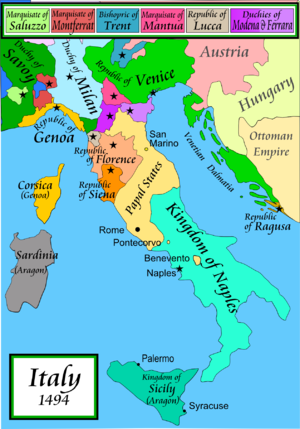 Our regular Italian commenter Ioshkafutz confirmed this viewpoint, and provided us with a comprehensive and engaging summary of Italian culture, which is reproduced below. It has been edited minimally for spelling, punctuation, and clarity: Our regular Italian commenter Ioshkafutz confirmed this viewpoint, and provided us with a comprehensive and engaging summary of Italian culture, which is reproduced below. It has been edited minimally for spelling, punctuation, and clarity:
Italy is many countries. A Milanese is closer to an Austrian than to a Sicilian, A Torinese to a Frenchman than a Calabrese. When I go to my Roman caffé / bar at night and Neapolitans truckdrivers enter, I don’t understand a word, or rather, just barely enough to know they are Italians. The rest could be Ancient Greek.
They — the Neapolitans — have their own musical genres, theater, and even cinema… all still thriving.
They’ll defend the legacy of the Borboni when Naples was a Capital city. They never really digested the Piedmontese invasion. The Romans instead have, also because when Rome became the Capital city and Mussolini brought cinema to Rome (he is responsible for cinecittŕ) Turin was marginalized.
Maybe Italy is already multicultural enough. Ever since Italy was a province of the Roman empire, it never became a political entity again until 1861.
Monday, July 14. 2008
Somehow, the Lefties have managed to make people feel a bit guilty about pursuing self-interest. (Lefties, however, tend to be very good at making money for themselves. Everybody is concerned with their own interests.) Nevertheless, they advise folks to vote on their self-interest: to vote themselves benefits from other peoples' labor, risk-taking, and creativity. That's the essential hypocrisy of Liberal-Leftism. I do believe in service and duty: to God, family, country, and one's fellow man - in that order. A quote from Self-interest is bad? at Weekly Standard: Oh, terrific. Now we have two of them--two presidential candidates, presumptive nominees of their respective parties, who insist they will not rest until they have inspired all of us stick-in-the-mud Americans to reach celestial heights of personal fulfillment by committing ourselves to a life of service. Service to what? Service to .??.??. something or other. The phrase that both John McCain and Barack Obama use is a "cause higher than yourself" or "greater than self" or alternatively a "cause greater than your own self-interest." Whatever the precise wording--for now, let's just use an unpronounceable acronym, CGTYOSI--we'll be hearing it a lot till November. McCain grabbed it first, years ago. CGTYOSI appears in his first memoir, Faith of My Fathers. In fact, it's the theme of the book, dramatized by the story arc: McCain begins as an impetuous young midshipman resisting the Navy's attempts to "bend [him] to a cause greater than self-interest," and then endures harrowing adversity, rejects the shallowness of his earlier life, and embraces a CGTYOSI. As a candidate, McCain has fastened on the phrase as one of those prefab word-clumps that politicians automatically release when answering a question about this or that. He uses it constantly. "If you've remembered anything I've said," he often tells audiences, "please remember there's nothing nobler than serving a cause greater than your own self-interest." As McCain tells it, that cause is found in AmeriCorps, the Peace Corps, and other government agencies that pay people to volunteer.
|
I am sick of this kind of sanctimonious BS. I get paid to work towards justice. There is truth in all this stuff, but it becomes cloying quickly. After all, how many people really want your "help"? Very few. Plenty of folks want your money, though. Everybody wants that. If you don't take good care of yourself and your family, what good can you possibly be to anybody else?
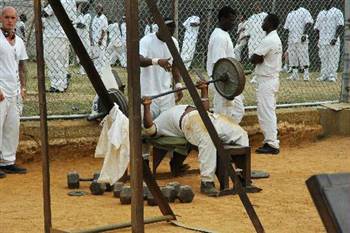 A provocative essay at Boston Review: Reentry: Reversing Mass Imprisonment. A provocative essay at Boston Review: Reentry: Reversing Mass Imprisonment.
I do not agree with many of the author's points, but all of the issues and debates are touched upon, and the author does make the correct point that not all criminals are incorrigible sociopaths. I also agree that we over-use jail time, which ought to be mainly for violent and comparably major offenses. Certainly not for drug addicts or financial offenders. Large fines. After all, many of our hard-earned tax dollars go to support those folks in jail. A year of jail time costs us more than a year of Ivy League "education" would. Everyone has broken a rule. As a rule of thumb, you have to break quite a few to get caught. My advice: teach and learn the rules, and do not break them. I think it's time to ask, again, what sorts of consequences we, as a society, want to impose for violations of the rules we make. And no weight-lifting equipment in our jails, please. One quote: As the social crisis of urban America supplied the masses for mass incarceration, the penal system itself became more punitive. The tough-on-crime message honed by the Republican Party in national politics since the Goldwater campaign of 1964 spoke to the racial anxieties of white voters discomfited by civil rights protests and summertime waves of civil unrest felt in cities through the decade. Conservatives charged that liberals coddled criminals and excused crime with phony root causes like poverty and unemployment. President Nixon launched a war on crime, only to be surpassed by President Reagan’s War on Drugs, which applied the resources of federal law enforcement to the problem of drug control. Policy experts abandoned rehabilitation, concluding that prisons could only deter and warehouse those who would otherwise commit crime in society. These politics produced a revolution in criminal sentencing. Mandatory minimum prison sentences, sentencing guidelines, parole abolition, and life sentences for third-time felons were widely adopted through the 1980s. The no-nonsense, tough-on-crime politics reached a bipartisan apotheosis with President Clinton’s 1994 crime bill, which launched the largest prison construction project in the nation’s history. As a result of these changes, prison time—as opposed to community supervision—became the main criminal sanction for felony offenders.
Read the whole thing. Link above. (By the way, I am a supporter of Prison Fellowship. I believe that Christ can save anybody's soul.)
Sunday, July 13. 2008
This is a summer weekend re-post from our dusty archives:  "Progress," like environmentalism, is a secular religion. "Progress," like environmentalism, is a secular religion.
I have always been suspicious of the concept of progress. For Chambers of Commerces, it has always seemed to mean more asphalt. For Leftists it has meant movement towards international socialism. In the world of morals, it has seemed to mean less morality and self-discipline. In art and design, it often seems vain and meaningless. In the world of religion, it has seemed to mean watering it down. In the Sciences though - medicine, technology, etc - advances have of course added much to quality and ease of life - but nothing to the meaning and purpose of our lives unless we are scientists. Wilfred McClay in Touchstone points out how the word has shaped our experience. Our words shape the way we think about things, sometimes in insidious ways and without our awareness, even as we use them: sometimes our words lead our thoughts instead of vice-versa. History has become for our secular age what “fate” was for the Greco-Roman ancients, and what “providence” was (and remains) for many Christians. This is the sense of History that Hegel and Marx promoted, and the sense that Supreme Court justice Anthony Kennedy recently appealed to in justifying an opinion by “evolving standards of decency.” It is the sense that moral innovators are appealing to in promoting homosexual and polyamorous “marriage,” artificial wombs, bioengineered enhancements, and all the other delights of “posthumanity.” The postmodernists who claim that we are beyond the sway of such metanarratives as History are speaking utter rubbish. (As usual.) “Progress” is the one article of faith that remains strong among us, the one torch in modernism’s darkening hall that still burns bright. To oppose it, even in the slightest, is to render oneself an “enemy of the future.” Which is why the possibility that such innovations might ultimately fail is, literally, inconceivable to so many true believers, as inconceivable to them as a sudden revocation of the laws of physics. You see, there are certain prevailing winds in this thing called History, and the Path of True Virtue can only be found in discerning those winds, and aligning one’s skiff with them. Or so the partisans of conventional wisdom would have it. And their confidence is oddly mirrored in the dejection of the orthodox, who feel themselves on the losing side of History. Yet both are wrong.
You can read the whole brief piece. It's a Christian view of time and of history. Update: AVI did a piece about cultural views of time last week.
|