Tuesday, September 16. 2008
Many businesses fail every day, and that's the way it ought to be. Otherwise, we would still have buggy whip factories in New York City. In Capitalism, failure is not a dirty word. In fact, failures reveal the success of the way things work. While McCain and Obama seek to grab news space by blaming someone or something for the Wall Street business failures, I do not. Businesses come and go, from bait shops to corner lunchrooms to investment banks to car manufacturers. I feel badly for folks who lose their jobs, but otherwise I feel good about the creative destruction that Capitalism provides space for. Business is all about calculated risk: in the end, what profit rewards is risk, regardless of the product. These investment banks were gambling to stay alive in a changing world, and made bad bets. Competition is what hones businesses - and they eventually fall if they cannot keep up or adapt - or behave imprudently, or encounter bad luck. I deal with many business people in my work, and it is my conclusion that the biggest obstacle to business creation, and thus capital creation and job creation and wealth creation, is the government. Note that the biggest screw-ups of the year, Fannie Mae and Freddie Mac, were government agencies. So much for government's role in the financial industry: it inevitably becomes politicized, mediocratized, and corrupted - as with any government involvement in any industry. Few people in government could figure out how to run a candy shop, much less a complex enterprise. Otherwise, they'd be doing it. Related: Tyler Cowen on how regulation made the problems worse. Also on how the hedge funds manage risk better than the investment banks. Also related: How the Dems supported the sub-prime fiasco. Follow the money. And the banks were all too eager to play that game - as long as there were buyers for the junk. A game of musical chairs, as in all bubbles.
Monday, September 15. 2008
While the democratization of Capitalism via the huge increase in investing by the general public over the past 30 years is a wonderful thing, there is also a downside. The downside is that people complain when they lose, and expect the government to do something about it - or to prevent it. They want to privatize gain but socialize risk. Related: How Fannie and Freddie co-opted the politicians. As Rush says re F and F, where are the investigations? The special prosecutors?
Sunday, September 14. 2008
Tom Brewton directed us to a new piece by Richard Neuhaus in First Things, A New Order of Religious Freedom. It's about religion and politics. One quote: More than he wanted to be remembered for having been president, Mr. Jefferson wanted to be remembered as the author of the Virginia “Bill for Establishing Religious Freedom.” In the text of the bill he underlined this sentence: “The opinions of men are not the object of civil government, nor under its jurisdiction.” In a republic of free citizens, every opinion, every prejudice, every aspiration, every moral argument has access to the public square in which we deliberate the ordering of our life together.
Another: In a democracy that is free and robust, an opinion is no more disqualified for being religious than for being atheistic, or psychoanalytic, or Marxist, or just plain dumb. There is, or at least there ought to be, no legal or constitutional question about the admission of religion to the public square; there is only a question about the free and equal participation of citizens in our public business. Religion is not a reified thing that threatens to intrude upon our common life. Religion in public is but the public opinion of those citizens who appeal to religion in public.
Saturday, September 13. 2008
 A quote from The Censor in the Mirror by Ha Jin in American Scholar: A quote from The Censor in the Mirror by Ha Jin in American Scholar:
In the summer of 2004, Yuan Hongbing, a Chinese writer, defected to Australia, taking with him four fiction manuscripts. After Yuan’s novels were published abroad, some top Chinese leaders were flustered. Luo Gan, director of the Politics and Law Committee of the Chinese Communist Party at the time, went so far as to give orders to punish with a death sentence whoever dared to pirate the books. Li Changchun, a member of the Standing Committee of the Political Bureau, who is in charge of ideology, issued the following directive: “The General Administration of Press and Publications, the Border Police, and Customs must work closely to prevent Yuan Hongbing’s novels from being smuggled into the mainland. We must ponder about this phenomenon: For many years our party has spent a great amount of manpower, money, and material resources in bringing up many writers, but our writers have not created any work that can trump Yuan Hongbing’s fiction artistically.” Regardless of whether Li was capable of literary judgment, he did raise a serious question for the party. The answer is clear and simple: The system of harsh censorship has crippled and “sterilized” the writers and artists who exist within its field of force.
Tuesday, September 9. 2008
Should libertarians fear the Dem nominee? asks Chapman at Reason. He begins: There are no disciples of small government in the Democratic Party, and Barack Obama fits right in. His economic program is based on the assumption that the economy is to the president what a marionette is to a puppeteer, requiring his direction and responding to his every wish.
Anyone partial to free markets, restrained government, fiscal discipline and light taxation approaches a Democratic nominee's economic platform with trepidation, expecting one fright after another. Obama does not disappoint.
Read the whole thing. Of course, Repubs are only marginally better because people in government tend to become enamored of - and dependent upon - the power. To vote as a statist, you must believe in the supreme wisdom of the State and its (our) employees. Few Americans believe that. In the end, the dividing line is between those who trust in the power and wisdom of The State vs. those who have faith in the wisdom and potential of the individual. I happen to think that The State is an ass, and foolish when it is not self-interested. No Pasaran has a bit on Statism. These are the things folks need to be considering in these elections. Americans are ambivalent about government.
Monday, September 8. 2008
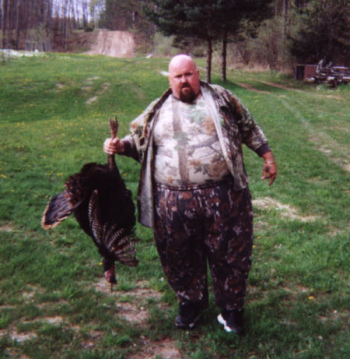 Well, so much for diversity and appreciating and embracing "the other." I think that thing only applies when "the other" is pathetic or damaged in some way, or manages to wiggle their way into some victim class. Well, so much for diversity and appreciating and embracing "the other." I think that thing only applies when "the other" is pathetic or damaged in some way, or manages to wiggle their way into some victim class.
Or perhaps some pomo reader, if we have one, could help me distinguish between the "good other" and the "bad other." It sure doesn't apply when "the other" is a regular American woman, albeit one with unusual energy and coping skills. Nick Cohen on When Obama's berserkers lost the plot. (h/t, Lucianne). One quote: For once, the postmodern theories so many of them were taught at university are a help to the rest of us. As a Christian, conservative anti-abortionist who proved her support for the Iraq War by sending her son to fight in it, Sarah Palin was 'the other' - the threatening alien presence they defined themselves against. They might have soberly examined her reputation as an opponent of political corruption to see if she was truly the reformer she claimed to be. They might have gently mocked her idiotic creationism, while carefully avoiding all discussion of the racist conspiracy theories of Barack Obama's church. But instead of following a measured strategy, they went berserk. On the one hand, the media treated her as a sex object. The New York Times led the way in painting Palin as a glamour-puss in go-go boots you were more likely to find in an Anchorage lap-dancing club than the Alaska governor's office.
Some animals are more other than others. Addendum: Apparently those folks at the Guardian also view people like me as "the other" - and as a primitive, apeish ignorant "other" for whom they hold contempt. They have clearly never met me. I'm an Ivy guy, and I wear ties and like guns. Call me a knuckle-dragging redneck if you want to. Story at Jules. Addendum: From our commenter "People on the left are breaking the teeth of reason on the irrefutable fact of Sarah Palin--the other--as they gnash the grinders in their dismay. They have attacked her strength and accomplishments with sexism; they have belittled her origins with classism; and they have mocked her beliefs, leaving only the shell of their multiculturalism. Thus the lie of identity politics and multiculturalism lay in ruins." Addendum: The Palin Problem. Rick Moran. One quote: Most women work because they have to in order to make ends meet or give the family those vital little extras not to mention the fulfillment many women get from the feeling of independence and pride that having a job brings. Politicians have tried for years to address these women directly with varying degrees of success. Democrats have offered child care, family leave, job protections for pregnant women, and the child health insurance program S-CHIP among other programs. Republicans haven’t ignored these women but have not offered much government assistance, preferring tax credits to ease the financial burden on the family. Palin is the first Republican politician with which these women can truly identify. She speaks their language. She sounds like them. Her family looks like their family. And when she speaks of the mixing of her career and family, she can look directly at the camera and give them a knowing smile of solidarity – as if they were neighbors casually talking over the backyard fence.
Photo is our refined, sophisticated, Euro-sensitive, metrosexual editor Bird Dog. Just your typical American voter...
Sunday, September 7. 2008
Will Wilkinson directed us to a piece of poli-sci research titled Rich State, Poor State, Red State, Blue state. What's the matter with Connecticut? They are asking why wealthier states tend to vote Dem, and vice versa. In wealthy states (CT is the wealthiest in the US), income has no correlation with voting patterns. An interesting piece of work. 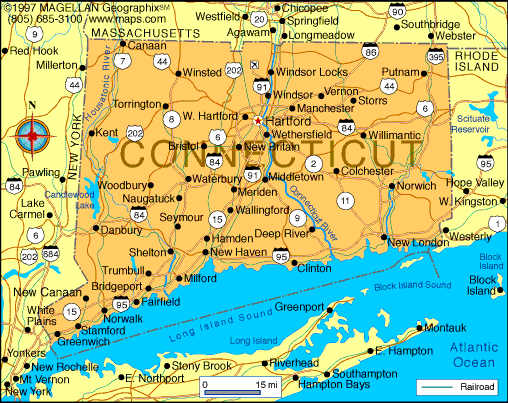
Thursday, September 4. 2008
An encapsulation of what I saw over a 12-hour period last Friday.
First off, I gots me some street cred on this Palin thing:
comment, Maggie's Farm, July 16, on who should be VP
Sarah Palin, governor of Alaska, no question. There's your neocon vote and there's your Hillary vote. At the slow-but-steady rate Obama is sinking, come November it'd be a landslide. Like the MSM, people are just dying to leave the issue of race behind. People would be positively giddy as they focused on gender again, but this time with an authentically personable figure, rather than the shrill Mrs. Clinton or the stiff, tightly-hairbunned Mrs. McCain.
As I said to Bird Dog the other day, while that's certainly not the first blog comment to recommend Palin for VP, it might be the first to dare use the words "Palin" and landslide in the same paragraph. I suggest in this article that this overt optimism might yet be justified. As such, I thought some of you might be interested in the observations I made this past Friday. It was a historic day on a couple of levels, and, as I'll show, Governor Palin was more than just a 'smart' pick. I doubt the McCain camp, itself, knows how truly inspired it was. And while the bloggers did superb work getting the info out, I think they were a little too busy to see the bigger picture and what really happened that eventful day. Let's start with landslide.
Continue reading "From Sparks To Flame"
Wednesday, September 3. 2008
We are ramping up to one heck of an angry political season - and it really pisses me off. I don't mind a little emotion and enthusiasm in a national election. Silly and immature as it may be, it's the American way to idealize candidates and then to devalue them once they have to start making real decisions. Gov. Palin has been a lightning rod for several reasons. 1. She's the new breed - the "new feminist" - who seems happy 2. She's prettier than Madeleine Albright or Hillary Clinton. 3. It's difficult to attack McCain himself. 4. She's not a representative of the "elite" 5. She's a serious political threat and the other side wants to damage her as fast as possible. In The Metaphysics of Envy and Revenge Gagdad Bob offers another perspective. One quote: ...hell hath no fury like a leftist who encounters a female or African-American who doesn't need him. Thus, the high-tech lowbrow lynching of Clarence Thomas and the current unseemly attacks on Sarah Palin. How else to account for the shroud of discreet silence over the John Edwards affair vs. the airing of every possible rumor and smear about Palin and her children?
James Lewis at RCP similarly has Palin and the Narcissistic Left. I do not approve of using shrink terms to put people down, but he does have a point. Indeed, politics can become a playground for the acting out of our most immature and primitive selves if we aren't careful, or a stage on which we project our internal issues and dynamics. Perspective and reason fly out the window and are replaced by hatred or love or whatever. That's why it can get so sick. In the process, reality, dignity, and even relationships can be lost. It's a pity, really.
Tuesday, September 2. 2008
No doubt. It's Soros again. Details at Classical Values. The money quote from 2004: In a December 9th e-mail signed by "Eli Pariser, Justin Ruben, and the whole MoveOn PAC team," the Soros front group stated: "In the last year, grassroots contributors like us gave more than $300 million to the Kerry campaign and the DNC, and proved that the Party doesn't need corporate cash to be competitive. Now it's our Party: we bought it, we own it, and we're going to take it back."

A big coonskin hat tip to commenter Roy Lofquist for the idea.
The Bill Hayes version of 'The Ballad of Davy Crockett' I listened to 50 years ago is here. Give it a listen. The following keeps to the general storyline of the song (including the sad 3rd verse) and will be much more enjoyable if you do.
And away we go!
The Ballad of Sarah Palin
Born on a mountain by the Yukon Sea
Oiliest state in the land of the free
Raised with a gun so she knew philosophy
And kilt a caribou when she was only three.
Sarah, Sarah Palin! Queen of the wild frontier!
She fought single-handed in the beauty pageant war
Till the blondes was whipped and big hair restored
And while she was handling this 'permanent' chore
She made herself a brunette forevermore.
Sarah, Sarah Palin! Dressin' for com-pa-ny!
When her child had Down's, her grief was gall
The Dems said Sarah, just abort it all
And lose yourself in the glacier tall
But she answered instead the motherhood's call.
Sarah, Sarah Palin! Spirit of democracy!
She went to the capital and served a spell
Pluggin' up the pork and corruption as well
Took over Juneau so we hear tell
And told the Bridge To Nowhere to go to hell!
Sarah, Sarah Palin! Servin' her country well!
John McCain called and said you ain't done
This here election has just begun
So she packed up her laptop and her virtual gun
And lit out a'smilin' for Washington.
Sarah, Sarah Palin! Leadin' the blogoneers!
Her land is biggest, and her land is best
From grassy plains to the mountain crest
She's ahead of us all in meetin' the test
We're followin' her legend right out of the West.
Sarah, Sarah Palin! Queen of the wild frontier!
Sunday, August 31. 2008
Dr. Merc, who is experiencing some nice gusts down in the Keys, wanted to make sure we didn't miss Steyn's piece on Sarah Palin - The Hostess with the Moosest. Steyn emerged from estivation to produce this. It begins: 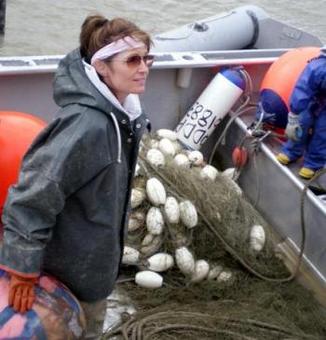 First, Governor Palin is not merely, as Jay describes her, "all-American", but hyper-American. What other country in the developed world produces beauty queens who hunt caribou and serve up a terrific moose stew? As an immigrant, I'm not saying I came to the United States purely to meet chicks like that, but it was certainly high on my list of priorities. And for the gun-totin' Miss Wasilla then to go on to become Governor while having five kids makes it an even more uniquely American story. Next to her resume, a guy who's done nothing but serve in the phony-baloney job of "community organizer" and write multiple autobiographies looks like just another creepily self-absorbed lifelong member of the full-time political class that infests every advanced democracy. First, Governor Palin is not merely, as Jay describes her, "all-American", but hyper-American. What other country in the developed world produces beauty queens who hunt caribou and serve up a terrific moose stew? As an immigrant, I'm not saying I came to the United States purely to meet chicks like that, but it was certainly high on my list of priorities. And for the gun-totin' Miss Wasilla then to go on to become Governor while having five kids makes it an even more uniquely American story. Next to her resume, a guy who's done nothing but serve in the phony-baloney job of "community organizer" and write multiple autobiographies looks like just another creepily self-absorbed lifelong member of the full-time political class that infests every advanced democracy.
Second, it can't be in Senator Obama's interest for the punditocracy to spends its time arguing about whether the Republicans' vice-presidential pick is "even more" inexperienced than the Democrats' presidential one.
I did kinda wonder what sort of person feels motivated to write two autobiographies at his age. Except for his odd parents and his nomination, what could he have to tell? Anyway, read the whole clever piece. Photo: Palin works on her husband's commercial fishing boat on weekends. Oh, and did we mention that she runs 7-10 miles per day? Or that she turned Alaska's politics upside down? Or that she refused her governor's perk of car and driver to drive herself to work? Or that she has had more executive experience than Obama, McCain and Biden combined? Plus she is a likeable, non-angry female. As in Insty's case, the females in my family are like totally fired up. Win or lose, she will be a national figure for years to come.
Friday, August 29. 2008
From guest poster and Maggie's Farm friend Bruce Kesler. We used to link him frequently when he wrote at Democracy Project. 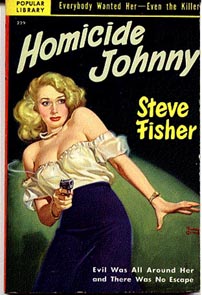 The 2008 presidential contenders bring to mind the “pulp fiction” of the 1920s-1950s. The 2008 presidential contenders bring to mind the “pulp fiction” of the 1920s-1950s.
Not that there was a dearth of serious writing during pulp fiction’s heyday, but the mass audience sought and was more exposed to pulp’s more exciting genre. Similarly, today there’s much well-researched political reporting and commentary, but most Americans seek or are presented with blogposts and sound-bites that more directly connect. More smartly spoken writing or speeches may just as much contain bias or misdirection. In either major media or blogs, the public usually recognizes the basic truths of motivations, words, actions, and consequences. Pulp blog readers’ views are frequently as well or better informed as their presumed betters. The pulps were adventures in outsmarting opponents, often ingenious, often far-fetched. The adventure settings were Western or wartime or urban detective, or about threatening extraterrestrials or planted mole aliens with adverse intentions. The primary pulp characters were either quietly heroic types or nefarious foes. Good, or relatively so by key decisions or outcomes, battled evil, or relatively so by dint of bad decisions or goals. The Internet is largely focused on the play-by-play of outsmarting opponents. It is dominated by opinionated blogs treating their favorites as heroes and their foes as threats to the blogwriter’s preferred social and world order. In major media or blogs, selected facts or supporting opinions are presented to further the theme’s narrative. The success of pulp fiction’s popular themes was made possible by the inexpensive paper used (pulp stock) for affordable mass-distribution paperbacks that offered a wide range of writers, many of whom came from or attained legitimate fame. The Internet’s low costs of distribution and access also increase the variety of points-of-view presenting themes appealing to partisans. A wide range of writers is available, some from backgrounds of accomplishment and some others attaining name recognition. Meanwhile, the major layoffs and reductions in newsprint have reduced the range of views and depth of newspapers. 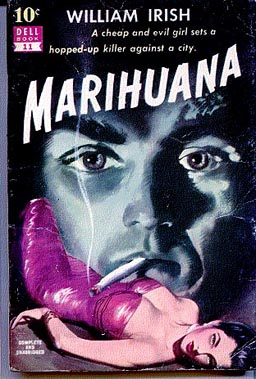 Another characteristic of the pulps was their enticing art depicting the valiant defending or the underhanded mishandling the weaker desirable female or the downtrodden. Today’s candidates have heroic or saintly posters, air self-flattering poses in TV ads that show their opponents in embarrassing clips, and creative and humorous blog photoshops. Another characteristic of the pulps was their enticing art depicting the valiant defending or the underhanded mishandling the weaker desirable female or the downtrodden. Today’s candidates have heroic or saintly posters, air self-flattering poses in TV ads that show their opponents in embarrassing clips, and creative and humorous blog photoshops.
Still, underlying both pulp fiction or pulp politics, there must be plausibility. Even the fantastic requires a factual basis. Although his rise from meager beginnings and his eloquence are in Barack Obama’s favor, as is his clear (even when obscured for political gain) liberal ideology for those of that inclination, he has hidden most of the little record he has. In light of seeping revelations from his own mouth and others’ research, his earlier-heralded promise of either hope, bipartisanship, sagacity, or integrity are increasingly exposed as shallow at best. It appears to many implausibly fantastic that someone of such unknown or little background, hyperbolically seeming an adult parachuted alien onto America, can be taken seriously as the presidential candidate of a major political party. The quieter, and less promoted by major media adulation, repeatedly exhibited real world personal and political character and courage of John McCain stands in stark contrast, and for those who weren’t previously aware is recognized in his climbing polls. That has not remade, nor are observers or conservative bloggers ignoring, his less sterling traits or views. But the understanding is gaining that character, experience and knowledge are overridingly important in being confronted with existential threats, unusual challenges or gathering broad support for initiatives. Pulp politics may not be elevated discourse, but it is insightful – more so than the supposedly more respectable but thinly veiled major media tilts - into choices faced by ordinary people. Bruce Kesler, an avid fan of the pulps and blogs, owns a financial planning and employee benefits firm in Encinitas, CA, whose writings have appeared in many MSM op-eds and blogs.
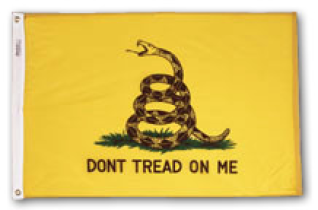 I always thought that the American Promise was for freedom. John Judis clearly thinks otherwise. A quote: I always thought that the American Promise was for freedom. John Judis clearly thinks otherwise. A quote:
(The speech) fed two other arguments. First, it figured in the liberal or progressive (to use Croly’s term) argument that government has a responsibility to make good on the American promise: through regulating the market, and through providing health insurance and education for all citizens. Second, it figured in Bill Clinton’s “New Democrat” argument (that has goes back to the Puritans) that in order to achieve the promise of American life, Americans have to exercise mutual and individual responsibility. People have to be willing to work; parents have to look after their children; corporations cannot behave like brigands. So through this notion of the American promise, Obama united the two historic strands of American liberalism: the older New Deal argument of the 1930s and the “New Democrat” argument of the 1990s. One America: Finally, Obama invoked his vision of a single America--and he used it not only to put forward the promise of racial reconciliation, but as an attempt to defuse the great social divisions of the last decades over immigration, abortion, gays and guns. And that, too, dovetailed back into the idea of the American promise, which could not be achieved, Obama suggested, if America continued to be rent by incivility and social discord. It was one of the most intellectually elegant speeches I’ve heard. Besides that, I expect that it will do Obama and the Democrats a lot of good in the weeks ahead.
America is indeed divided. There is an America that wants free stuff from other people's labor, energy, and risk-taking, and there is an America that wants freedom and to be left alone by the government, to find its own way through adult life. We are meant to build our lives, and to live with it. That's what grown-ups do in a free country.
Wednesday, August 27. 2008
 I get 90% of my ideas for my website posts in the shower. And this is probably why. I get 90% of my ideas for my website posts in the shower. And this is probably why.
My morning shower thought for today was this: Why were the top two Dem candidates people who have never accomplished anything substantial or difficult in their lives - other than to be in elections? (Note to John McCain: An ad asking "Name one thing Obama has accomplished in his life.") This is not coincidence. Many politicians are not very good at regular life, but these two stand out as having only been good at being, not at life accomplishment. Being female, being black, and being medium-smart and above-average crafty and calculating. They have never run anything, made anything, or done anything: It's all about being them. As Dino notes: Think about this: most people have someone whom they know or with whom they work, a relative perhaps, who has a thicker résumé and a longer list of achievements than the Democratic presidential candidate. Consider this: if history were different and Senator Obama had decided this year to run to become governor of Illinois, would he have been given rock-star status? Could his Republican opponent have run against him as “too inexperienced” to govern the Prairie State?
These folks are all about Jive Talkin': Admittedly, I will always tend to vote for the more conservative candidate in any election, even if he or she is brain-damaged. That's because individual freedom and protection of our freedom is my main political agenda. That's my bias. I'm sure the Lefties approach things similarly. However, my resume (and life experience) is deeper than Obama's or Hillary's, for sure. But that's not saying much.
"The big ideological defeat hidden by environmentalism" at Samizdata, who quotes Will Wilkinson: Climate eschatology really is the ultimate in big lie crisis politics. The far-left has failed so comprehensively to make the case for its vision of society and economy that the only thing left to do is to brazenly and repeatedly assert that the world will literally collapse unless we implement this otherwise indefensible vision.
and I think the point is that the clock really is ticking. If we don't "do something" soon, we'll probably see that we don't really need to do anything really dramatic, and then the window for radical social change will be closed. So I expect the volume to get much louder.
Monday, August 25. 2008
The "Root Cause" Scam Norm Geras from Normblog is doing some deep thinking: The root-causers always plead a desire merely to expand our understanding, but they're very selective in what they want to "understand". If causes and explanation are indeed a serious enterprise and not merely a convenient partisan game, then it needs to be recognised that causality is one thing and moral responsibility another, though the two are related.
and: Ever on the lookout for damning causes, the root-causers never go for the most obvious of these. This is the cause, indeed, which shows, by its absence, why most critics of the Iraq war or of anything else don't murder people when they are angry. It is the fanatical, fundamentalist belief system which teaches hatred and justifies these acts of murder. That cause somehow gets a free pass from the hunters-out of causes.
My only disagreement with the article is that it seems to assume that the terrorism apologists are sincere in their positions and postures - which I feel is naive. Thus Norm's great analysis will have no impact on any of the hard Left, reflexively anti-Western readers of the Guardian (in which the piece appears). After all, what is the "root cause" of the anti-Western reflex of the Left? Whatever it is, it isn't ignorance (except in the young). Intellectual integrity - and even integrity - mean nothing if you can convince yourself that your mission is to save the world via Lefto-Fascism - or just to try to promote yourself! You rise above such bourgeois hang-ups. Just like the Jihadists...hmmmm. Read the entire - link above. And read my piece on related subject on Maggies last week.
Sunday, August 24. 2008
 Just as professional journals and newspapers are more interested in printing pieces that support hypotheses rather than papers with negative findings, so we all tend to spend more time discussing the risks of action rather than the risks of inaction. Just as professional journals and newspapers are more interested in printing pieces that support hypotheses rather than papers with negative findings, so we all tend to spend more time discussing the risks of action rather than the risks of inaction.
That seems to be human nature, but it ain't rational and, fortunately, people vary across a spectrum of activity/passivity. Passive people worry about the risks of action. Active people worry about the risks of inaction. I am more-or-less in the middle. To discuss that half-intelligently, though, I first need to review the notion of Type 1 and Type 2 errors, now that we have taken a look at the null hypothesis a couple of days ago. A Type 1 error, also known as False Positive, is the error of erroneously rejecting the null hypothesis. In other words, it supports a connection which does not really exist. A Type 2 error, or False Negative, is the error of wrongly accepting the null hypothesis. In other words, it says nothing is there, when it is, in fact, there. For example, a blood test which has a 10% False Positive rate will wrongly tell you that there is an abnormality 10% of the time. A blood test with a 10% False Negative rate will miss an abnormality 10% of the time. For another example, convicting an innocent person is a Type 1 error; letting a guilty person go free is a Type 2. Depending on the matter at hand, either sort of error could have worse consequences. A Type 1 error in a death penalty case is a grievous error. But sometimes you need Type 1 errors. My favorite example of a good Type 1 error is in the emergency treatment of appendicitis. Since medical diagnosis contains both art and luck as well as science, some error rate is inevitable unless you have the diseased organ in hand. But since a False Negative diagnosis would have dire consequences (ruptured appendix), it is necessary to do some unnecessary appendectomies on patients who might have appendicitis, but do not turn out to. In the case of emergency appendectomies: one study indicates that the Type 1 error rate is around 10%, with 18% False negatives. I would have guessed that the False Positives would be higher, and you could argue that there is room for them to go higher. The point is that, with appendicitis, you want to minimize your False Negatives by having more False Positive diagnoses - by being deliberately biased against the Null Hypothesis that there is nothing there, but without cutting open everyone with a bad stomach ache. Thus that is the opposite of what you want in a justice system, where the null hypothesis of innocence is presumed in order to minimize False Positives.
Thursday, August 21. 2008
Watts says that the Global Climate Change Impacts in the United States report contains more advocacy than science: Skeptics win one. One quote from his piece: This report’s contents and the “cart before the horse” way it was produced is the biggest official “crock” perpetrated on the American public I’ve ever been privy to. On a personal note, there are days when I struggle to keep doing this, at times I think I’ll just shut down the blog, turn off the surfacestations website, and return to a normal and hassle free life. Days like this keep me going.
Tuesday, August 19. 2008
Despite its uselessness, squishy relativism remains a force in some sectors of society. It's dangerous because it makes people feel that they shouldn't evaluate anything. Dr. Bob explains the inherent contradictions. A quote: I find it interesting that most every argument rejecting absolutes contains within its very language and structure, not to mention its premises, a framework of absolute assertions. And our subject does not disappoint: tossing around terms like “wise” and “fools” and “shame” and “credit”, qualitative words without meaning when there is no transcendent standard against which to measure them. What is shame if not the humiliation of rejecting an absolute good? Who is wise, and who a fool, if there is no standard of enduring and unchangeable wisdom by which to categorize one thusly? The lines of their straightedge are random and irregularly spaced — if there are measuring lines at all — yet they carefully measure and mark off “progress”, confident they have measured accurately. There is, of course, the inevitable rejoinder to all such foolishness which asks, “Are you absolutely sure there are no absolutes?” But beyond this childish rebuttal — childish, not in the sense of silliness or immaturity, but rather of unvarnished simplicity — there lies an even more evident and profound incoherence which can be discerned — from which a not-so-evident proposition emerges from the heart of anti-absolutism.
Read the whole thing.
What is college for? I've been writing about that subject recently. Stanley Fish's essay of the above title begins thus: Pick up the mission statement of almost any college or university, and you will find claims and ambitions that will lead you to think that it is the job of an institution of higher learning to cure every ill the world has ever known: not only illiteracy and cultural ignorance, which are at least in the ball-park, but poverty, war, racism, gender bias, bad character, discrimination, intolerance, environmental pollution, rampant capitalism, American imperialism, and the hegemony of Wal-Mart; and of course the list could be much longer.
So much for the humility of scholars. Read the whole thing.
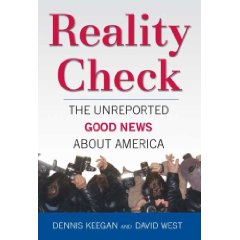 Two friends of Maggie's Farm, Dennis Keegan and David West, have written this book which has come out today. Two friends of Maggie's Farm, Dennis Keegan and David West, have written this book which has come out today.
An Amazon reviewer says: This book provides an unbiased review of the major issues of the past 10 years. Heavily researched and footnoted, it provides a much different picture of the United States than what the media paints. If you would like data rather than opinion on the state of the U.S., this is the book to read.
The book description reads: Streaming headlines, round-the-clock broadcasts--we live in a world of twenty-four hour news. But lately, most of what we read and hear is either negative, biased, or both. Cutting through the gloomy reports and liberal slant are Dennis Keegan and David West with their brand new book, Reality Check: The Unreported Good News About America. Contrary to what the cynical reporters and politicians say, Keegan and West prove that America is still a shining city on a hill, with a low unemployment rate, high GDP, and enviable democracy. These are not opinions, but facts--based on statistics that the media isn't reporting because of political agendas, industry competition, and limited resources. In Reality Check, Keegan and West cut through the bias and spin to reveal: How our twenty-four hour news culture gives us more inaccurate information, not less
Why the U.S. economy is doing better than we realize
* Why the recent rhetoric and politics of change may do more harm than good In this age of information saturation, the need to question and critically think about what we're reading and hearing is more important than ever. In Reality Check, Keegan and West show us how to be discerning consumers and why the news about America is much better than the media would have you believe.
A timely book. Check it out.
Friday, August 15. 2008
via Surber: (Republican New Jersey Assemblyman Michael Doherty) has called for repealing New Jersey’s ridiculous global warming panic laws. Doherty said: “There are many credible members of the scientific community who have questioned the theory of global warming, and now we have some scientists actually suggesting the earth’s temperatures may be entering a period of dramatic cooling. With this growing level of scientific uncertainty, it makes no sense to enact a new set of economically damaging regulations prompted by the global warming hysteria of recent years.”
|