Tuesday, June 16. 2009
Via Drudge, ABC turns programming over to White House. Good grief. So much for the MSM, press ethics, and journalistic healthy skepticism and integrity. But that's not news.
This is a sick, perverted symbiosis.
Monday, June 15. 2009
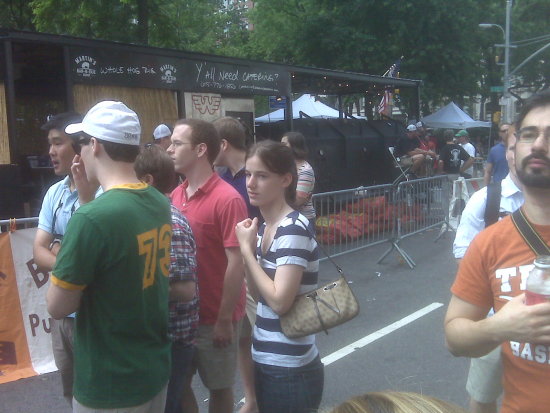
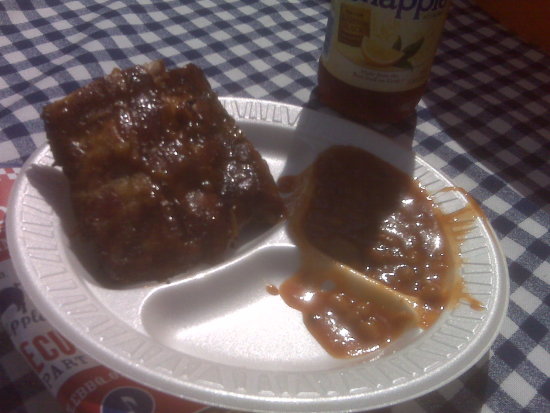
Photo quality looks like the Bird Dog pup took these with her cell phone yesterday, in Chelsea (aka Hell's Kitchen):



 The Bird Dog family has a multi-generational attachment to Bermuda. We always stay at Cambridge Beaches: it's our place. No glitz, unostentatious, no jacuzzis, heavy on Brits, lots of little one-room "villas" perched on the hill over the ocean, sort-of mediocre but edible food. I like to feed on Grouper, Bermuda Fish Chowder, Conch fritters and Dark 'n Stormies whenever I am in Grouper-land. (We do not golf, so we do not need the Mid-Ocean Club.) The Bird Dog family has a multi-generational attachment to Bermuda. We always stay at Cambridge Beaches: it's our place. No glitz, unostentatious, no jacuzzis, heavy on Brits, lots of little one-room "villas" perched on the hill over the ocean, sort-of mediocre but edible food. I like to feed on Grouper, Bermuda Fish Chowder, Conch fritters and Dark 'n Stormies whenever I am in Grouper-land. (We do not golf, so we do not need the Mid-Ocean Club.)
You can walk to a place that rents little Whalers and snorkeling or scuba gear, and they will give you a map of the good coral reefs. You go offshore and find them yourself. Mopeds always, but you drive on the left so it's a bit of an IQ test in the traffic circles.
It would pain me to see the US take over Cambridge Beaches as a place to put the Gitmo terrorists. It would tick off the Brits too, no doubt.
Remarkable cell phone (?) video from Iran protests, at LGF
Roy Spenser presents the hypothesis that the Pacific Decadal Oscillator, a strange oceanic and atmospheric thingy that happens in the North and South Pacific, explains atmospheric temperature changes better than anything else.
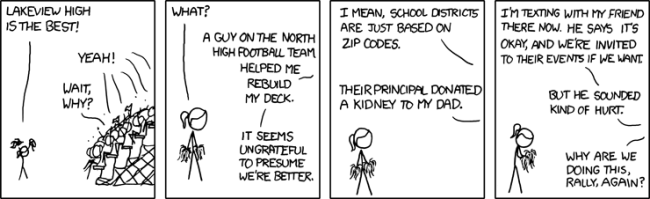
Tiger posted some toon sites. I liked xkcd. A sample:
Sunday, June 14. 2009
 Another quote from the Steyn piece we posted and commented on yesterday: Another quote from the Steyn piece we posted and commented on yesterday:
"Health" is potentially a big-ticket item, but so's a house and a car, and most folks manage to handle those without a Government Accommodation Plan or a Government Motor Vehicles System – or, at any rate, they did in pre-bailout America.
And another:
In Britain, once the crucible of freedom, civic life is all but dead: In Wales, Northern Ireland and Scotland, some three-quarters of the economy is government spending; a malign alliance between state bureaucrats and state dependents has corroded democracy, perhaps irreparably. In England, the ground ceded to the worst sociopathic pathologies advances every day – and the latest report on "the seven evils" afflicting an ever more unlovely land blames "poverty" and "individualism," failing to understand that if you remove the burdens of individual responsibility while loosening all restraint on individual hedonism the vaporization of the public space is all but inevitable.
By way of contrast with the excellent Steyn essay, economist Robert Frank thinks we'll all be happier if we're taxed more and controlled more, presumably because we are incompetent, dysfunctional morons. A quote from a comment on his book:
Behaviorist economics has become the latest fad among liberals. Classic free-market economists hold that individuals are rational, or at least act rationally: thus free decisions in a free market deliver optimal economic results. The behaviorists, among whom Frank is a pioneer, propose by contrast that government should protect us against the consequences of our passions. Behaviorist economics has supplied a scientific rationale for increasing taxes, imposing additional regulations, and limiting individual choice. It’s all for our own good.
One wonders to what extent the current success of behaviorism on the liberal left might implicitly draw on the American Puritanical tradition. In the name of science (global warming, healthy living, and so on), the liberal academic community seeks to impose limitations on individual free choice, the same way the old-time Puritan pastors did. (When I raised this historical precedent in a conversation with Frank, who sees himself as a God-free libertarian, he was speechless.)
Frank's vision is of citizens as a herd of happy, peaceful, benighted sheep, grazing, screwing and reading comics in a meadow while producing wool for the State's mills - and ruled by wise, altruistic men like him (who of course lack the passions of us peons - other than the passion to run the world their way. And who wants their life to be fully rational anyway? Not me.).
Problem is, as our post on technocrats and policy wonks yesterday discussed, the People have far more accumulated wisdom and life experience than any group of scheming technocrats or condescending academics who wish to create a world in their own image.
I would much prefer Sippican, Vanderleun, Glenn Reynolds, or my neighbor as President than the smartest guy in the Harvard School of Government. They understand why the energetic people of the world want to come to America.
Furthermore, we have seen all over the world in the 20th Century 1. how dispiriting powerful States are to the inventiveness and productivity of the aspiring, imaginative, creative and energetic individual (and how, if you dispirit the producers, there's no money to fund anything), 2. how entire sociopathic populations and cultures can be created (as in the Soviet Union) by energetic and resourceful people working the system and sneaking around it, and 3. how States politicize everything, and how power corrupts.
Frank is thus dangerously naive to idealize the State as some benevolent, altruistic, all-wise entity - almost like a god - and he is ignorant to view his fellow Americans as needing control and direction at gunpoint. It is an infantile and grandiose vision, and one which every proud red-blooded American should find demeaning and insulting. Un-American. Steyn's point about civic life is very well-taken by us Yankees: civic life isn't the Federal Government - it's your neighborhood and town.
I thought this debate was over when the Berlin Wall fell. Who imagined that the fall of Communism across the world would just provide a fresh opportunity for these soul-destroying weeds to sprout up again?
Count me as a Jeffersonian in this respect: "The government which governs least, governs best." We are not idiots, Prof. Frank.
1 Samuel 15:34 - 16:13
34Then Samuel went to Ramah; and Saul went up to his house in Gibeah of Saul. 35Samuel did not see Saul again until the day of his death, but Samuel grieved over Saul. And the Lord was sorry that he had made Saul king over Israel.
16The Lord said to Samuel, “How long will you grieve over Saul? I have rejected him from being king over Israel. Fill your horn with oil and set out; I will send you to Jesse the Bethlehemite, for I have provided for myself a king among his sons.” 2Samuel said, “How can I go? If Saul hears of it, he will kill me.” And the Lord said, “Take a heifer with you, and say, ‘I have come to sacrifice to the Lord.’ 3Invite Jesse to the sacrifice, and I will show you what you shall do; and you shall anoint for me the one whom I name to you.” 4Samuel did what the Lord commanded, and came to Bethlehem. The elders of the city came to meet him trembling, and said, “Do you come peaceably?” 5He said, “Peaceably; I have come to sacrifice to the Lord; sanctify yourselves and come with me to the sacrifice.” And he sanctified Jesse and his sons and invited them to the sacrifice.
6When they came, he looked on Eliab and thought, “Surely the Lord’s anointed is now before the Lord.” 7But the Lord said to Samuel, “Do not look on his appearance or on the height of his stature, because I have rejected him; for the Lord does not see as mortals see; they look on the outward appearance, but the Lord looks on the heart.” 8Then Jesse called Abinadab, and made him pass before Samuel. He said, “Neither has the Lord chosen this one.” 9Then Jesse made Shammah pass by. And he said, “Neither has the Lord chosen this one.” 10Jesse made seven of his sons pass before Samuel, and Samuel said to Jesse, “The Lord has not chosen any of these.” 11Samuel said to Jesse, “Are all your sons here?” And he said, “There remains yet the youngest, but he is keeping the sheep.” And Samuel said to Jesse, “Send and bring him; for we will not sit down until he comes here.” 12He sent and brought him in. Now he was ruddy, and had beautiful eyes, and was handsome. The Lord said, “Rise and anoint him; for this is the one.” 13Then Samuel took the horn of oil, and anointed him in the presence of his brothers; and the spirit of the Lord came mightily upon David from that day forward. Samuel then set out and went to Ramah.
Saturday, June 13. 2009
Roxy Music in 1976 with Let's Stick Together, plus a cameo appearance by the appealing Jerry Hall. (h/t, the Englishman)
When professionals unionize, they are no longer professionals. I think we posted this last year, but Gates reminded us of this important piece:
It's time for a free ad for Sippican's craftsmanship. Readers may recall the stunning and unique humidor he made for me. He seems to be able to make anything, in any historical style, including custom built-ins.
I'm sure he'd love to build something for you, especially if you are friendly to him. Here's his furniture site. Here's a small (Shaker?) Tiger Maple side table he made for us:
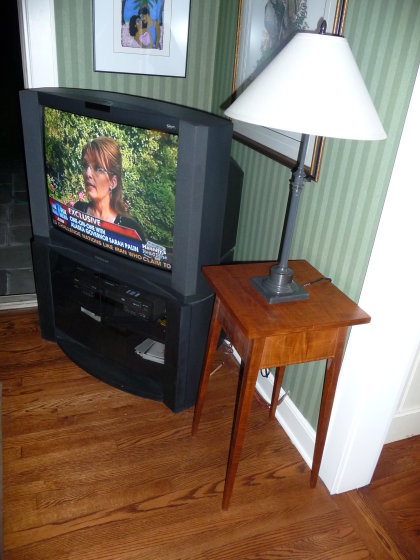
Sipp was kind enough to bring over a similar table the other day, in an antiqued (can't appreciate the antiquing in my in photo) finish. It is situated among the pile of other engagement gifts, below:
Continue reading "Sippican Cottage Furniture makes good stuff"
Friday, June 12. 2009
From The Committee of Public Sensitivity, at Pajamas:
Ezra Levant: I think most debates are won or lost before they’ve even begun. That’s because one side manages to define the terms of the debate and even the vocabulary. Take the very name “human rights commission.” How could you possibly argue against something so saintly? And me? I was accused of “hate speech.” Who could possibly support me?
Time to turn that around. I was actually the defender of human rights — freedom of speech, freedom of the press, freedom of religion, property rights. The HRCs were violating my rights. I wasn’t a hater; I was merely publishing the news. But, as it turns out, many staffers of HRCs are so radical, their own politics can reasonably be called hate. Etc. My point is: I decided not to let the other side have all the good words. That’s a story about political correctness. But it’s about something much deeper than that; it goes back to George Orwell’s Newspeak and 1984. I wasn’t about to let some petty fascists tell me I was abnormal. They were. And it was my goal to prove it.
From Coyote:
Bill Whittle makes a great point in this video which is at the heart of the problems with this administration: While Obama and his young policy wonks may be smarter (or at least think they are smarter) than other folks individually, they cannot possibly be smarter than the sum of 300 million well educated, relatively affluent Americans making decisions for themselves. Every technocrat founders on these rocks, when they substitute their decision as command and control planners for individual decision making (example). Everyone talks about a revival of interest in Ayn Rand, and that is great, but it is Hayek who has never been more relevent.
More on the failures of technocrats here.
His final link includes the key phrase "You don't have the right to make decisions for other people." Smart or not, most technocrats and policy wonks have never had a job outside of government, academia, or think tanks - and thus tend to be disconnected from how reality works. Their insulation protects them, and reinforces their rationalizations for their power-seeking.
Our current global cooling trend threatens world grain production.
If warming were doing this, it would be front page news.
“You can get much further with a kind word and a gun than you can with a kind word alone.”
Al Capone, quoted at My Vast Right Wing Conspiracy in a piece on CaponeCare
Nina Anasiashvilli in Giselle:

Thursday, June 11. 2009
High Water (for Charlie Patton)
High water risin' - risin' night and day
All the gold and silver are being stolen away
Big Joe Turner lookin' East and West
From the dark room of his mind
He made it to Kansas City
Twelfth Street and Vine
Nothing standing there
High water everywhere
High water risin', the shacks are slidin' down
Folks lose their possessions - folks are leaving town
Bertha Mason shook it - broke it
Then she hung it on a wall
Says, "You'll dance with whom they tell you to
Or you don't dance at all."
It's tough out there
High water everywhere
I got a cravin' love for blazing speed
Got a hopped up Mustang Ford
Jump into the wagon, love, throw your panties overboard
I can write you poems, make a strong man lose his mind
I'm no pig without a wig
I hope you treat me kind
Things are breakin' up out there
High water everywhere
High water risin', six inches 'bove my head
Coffins droppin' in the street
Like balloons made out of lead
Water pourin' into Vicksburg, don't know what I'm going to do
"Don't reach out for me," she said
"Can't you see I'm drownin' too?"
It's rough out there
High water everywhere
Well, George Lewis told the Englishman, the Italian and the Jew
"You can't open your mind, boys
To every conceivable point of view."
They got Charles Darwin trapped out there on Highway Five
Judge says to the High Sheriff,
"I want him dead or alive
Either one, I don't care."
High Water everywhere
The Cuckoo is a pretty bird, she warbles as she flies
I'm preachin' the Word of God
I'm puttin' out your eyes
I asked Fat Nancy for something to eat, she said, "Take it off the shelf -
As great as you are man,
You'll never be greater than yourself."
I told her I didn't really care
High water everywhere
I'm getting' up in the morning - I believe I'll dust my broom
Keeping away from the women
I'm givin' 'em lots of room
Thunder rolling over Clarksdale, everything is looking blue
I just can't be happy, love
Unless you're happy too
It's bad out there
High water everywhere
The song is from 2001. This is London, April 26, 2009:
Wednesday, June 10. 2009
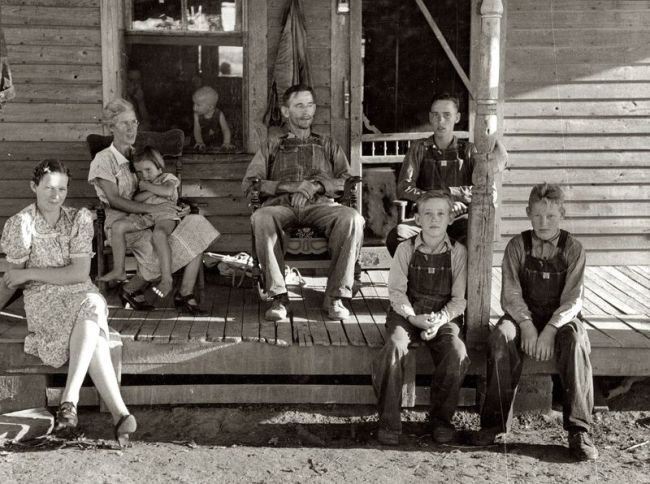
Dr X labels this photo:
Caruthersville, Missouri (Russell Lee).
Farm Security Administration client who will become a farm owner-operator under the tenant purchase program.
We posted Klavan's Why are Conservatives so Mean? video last week, which was very much based on de Tocqueville.
Samuel Gregg in the Phila Bulletin notes that this is the 150th anniversary of de T's death. A quote from his piece Despotism - The Soft Way:
For all their love of liberty, de Tocqueville stated, “Americans are so enamored of equality that they would rather be equal in slavery than unequal in freedom.”
Democracy, de Tocqueville argued, encouraged this fixation with equality because it requires people to relate to each other through the medium of democratic equality. This encourages us first to ignore, then to dislike, and finally to seek to reduce all differences that contradict this equality — particularly wealth disparities.
This is key to what de Tocqueville considered democracy’s tendency to “soft despotism.” Democratic despotism, de Tocqueville thought, would rarely be violent. Instead, it would amount to a Faustian bargain between the political class and the citizens. He predicted that “an immense protective power” might assume all responsibility for everyone’s happiness — provided this power remained “sole agent and judge of it.” This power would “resemble parental authority” and attempt to keep people “in perpetual childhood” by relieving them “from all the trouble of thinking and all the cares of living.”
Is America on the road to comfortable servility? “The American Republic,” de Tocqueville wrote, “will endure until the day Congress discovers that it can bribe the public with the public’s money.” Since Roosevelt’s New Deal, America has slowly drifted toward a political economy of soft despotism. Despite the Reagan Revolution, the trend-lines of government-spending and intervention have been in the anti-liberty direction. Entire constituencies of people now exist who regularly support politicians who promise that, in return for their votes, their entitlements (corporate-welfare, bailouts for those “too big to fail,” the old-fashioned welfare state, etc.) will be maintained and increased.
The problem is that governments can only tax-and-spend so much before incentives to wealth-creation (as opposed to wealth-transfers) begin disappearing.
|