Monday, December 8. 2008
Regular readers know that Maggie's Farm is a big supporter of Ducks Unlimited, one of the major conservation organizations in North America. The 1,000,000 members of DU now protect over 12 million acres of wildlife habitat. That is a heck of a good cause. We like to have fun, too, while raising $ to protect habitat. I took some photos of our annual event (which is mainly a boy's-night-out). Our raffle girls (with their scary boss on the left who insisted on joining the photo):  More photos on continuation page -
Continue reading "Our Ducks Unlimited Event"
Sunday, December 7. 2008
S,C&A considers many of the things that bug the heck out of us in a piece of the above title. One quote: Leftists today hate freedom and democracy because those ideas have created the environment for success. Assistant Village Idiot recently noted in a comment that Arabs don’t hate us because we have succeeded, but rather, because they have failed. The same is true for the leftists - their burning hatred of democracy stems from their failure to create a single instance of a functioning society that isn’t a least a generation behind our own. Not even the redistribution of wealth can make up for the values and freedom that create an environment that allows for the creation of wealth.
 Earth cooling because of global warming
Cheer up! And you will cheer up everybody around you. More slaves in the world today... Remarkable deer and bunny photos from Tanja Askani. More: Wolf and dog Russia tightens Europe's energy noose A prescription 9mm handgun. Would Medicare cover it? Obama plans huge spending spree. Sounds like history's biggest pork festival. And what do school buildings have to do with good education? Or school internet, for that matter? (Unless the brains full of mush are required to read Maggie's daily...) We've done this too. Paying an erroneous ticket simply to avoid the hassle. Dems suddenly change their minds about waterboarding. It's really not that bad: they do it to me every time I go to the dentist. I wish they would let me control the suction. Boston's border control chief hires illegals. What's your religion? Atheists worship solstices. Who cares? Urban safety and the great Jane Jacobs. Althouse Truthers to the left of me, truthers to the right of me. Michelle Cost-benefit analysis on wind power. Candles are cheaper. Bill Ayers, Victim And, related to the above, on the the Guardian's position on terror, via Thompson: Under no circumstances should we, rational Westerners, seek to apply the same critical standards to the Mumbai murderers and their supporters as we do - haltingly and insufficiently - to our own actions and those of our leaders. What we have to do is understand and empathize with their feelings and, as we can’t expect them to dilute their rage with reason or to seek methods to vindicate their claims that don’t involve hand grenades or AK 47s, we must make ourselves constantly ready to indulge their homicidal tantrums. Above all, we must never, ever treat them as our equals.
Krauthammer on Iraq. A quote: For the United States, it represents the single most important geopolitical advance in the region since Henry Kissinger turned Egypt from a Soviet client into an American ally. If we don't blow it with too hasty a withdrawal from Iraq, we will have turned a chronically destabilizing enemy state at the epicenter of the Arab Middle East into an ally.
Yes. That's the point.
 How Orson Bean found God: Powerline
The Coming of Love: Anchoress
Sunday, December 7, 1941 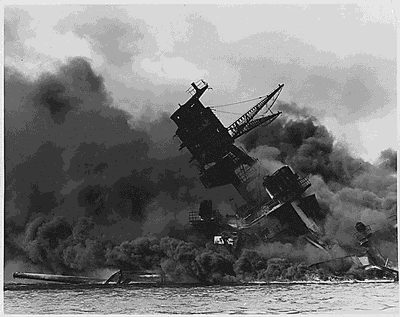
Saturday, December 6. 2008
via Dr. X. I'd be more interested in knowing how our American readers' kids do on this test than on how our readers do.
From Dan Ford: ...on December 7, Asahi News in Tokyo will broadcast a "Scoop Special" about how the US planned to bomb Japan from China, thus proving that the Pearl Harbor attack was purely in self-defense. Tomoko Nagano, meet Richard Barthel! You two will have much to talk about.
Dino revisits his topic of the "lazy, easy" lives we have been leading in recent years. Can we awaken from the dreams? One quote: “The American boy of 1854 stood closer to the year 1 than to the year 1900.” Soon, almost no one in America will have a visceral understanding of what 1854 was like, and what the heck Henry Adams was talking about.
Another: A typical boy of 1854 knew what farming was like and may well have worked on a farm, knew horses and other animals, and learned how to maintain and fix things, from houses to wagons to furniture. A typical young man of 1947 had been in the army, knew people who lived on farms, could tune and maintain his own car, and could change the fan belt on the refrigerator and refill it with Freon. Both the boy and the young man had some feel for the technologies that were developing and changing around them, since the technologies were often sized on a human scale and involved mechanical processes that they had some acquaintance with. To an important extent, this is no longer true. You can’t fix an iPod the way you can fix a record player; indeed you can’t even easily open up an iPod to understand it, as you could unscrew the turntable cover to figure out how 33 1/3 rpm became 45 rpm. Nor can you fool around with a Toyota Prius the same way you could try to replace a 283 with a 327 in a ‘57 Chevy.
Read the whole thing.
Does the average person really lie three times per ten minutes of conversation? If so, I may too trusting, or too gullible, for this world. Psychologist Paul Ekman studies emotions and deception, and has Evaluating Truth training seminars. He is the expert on micro-expression of emotion. Some of his online training programs are here. Cool stuff. Useful, too. A new FOX TV show based on Ekman's work, Lie to Me, will begin airing in January. From the clip below, it looks to be darn interesting:
Vanderleun addresses one of our perennial topics, The Religion of the Left. One quote: The Religion of the Self teaches, as its first and last precept, that there is nothing in this world greater than the self and -- beyond this world, out beyond even the unimaginable edges of the universe -- there is... well... nothing at all; "purposeless matter hovering in the dark."
We're on the same page, Mr. V. Often, if not always. This subject goes to the core of the worldview gap we are experiencing.
Best email I received yesterday (from a bow hunting pal): "We've got four deer hanging in the garage. Can you come over tomorrow around two to help cut em up and have some beers?" My reply: "You betcha."
 Best ad of the year: The Doghouse
Mumbai's the Word. Dalrymple. One quote: ... making the justified assumption that the terrorists were not actually deficient in raw intelligence, it was not the target that was important to the young killers, it was the act of killing itself. And their manipulators probably knew that there are always fools enough, at least among intellectuals in the west, to assume that if you go to extreme lengths, you must have some 'cause' - which is to say some good cause - that impels you to go to them.
Will the academic bubble be the next to burst? The Next Bubble by Donald Downs. One quote: A prescient friend of mine recently related a thought he had while teaching a few years ago at a "third tier private school" that had high tuition. At "job fairs" at the school, most of the positions being offered involved jobs as low-level managers at Target, McDonalds, and similar businesses. My friend surmised that students had to wonder why they or their families had depleted their bank accounts to pay for an educations that led to positions that simply did not require the pedagogical preparation the school offered. To be sure, a liberal education is a precious thing in its own right. But its preciousness has a way of declining when its costs put middle class citizens in a vise---especially when those citizens are already living in the vise of the new economy.
Advice to Himself Sad Catullus, stop playing the fool,
and let what you know leads you to ruin, end.
Once, bright days shone for you,
when you came often drawn to the girl
loved as no other will be loved by you.
Then there were many pleasures with her,
that you wished, and the girl not unwilling,
truly the bright days shone for you.
And now she no longer wants you: and you
weak man, be unwilling to chase what flees,
or live in misery: be strong-minded, stand firm.
Goodbye girl, now Catullus is firm,
he doesn’t search for you, won’t ask unwillingly.
But you’ll grieve, when nobody asks.
Woe to you, wicked girl, what life’s left for you?
Who’ll submit to you now? Who’ll see your beauty?
Who now will you love? Whose will they say you’ll be?
Who will you kiss? Whose lips will you bite?
But you, Catullus, be resolved to be firm. . (I don't know who did that translation.) Here's the original:
Ad se ipsum
Miser Catulle, desinas ineptire,
et quod uides perisse perditum ducas.
fulsere quondam candidi tibi soles,
cum uentitabas quo puella ducebat
amata nobis quantum amabitur nulla.
ibi illa multa cum iocosa fiebant,
quae tu uolebas nec puella nolebat,
fulsere uere candidi tibi soles.
nunc iam illa non uult: tu quoque impotens noli,
nec quae fugit sectare, nec miser uiue,
sed obstinata mente perfer, obdura.
uale puella, iam Catullus obdurat,
nec te requiret nec rogabit inuitam.
at tu dolebis, cum rogaberis nulla.
scelesta, uae te, quae tibi manet uita?
quis nunc te adibit? cui uideberis bella?
quem nunc amabis? cuius esse diceris?
quem basiabis? cui labella mordebis?
at tu, Catulle, destinatus obdura.
Friday, December 5. 2008
I have skied quite a bit and have had my share of fun/dread with some reckless things and silly drops, but never experienced these drops of 210, 230, and 245 feet (h/t, Theo). If I had, I would not be here to post this:
-
 One of my personal rules since my formal education ended has been to make sure I learn a minimum of ten interesting things per day.
I learned about CD rot today. Indeed nothing is permanent except (we, or some of us, believe) God. The Second Law of Thermodynamics says that our whole universe gizmo-thingy is set up that way. As it happened, last night, at a dinner out, a hunting buddy mentioned re-reading St. Augustine's chapter in The Confessions about time. My confession was that I did not remember that chapter at all. I do recall learning that God is a timeless entity and that God's time is not our time - but not in Augustine. And I also confess that the entire subject of time is a mystery to me. Anyway, here's a short essay on Augustine on the subject of time: Time as a Psalm.
"In politics today, intention, symbolism, and rhetoric are everything; facts, nothing." A must-read. VDH: Parallel Lives. Barrister emails: Forget politics. Politics is a power and money game, of course, because many humans get a kick out of those things. But how does Rangel keep his chairmanship, much less remain in the darn House, after these revelations? Or am I naive as hell?
Your doctor may be so concerned about protecting you from alcoholism that he or she might not tell you that current research indicates that 1-2 drinks per day appears to reduce the risk of heart and arterial disease by 18-30%. More is not better, however. Details at Medscape.
 Ever hung out in a duck blind? 24/7 live feeds from a duck blind in Mississippi. (Thanks, C.)
You just might want to keep the feed running all day, especially if you are stuck in the office.
 Nativity scenes are full of hate?
The ten most irritating phrases And more snow in England. It's "climate change" Moslem prayer rooms in every Roman Catholic school? GM's magical thinking Why bailouts don't work: Reason. Related: Public spending crowds out private spending Stock up on canned goods. Coyote makes the case that the media uses the same fears to sell economic trouble as they do to sell snowstorms Dino: Much of the financial world stopped functioning 80 days ago The case against physician-assisted suicide Dick Fuld: Villain or victim? Climate lawyers? Sheesh. I seethe, therefore I am. Ace "No you don't have a higher duty - you're a reporter." Driscoll Fake Chinese Nintendo consoles burst into flame In 1962, President Kennedy said: The problems are more difficult than I had imagined them to be. The responsibilities placed on the United States are greater than I imagined them to be, and there are greater limitations upon our ability to bring about a favorable result than I had imagined them to be. And I think that is probably true of anyone who becomes President, because there is such a difference between those who advise or speak or legislate, and between the man who must select from the various alternatives proposed and say that this shall be the policy of the United States. It is much easier to make the speeches than it is to finally make the judgments. . .
Thursday, December 4. 2008
 Ceviche/Seviche/Cebiche. I used to make it with sliced sea scallops; lime juice, olive oil and salt, marinate it for an hour or so, and serve with thin-sliced onion and red pepper, and a little fresh Cilantro.
Now Ceviche has gone global, and now it only "cooks" in the juice for a minute or two. You have to go to Peru to find the best, says this author.
Is "success" luck or pluck? Volokh considers Gladwell's book. Luck or pluck? Well, we all know that we make our own luck...but bad luck is never our fault. I think it's one of those black-and-white pseudo questions, like Nature vs. Nurture. Life is more complicated than that, and everybody has his own definition of success in a free country. And everybody fails, to some degree, in meeting his life goals whatever they may be. (My life goals happen to be to have a relationship with God, to be honest and honest with myself, to be close with my family and to give them a hand when needed, to read lots of books, to pay my hefty bills, to have some pals I can count on, to have a pleasant and civilized environment to live in, to make some efforts for the things I care about, and to have some good recreation - which includes guns, horses, golf, Scotch whiskey, ceegars, and posting on Maggie's - among other things. That's about it. I am a happy and frequently unhappy product of my culture. Saving the world is above my pay grade narcissism quotient.) Some people equate being rich (defined how? Some would term me prosperous, and some not) as success. I do not. Anyway, Wilkinson also takes a look at Gladwell and income inequality. One quote: If you understand that prices convey information about supply and demand, and that a wage is a price, then you understand that differences in wages for different kinds of labor convey information about the supply of different kinds of labor relative to demand. Wage inequalities are how people can know what’s a “high-value profession” and what isn’t. It guides our choices about the kinds of skills to seek. We need that guidance because effort isn’t enough. You can work as hard as you like in a low-wage job, and you’ll still be in a low-wage job.
When I read in the news shallow pop psychology takes on the heritability of specific traits, like conservative voting, homosexuality, and alcoholism, I am annoyed by the scientific ignorance of newspaper reporters.
I have planned, for a year, to put some time aside to write a magnum blopus on the subject, but finally realized it's better just to post something on the subject, and forget about letting the "best" be the enemy of the "good enough". Tempus fugit.
There is no doubt that personality traits are inherited. Every grandma, dog breeder, and parent knows this. And every family knows this: Bill is a true "Smith." Sally is a real "Jones." Ally is a real blend. Ted is a clone of Grandpa.
They call this general field of study "behavioral genetics," but it is actually about personality genetics and the heritability of "temperament." When you see identical twins, separated at birth via adoption, smoking the same brand of cigarettes, having the same IQ, and driving similar cars on opposite coasts, you can see it dramatically, but the fact is that the underpinnings - the foundations of personality, are surely inherited.
But they are not inherited like eye color. It's complicated.
But what is done with those foundations is what is most interesting. Free will does exist.
A re-post, but well worth it: "Huck's Tune" was released on the soundtrack to the movie Lucky You last year. A Spanish YouTube user has put the whole song up along with a homemade music video. There are a few transcriptions of the lyrics available online but I have decided not to include them so as not to spoil it for first-time listeners. Damn good stuff.
From guest writer Bruce Kesler, who seems to have found a comfortable new place to pitch his tent at Maggie's -  Economics fails us in the current economic travails, because of its inherent limitations and because it doesn’t deal with a root distortion of the factors considered.
Traditional economic theory has advanced over the past two hundred years, from simpler unifocal causation to multicausal, usually seen to operate mechanistically, which lends itself to mathematic modeling. In various ways, the emphasis is on rational decision making. Time lags are introduced to approximate learning and reaction curves. Neoclassical microeconomics has been aggregated in Keynsian macroeconomics, both lending themselves to feelings of efficacy in prescribing governmental actions. More recent behavioral economics adds that the process, at the individual or societal level, is less than perfectly rational measured choices, and often irrational. Stated, real or perceived self-interests are imperfectly or not pursued, and experiential feedback is imperfectly or not heeded. Experiments, data manipulation and controlled observations of inputs and results extend the testing and understanding of the many various approaches to economics. But, they still result in confusion, both by their battling contentions and lack of adequate predictability. Still, governments and their advisors continue to argue for one course or another, largely based on these theories, and all of us are affected. This isn’t to argue that such efforts at understanding and guidance are misplaced or unnecessary. It is to argue that more humility is needed in charting such courses. It is also to argue, now even more importantly, that a major element is missing from current economic thought: some segments of society have grown so large or powerful they are treated as too big to either challenge or fail, which grossly distorts the operations of the economy and results in grossly excess costs that create greater lasting harms.
Continue reading "The Economics of Too Big to Fail"
|