Monday, May 12. 2008
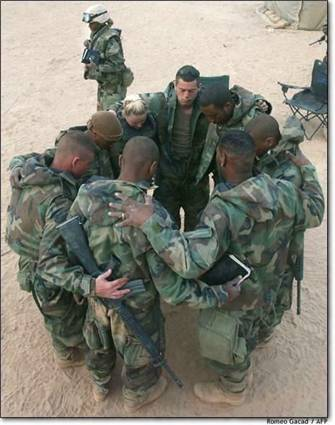 This well-worn oldie came in over the transom again, but I thought it deserved a re-post this time: What Is A Veteran? This well-worn oldie came in over the transom again, but I thought it deserved a re-post this time: What Is A Veteran?
A "Veteran" -- whether active duty, discharged, retired, or reserve -- is someone who, at one point in his life, wrote a blank check made payable to "The United States of America," for an amount of "up to, and including his life." That is honor, and there are way too many people in this country today, who no longer understand that fact.
When in England at a conference, Colin Powell was asked by the Archbishop of Canterbury if our plans for Iraq were just an example of 'empire building' by George Bush.
He answered by saying, 'Over the years, the United States has sent many of its fine young men and women into great peril to fight for freedom beyond our borders. The only amount of land we have ever asked for in return is enough to bury those that did not return. (More details on that exchange here.)
Continue reading "Our Veterans"
Saturday, May 10. 2008
Stick with it to the debate with the three Canadian Moslem lawyers (or law students?). Video: The Agenda: May 6, What's wrong with Mark Steyn's view of the world (h/t, LGF)
Learned from Kudlow on the radio today: Corporate business taxes in New York State and New Jersey are the highest business taxes in the world. Of course, businesses taxes are nothing more than covert taxes on everyone, from the company's employees, to the people who buy the product, to the investor: business taxes are passed on in the form of lower wages, higher prices, and slower growth. If we desire economic growth, job growth, and prosperous employees, there should be no taxes on the profits of public corporations. (Surely we could handle the resultant loss of tax accounting and tax attorney jobs, because the country is full of burgers needing flipping - and other jobs "Americans won't do.")
Thursday, May 8. 2008
 Donald Boudreaux considers his colleague Bryan Caplan's much-discussed book, The Myth of the Rational Voter. One quote: Donald Boudreaux considers his colleague Bryan Caplan's much-discussed book, The Myth of the Rational Voter. One quote:
Each of us has muted incentives to study the facts and issues carefully -- and to reflect upon them dispassionately -- because no one of us is responsible for deciding which policies the government will implement. But Bryan Caplan explains another reason why each of us as a voter generally exercises less wisdom than we do in our private affairs. This other reason springs from what Caplan calls our "preferences over beliefs." Each of us wants to believe certain things. Each of us gets satisfaction simply by holding certain beliefs firm to our hearts. Just as many of us enjoy feeling loyal to our favorite sports teams, many of us enjoy believing that our favorite political party is an especially wise steward of the public interest. Many of us enjoy believing that our troubles are caused by foreigners. Many of us enjoy believing that if the rich pay higher taxes, middle-class and poor people will be better off. We resist rejecting these beliefs even if the evidence before us suggests that they are mistaken.
Indeed, people are only sometimes rational, and even less often rigidly logical. We are not computers, or Mr. Spocks. In most things humans do, we engage our souls, hearts and our minds, and it is the challenge of adulthood to monitor, critique, and to balance those things in ourselves. For example, were it not for our hearts and souls, it might make sense for us to vote for a thoroughly pragmatic, efficient, and logical Brave New World. Wisdom is not the same thing as logic, and logic is not the same thing as virtue. Therefore I am in favor of a degree of irrationality in voting. And, anyway, who is the Grand Arbiter who gets to define "rational voting"? People like Thomas Frank, who believe that it is "rational" to vote yourself other peoples' money? Or "values voters" like me? Politics, government - and life itself -is messy and complicated, and even more so with freedom. Books that need to be written: "The Myth of the Rational Human" (well, Freud covered a lot of that ground already) "The Myth of the Rational and Virtuous Government" "The Myth of the Rational and Virtuous Politician" "The Myth of the Rational and Virtuous Bureaucracy" and "The Myth of the Rational Expert" Editor's Comment: Great blog minds think alike. Bainbridge today on The Imperfectibility of Human Institutions. He quotes: The Framers understood that the self-interest which in the private sphere contributes to welfare of society — both in the sense of material well-being and in the social unity engendered by commerce — makes man a knave in the public sphere, the sphere of politics and group action. It is self-interest that leads individuals to form factions to try to expropriate the wealth of others through government and that constantly threatens social harmony. John O. McGinnis, The Original Constitution and Our Origins 19 Harv. J.L.& Pub. Policy 251, 253 (1996).
In a short post on tax competition, Mankiw gets right to the heart of it all: ...are you more worried about too little government or too much?
Wednesday, May 7. 2008
 As the human race awaits the next inevitable Ice Age which will leave vast areas of the Northern Hemisphere under mile-thick glaciers, humans find it amusing to argue about the weather. As the human race awaits the next inevitable Ice Age which will leave vast areas of the Northern Hemisphere under mile-thick glaciers, humans find it amusing to argue about the weather.
Quote from a piece at Global Warming Politics: “The warmers are getting more and more like those traditional predictors of the end of the world who, when the event fails to happen on the due date, announce an error in their calculations and a new date.” [Dr. John Brignell, Emeritus Engineering Professor at the University of Southampton, on Number Watch (May 1)] Oh dear! The inevitable is happening. The ‘global warming’ trope is unravelling on a daily basis - scientifically, economically, and politically. The wheels are coming off the hysterical bandwagon, and it is not going to be a salutary sight watching the politicians and the media junkies jumping cart and trying to throw mud in everyone’s eyes.
However, fear-mongers like well-known emitter Al Gore says cyclone a consequence of global warming. WTH? Does he believe that, or does he just have a policy that everything that happens in weather is man's fault? He parodies himself while frightening the ignorant. Meanwhile meteorologist John Coleman echoes our piece on how the warming frenzy is damaging worthy environmental efforts. From his Open Letter to Environmentalists: Here is what I am suggesting you do. Campaign for your environmental goals on the basis of their own merit. Let go of the global warming frenzy before it leaves you discredited and embarrassed. Stop screaming, “The sky is falling.” It is not. Do your good work. Devote your lives to our environment. In many ways you will succeed. We are all grateful for your love of the planet. But, don’t use scare tactics. Most of all I urge you not to become extremists. And, may I encourage you to live your lives in a loving way, love your fellow human beings and our wonderful advanced standard of living and way of life as much as you love the Earth.
Image is a free plug for Prehistoric World Images.
Is there a post-Protestant Ethic, post-Consumption & Hedonism Ethic of Capitalism? I suspect this book review from Spiked is more interesting that the book itself. A quote: Barber argues that the new ethic of capitalism is one of ‘infantilisation’: money today is to be made in maintaining adults as needy children, who stuff down dumbed-down films, saccharine food and video games. While in the early stages of capitalism it benefited the capitalist system for everybody to save their pennies, now it benefits the system for us to splurge every penny and borrow more. While in the time of Franklin people were encouraged to restrain themselves and reinvest, now, says Barber, we are encouraged to act on every immediate whim, to be the grasping child in a sweet shop unable to say no.
Apparently I am way out of date, as usual, because I still operate on the Ben Franklin model, more or less.
Tuesday, May 6. 2008
I found the link to Keith Thompson's 2005 SF Chronicle op-ed piece, titled Leaving the Left: I can no longer abide the simpering voices of self-styled Progressives in a comment somewhere recently. I cannot recall whether I had read it in the past or not, but I post it because it sounds much like what happened to my thinking in my 30s. Like most well-educated Protestant families in New England at the time (and much less so, today), I was raised in a soft-Left-oriented home. You know: "Joe McCarthy was the devil, but Joe Stalin meant well and besides, the Russians have free medical care." (The only Socialist we were willing to hate was Hitler.) This was combined with a solicitous condescension towards blacks, the "poor" people who worked with their hands, and any other convenient "victim" group. We "cared" about them, or so we convinced ourselves in our self-admiring superiority - but we didn't really know any of them very well, and had no clue about how they ran, or planned, their lives. What else did we take on faith? That the UN would bring an end to war, that higher taxes (on other people) were a very good idea, that pacifism usually made sense even in the face of an enemy ("Better Red than Dead"), that FDR was a great president, that the world of business - as compared to the "professions" - was tainted with "selfishness" and thus dishonorable, that patriotism was jingoism and nationalism a bad thing, that there was no real "evil" (other than Conservatives), and that DDT was a terrible thing. Socially "nice" stuff like that. (Of course, we took many good, solid things on faith too, but that's another story and another blog post.) We all felt smugly virtuous, I think, and quite superior to the ignorant and presumably unwashed masses who cast votes for "idiots" like Nixon and Barry Goldwater instead of for the enlightened ones who only wanted to "help them." That was before I fully appreciated how much Americans - and I - appreciate our freedom from government power and intrusion. And what a sturdy, thrifty, resourceful, practical, independent, hard-working bunch we Americans really are. I will never forget my first lesson in this on a summer job during high school, but it took years of exposure to real life and to real people to cure me of my malady which was, at the bottom of it, I think, related to pride: the sickest form of pride - the notion that we - the fortunate and privileged "intelligentsia" - the bien-pensants - knew what was best for other folks and for the country. We were educated in everything except humility, common sense, and an adequate appreciation for freedom. Life's wisdom cannot be taught. Only learned. So, to return to a quote from Thompson's essay, which is similar to, but better than, the one I would have written: I grew up in a northwest Ohio town where conservative was a polite term for reactionary. When Martin Luther King Jr. spoke of Mississippi "sweltering in the heat of oppression," he could have been describing my community, where blacks knew to keep their heads down, and animosity toward Catholics and Jews was unapologetic. Liberal and conservative, like left and right, wouldn't be part of my lexicon for a while, but when King proclaimed, "I have a dream," I instinctively cast my lot with those I later found out were liberals (then synonymous with "the left" and "progressive thought"). The people on the other side were dedicated to preserving my hometown's backward-looking status quo. This was all that my 10-year-old psyche needed to know. The knowledge carried me for a long time. Mythologies are helpful that way.
If you never read it, please do so.
A quote from Sowell's latest: ...I received a letter recently from a man who grew up in my old neighborhood back in Harlem. When he and I were in the same junior high school, one day a teacher who saw him eating his brown bag lunch suddenly arranged for him to get a lunch from the school cafeteria without having to pay for it. It happened so fast that my schoolmate had already taken a bite from the school lunch when he suddenly realized that he had been given charity-- and he wouldn't swallow the food. Instead he went to the toilet and spat it out. By now his brown bag lunch had been thrown out, so he just went hungry that day. He went on to become a very successful psychiatrist.
Sunday, May 4. 2008
Good to see you Overlawyered folks visiting - check us out while you're here - you might like Maggie's Farm - Re-posted from April 15, 2006 - forgot to post it on Tax Day. (As the weather improves, we like to go like totally Green and virtuously recyle old pieces a little bit, on weekends. To save Gaia.)  Here's my story for Tax Day. I could tell you far worse, but why spoil a nice day? As regular readers know, I live in a small, charming New England town in central Connecticut, not too far from Hartford, with no crime and with no problems, except made-up ones like the crisis of having Coke machines in the High School. Here's my story for Tax Day. I could tell you far worse, but why spoil a nice day? As regular readers know, I live in a small, charming New England town in central Connecticut, not too far from Hartford, with no crime and with no problems, except made-up ones like the crisis of having Coke machines in the High School.
When Robert Frost wrote "Mending Wall," his sentence "Good fences make good neighbors" was intended to be ironic, at the least. But fences do matter, in life. The folks who owned our little farm built a pool many years ago near the edge of the river - it's a nice trout stream which borders the southern end of our place. Yes, the pool was built before anyone ever heard of the word "wetlands." Nice pool, perfect for smoking an Uppmann Magnum next to, with a glass of Scotch, while dangling one's feet in the water, listening to the river and the birdies, and just generally enjoying being a late-middle-aged American fellow. I go to down to our little Town Hall, just to stay on the right side of the law, to make a cautious inquiry. Town Hall sits in a nice old colonial house in the center of town, with a brick addition on the back. "It's about a pool fence," I tell the receptionist, who is doing nothing at all. "P&Z", she replies. I go up the stairs to P&Z, and wait for 20 minutes while it is decided that it is OK with the all-wise and all-knowing government for someone to install central vacuuming in their house. "It's about a fence," I finally am able to say. "Go the Building Dept." I go to Building Dept., where there are two guys hanging around the desk. "It's about a pool fence." The guy is friendly and helpful. "Show me where on the map." I show him the property, and he says "Got to go to Wetlands first." I am now running short on time. I go down the stairs and to the back to Wetlands. The nice young lady takes about 20 minutes to determine that the obvious fact that my property abuts a river. "You can't build a new fence there - that's a high-velocity flood zone." "But I am required to have a fence around the pool", I insist, "because the town requires it". And then I made a foolish error, mainly because I was impatient and had limited time. "The old fence was washed away when Katrina blew through here in the fall, so all I need to know is whether it is OK to replace it." "An unfenced pool? That is a zoning violation. I am obligated to inform the P&Z inspector." I sputtered "But but but..I only need to replace it." She replied "We will need it inspected first, but you are probably currently in violation, because we take pool safety seriously in this town. But construction in a wetlands flood zone will require a variance and a hearing which will take several months to schedule. You can begin by filling out these forms", she said, handing me a packet about one inch thick. "Honestly, I might suggest to you that you get a local lawyer to represent you in this matter, because these issues become complicated, especially when you want something grandfathered." I'm a lawyer. But I know little about Land Use law. So I am supposed to hire some goofball who plays golf with the folks in Town Hall for a $2000. retainer? As I leave, I wonder why there is no law for a fence on the river. Heck - a kid or turtle or fish or moron could drown in that. And no-one can see my pool from any other house or road, so it hardly qualifies as an "attractive nuisance." But I don't mind that much. Just another dumb law - we all get used to them in this era in which government tries to be everyone's parent. Too bad people who go into government tend not to be too...um...swift. As everyone knows, but that's OK. And I also wonder about this: We must have fences around pools, but not around rivers and ponds and lakes - or the ocean. And no fences to protect our national borders. Which is more important? I don't mind being Frost's practical but un-soulful neighbor: I will gladly provide both my pool fence, and my national border fence. The law may be an ass, but it's the law. But when it takes a specialized lawyer to understand the law, it's a big problem - and expense - for everybody. If our laws are not comprehensible, everybody loses. Except us lawyers.
 Cuba lifts ban on home computers. No internet access, though. What fun are those boxes without Ye Olde Internets? Cuba lifts ban on home computers. No internet access, though. What fun are those boxes without Ye Olde Internets?
A step in the right direction, though. Police states like China and Cuba love to keep their subjects poor, stupid, and insulated from outside ideas and information. TMI might confuse their tiny brains, you know? They do not trust the good sense of their people to make up their own minds about life. On some level, they view "the people" as their enemy. That is paranoid - and evil. Regular people are farm animals to them, and nothing more than fodder for The State.
Thursday, May 1. 2008
I thought we were all going to drown in 10 years. "Never mind," say scientists. The article doesn't even bother to mention that we've had over ten years with no warming, in complete contradiction of all warming models. That's "climate change" for you. Now, any "warming" is real, but any cooling is an accident. But what if the warming was an accident, and long-term cooling is real? No doubt Al Gore's hedge fund is now going long the goose-down futures market. This reminds me of Paul Krugman predicting 15 of the last two recessions. Now watch the ideological warmingists "adjust" their models to keep the cash coming in. Up here in Yankeeland, there's the old saying "If you don't like the weather, wait ten minutes." From what I have been able to learn, some warming would be good for the human race for food and wine production, as it has been in history. Nevertheless, I am not throwing away my ski parkas. We are having a dang cold Spring up here.
Wednesday, April 30. 2008
From our brother-in arms Coyote: Todd Zywicki has a nice post on the The Two-Income Trap: Why Middle Class Mothers and Fathers are Going Broke by Professor Elizabeth Warren and Amelia Warren Tyagi. In his writings on the tactics for engineering the communist state, Karl Marx talked a lot about the need to "proletarianize the middle class." This has been a very popular tactic among leftish writers and politicians today, attempting to convince the middle class that they never had it so bad.
No doubt. Let's inculcate a sense of grievance in those two-income middle-class families, so they will turn to the State for rescue. The fact is, we have two-income families because people want more money, and desire a higher standard of living than the average single-income middle class family in 1970. Ah, but they have less disposable income than in 1970 - and here's why (from the linked pieces):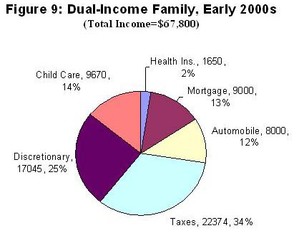 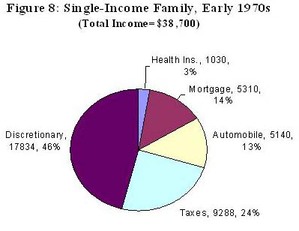
Discretionary income has shrunk from 46% to 25% of total income - and taxes account for all of that reduction. The governmental solution, no doubt, will be to raise their taxes to provide more "free services." That's the Gramscian tactic: tax 'em 'til they feel poor, then apply incremental Marxism until they own your soul and you become a grateful serf of The State at The People's Tractor Factory #23. For details, read the links above.
If economists only do things that make economic sense, then Captain Capitalism lists a few things they surely do not do. I would add one more: they would never run a blog like Maggie's Farm.
This is a pretty good rule-of-thumb. (h/t, Tangled Web)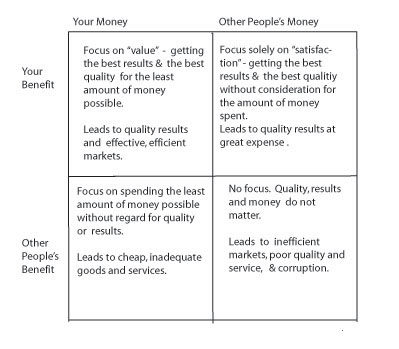
Tuesday, April 29. 2008
As Englishman notes, the tropical troposphere should be the most sensitive indicator of global warming. It just isn't happening. Full discussion and details at Climate Audit. 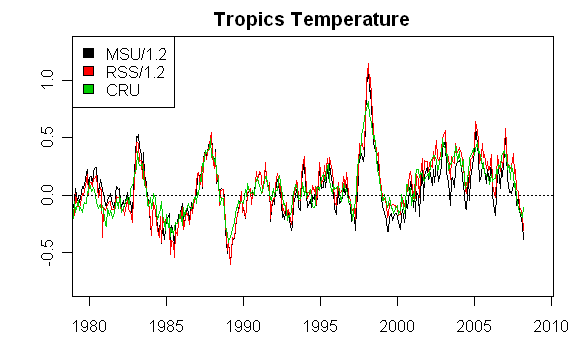
Monday, April 28. 2008
 I think so, and Climate Skeptic agrees: I think so, and Climate Skeptic agrees:
Observe today how little of the discussion is about anything other than climate. There are still many environmental issues in the world that can be improved by the application of man's effort and technology -- unfortunately, climate is the least of these but the issue getting the most attention. Consider how the global warming panic has sucked the oxygen out of the environmental movement. Ten years from now, I predict that true environmentalists will be looking back on the hysteria over trace amounts of CO2 in the atmosphere as a huge setback for real environmental progress.
As readers know, we are old-time Conservationists here. We believe in National Parks, State Parks, nature preserves, farmland protection, habitat protection, species protection, zoning, "open space", clean rivers and waters, unpolluted air, and we do not approve of the government subsidizing real estate developers and urban sprawl by building highways to nowhere. The Audubon Society came into being to protect Egrets. The photo above of an American Egret in CT, with his breeding plumage (sent in by a reader last week), shows the reason. At the turn of the century, those breeding-season plumes were all the rage for decorating lady's hats. Thus our egrets - the American and the Snowy in particular - were hunted almost to extinction. That is called "unsustainable use." The same applied to the market-gunning and netting of waterfowl - and the Passenger Pigeon. Of necessity, we now have hunting laws, hunting seasons, wildlife refuges, and protected species. Thus we are not Libertarian when it comes to land-use and unsustainable and irreversible exploitation of wildlife or wildlife habitat. The Conservation Movement of John Muir and Teddy Roosevelt had to become politicized, because laws were required in the presence of competing interests: witness, nowadays, the political conflicts in MA and in Europe around the efforts to enforce sustainable fish harvests. We simply try to be rational about it all. For example, we have no problem with oil drilling in ANWAR or off the Florida coast (as the Cubans and Chinese are doing). We have no problem with responsible logging, which effectively mimics the effects of natural wildfire on forest succession. We love to hunt and fish, and do so responsibly and sportingly. We think the earth probably has more than enough people on it. We favor nuclear power for reasons of energy independence and because it's the closest thing to a free lunch after compound interest. We feel that biofuels are a lousy idea for many reasons.  At the risk of sounding corny, we believe in good stewardship of our inheritance. At the risk of sounding corny, we believe in good stewardship of our inheritance.
What's irrational? The Green Movement is irrational. Most of it represents feel-good ideas that are hooey: symbolic hooey that is meant to make people feel virtuous while accomplishing nothing. Witness the lightbulb craze, "organic" vegetables, "recycling" plastic bottles (totally energy-inefficient), or hybrid cars (which do nothing "for the planet" but which are great on gas mileage). It's empty vanity and fashion, and nothing more (for an example, see this foolish agonizing piece by Michael Pollan, who has caught a bad case of the vain and guilt-ridden sanctimony of the "I can make a difference" disorder). Pure organic pixie dust for the latte liberals. The CO2 obsession is similarly irrational, and, deep down, everybody must know it. It is irrational because it is futile, regardless of whether there is any current warming, and regardless of whether there is any man-made warming. (We suspect that it is long-term cooling.) As Steyn said yesterday at NRO: Whether or not there’s very slight global cooling or very slight global warming, there’s no need for a “war” on either, no rationale for loosing a plague of eco-locusts on the food supply. So why be surprised that totalitarian solutions to mythical problems wind up causing real devastation? As for Time’s tree, by all means put it up: It helps block out the view of starving peasants on the far horizon.
If anybody thinks the Chinese, the Russians, and, eventually, Africa, intends to stop building fossil fuel power plants, they are dreaming. If anybody thinks wind power will ever be more than a drop in the bucket - even if subsidized as it is - is dreaming. And those who want (more) "carbon taxes" just want another cover, another excuse, to take more of our money. They can have more "carbon tax" if they reduce my income tax to compensate. Everybody wants more power, and as cheap as possible, because power is the wonderful stuff that makes our modern civilized, efficient and lazy lives possible. The rapidly-developing world understandably wants more of it. Somebody will need to pry my Stihl saw - and my computer - from my cold dead hands. So, to meander back to my main topic, I agree with Coyote that the CO2 frenzy and the other trendy Green frenzies have "drained the oxygen" from a Conservation movement which has many other compelling areas in which it can be, and should be, effective. And, yes, I do believe that many of those Greenies are motivated by a Socialist agenda using "Gaia" as a front. I will believe their sincerity when they quit driving and flying. However, their socialist-totalitarian streak, plus their wackiness and scolding, have damaged rational conservation goals via guilt by association. On the other hand, I do favor the use of local, state and federal powers (and especially some non-profits which do the same things free from political considerations) for the conservation goals which are important to me, which I believe to be rational, and which I like to believe contain no ideological agenda but which certainly contain a moral and practical agenda: we do not wish to hand down a planet covered with asphalt and oceans without Codfish. Some things - maybe just a very few precious things - should be more important than freedom and free markets, but that's where the political debates begin, isn't it? That is the line of scrimmage. On the "values" scale, we rank individual freedom at the top of the list, but, like everybody, we also have competing values, morals, and interests.
Friday, April 25. 2008
I read the Los Angeles Times article we linked about how the Bush administration failed to protect New Orleans, and it just didn’t smell right. We looked into the departmental files and found a clipping from a blog called MemeFirst, and it reminded us of the Save Our Wetlands lawsuit where a wise Federal Judge stopped the Corps from building proper dikes. Some of you will recall that in the comments section of this post last week, I mentioned that flood planning and abatement measures take decades to build, and I wrote that I wouldn't be surprised to find out that relevant planning decisions went back to the Carter or Reagan administrations. Actually, it was the administration of Lyndon B. Johnson that set in motion the modern flood protection system for New Orleans - or at least the flood protection system that New Orleans was intended to have. After Hurricane Betsy in 1965, Congress approved and Johnson signed a law to build the Lake Pontchartrain Hurricane Barrier Project to protect New Orleans from future catastrophic hurricanes. The centerpiece walls and gate systems mandated by the bill, however, were never built. Why? A lawsuit begun in the mid-70s by environmentalists stalled development well into the 80s. After nearly a decade of litigation that prevented implementation of the plan, the Army Corps of Engineers finally threw in the towel and shifted to a compromise plan that had less of an "environmental impact." Some protection, after all, was better than none. Bottom line, the federal government had a plan to protect New Orleans from hurricanes like Katrina, but was unable to implement it due to interference from local environmentalists and the local judiciary. The environmental group that brought the lawsuit - the now-ironically named "Save our Wetlands" - hasn't yet taken down the web page boasting of shutting down the Lake Pontchartrain Hurricane Barrier Project. In the document, the group claims that because its attorney broke down and wept in front of Judge Schwartz, he issued an injunction that shut down hurricane barrier construction. Here's the text: “The Save Our Wetlands attorney goes right up to the Judge’s cigar, pointing his finger and says to the Judge Charles Schwartz, ‘it is not that I don’t like you it is that I am losing respect for you’. The Save Our Wetlands attorney then says, ‘You said you were going to issue an injunction now god damn issue it.’ At this point the Save Our Wetlands attorney breaks down and begins to cry, kicks open the chamber door, and enters the courtroom cursing profusely, to a courtroom packed with people. He then kicks open the courtroom door and goes immediately to his apartment and collapses; he had not slept in three days. “At 8 a.m. he gets a call that he is to appear in the Judge Charles Schwartz’s courtroom at 9 a.m. The Save Our Wetlands attorney thinks that he will be held in contempt and taken into custody by U.S. Marshals. Upon arrival Judge Charles Schwartz reads the injunction. The Save Our Wetlands attorney apologized to the co-counsel for his actions the night before. He is told, by his co-counsel Doug Clifford that it is his opinion that the Save Our Wetlands attorneys actions brought a human element to the discussions in Judge Schwartz's chambers on the previous night, and that it broke U.S. Attorney’s Gerald Gallinghouse's mental and political pressure inside the judges chamber. And it was because of this, that Judge Charles Schwartz issued an injunction against the United States Army Corps of Egineer's Lake Pontchartrain and Vicinity Hurricane Barrier Project. Save Our Wetlands Inc. nominates United States District Judge Charles Schwartz as the savoir of Lake Pontchartrain and the reason the National Bayou Savage Refuge Center--the largest urban wildlife refuge in the world exists today.”
...And also the reason New Orleans does not exist today. Getting-what-they-want-by-crying has been the modus operandi of the environmental movement in the U.S. for decades, figuratively speaking. In this case, environmentalist do-gooder busybodies actually cried to get what they wanted. On a lark I used Google Earth to investigate the fate of the home of the presiding judge - Charles Schwartz, Jr. - which backs up on the Metairie Country Club. It's still standing, but he'd better find himself a pair of waders, especially if he plans on playing the back nine anytime soon. Who's crying now? The left-wing think tank, Center for Progressive Reform, takes the position that the injunction was simply a minor annoyance that would shortly have gone away, but also reveals that the left, the enviro-loonies (and the local Democrat machine) had mounted fierce opposition to the Corps. Right-wing pundits and politicians, however, have attempted to blame the flooding on environmental litigation that temporarily halted the Corps from pursuing the first option. They argue that if the law suit had not been initiated, the Corps would have been able to complete the first option and the city would therefore have been better protected. As this report documents, these claims are wholly unfounded. It is beyond dispute that the litigation would have only temporarily delayed the Corps from pursing option one had it chosen to do so. In the process of responding to the lawsuit, however, the Corps decided to switch to the second option because it believed that one represented the better policy. This switch also responded to the widespread local public opposition to the first option. See Special Levee Report.
Let us look at the sentence that starts with “It is beyond dispute that”. Has the dear reader previously noticed how the left loves that phrase? The actual translation is, “I don’t want to talk about it!” That in turn relates to the fact that the speaker actually lacks the facts, the logic, or both to dispute it. The writer would have us believe that if the Corps had merely written a more extensive (expensive) environmental impact statement, the litigants would have happily dropped their complaint. Anyone with even the most passing familiarity with environmental strike suits knows that complaining about the EIS is merely the opening gambit for litigation designed either to stop a project altogether or to make it too expensive for the proponents to proceed. The Corps chose to drop its fight and comply with the community’s expressed wishes, for which they are entirely unwilling to accept the consequences. In fact the city sued the Corps for $77 BILLION in damages for its actions, but in an article February 1 entitled “In Court Ruling on Floods, More Pain for New Orleans”, the Times sniffs, “There is disappointment but little surprise in New Orleans after a federal judge grudgingly absolved the Army Corps of Engineers of liability in the flooding of the city after Hurricane Katrina.” The leftyloonies at the Times (and the federal judge) appear to actually believe that the Corps of Engineers should be held liable for damages to New Orleans for conceding that it had lost a lawsuit
Thursday, April 24. 2008
Photo: Maj. Gen. George B. McClellan 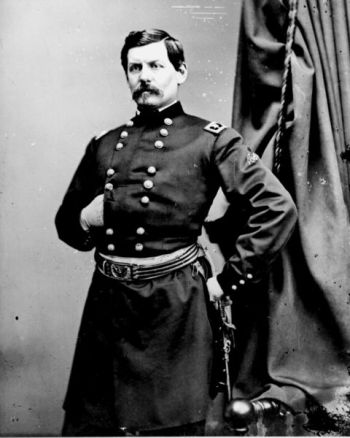 Peacetime Generals: Too Fearful of Losing to Risk Winning Peacetime Generals: Too Fearful of Losing to Risk Winning
Peacetime generals have never been able to fight wars. President Abraham Lincoln’s peacetime general was George Brinton McClellan. According to Wikipedia, “Although he understood that the Confederacy had to be defeated, McClellan, a member of the Democrat Party, advocated military conduct under “the highest principles known to Christian civilization” and was generally conservative on slavery. Hence, he was never in favor with Radical Republicans, who demanded the immediate abolition of slavery and regarded McClellan as “soft” on military measures. McClellan's supposed moderation became a central issue when he ran for president in 1864. Although he strongly advocated continuing the war until victory was achieved, some historians have suggested that if McClellan had defeated the Republican Lincoln, the peace faction within the Democratic Party would have insisted that the war effort be suspended, and the Confederacy would thereby have achieved independence.”
The Reader's Companion to American History adds: “A month into the Civil War McClellan was appointed major general in the Regular Army and commander of the Department of the Ohio. After efficiently managing a campaign in western Virginia, he was summoned to Washington late in July 1861, following the Bull Run debacle, to take command of the main Union army in the East. Over the next eight months he trained and organized the Army of the Potomac, serving for four of those months as general-in-chief of all the Union armies. “In April 1862 McClellan took the field to direct the largest campaign of the war, an advance against Richmond via the Virginia peninsula. For three months he inched his way cautiously toward the Confederate capital, but in the Seven Days' Battles (June 25-July 1) he was driven into retreat by Robert E. Lee's smaller Army of Northern Virginia. Ordered to evacuate the peninsula in August, McClellan was slow to send reinforcements to the embattled Union forces at Second Bull Run, and Lee was again victorious. When the Confederate army invaded Maryland early in September, President Abraham Lincoln reluctantly turned once again to McClellan, a general stained by defeat but the only general capable of restoring shattered Union morale. On September 17, along Antietam Creek near Sharpsburg, McClellan finally brought Lee to battle. Despite his greatly superior force, McClellan's cautious generalship gained only a draw in the bloodiest single day's fighting of the war. He refused to pursue Lee back into Virginia and was reluctant to renew the campaign in the weeks that followed. On November 5, 1862, Lincoln ordered him relieved of command. . . . He was a general afflicted with "the slows" (as Lincoln put it), too fearful of losing to risk winning.”
Every president since Lincoln has had serious problems with peacetime generals in the opening years of a war. It is not hard to understand. The peacetime military is civil service with dazzling uniforms, and the skill-set needed and used to get that all-important promotion from Colonel to General, or Captain to Admiral, is the antithesis of the skill-set needed to win battles. The warfighter must be a risk-taker, an innovator, and a swift decision-maker. The “Perfumed Pentagon Prince” to succeed in the Pentagon must be compliant, doctrinaire, and collaborative. Generals Colin Powell, the media Saint, and Norman Schwarzkopf in the first Iraq war were pushed by SECDEF Cheney to listen to Colonel John Boyd (see “BOYD, The Fighter Pilot Who Changed the Art of War”) who devised the famous “Left Hook” that cut off and isolated the Republican Guard. Generals Powell and Schwarzkopf wanted to follow the “Powell Doctrine” which called for a deliberate massive push “up the center” with overwhelming force, the tactic developed for opposing Soviet tanks in Eastern Europe, but they were overruled by Cheney, and Stormin’ Norman was gracefully given credit for the wildly successful “Hail Mary” attack. President Clinton had similar problems. Pentagon brass refused to attack Al Qaeda on the grounds that it was not a “country” and they couldn’t attack private individuals. Former White House counterterrorism chief Richard Clarke in his book “Against All Enemies: Inside America’s War on Terror”, quotes Mike Sheehan, a State Department official, saying in frustration, “What’s it going to take, Dick? Who the shit do they think attacked the [USS] Cole, fuckin’ Martians? The Pentagon brass won’t let Delta go get bin Laden. Hell they won’t even let the Air Force carpet bomb the place. Does al Qaeda have to attack the Pentagon to get their attention?” We know they did, and it did, but that came later. Further, according to Dana Priest's book “The Mission”, the Clinton White House wanted U.S. pilots in the no-fly zone to provoke the Iraqis into attacking American planes. The then-CENTCOM commander, General Anthony Zinni, believed that this could lead to war with Iraq and insisted that the White House issue him a direct order to undertake such an action. Faced with leaving a paper trail, the White House changed its mind.
Continue reading "Masters of War and Failures in Generalship"
"Teaching for "social justice" is a cruel hoax on disadvantaged kids." Sol Stern on Bill Ayers and his ilk, at City Journal. This Ed School stuff is straight from Gramsci's handbook, and it represents a conspiracy to keep the "masses" poor and stupid - and angry, hopeless, and helpless. In other words, ripe for "rescue" by The State. Speaking of Gramsci and Ayers, we did a piece a while ago about Hillary and Obama and their Alinsky connection.
Tuesday, April 22. 2008
 From the Peoples' Cube: From the Peoples' Cube:
Now that the idea of social awareness and class struggle has reached American pulpits, it was only a matter of time before progressive historical revisionism left its academic confines and flooded the nation's churches, raising consciousness of the worshiping masses and prompting them to re-evaluate archaic concepts of "faith," "freedom," and "morality." Armed with the winning theory of class struggle, more and more oppressed churchgoers are finding the courage to speak out against violations of human rights in the ancient world, and indeed against the entire litany of "traditional" "conceptions" based on the "Bible" and its "teachings." In this sense, the conference of religious leaders and scholars from around the world, titled "From Security to Homelessness: Moses and the Renegade Exodus of the Hebrews" was the first major event of its kind, focusing on Moses' fraudulent activities and the resulting major humanitarian disaster called the Exodus. Convened at the Cathedral of the Victim Trinity in Chicago just before the Easter and Passover holidays, the confab manifested itself as a global showcase of progressive religious studies.
Read the whole thing. (Image from the piece.)
From Kudlow, in Why Not Blame Obama?: In fact, in America’s largest cities, a firefighter married to a schoolteacher can earn close to $200,000 filing jointly. So not only will each spouse separately pay more for Social Security and health care under Mr. Obama’s plan, together they’ll also be slammed by Mr. Obama’s cap-gains tax increase. This is more than just a failure to understand the Laffer curve. It’s another cultural misstep by Mr. Obama. I can’t help but wonder if the senator knows any cops or firemen. His appeal is to well-educated latte liberals. That remark about middle-income folks having turned to God, faith, and guns because of economic setbacks? Not only was it ill-advised, it illustrates the wide cultural chasm that exists between the candidate and the rest of America.
Kudlow makes the point that we have made many times here: the American socio-cultural Middle Class - if any such thing exists - spans family annual incomes between $40,000 - 200,000. Plumbers in my village make $200,000 if they work hard and will show up on weekends. My gunsmith charges $175/hr (but he gives me a break if a job takes too long), and his wife works for the town.
What is Constitutional and What is Unconstitutional in Eminent Domain? FindLaw, a web-based subscriber source of legal materials, gives us some details on the use of eminent domain for redevelopment purposes: “The Supreme Court has approved generally the widespread use of the power of eminent domain by federal and state governments in conjunction with private companies to facilitate urban renewal, destruction of slums, erection of low-cost housing in place of deteriorated housing, and the promotion of aesthetic values as well as economic ones.”
The principles applied by The Supreme Court in Kelo go back as far as 1810 when in Custiss v. Georgetown and Alexandria Turnpike Co, the Court stopped a district court from interfering with the taking of private land for a private turnpike. Similar cases are Clark v. Nash, 198 U.S. 361 (1905) (a water ditch), and Mt. Vernon-Woodberry Cotton Duck Co. v. Alabama Interstate Power, 240 U.S. 30 (1916) (power company). In Berman v. Parker, 348 U.S. 26 (1954) the Supreme Court states, “The District of Columbia Redevelopment Act of 1945 is constitutional, as applied to the taking of appellants' building and land (used solely for commercial purposes) under the power of eminent domain, pursuant to a comprehensive plan prepared by an administrative agency for the redevelopment of a large area of the District of Columbia so as to eliminate and prevent slum and substandard housing conditions - even though such property may later be sold or leased to other private interests subject to conditions designed to accomplish these purposes.”
All these cases, however, are united by a principal of the courts deferring to the decisions of the legislatures as to what constitutes public use, or “public convenience and necessity”, the criteria for eminent domain. Elsewhere in Connecticut, a vast swathe of central Stamford was taken by eminent domain for urban redevelopment purposes by the Frank Rich Company, and Stamford was transformed in terms of economic growth, employment and culture. It hosts the US headquarters of UBS (with the largest trading floor in the world) and UBS is about to be joined by the Royal Bank of Canada’s headquarters, and there are so many jobs that people commute 90 minutes or more to work there. It was tough on the homeowners in central Stamford, but a great boon to the public at large. Justice O’Connor’s dissent in Kelo distinguishes Berman by its slum removal goal; public use in her view was not just building something to create an economic resurrection of an area of Washington, it also got rid of some nasty ugly old buildings.
However, note that Kelo really makes no change in judging the Constitutionality of a taking; it will continue to be determined by someone’s definition of “public use”. The SCOTUS majority chose to defer to the local representatives of the public in this case. This is a step back from the Court’s recent activist role, and I think it is healthy. When an issue before a court revolves around interpretation by individual decision makers of whether a proposed use of land is or is not public enough, I favor deferring to the “boots on the ground”, the local authorities. Arch-liberal Edward Lazarus actually makes my point:
“Conservatives have managed successfully to equate the term ‘activism’ with all controversial or unpopular judicial decisions. Indeed, they have even managed to take uncontrovertibly non-activist decisions and label them activist. A prime example is the Court's controversial decision in Kelo v. New London, in which the Court refused to strike down New London's decision to use the power of eminent domain to take private property and give it over to a private developer. Now, many reasonable criticisms have been leveled against the Kelo decision (though it is also powerfully defended). But one thing is certain: the decision is the very opposite of activist. Kelo is a decision refusing to impose a judicial check on the judgment of New London's elected officials. If anything, the decision is excessively passive. None of this, however, stops conservatives from tarring the decision with the activist label.”
Continue reading "A reply to some of our readers, and more on Kelo and eminent domain"
|