Monday, March 17. 2008
Best essay I have read on the subject, and it goes far beyond the story of the day. A quote: One can argue (unconvincingly, in my view) that Christian morality and teaching mandate government and political efforts to aid the poor and oppressed — as opposed to our individual responsibilities along such lines, or those facilitated collectively through the church. What one can not do is square such a constricted, monotone theology with Christianity’s vast octaves of orthodox teaching and history. If Christianity is nothing more than do-good government social programs which require no personal moral transformation, which frequently cause more harm than good to their intended beneficiaries, and require no personal sanctification or sacrifice — then who needs Christianity at all? Wrapping social programs in Scripture verses and Jesus-talk does not make them “Christian” any more than putting mascara on a pig makes her Miss Universe.
and another: The problem with ministers like Reverend Wright and others, who wrap their political and social agendas in Christian facades and Bible-talk, is that they are partly right. That social justice, concern for the poor and the underprivileged, and the mitigation of hatred and racism are — and have always been — emphatic teachings and priorities for Christianity is indisputable. But Christian opposition to injustice and oppression is not its sole and central doctrine, but rather a manifestation of the personal deliverance of the individual from the slavery and oppression of sin which Christianity offers. The half-righters have interchanged cause and effect — and thereby have guaranteed that the results of such efforts will be harmful rather than healing. For to be partly right is to be totally wrong — when the part in error is core truth about the nature of man and his relationship to God. Good deeds arising out of the darkness of the unredeemed heart invariably foster repression and dependency rather than deliverance and liberty. As Ratzinger points out, speaking of the natural evolution and outcome of liberation theology as a solution to oppression: … the overthrow by means of revolutionary violence of structures which generate violence is not ipso facto the beginning of a just regime. A major fact of our time ought to evoke the reflection of all those who would sincerely work for the true liberation of their brothers: millions of our own contemporaries legitimately yearn to recover those basic freedoms of which they were deprived by totalitarian and atheistic regimes which came to power by violent and revolutionary means, precisely in the name of the liberation of the people.
Read the whole thing.
Sunday, March 16. 2008
I do not think that I like Eliot Spitzer, but I don't know him as a person. I do know that if he came to me for comfort and help, I would be happy to offer it to him as a fellow flawed, sinful, and foolish human. I would pray with him for himself and for his family, who are surely suffering for his idiot behavior. However, his story got the brain thinking about how, if you do 999 good, charitable, loving things in your life, and one bad, illegal thing (not that Spitzer is in that category - I doubt it, based on how he handled his powers as a prosecutor) - you are screwed if you get caught. Nobody will care about the other 999. That is why cops say that there are only two kinds of people - crims that haven't been caught, and those who have been. One must be careful in this life, because it can blow up in an instant.
Saturday, March 15. 2008
 That's what my check-out gal said to me today at Home Depot. I inquired "How do you know to say that to me?" She said "Honey, I can just tell." That's what my check-out gal said to me today at Home Depot. I inquired "How do you know to say that to me?" She said "Honey, I can just tell."
"God bless you too," I said, although He obviously already did. She found a hole in a manure bag, and ran off to get some tape to cover it, even though I didn't care. I spent $120 on cow manure, but I can get the bull's stuff "free" from the politicians which will cost me much more in the end...but it won't grow the stuff She Who Must Be Obeyed wants to grow. The BS from bulls - or cows - is far more useful to us, and smells better. I am mixing up a wholesome soil stew for boxes and planters. Pansies first, then the really good stuff in a while, after frost season if global cooling gives us a break.
Thursday, March 13. 2008
Obama's pastor is too full of hatred to be in the ministry. He should move elsewhere before his anger gives him cancer or a heart attack. Maybe to Iran, where the government would share his views. Honestly, this sort of thing is too despicable for me to write about. Yes, he has the American freedom - but does he appreciate it, and what it has cost, and how precious a gift it is? Apparently not. What else does he want? What more could anyone ask for in this life? Rev. Wright hates me, I think. Hatred and ingratitude are not becoming in a clergyman - or in anyone.
If you decide to revisit the now-famous Mamet Village Voice essay, read the comments too. I value his essay for two reasons: first, because he put into words something close to what I experienced many years ago and, second, because Mamet's cultural status might offer some folks "permission" to take a fresh look at their views.
Sowell notes that the cost of incarceration in some states exceeds the costs of higher education. The point, of course, is that when people (not Sowell) talk about those costs, they ignore the monetary and social costs of letting those folks loose on us. That's the fallacy. On the other hand, MA can send 'em all to Harvard for all I care, if they want to.
Wednesday, March 12. 2008
Quoted from Roger, who understands LaR's quip: La Rochefoucauld’s observation that “hypocrisy is the tribute that vice pays to virtue” will doubtless be trotted out early and often when in the case of Eliot Spitzer and the girls. It is a famous, though often misinterpreted, observation. The epigram has generally been presented as meaning—in the words of one journalist—that “the loudest moralizers may be most suspect.” But I believe that La Rochefoucauld meant to suggest that hypocrisy was an implicit acknowledgment of the claims of virtue. Otherwise, why bother with dissimulation? There are, as I say, many reasons to dislike Eliot Spitzer. I, too, hope he goes away, and quickly. The music critic Tim Page, referring to an unpleasant and pretentious college president, observed that he was the sort of chap that gave “pseudo-intellectuality a bad name.” I feel similarly about Eliot Spitzer and hypocrisy. His behavior gives that ambiguous vice a bad name. What’s wrong with Eliot Spitzer is not so much that he praised good things and did bad ones. Most of the items he championed in his various moral campaigns were, when you looked behind the rhetoric, of dubious value. Really, he was a power-hungry, regulation-crazed functionary whose chief sin was to harness the power of the state to destroy his enemies and aggrandize himself. Had he been a little more hypocritical he might have been less dangerous.
Tuesday, March 11. 2008
 It has nothing to do with Rudy Giuliani's "broken window" approach to restoring civilization to NYC (which is no fallacy - it worked well, because providing latitude in the little things, filth, petty crimes, bums and addicts sleeping in parks, hostile squeegee men, etc. implicitly endorses latitude in bigger things, leading to an atmosphere of anarchy that nobody wants to experience). It has nothing to do with Rudy Giuliani's "broken window" approach to restoring civilization to NYC (which is no fallacy - it worked well, because providing latitude in the little things, filth, petty crimes, bums and addicts sleeping in parks, hostile squeegee men, etc. implicitly endorses latitude in bigger things, leading to an atmosphere of anarchy that nobody wants to experience).
The excellent Bastiat QQQ yesterday brought it to mind. Bastiat's famous parable of the Broken Window explains how a kid breaking a window, despite the expenditures to repair it, on the bottom line does no favor to the village's economy. While some Keynesians might argue otherwise, I would make the case that, although maintenance of things we care about is a large part of an economy - cars, houses, boats, gardens, horses, dogs, bodies, etc - the fallacy there is the failure to reckon the opportunity cost of the money on the part of the window-owner. I recently posted on the subject of the pseudo-rationality that ensues when the costs of an event are calculated, but is not compared to the costs of inaction or of alternate actions - or the advantages thereof. If anyone were to calculate the global economic advantages of global warming, for example, I think everyone would be praying for it - but I doubt it will occur in any meaningful way.
 Well, it's that time again on Wall St. In my experience, when the banks start letting people go in sizeable numbers, it's a sign that we're near a bottom of some sort of periodic mess. Well, it's that time again on Wall St. In my experience, when the banks start letting people go in sizeable numbers, it's a sign that we're near a bottom of some sort of periodic mess.
They are always behind the boom-and-bust curve, and there is no such thing as job security on The Street: everybody needs an exit strategy. So it's a good time to be a young, junior person on The Street, because they mainly focus on dropping the expensive people. That means the junior folks might get a good 7-10-year run until the next round happens.
Erroll Flynn's rape trial. Scott at Powerline. A quote: Giesler later said that Flynn was the best witness he ever had. Flynn, in his autobiography, says, “Maybe he meant I made the most skillful liar under oath.”
Monday, March 10. 2008
 Mine has not gone so well. As our Editor Bird Dog also says, it's usually the high point of my year with God, but this year it has not gelled the way it has in the past, and I have been continually distracted - or, more accurately, permitted myself to be distracted. Mine has not gone so well. As our Editor Bird Dog also says, it's usually the high point of my year with God, but this year it has not gelled the way it has in the past, and I have been continually distracted - or, more accurately, permitted myself to be distracted.
This leaves me feeling disappointed with myself, and thus more in need of Lent and of God's grace, and thus the thing snowballs in the wrong direction down the wrong hill. I know that I have only so many Lents, and so many Easters, in my life. Still, I cannot get in the groove this year and fear that Easter will therefore be a hollow celebration followed by just one more unnecessary high-calorie brunch, followed by an undeserved nap. Something is in my way, but I do not know what it is. It's nothing obvious, or I would be able to identify it. As contrast, our friend The Anchoress says: Lent has been for me a daily movement through shadows and light; so many to pray for, so much to pray about and the comprehension of all of my limitations and deficiencies. I begin to know all I do not know and have never felt so little. Sometimes, as the psalmist says, “my sin is ever before me,” and the shadows feel very heavy; other times the silence and contemplation thrust me into dizzying light, where there is warmth but then I know even less. I realize I am almost wholly unschooled in love, unacquainted with decency. What I have learned most whole-heartedly this Lent is that my instinct throughout my life have been pretty-much right on: that I am an uncultured, untutored, self-concerned and barely conscious rough beast, and I have been slouching unaware through humanity for almost 5 decades; I am only finally evolving just a little - a very little - for the better.
I do not need much more self-flagellation, but there is something maybe short of that...
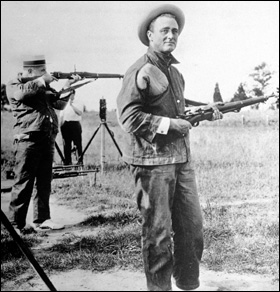 We have written several times about the destructive effect of the FDR presidency, most recently here, so there is no need to repeat ourselves. We have written several times about the destructive effect of the FDR presidency, most recently here, so there is no need to repeat ourselves.
However, it is good to see that Burt Prelutsky has come around. He begins: Growing up, as I did, in the home of Russian Jewish immigrants, it figures that I’d start out thinking that, by all rights, Franklin D. Roosevelt belonged on Mount Rushmore. But, all these years later, I have concluded that most of America’s woes can be traced back to his presidency, and that the best reason for him being up there along with Lincoln, Jefferson, Washington and Teddy Roosevelt, is that his head was already made of stone. Although FDR is often, mistakenly, credited with bringing the Great Depression to an end, as Amity Shlaes made clear in her book, The Forgotten Man, his policies, which can best be described as socialistic and anti-business, in reality prolonged America’s misery. The mere fact that he and his economic advisors thought it made perfect sense to keep raising taxes during the 1930s suggests that their primary motive wasn’t to lift the country out of its economic morass, but to take advantage of the situation to inflate the power of the federal government. The end result of his 12 years in the White House is a hodge-podge of Washington bureaucracies and an economy that finds the federal government being far and away the single largest employer in the U.S. Couple that with his personal fondness for Joseph Stalin, his filling his administration and the State Department with like-minded people, and you have a perfect blueprint for disaster. For as Thomas Jefferson recognized, “A government big enough to give you everything you want is strong enough to take everything you have.”
Burt sounds like a Maggie's Farm contributor. Read the whole thing. Photo: FDR around 1917.
Sunday, March 9. 2008
Jeffrey Bell at Weekly Standard wonders how the Repubs might deal with the aftermath of a "failed presidency." It's a worthwhile piece, but I am far from sure that Bush has been a failure - unless the measure of failure is the popularity poll of the week. Few presidents remain popular towards the end of 8 years, because everything they have done annoyed somebody.
Recessions are the times when wealth returns to its proper owners. Anonymous
I am most of the way through Tim Blanning's The Pursuit of Glory: Europe 1648-1815. It's the most enjoyable history book I've read in years, packed with color, remarkable details, and insights into the recent route to the modern world. A page-turner, in fact. I was not surprised how much I had forgotten about Frederick the Great. As Publisher's Weekly says: Blanning, professor of modern history at the University of Cambridge, has performed the miracle of balancing and blending traditional political and diplomatic accounts with the newer fields of social, economic and intellectual history. A prime example of this is the author's treatment of the impact of the new "public sphere." As people discoursed through coffeehouses, Masonic organizations or periodicals, "a new source of authority emerged to challenge the opinion-makers of the old regime: public opinion."
Saturday, March 8. 2008
EU to Ireland: Drop dead. Ireland and the EU. (h/t, Gates) The passivity of Europe in the face of the EU's power grab is utterly beyond my comprehension. It must be the same people who were "Better Red than dead," because they have been subjected to an imperial conquest without a shot being fired.
The democratization of fashion and high-end fancy stuff. Fascinating.
Friday, March 7. 2008
This is cool. I don't know whether it is true, though. Now out to dinner.
 "What is Endangered: Climate or Freedom? And Just How Sensitive is the Climate Anyway? A final dispatch from the International Climate Change Conference" "What is Endangered: Climate or Freedom? And Just How Sensitive is the Climate Anyway? A final dispatch from the International Climate Change Conference"
From Bailey at Reason, with quotes from Vaclav Klaus. One bit: Klaus noted that ideological environmentalism appeals to the same sort of people who have always been attracted to collectivist ideas. He warned that environmentalism at its worst is just the latest dogma to claim that a looming "crisis" requires people to sacrifice their prosperity and their freedoms for the greater good. Let me quote Klaus at length. "Future dangers will not come from the same source. The ideology will be different. Its essence will, nevertheless, be identical—the attractive, pathetic, at first sight noble idea that transcends the individual in the name of the common good, and the enormous self-confidence on the side of its proponents about their right to sacrifice man and his freedom in order to make this idea reality," warned Klaus. "What I have in mind [is], of course, environmentalism and its currently strongest version, climate alarmism."
Photo: Our favorite photo of tennis fan and freedom's champion Vaclav Klaus
Thursday, March 6. 2008
 A quote from a piece on Mayor Bloomberg at Pajamas: A quote from a piece on Mayor Bloomberg at Pajamas:
Since he took office six years ago, Mike Bloomberg’s record is, among other things, a study in finicky prohibition. Not only is Bloomberg certain of what’s best for you, he knows you to lack the good sense to choose it. In order to ensure the well being of his charges, the Mayor has instituted a few laws about which he has said, “People will adjust very quickly and a lot of lives will be saved.” Has an American politician ever expressed a more vitally un-American sentiment? Dubious claims of life-saving aside, American citizens aren’t to be schoolmarmed into compulsory purification.
This connects with a piece from Wilkinson linked at Overcoming Bias. A quote: I say, again and again, that it is an embarrassing non-sequitur to argue that people are "irrational" and then leap to the conclusion that they need benevolent paternal guidance from the state. After all, if people are irrational then voters are irrational, politicians are irrational, bureaucrats are irrational, etc. ... There is no way to wriggle out of the fact that people who win elections are just like the rest of us. ... I don't doubt that non-terrible policies are sometimes successfully enacted. To doubt that would be a bit like a market skeptic doubting that anyone ever succeeds in buying a candy bar. That would be terrifically dense. What I doubt, very strongly, is that the discovery of "irrationalities" undermines the authority of market institutions more than it undermines the authority of government institutions.
Well said. Serious adult people are not interested in controlling other adult people (unless they're married, of course).
Wednesday, March 5. 2008
Le Bernardin. Try it when you are in town. They do fish.
Tuesday, March 4. 2008
Buy the slaves to free them. Not a bad notion, with no lives lost and cheaper than war.
 In San Francisco, of course. Ye oldest profession, is it not? In San Francisco, of course. Ye oldest profession, is it not?
Is this is where the Libertarian rubber meets the moral, umm, road? Sometimes I wonder whether sexual intimacy has become the moral equivalent of defecation, in this pomo world. But maybe it always was: we are just apes, right?
From Mediocracy: Steven Pinker has become a bit of a hero for those not entirely seduced by the mediocratic project. He is perhaps the only prominent academic prepared to trumpet the idea that ability is at least partly inherited. This idea has, apparently, become highly controversial, a fact which a visiting Martian might find rather bizarre. When the Financial Times reviewed The Blank Slate, it treated Pinker as some kind of firebrand radical, referring to his "dangerous work", and that it "would be best if it didn't get into the hands of those who would use it to terrifying ends".
and ... if people's sense of well-being comes from an assessment of their social status, and social status is relative, then extreme inequality can make people on the lower rungs feel defeated even if they are better off than most of humanity ... The medical researcher Richard Wilkinson, who documented these patterns, argues that low status triggers an ancient stress reaction ... Wilkinson argues that reducing economic inequality would make millions of lives happier, safer, and longer. (ibid) An example of pseudo-rationality: in this case, an incomplete analysis that looks cogent but is actually biased. What it leaves out is (a) that we can only reduce ex post (= after the event) inequality by changing the rules of the game, and (b) that this is certain to have its own associated costs, which are left out of the equation. The need to compete for status is no less likely to be an important human drive than the need for status itself. If you make it harder for people to win, that may also generate stress. While there is plenty of research purporting to show the stressful effects of inequality, I doubt there is much (if any) looking into the stressful effects of intervention, restrictions, red tape, or deselection on ideological grounds (the flip-side of affirmative action).
Mediocracy thus presents an excellent case of pseudo-rationality in which the human costs of an intervention are ignored. In my experience, failure to enter these costs into calculations generally results in further problems which also end up begging for another government intervention to try to correct. Thus governments and agencies grow, on the fertile soil of their own manure.
|