Monday, June 11. 2007
We have mourned, on these pages, the destruction of the great American downtowns during the 60s and 70s in the name of progress. And we have praised the liveable, human-scale cities which, for whatever reason, managed to escape the wrecking ball. Why does Savannah, GA always come to mind? Georgia on my mind, I guess. In 1950, Louisville was the 12th largest city in the US, and a thriving place. But the downtown lacked parking lots, so lots of buildings "had to" come down. Photo below: the 1920 Rialto Theater during the 1969 demolition, replaced by a parking lot. I'd be willing to bet they wish they had the Rialto now. An essay, Louisville after the Bombings, here. Our Dylanologist says the same essay could have been written about Nashville. 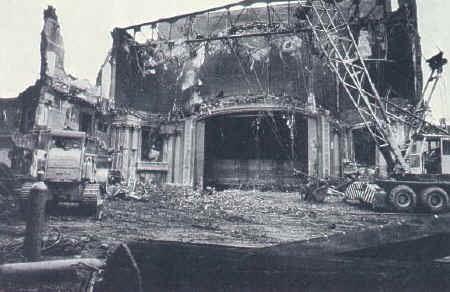
Friday, June 8. 2007
All the red-faced tirades of Lindsay Graham and Ted Kennedy, and the condescending and insulting comments by GWB (all furious at the "emotional" arguments of the opposition, apparently), were not enough to save the Senate immigration bill, which essentially died yesterday when it failed to garner enough votes to limit debate. This marks the second time in two years that an amnesty bill has been defeated before making its way to the President's ready-and-waiting desk. and the condescending and insulting comments by GWB (all furious at the "emotional" arguments of the opposition, apparently), were not enough to save the Senate immigration bill, which essentially died yesterday when it failed to garner enough votes to limit debate. This marks the second time in two years that an amnesty bill has been defeated before making its way to the President's ready-and-waiting desk. President Bush, who recently lashed out at his own Republican base by questioning their patriotism and accusing them of trying to "frighten" Americans by calling the bill an amnesty, apparently came down sick the same evening, according to Larry Auster. Perhaps not coincidentally, Bush was photographed drinking a beer (see above photo) before the episode, despite his well-documented abstention from alcohol. Update: As noted in the comments, the official line from the White House is that it was a non-alcoholic beer. The actual source of Bush's stomach ailment? A surfeit of rootbeer and raspberry cheesecake at the G8 dinner, apparently.
Thursday, June 7. 2007
Aldous Huxley's Brave New World is more relevant today than it was when it was written 75 years ago. This creepily prophetic, forcefully anti-utopian science fiction novel describes a world government which scientifically manages everything from hatchery to grave for the happiness and safety of all - except for the Alphas, who have the responsibility for running the whole thing. Truly rule by experts. Freedom is an antiquated illusion, and the government is an omnipotent, benevolent god. Caitrin Nicol, in The New Atlantis, takes a fresh look at the book. Some quotes from her piece: This “illusion of freedom” was cast into a clearer light by a reviewer who discerned that the temptation to sacrifice liberty to end suffering often becomes an attack on the reality of the liberty itself. Rebecca West, a prominent novelist and literary critic (and erstwhile mistress of H. G. Wells) said Huxley had “rewritten in terms of our age” Dostoevsky’s famous parable of the Grand Inquisitor from The Brothers Karamazov—“a symbolic statement that every generation ought to read afresh.”
and An unholy alliance of industrial capitalist, fascist, communist, psychoanalytic, and pseudo-scientific ideologies has brought about the end of history. The past is taboo—“History is bunk,” as “Our Ford” so eloquently said—and there is no future, because history’s ends have been accomplished. There is no pain, deformity, crime, anguish, or social discontent. Even death has no more sting: Children are acclimatized to the death palaces from the age of eighteen months, encouraged to poke around and eat chocolate creams while the dying are ushered into oblivion on soma, watching sports and pornography on television. Postmortem, the useful chemicals in every corpse are recovered in cremation to be used as fertilizer. “Fine to think we can go on being socially useful even after we’re dead,” gloats one character. “Making plants grow.”
and Unlike the other great dystopias, Huxley’s World State, though totalitarian in its orthodoxy, is ostensibly ordered on the wants of the governed rather than the governors. Threats are rarely used or needed. Rule by bread and circuses has proved more potent than force—and more pernicious, precisely because every means of control is a perversion of something people really want. The only people with any capacity for dissatisfaction are a handful of Alphas, who are as unable to articulate their objection as Russell is. It is difficult to reject the sinister when by slight distortion it masquerades as the sublime. Why feeling should be able to distinguish these things while reason cannot is an interesting question, one which could be left forever unsettled by tinkering, through biotechnology or psychological control, with what Huxley (in a later foreword to the book) called “the natural forms and expressions of life itself.” One such expression, of course, is a certain measure of autonomy over the meaning and direction of our lives. Its total absence in the World State is ominously signified by the professional title of the genetic engineers: the Assistant Predestinators.
The scariest things about Huxley's book are 1) On a bad day, anyone might be willing to sacrifice some liberty for security, and, 2) On a bad day, the Brave New World Huxley imagined has a certain regressive, hedonistic appeal and, 3) There are politicians who, unknowingly, use the idea of such a world as an ultimate goal - assuming, no doubt, that they would be the Alphas, and not me. At Maggie's Farm, we try to make a stand for the messy, often-difficult, often-painful freedom of the human soul and spirit. Please take the time to read the whole thing. And read the book, if you haven't.
Wednesday, June 6. 2007
 No Looking Backwards (in this morning's links) linked to an editorial in New Hampshire's Union Leader, which explains the freedom view of the world in terms of the minor issue of mandatory seatbelts. No Looking Backwards (in this morning's links) linked to an editorial in New Hampshire's Union Leader, which explains the freedom view of the world in terms of the minor issue of mandatory seatbelts.
When freedom is removed from the political equation, and replaced by benevolence, the result is tyranny. Don't all tyrants say they want what is good for some or most of "their people"? I love the C.S. Lewis observation, which we often quote: - Of all tyrannies, a tyranny sincerely exercised for the good of its victims may be the most oppressive. It would be better to live under robber barons than under omnipotent moral busybodies. The robber baron's cruelty may sometimes sleep, his cupidity may at some point be satiated; but those who torment us for our own good will torment us without end for they do so with the approval of their own conscience.
I will trust free markets over government any day of the week. The problem with all of the "minor" issues - trans-fats, smoking, motorcycle helmets, seatbelts, gun control, etc - is that they eventually add up to an oppressive, dispiriting burden, as in the UK. A quote from the Union Leader article: When the state crosses that line and begins protecting adults from themselves, the people have lost their authority over the state. At once, there is no decision the state may not make regarding an individual's personal behavior. The people have conceded that power, and it is no longer theirs. New Hampshire remains the "live free or die" state, and its people take that motto very seriously. Start telling them how to live their lives, and they will start telling you exactly where you can go.
That's right. But you can feel like a nut and a crank standing up and opposing each tiny, seemingly well-intentioned step that government takes, even though the imposition of most of these issues is really driven by controlling do-gooder cranks with too much time on their hands. The problem, as I see it, is that these are laws, not advice. Heck - I usually use my seatbelt - especially when I am driving my pick-up, drinking Coors Lite, reading the paper, shooting various animals and shooting various annoying people out the car window, listening to the radio, eating a bagel, talking on my cell, and blogging on my Blackberry - all at the same time, like every normal busy red-blooded American does. If America doesn't still stand for individual liberty from state power, then what good are we? If we, and our politicians, remove individual liberty from the equations they apply to law-making, what are we? If laws have to have "Environmental Impact Statements," how come they don't have to have "Freedom Impact Statements"? (I don't think I am the first to say that, but if I stole it, I don't remember from whom.) Addendum: I should also have re-linked the Cafe Hayek piece on the subject of trans-fats (which government experts insisted upon, just a few years ago, as an improvement over lard) and the food Nazis. A nanny with cops and guns backing her up is worth calling a Nazi, in the sarcastic Seinfeld sense of the term, if you ask me. (See our Mayor Bloomberg satire, which some readers thought might be real.) Appalling examples delivered fresh, daily, at Moonbattery
Tuesday, June 5. 2007
Like the Barrister in his fine piece on the subject of poverty, I am interested in understanding who the poor are in the US, and why. What lies behind the census data and stats? In medicine, we of course deal with many people who are poor due to various physical and mental dysfunctions and disabilities, and our charities and government programs offer them a great deal of help and support. In fact, the poor in general are beneficiaries of a huge safety net in the USA thanks to the generosity of our citizens. But what I found most interesting in The Barrister's piece was this notion of the "voluntarily poor." In America, we are too quick to assume that everybody wants to be rich. Indeed, I think no sane person would refuse a $160,000,000 check from Powerball, but the word "voluntary" refers to behavior, not to idle thoughts and dreams. If you aren't willing to move from Podunk, Maine to Charlotte, NC to get a good job, you are indeed voluntarily poor. And if you would rather drop out of high school and have four kids as a single Mom in St. Johnsbury, VT, you are also voluntarily poor. If you are an uneducated, illiterate immigrant, you are voluntarily poor - but presumably better-off than at home. I would like to be able to look behind the poverty stats to try to understand what choices in life the poor have made, with the understanding that these choices probably reflect a part of what they want in life. Not everyone is materially-driven, and most people are only partially materially-driven. Some people are driven to nothing at all, including basic self-respect. Some are, in fact, motivated by dependency. There are only two facts that I know for certain: Single moms are often poor, and people who do not work full-time are often poor. Gals who get knocked up without "a ring and a date" are deeply foolish. Government support (if it were included as income) would bring them out of the poverty stats, however - but that support from their neighbors rewards bad decisions made by folks who have not been taught better, or who simply haven't made any life plan. Life lived recklessly sometimes - but very rarely - works out. I'd like every kid to be taught, by example and by words, that they have something of value to add to their families, their country, and to other people, but that none of that will be be realized without making smart choices and without making a plan. Freedom demands a lot of maturity from people because it offers so many choices. LaShawn has a piece on the subject: Why Mothers Need to be Married. The recent, widely-quoted piece in The Economist makes it clear that getting and staying married correlates highly with good kids and correlates highly with a secure life. Apparently, if you graduate from high school, get married before having kids, and if at least one of the couple has a job, and if you have no more kids than you can afford, things tend to work out fairly peachy in the USA. However, the post hoc ergo propter hoc fallacy implied is not addressed. In the end, do the data say anything more circular than "People who run their lives well do well in life"?
Sunday, June 3. 2007
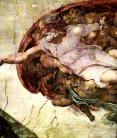 One of our team posted a piece written by a psychiatric nurse, of all people, about peoples' views of God. It's a wonderfully provocative subject. One of our team posted a piece written by a psychiatric nurse, of all people, about peoples' views of God. It's a wonderfully provocative subject.
Often, when Christians discuss the pagan or heretical things that people worship, we discuss the things that we are tempted to put above God - the false gods: ego, money, comfort, power, worldly success, pleasure, toys, popularity, etc. I cannot claim to know exactly why we were given the gift of Jesus and His sacrifice, but He sure made it easier to worship God. However, when we think of God himself, what do we think of? The answers are highly varied. It's like a Rorschach test, probably telling more about the person's psychology than about the nature of God. My opinion? The face and mind and nature of God is too big for any human to get his mind around. Is that a theological cop-out?
Friday, June 1. 2007
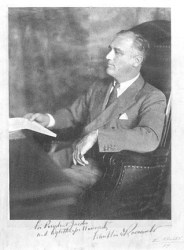 Long-time readers know that, while we feel FDR was a fine wartime leader, his domestic and economic policies made him the most destructive president in American history, whose errors continue to plague us. Long-time readers know that, while we feel FDR was a fine wartime leader, his domestic and economic policies made him the most destructive president in American history, whose errors continue to plague us.
He and his advisors and allies exploited the Depression to try to create their 1930s-era statist-style, Soviet-inspired big government, and partially succeeded. Alas for America, many of our post-JFK Dems have clung to this antique idea for dear life. They haven't found a new, positive idea yet. When we look back at the Depression, we can see that Andrew Mellon was right, and that FDR's professors and socialist intelligentsia advisors like Ickes - all of whom played on FDR's well-intentioned but naive sense of "noblesse oblige" - were fundamentally wrong about the resilience of American enterprise and vigor - wrong because their anti-capitalist ideology required them to be wrong about their basic understanding of economics. About economics, and human nature - of which economics is just a reflection. Kling takes a gander at Amity Schlaes' new study of the Depression - The Forgotten Man (h/t, Buddy via Insty). The "forgotten man" is the guy who paid the bills for all of FDR's ultimately useless programs (guys which includes both of my grandpas who were dutiful but deeply unappreciative, and one of whose boats went to Dunkirk - never to be returned by the Brits). One quote: The struggle over economic policy in the 1930's was really an episode in the long, historical conflict between business participants in the market and anti-business academics. Roosevelt gave free rein to the professors, until the start of the Second World War led him to realize that he would need the tycoons to help mobilize to defeat Hitler. I suspect that one reason that Roosevelt and the New Deal come off so well in the conventional wisdom is that history books are written by professors, not by entrepreneurs.
Read Kling's whole piece. Despite the astonishing American post-war economy, we still see politicians trying to make hay with the Rooseveltian perennially-pessimistic, anti-commerce, statist view of the economy. (I recently read the interesting factoid that he drank exactly 12 gin martinis daily, beginning at noon, prepared to his specifications by his butler, until the day he died - but never appeared intoxicated. FDR, that is - not Arnold Kling.)
Wednesday, May 30. 2007
Ardent Greenies find fault with every power source except solar panels, which are trivial. In the end, I think they want us to live in the stone age. On Maggie's Farm, of course, we have our own mini-fusion reactor in the basement which provides all of our power needs along with an endless source of truly hot water. It is entirely safe, designed by Arnie, our brilliant tractor-repair guy, constructed from old cast-iron tractor parts, and any dangerous radiation is fully contained by solid hardwood planks. The cracks are secured with duct tape, and all is painted with a coat of lead paint, just to be extra-safe. But Greenies hate nuclear, and I don't know why - France gets 70% of their power from nuke plants. Greenies don't like windmills. They hate oil, gas, and coal - and wood. They make laws (Belgium) that you cannot cook on a grill. In today's article in the WSJ, they want to tear down the Klamath River hydroelectric dams. Fine - but propose a non-frivolous alternative and don't play childish fantasy games like telling me to change my lightbulbs or to plant a tree. A quote from the article: Al Gore has been hectoring Americans to pare back their lifestyles to fight global warming. But if Mr. Gore wants us to rethink our priorities in the face of this mother of all environmental threats, surely he has convinced his fellow greens to rethink theirs, right? Wrong. If their opposition to the Klamath hydroelectric dams in the Pacific Northwest is any indication, the greens, it appears, are just as unwilling to sacrifice their pet causes as a Texas rancher is to sacrifice his pickup truck. If anything, the radicalization of the environmental movement is the bigger obstacle to addressing global warming than the allegedly gluttonous American way of life. Once regarded as the symbol of national greatness, hydroelectric dams have now fallen into disrepute for many legitimate reasons. They are enormously expensive undertakings that would never have taken off but for hefty government subsidies. Worse, they typically involve changing the natural course of rivers, causing painful disruptions for towns and tribes. But tearing down the Klamath dams, the last of which was completed in 1962, will do more harm than good at this stage. These dams provide cheap, renewable energy to 70,000 homes in Oregon and California. Replacing this energy with natural gas -- the cleanest fossil-fuel source -- would still pump 473,000 tons of additional carbon dioxide into the atmosphere every year. This is roughly equal to the annual emissions of 102,000 cars. Given this alternative, one would think that environmentalists would form a human shield around the dams to protect them. Instead, they have been fighting tooth-and-nail to tear them down because the dams stand in the way of migrating salmon. Environmentalists don't even let many states, including California, count hydro as renewable. They have rejected all attempts by PacifiCorp, the company that owns the dams, to take mitigation steps such as installing $350 million fish ladders to create a salmon pathway. Klamath Riverkeeper, a group that is part of an environmental alliance headed by Robert Kennedy Jr., has sued a fish hatchery that the California Department of Fish and Wildlife runs -- and PacifiCorp is required to fund -- on grounds that it releases too many algae and toxic discharges. The hatchery produces at least 25% of the chinook salmon catch every year. Closing it will cause fish populations to drop further, making the demolition of the dams even more likely. But the end of the Klamath won't mean the end of the dam saga -- it is the big prize that environmentalists are coveting to take their antidam crusade to the next level. "This would represent the largest and most ambitious dam removal project in the country, if not the world," exults Steve Rothert of American Rivers. The other dams on the hit list include the O'Shaughnessy Dam in Yosemite's Hetch Hetchy Valley that services San Francisco, Elwha River dam in Washington and the Matilija Dam in Southern California. Large hydro dams supply about 20% of California's power (and 10% of America's). If they are destroyed, California won't just have to find some other way to fulfill its energy needs. It will have to do so while reducing its carbon footprint to meet the ambitious CO2 emission-reduction targets that Gov. Arnold Schwarzenegger has set. Mr. Schwarzenegger has committed the Golden State to cutting greenhouse gas emissions 80% below 1990 levels by 2050 -- a more stringent requirement than even in the Kyoto Protocol.
Hey, Arnold - 80%? Pretty to think so, but it will never happen. The whole piece is subscription-only in the WSJ.
Played hookie from work today with a couple of Maggie's Farmers and friends. It's getting late in the spring season here for trout. This is our ultra-secret ultra private trout stream in CT. The old story is you tell the wife that you're taking the day off to do some things with friends. She asks, slightly annoyed by the irresponsibility, what you're doing. You reply, "Well, we're going over to the Indian casino, and I hope you don't mind our acting foolish once in a while." She says "OK, I do not approve, but have fun and don't come home drunk." Then you sneak off and do what you really want - trout fishing. Why are my photos today blue-tinged and out of focus? I need to get this camera fixed. 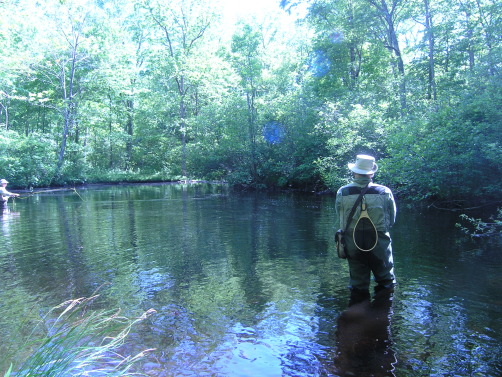
 The same old tired politics of greed, envy, resentment, and whining emerge once again from multi-millionaire, private-jet-addicted Mrs. Clinton. Does she have a single middle-class friend? Or a single real friend? I doubt it. The same old tired politics of greed, envy, resentment, and whining emerge once again from multi-millionaire, private-jet-addicted Mrs. Clinton. Does she have a single middle-class friend? Or a single real friend? I doubt it.
Well, she knows first-hand that the distribution of riches and power aren't "fair." She got them purely by exploiting - and putting up with - a hideous marriage. However, she does not realize that most people seek neither riches nor power, but seek just freedom from government burden and government interference to build their own lives according to their own lights. She must imagine that everybody is like her: hungry, greedy, angry, empty, and unfulfilled. It's a psychodrama. It has always been darkly amusing to me that the most redistributionist of our politicians are always the greediest and the most worshipping of personal wealth: see Edwards, Kerry, Kennedy, Soros, Clinton, Reid, Pelosi, etc etc. There is a level at which taxes no longer effect your daily life, and are just another minor expense. No doubt her advisors told her that this could be a winning theme, plus a distraction from her Iraq vote. Although this theme stands in opposition to the hearty and healthy red-blooded American themes of opportunity, risk, adventure, and the freedom to chose your own path through life, pursuing whatever heart and conscience decide - and living with the consequences - I guess her pollsters have concluded that there are voters out there who are mad that somebody else has more toys than they do. This is a truly infantile, negative, and mean-spirited appeal to the lowest and least admirable aspects of human nature. Editor's note: Blue Crab calls it a fresh new exciting idea for America - socialism.
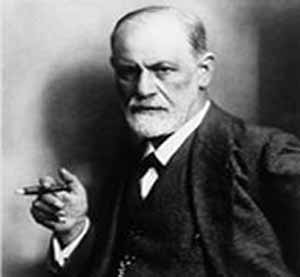 Can personality change? Well, it depends on how you define "personality" and on how you define "change." Can personality change? Well, it depends on how you define "personality" and on how you define "change."
Certainly manner of behavior and attitudes can change over time as people adapt and "grow," but the deep foundations of personality are genetically hard-wired (we term that "temperament"), along with the first few layers above that (which we often think of using concepts like "character structure" or "constellations of unconscious assumptions/fantasies about people, one's self, and the world"), are highly resistant to alteration - which is where psychoanalysis comes in. That question was asked in the context of two movies at PsyBlog, who took the trouble to review the best of the psychology blogs: Part 1 and Part 2. (h/t, Neurophilosophy.) I am going to check them all out. I am not aware of any dedicated psychoanalytic blogs. There should be at least one, but analysts tend not to be compulsive talkers and, when they write, it is always too long-winded and jargon-packed for the average ADD reader. The shrinks on our blogroll are more politically-driven than focused on the art and science of the analytic therapies.
The subject of the study and handsome Mockingbird, whose songs have fooled many a beginner birder, comes up because of this nifty story about one from Attack Machine. They are remarkable mimics.  The Mockingbird, (Mimus polyglottos), once a Southern bird, is now found across the US and into southern Canada. His repertoire of over 200 songs - copies of the songs and calls of other species - caused him once to be caged as the American nightingale. The Mockingbird, (Mimus polyglottos), once a Southern bird, is now found across the US and into southern Canada. His repertoire of over 200 songs - copies of the songs and calls of other species - caused him once to be caged as the American nightingale.
The family of Mimic Thrushes also includes thrashers and the catbird. All are fond of tangles, shrubs and borders. Many of our Mockingbirds in New England overwinter here, and occasionally visit the bird feeder, but they do not seem to like seeds very much. You can read more about them here.
Monday, May 28. 2007
 Half the county was at Home Depot this morning. We aren't into buying Hostas at Home Depot, but their tomatoes are good, and mine are in the ground now. And I have 20 more bags of black mulch to carry around. Half the county was at Home Depot this morning. We aren't into buying Hostas at Home Depot, but their tomatoes are good, and mine are in the ground now. And I have 20 more bags of black mulch to carry around.
But getting back to Hostas, Mrs. BD found this site. Long-time readers know that we have rules about Hostas - never anywhere near the sun and never less than 5-20 plants of the same type en masse. Done right, they can be wonderful, but done wrong, they can be tacky. One of their downsides is that they take a few years to fully establish themselves. One of their upsides, besides their preference for dense shade, is the astonishing variety of sizes and colors of foliage available these days. Here's our previous piece on Hostas.
Friday, May 25. 2007
 I heard Thomas Sowell quoted on the radio last night. I don't have the link, but he was asking something like "What problem does this immigration "reform" act solve?" His answer: just one problem - the politicians' problem, which is to look like they are doing something and to get the immigration theme off the table. I heard Thomas Sowell quoted on the radio last night. I don't have the link, but he was asking something like "What problem does this immigration "reform" act solve?" His answer: just one problem - the politicians' problem, which is to look like they are doing something and to get the immigration theme off the table.
Too bad for the politicians: the voters aren't stupid. Too bad for the voters: the pols don't give a damn in this unholy alliance they have made. Primum non nocere is my advice. Second, a quote from me, yesterday (Buddy thought it was good): People are not annoyed because they are racist. They are annoyed because they are being invaded. The fact that this particular invasion is not lead by an army is irrelevant: nowadays, leaving your gun behind is more effective.
People tend to hate to be invaded. It's sorta human not to put up with it, unless you are French.
 The Torpedo Factory Arts Center in Alexandria's Old Town was saved from the wrecker's ball as the dock area of Old Town was about to be destroyed by urban planners. The Torpedo Factory Arts Center in Alexandria's Old Town was saved from the wrecker's ball as the dock area of Old Town was about to be destroyed by urban planners.
Now, the saving of the Torpedo Factory (the building was a WWl-era torpedo factory) is considered to have been one of the triggers for the preservation and rejuvenation of Alexandria. I get a kick out of those old factories that were built in monumental style. Temples to manufacturing, industry, invention, and the American work ethic.
Thursday, May 24. 2007
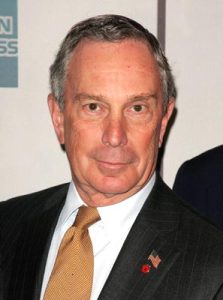 SPECIAL TO THE NEW YORK TIMES. May 24, New York. New York City's Mayor Michael Bloomberg announced a series of bold new initiatives to protect the health of New Yorkers today. SPECIAL TO THE NEW YORK TIMES. May 24, New York. New York City's Mayor Michael Bloomberg announced a series of bold new initiatives to protect the health of New Yorkers today.
The Mayor's approval rating of 76% has been largely due to his efforts to safeguard city residents from tobacco smoke, trans fats, cars, guns, and other ills with which the ignorant masses are too stupid to deal with on their own. He seeks to build on this foundation with his ambitious new program, entitled "A City That Really Cares." Highlights of his proposals, which the City Council is expected to accept with little debate, include the following: 1. Banning the sale or wearing of heels on women's shoes over 2" high.
2. Requiring the wearing of warm scarves when the temperature drops below 40 degrees F.
3. Banning sunbathing in all New York City parks and beaches.
4. Requiring a serving of broccoli and carrots with every restaurant meal served within the five boroughs.
5. Banning the dangerous habit of swimming at ocean beaches.
6. Requiring the unplugging of all TVs and toaster ovens when not in use, due to fire hazard.
7. Banning any employer from demanding more than three hours per day of computer work, due to risk of carpal tunnel syndrome and eye strain. (Any work on Bloomberg machines will be exempted due to the important role of financial services in the city.)
8. Requiring the wearing of sturdy rubbers during rain, and lined boots during snow.
9. Requiring the wearing of hats during sunny days, and wool hats when the temperature drops below 40 degrees F.
10. Banning the use of iPods on city sidewalks due to the street-crossing risks iPods cause.
11. Banning all dangerous sports in schools or on city property. While the list is not complete, this will certainly include football, soccer, dodgeball, and handball. Running and jogging may also be banned, as they contribute to joint diseases and anorexia nervosa.
12. Banning the sale or use of any tobacco products indoors, outdoors, or in any vehicles other than golf carts, limousines, or private jets and helicopters. Violators will meet a stiff fine of $250 per incident. One thousand police officers will be transferred to a new Public Health Unit of the NYPD to monitor compliance, with many more expected. This unit will have extensive rights to enter your home to check for tobacco smoke, trans fats, and safe TV use. During his presentation, the Mayor emphasized his committment to health. In response to a question asking why he had not included a ban on sale of alcohol products, meat, candy, soda, junk food and and fried food, the Mayor replied "Now just hang on. This is only Phase One. As people get used to following good habits, we will introduce further steps in our "The City that Really Cares" program. So let's be constructive and positive, and work together in a stepwise fashion to guarantee good health for all New Yorkers." Public health experts praised the Mayor's presentation. Dr. Harvey Weiss, Professor of Public Health at Columbia University and an advisor to Mayor Bloomberg, attended the press conference and stated "This is a wonderful beginning, but there is so much more we can do to help people." "The people of New York need to understand that we really care, and we care enough to include significant enforcement in this program. We will get to butter, chicken fat, lard, eggs, meat, cheese, creme brule and ice cream as time goes on. Plus we are deeply concerned about cell phone usage, overly-tight lingerie, poorly-fitting shoes, and of course the crisis of noise pollution. We hope to submit requirements for noise-free jackhammers and garbage trucks in the near future." "Health is too important to be left up to people."
I had never banged around Alexandria, Virginia until this past weekend. Since we have been touching on one of our pet hates, urban renewal, in Old Town Alexandria we have a perfect example of how the absence of urban renewal has make it possible to have a downtown that everyone wants to go to to shop, to eat, to hear music, to see galleries, to maybe meet a new girl- or boy-friend, and to hang out on the street or on the piers with an ice cream cone. People like to go to places which are crowded, have a human scale, have some history and a touch of shabbiness or at least randomness. In other words, real places. Tiny Greenwich Village in NYC is crowded every night, but it cannot hold a candle to Georgetown for quaintness or size (but it has way better music). Why so many people seem to enjoy totally phony, manufactured places like Disney World is another topic for another day. Wikipedia has a nice little piece on the town's history, which of course includes its history as a major American port, its slave trade, and its role as a supply center for the Civil War. Washington considered it to be his home town. My lame photo, as usual, does no justice to what a hoppin' and pleasant place the Old Town is. 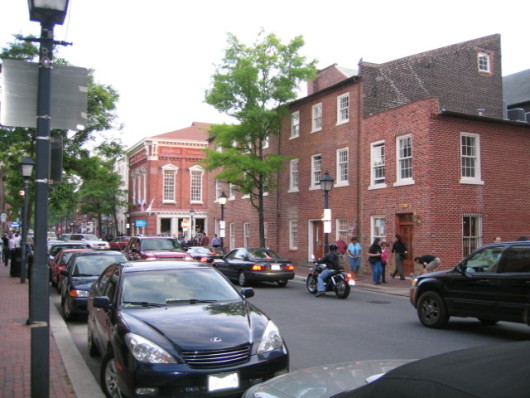
Wednesday, May 23. 2007
A re-post from April, 2006.  I recently complained to our web Boy Genius Chris about all of the searches that our Maggie's Farm blog receives for Farm P*rn, but he says there is nothing to be done. To defeat that waste of time for the poor perverted bestiality-fans who are surely not looking for this blog, I posted last month, for their erotic delight, a stark nekked 1950 Farmall tractor, Model C. A dang nice one, too, in decent shape despite her age. That Farm P*rn post, with an "o" instead of the star, received lots of hits, but they didn't stay very long. Somehow, I do not think that they are our core readership. Either that, or they just aren't into tractors, like we are. I recently complained to our web Boy Genius Chris about all of the searches that our Maggie's Farm blog receives for Farm P*rn, but he says there is nothing to be done. To defeat that waste of time for the poor perverted bestiality-fans who are surely not looking for this blog, I posted last month, for their erotic delight, a stark nekked 1950 Farmall tractor, Model C. A dang nice one, too, in decent shape despite her age. That Farm P*rn post, with an "o" instead of the star, received lots of hits, but they didn't stay very long. Somehow, I do not think that they are our core readership. Either that, or they just aren't into tractors, like we are.
The Dylanologist advised me to use stars (*) when we want to say p*rn, or s*x, or things like that, to reduce the search machine links. However, today we unveil some true Country P*rn: M*ting Box Turtles. What is finer than a spr*ngtime r*mance, and p*ssionate, true-l*ve, reptilian am*re in a dewy morning meadow with a s*xy, hard-shelled but soft-hearted, fun-l*ving gal? "Mmmmm-Hmmm. A little to the left". "My left, or yours?" "Never mind." In July or August, she will lay 4-6 eggs. The odds are overwhelming that not one of them will reach maturity, but with luck she will have 30-50 years of egg-laying, and maybe one or two of those 200 lifetime eggs will make it to adulthood, to replace herself and her true love in the great chain of being. It's a hard life: you not only have natural predators and the risks of hibernation, but you have to deal with dogs, lawn-mowers, and car tires. Cool fact: Like some other turtles, Box Turtle females can contain sperm for a number of years so they can continue laying eggs without benefit of marriage or desire. You can tell the males by the indented plastron: they are designed, very "intelligently," for l*ve. Bless their tiny reptilian hearts, deeply in l*ve and strongly committed, for the moment, at least. True love, d*ggy turtle- style.
Our editor Bird Dog has asked that 
I pen a little comment on the so-called "immigration reform" bill currently on the Senate floor. This bill, as written, will do two main things: (1) give permanent residency to almost all illegal aliens in the USA (a number estimated at anywhere from 12 to 20 million - no one knows) and (2) create a massive increase in LEGAL immigration with the "guest" (i.e. permanent) worker program. (Calling this an "illegal immigration" bill is highly misleading, as its true legacy would be a big increase in legal immigration from the new visa categories, and from all the relatives of these visa recipients who would become eligible for green cards.) Now, 11 years ago, if anyone cares to think back, Congress was considering the report of an immigration committee headed up by the late Barbara Jordan (D-TX). Her sensible recommendations, borne out of seven years of studies and analysis, advocated a modest decrease in legal immigration. A Republican Congress rejected even this reasonable measure, reaffirming the core principle of US immigration policy of the last 40 years: always MORE, never mind who, how or why. I think the biggest error many people make in approaching the issue is that they view it primarily in terms of morality, as though the issue were not mainly about the key questions of "who" and "how many" but vague notions of fairness and historical tradition - as though attitudes mattered more than actual consequences of policy. This approach, of course, is precisely what got us into this mess in the first place: the 1965 immigration bill, which inaugurated the current era of mass third-world immigration, was inspired in part by the Civil Rights act and attempted to apply egalitarian principles to immigration policy. Since then, every attempted "fix" to the broken system has only exacerbated the problem, since no one has questioned this approach to immigration policy, or even advanced a justification, apart from tired cliches, as for why we even still have a policy of large-scale immigration. Immigration is not an "emotional" issue, as many in the press like to write, but a highly number-intensive one, susceptible to statistical analysis, economic number-crunching and all sorts of other useful tools. Fortunately, many smart people have done just these sorts of studies, and the results are out there for all to find (though rarely reported by the mainstream media). As for the current bill - many other bloggers have provided excellent critiques, and I will not repeat them. Any real reform would have to do the following: (1) Severely restrict the number of legal immigrants (to 400k or below); (2) abolish family reunification; (3) amend the "birthright citizenship" clause in the 14th Amendment; (4) demand workplace enforcement; and (5) take seriously efforts at integration and assimilation for those we do admit. With that done, it would actually be possible to start reducing the illegal population through enforcement of existing laws. Photo: Senators Mel Martinez, Lindsay Graham and Ted Kennedy amuse themselves at a press conference about their immigration bill last week. Update: Michelle lists all of the freebies in the illegals' goody bag. Sweet.
Monday, May 21. 2007
I challenge anyone to name a quainter, cozier town than Georgetown (which also has 15-minute access to a city) - or one in which it is more difficult to park a car. It might be worth it to be a politician just to live there for a while. Georgetown beats Cambridge Mass. hands down as a place to live. Every city in America which destroyed their 19th century factories, train stations, town houses etc. during the 70s government-funded frenzy for "urban renewal" is crying today. Case in point, as our Dylanologist keeps reminding us, is Nashville which would be packed with pubs, shops, tourists, and million-dollar townhouses today if they had not bulldozed the old downtown to "modernize" it, to sterilize it, and to erase its history along with every human-scale building. So people go to the disgusting malls, which are, happily, a dying fad. Like Bridgeport and Hartford, CT, the urban renewalist Stalin-inspired and highly-educated planning geniuses removed every reason a person might want to go, or to live, downtown. Only the backwater cities escaped that assault. Lucky for them. The supremely elegant and lovely Savannah, Georgia is my prime example, but we will do Alexandria, VA in a couple of days - same story but without the aristocratic flavor of Savannah. God bless Jane Jacobs. I was fortunate to hear her speak once in New York on the subject of Harlem. 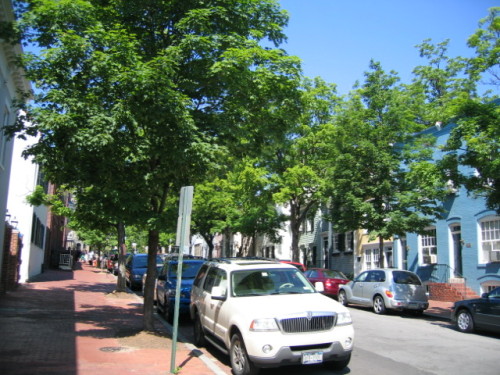
Sunday, May 20. 2007
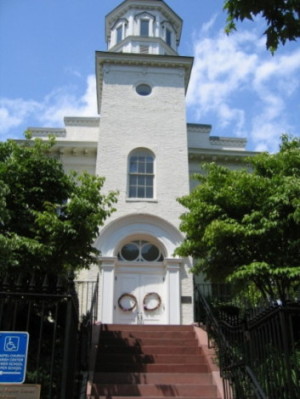 This morning, in lovely Georgetown with unseasonably cool and comfortable weather for that swamp (figuratively and literally) of a city, Washington, DC. This morning, in lovely Georgetown with unseasonably cool and comfortable weather for that swamp (figuratively and literally) of a city, Washington, DC.
The first Roman Catholic church in DC, built in 1789. I did not intend to cut off the steeple in my photo. The building is now renovated as The Chapel of St. Ignatius Loyola as part of Holy Trinity Parish, which now has a new sanctuary on the corner of N St. built in 1851. The parish was started by Archbishop Carroll, who was also the founder of Georgetown University. We cannot underestimate the role of the Jesuits in this nation's history. My graduating child, who is Protestant, of a more-or-less evangelical flavor, told me that Georgetown holds an outdoor Mass in front of Healy any time something wonderful, or anything disturbing (including things like not winning in basketball) happens. As an approach to both the grim and the joyful vicissitudes of life, I find that wonderful and rational. Go Hoyas!
Saturday, May 19. 2007
There are certain persons - politicians - who have come to believe that they understand how all the activities of everybody in the world happen, and how these actions interact, and believe that they can direct this interaction better that the individuals themselves can acting in their own sphere of knowledge and interest. There are two big problems with this approach, generally: First, you have no idea what you're talking about. About much of anything. You've never really worked a day in your life. You have only the faintest idea about how the average person gets by in this world. Polite persons are silent when they are ignorant. What does that make you? Second, even if your knowledge, such as it is, is able to inform your decisions about what we're all supposed to be doing, We can't all stand still while you figure out all the forms we've got to fill out. I know you love standing in line. Check that -- you adore having us all standing in lines you get to cut to the front of. And you adore filling out forms. Check that; you just love having us fill out forms you get to weigh and shred, after extracting the check. And you just wet yourself in glee thinking about endless talking about what to do, rather than the endless doing required of we benighted souls if we're going to get three hots and a cot until we get the bed with a lid. All bad managers don't like anything unauthorized to happen. That's why the worst managers, the communists, wrote it down for you: If you're not directed to do it, it's illegal. Got that? They just did wholesale what all politicians do retail: pass laws all day long. Sooner or later, everything will be "decided" either way. So what you get is productive people standing around while the boss, serene in the idea that they're smarter'n everybody else, figures out what we all should be doing. This is how you get Jimmy Carter making out the schedule for the White House tennis court when he's supposed to be, oh, I don't know, responding to the attack on the sovereign US territory that our embassies represent or something equally important. I'm getting around to that. Hold on a second, I'm on the other line. Anyone who's ever been in a socialist country, never mind a communist one, has read or heard the breathless announcements: Funds are just being released for this now! The Bureau of Reliquary, Fill Dirt, Rice Weevil Eradication and Toiletries is announcing their Five Year Plan for this crater! We're all supposed to run in place while the Implementation of the Overarching Arrangement of the Synod of Blueprints of the Delegation of Design of the System Subcommittee of Schemes working with the Council of Convocations Delegation to the Body of the Congress of Lickspittle and Nepotism figger out where we all fit in their universe- you know, the one their faux socialist professors banged into their pointy little heads. EU, or Eeeeuuuww -- not a dime's bit of difference. The paint's peeling off the "Coming Soon" sign from age, generally, if the goverment's involved heavily. It takes a year to get a building permit, minimum, in the town I live in. The house gets built in ninety days, by the people being ordered around by the those folks that need a year to make up their minds if you deserve that roof over your head. So how am I going to prove it? How am I going to prove that Al Gore doesn't know how to run an Ice Cream Parlor, never mind a country --never mind a whole planet? How am I going to prove that someone that can't find billing records when they appear to be the most important thing in the world is unlikely to be of use running the entire healthcare industry, where laying your hands on records in a timely fashion seems kind of important to the persons involved, as they point the physicians towards the correct limb to remove and so forth? Easy. I can prove people are busy doing things all the time you wouldn't expect, or anticipate, and no matter how kooky and weird they might be, you can't predict which will pan out. Let's go to the Patent Office. At the Patent Office, everybody's equal; just right it down and we'll see what pans out. Item 1: Bird Diaper Item 2: Spaceship Warp Drive So tell me, all you smartie pants; which one will pan out? Damned if I know. But I know one thing; if I left it up to you, you'd choose wrong, spectacularly wrong, nine times out of ten.
A re-post from May, 2006  Japanese Wisteria blooms in May in New England. Japanese Wisteria blooms in May in New England.
It's a sentimental Victorian plant that is perfect for shading pergolas, arbors and porches. Once established, it grows like a weed, up to 10' per summer. It takes work to keep it under control. Robins love to nest in their tangles: I have a pair of robins nesting in mine right now, so I cannot trim it until the babies leave the nest. Like many exotic, introduced plants, it can be very invasive and aggressive: eliminating wild stands of wisteria is a tough job. I grow sweet-smelling Autumn Clematis up my Wisteria vines, so the vine serves double duty. Autumn Clematis is another one of those strong vines that grow like crazy, with amazing September perfume.
Friday, May 18. 2007
It is now widely believed that essentially all 6000 world languages evolved, by geographical separation, from one proto-language. (This theory tends to undermine Chomsky's claim to fame for theorizing an internal hard-wired grammar - Chomsky's sole interesting idea, in my opinion.) However, languages are dropping like flies, as the planet shrinks. McWhorter in the NYSun argues that this is a good thing, but he hopes hobbyists will keep the old ways alive. Will the universal language be English? I hope so. It's a pretty good language, but Italian is far more musical, and I'd be happy to have an excuse to learn it. Would no longer need a translated libretto for the operas I love.
 Carbon for me but not for thee. The hypocrisy - nay, deception - abounding amongst the carbon fanatics causes me to doubt whether they really believe anything of what they say. Perfect example, at Samizdata. I guess gummint carbon doesn't count. Gaia apparently loves Government Carbon. Carbon for me but not for thee. The hypocrisy - nay, deception - abounding amongst the carbon fanatics causes me to doubt whether they really believe anything of what they say. Perfect example, at Samizdata. I guess gummint carbon doesn't count. Gaia apparently loves Government Carbon.
Here's my pledge: When politicians, bureaucrats, and Greenies quit flying and driving, and quit generating tree-murdering piles of paper upon which are written unintelligible rules for me, I will reconsider their sincerity. I'll never forget my Greenie friend who preached thus to me in my cozy red-neck bar one snowy night this winter in the Massachusetts Berkshires: "I have to drive to get to work, but you could ride a bike because you're closer." My reply: "They will have to pry my F-150 out of my cold dead hands." Yes, she had driven to Rudy's Bar and Grill too, in her Camry, and somehow made it home without a DUI. I don't approve of wasting precious ethanol as a fuel, but I do believe in that old "in vino veritas." My friend is very moral and sanctimonious, but she does like to drink stuff with ethanol in it. She prefers Wild Turkey (which is entirely organic), but she isn't too picky about guys. Photo: Is that my friend? Or is it Gaia herself, in human form? I forget.
|