Saturday, February 18. 2006
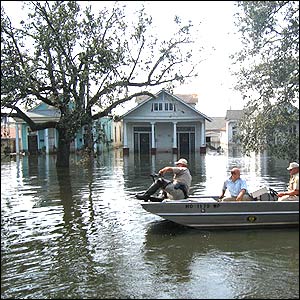 The National Flood Insurance Program is bankrupt. Not recently. That means that taxpayers are subsidizing building in flood zones, flood plains, and areas with high risk of natural water disasters - and thus encouraging, rather than discouraging, stupid behavior by making it economically risk-free to the individual. The National Flood Insurance Program is bankrupt. Not recently. That means that taxpayers are subsidizing building in flood zones, flood plains, and areas with high risk of natural water disasters - and thus encouraging, rather than discouraging, stupid behavior by making it economically risk-free to the individual.
For reasons of principle, conservation, and common sense, this subsidy should end. If you chose to live in such a high-risk place, you should carry the risk, not me. Flood Insurance should be a purely commercial enterprise, the same as any other aspect of homeowner's insurance. Not retroactively, but in the future. Somehow, I doubt anyone in DC cares about this every much, but the Katrina costs should be a chance to reconfigure this insurance/subsidy scam. From Burnett at TCS: When people own property and are fully responsible for losses due to their poor land use or development decisions, they are less likely to build or rebuild in areas regularly prone to flooding or erosion. This link -- between a person's property ownership and responsibility for their land use decisions -- disciplines people who use their property badly. Unfortunately, a host of government programs break this link by subsidizing unwise development. All too often the result is lost lives, destroyed property and diminished livelihoods. The U.S. Army Corps of Engineers (Corps) flood control program and federal flood insurance subsidize construction in flood-prone areas and encourage high-risk development by shifting the cost of insurance and physical protection against floods from property owners to taxpayers. The result: more construction in high risk areas. Its economics 101 -- if you subsidize something you get more of it.
I guess politics trumps logic, every time. Read entire. (Image from New Orleans)
Monday, February 13. 2006
It is widely accepted today that the early Indians were responsible for the extinction of the large animals of North America - the amazing Pleistocene mammals - mammoths, camels, etc. that were abundant here during the retreat of the most recent Ice Age. However, now it appears that the Indians had a major impact on all edible species, and that the abundance of animals found by the early European explorers may have been a consequence of the Indian population collapse due to disease. Story about the Indians and California wildlife here. For really old animals - Spinosaurus. It seems that this guy was the largest carnivorous dinosaur. H/T, Lucianne.
This migrating flock of mostly male Robins breezed in around 4 this afternoon, the day after the Big Snow. 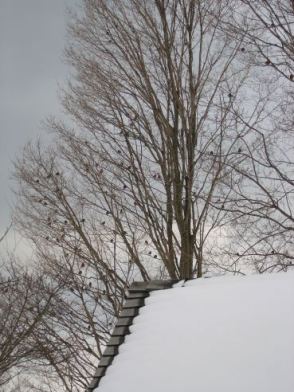
Monday, January 30. 2006
At the request of Mr. Free 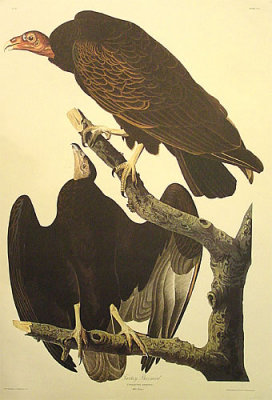 Market, we bring you one of Market, we bring you one of
the ugliest birds in North America. These large carrion eaters and scavengers have expanded their range north in recent decades, and now can be found throughout the US during the summer breeding season. They move to the southern US and South America in the fall. Birders call them "TVs." They find their food by sight and by smell, and are most commonly seen coasting around on thermals, effortlessly searching for dead animals with their long wings at a marked dihedral. They like to nest on cliffs. Identification: The Black Vulture of the American south is one similar species, and, because of its size, it could be confused with Golden Eagle at a distance. Why "turkey"? It's not just because of the unfeathered head, but also because they resemble Wild Turkeys from a distance when seated on the ground as they hunker over a dead deer or road kill. More about this vulture at the CLO site here. Image by Audubon.
Wednesday, January 25. 2006
Rows and floes of angel hair
And ice cream castles in the air
And feather canyons ev’rywhere
I’ve looked at clouds that way
But now they only block the sun
They rain and snow on ev’ryone
So many things I would have done
But clouds got in my way
I’ve looked at clouds from both sides now
From up and down, and still somehow
It’s cloud illusions I recall
I really don’t know clouds at all From Joni Mitchell's Both Sides, Now. You only need to write one song like that in your life. But this piece is about changing cloud cover, and how it effects heat balance on the earth. It seems to be a changeable thing. Scientists don't understand clouds very well.
Friday, January 13. 2006
Bobcat My pal Walter took this remarkable photo in northern Litchfield County, CT, on Sunday. A hell of a photo of this elusive critter. Info about this wonderful predator here. 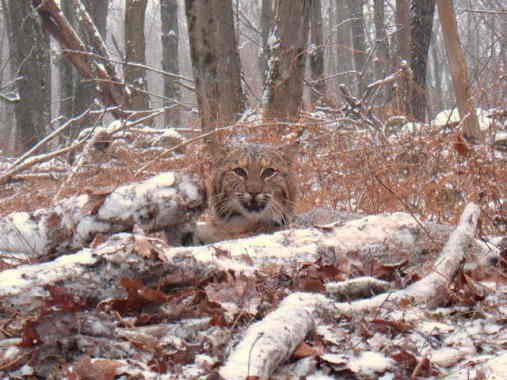
Thursday, January 5. 2006
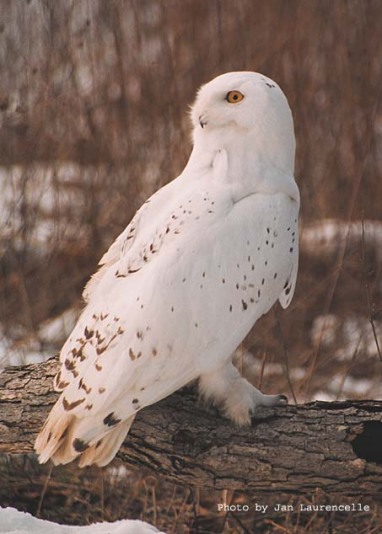 The magnificent Snowy Owl
can be found almost
anywhere in the US during
the mid-winter when they tend to move south from their tundra home, and on some low-lemming years in considerable numbers. 1973/74 was remarkable for Snowies. I have a friend who had one using his roof as a perch in CT for a week. These tundra birds are partial in general to tundra-like wind-swept areas in the winter: marshes, shores, large fields, garbage landfills, etc., and hunt from a low perch or sit on the ground. They are daytime hunters and eat any small furry things but voles (meadow mice), rats, and the like are their main diet. In the northeast, it isn't unusual to find them on eastern Long Island and Cape Cod. Info on the Snowy here at CLO. Remarkable the way owls can turn their heads around, isn't it, as in this photo by Janice Laurencelle via Owl Pages.
Thursday, December 29. 2005
 Turtle Conservation Turtle Conservation
Among the many predators of sea turtles, Mexicans with the notion that they enhance potency may be the most devastating. So there's an ad campaign. Worth trying. Story here. Moral of the story: Guys who like turtles get the hot babes.
Thursday, December 8. 2005
 The pheasant was an early game bird introduction to America. A very handsome Asian native, it had already been a popular game bird in Europe when first brought to the US during colonial times by sportsmen (to Virginia, in fact, where it did not prosper). The hen pheasant comes in a plain brown wrapper with a shorter tail, but the roosters can appear in atypical colors due to hybridizing efforts. The pheasant is a rare example of an introduced bird which has no deleterious effects on existing ecosystems. The pheasant was an early game bird introduction to America. A very handsome Asian native, it had already been a popular game bird in Europe when first brought to the US during colonial times by sportsmen (to Virginia, in fact, where it did not prosper). The hen pheasant comes in a plain brown wrapper with a shorter tail, but the roosters can appear in atypical colors due to hybridizing efforts. The pheasant is a rare example of an introduced bird which has no deleterious effects on existing ecosystems.
Pheasant prefers northern, open agricultural lands with areas of dense cover, and does not survive in the southern US. Pheasant is widely pen-bred and reared for hunting purposes, but few released birds in the US survive assaults from red-tailed hawks and coyotes, as they have not had the opportunity to become street-wise. The bulk of the wild, breeding populations are in the Dakotas, but they are found throughout the northern midwest and can even be found occasionally in the northeast. As agriculture has become more efficient, their numbers have slowly declined. In Europe, pen-raised birds are typically allowed to enter an area where they have the chance to become semi-wild, capable of strong flight, and independent, but are held by food until the day they are driven by beaters into high flight designed to be challenging for shooters. In the western US, pheasant are hunted with dogs, or driven to the ends of large fields where they are forced into flight. In the eastern US, typically, fat pheasants are hunted on the day of release, hence our pal L's expression "flying mattresses." Such birds are not particularly sporty but most of us have found ways to miss plenty of them, especially when given time to think. It is considered proper decorum to let them get well underway in flight before pulling the trigger since, unlike grouse, you usually have a fairly open shot and you don't want your pellets to turn them into ground hamburger meat. In the midwest and west, pen-raised birds are used to supplement wild populations for sportsmen. Fun to hunt? Definitely. Good for dog work? Yes. Good to eat? You bet. Cook to pink in the center. Read more about Ring Necked Pheasant at CLO. An organization called Pheasants Forever works on land management for pheasant. (Details of English pheasant rearing practices corrected thanks to our across-the-pond cousin Mr. FMFT)
Friday, December 2. 2005
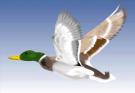 We enter duck season these weeks, in many areas of the US. We enter duck season these weeks, in many areas of the US.
The noble Mallard is the King of Ducks in the US. He is our most abundant and adaptable duck, and the tastiest, at least for those for whom the others are too gamey. (Not for me, tho.) He is found across the entire US and most of Canada, wherever water is nearby, from parks to prairies, and everyone is familiar with this handsome drake who is often seen in companionship with his plain, brown hen. These ducks are highly migratory in the mid-west and west, following unfrozen water south. (Like most species of ducks, they tend to prefer fresh to salt water.) Thus their widespread population is heavily concentrated in the southern US during the winter. Many duck hunters will shoot nothing but drake Mallards. And they are a fine bird, even if you do not hunt them. More info about the sporty Mallard here.
Here's a shot from our Ducks Unlimited Dinner Thursday night. We have a superb committee of guys who put this together each year, and an excellent crowd of semi-rowdy and actively-bidding sportsmen. We must have raffled at least 15 rifles and shotguns, among the 100+ cool items and trips, etc we raffled and auctioned. Good, wholesome, well-lubricated American fun for the cause of conservation. Now we begin planning for next year, but first the committee will relax and enjoy a few pheasant shoots with the dogs before the snow flies. 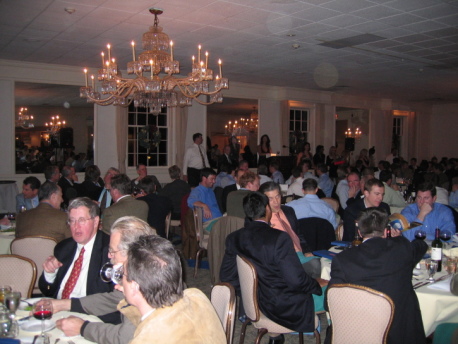
Thursday, December 1. 2005
Light Blogging Today Your editor will be preoccupied today with an annual charity event tonight for a favorite conservation organization - Ducks Unlimited - which has over 700,000 members in the US and Canada, and over 11 million acres of wildlife habitat under protection and management. We raise them a lot of money each year at a festive Christmas-themed guy's night out, but it's a fair amount of work getting things ready. Special thanks are due to Vineyard Vines, who has donated our table gifts this year, and to Windjammer Barefoot Cruises and Land Rover, who have been loyal supporters for many years.
Thursday, November 17. 2005
Grizzlies and Sea Otters It's a pleasure to have two conservation success stories at once. First, a report on studying the Yellowstone Grizzlies who have made a remarkable comeback. It looks to be a short series in the CSM. Second, the resurgence of the Pacific coast's Sea Otter has fishermen bent out of shape, although the otters' numbers are nowhere close to what they were historically. They have to eat, too. CNN
Thursday, November 10. 2005
Ducks Unlimited If there is one thing that all Maggie's Farm's contributors share, besides friendship and trust, it is support of the conservation efforts of Ducks Unlimited. Unlike some (not to be mentioned) conservation organizations, DU goes out there and just does it, rather than spending all of their money on lobbying to try to get the government to do it. But, as the experts in habitat recovery, and owning the strange heavy machinery to do it, they often work in tandem with government efforts. And it's interesting because it's what I call a cross-over organization, combining hunters, conservationists, environmentalists, wildlife photographers, bird-watchers, hikers, naturalists, and scientists - and all sorts of people for whom protection of natural habitat is important. DU is huge, with over 11 million acres under protection now, and over 700,000 members in the US. Grass-roots fund-raising has been their mainstay, and if you do not have DU events in your neighborhood, you should. Email us if you want to get involved in your area - we'll direct you to the right contact person. DU events are good, wholesome, American fun, for a great cause. Their efforts support, protect, and rehabilitate wildlife habitat across Canada, the US, and Mexico, and they have been expanding world-wide (including helping with the rehabilitation of Iraq's marshes which were destroyed by Saddam in his program to eliminate the annoying "Marsh Arabs" who were one of many thorns in his side. Mesopotamia - Between the Rivers - was not only the cradle of civilization but an enormous and highly productive marsh). DU people love "swamps", and all other wildlife habitats. Maggie's Farm loves DU.
Friday, November 4. 2005
Migration Updates from our friends at Lighthouse Point, New Haven - a south wind this week, so no migrating hawks: 10/31: 800+ Black-capped Chickadees, 1,500 Cedar Waxwings, 1,000 American Robins, 120 Eastern Bluebirds, 2,000 Red-winged Blackbirds, 350 House Finches 11/02: Migration flight from approx 7:00 AM thru 10 AM and then slowed down... 5000+ BLACKBIRDS/ GRACKLES, 850+ CEDAR WAXWINGS, 75 COWBIRDS, 1200+ ROBINS, 45 BLUEBIRDS, 200+ BRANT
Thursday, October 27. 2005
Bell the Cat and Shock the Dog If you have an outdoor cat, please bell that cat. The domestic cat is the major destroyers of songbirds, and, since cats come from Egypt, our local birds aren't genetically prepared for them. I don't care whether they are natural hunters - they don't belong here. As far as turtles go, I use the training collar to train my dogs off turtles when I am tramping through the woods and marshes. This might sound just a little wierd to do, but domestic dogs, along with car tires, are the main killers of turtles like our endangered Box and Wood Turtles and, once again, these dog predators are not native to the northeast. A dog can kill a turtle with one bite. When they get near a turtle, I give them a good shock and a loud "Careful", and that seems to handle it fairly well. (Same procedure works for rattlesnakes in the south and west.) They learn after once or twice that reptiles are surrounded by a magic electromagnetic force field, and leave them alone. Training collars: Yes, we believe in them absolutely. Used correctly, they will save your dog's life, and help you raise a dog that you can live with easily, without harming your dog one bit. Who wants a disobedient dog? Nobody - an untrained dog is nothing but a burden, whether in suburbia, the city, or in the hunting fields. And a dog that is a burden gets neglected, while an obedient dog gets love and company. Some dog trainers refuse to use the training collars to reinforce obedience training, but I think that is silly and overly sentimental: you cannot reason with a dog, and obedience cannot be optional. Carrot and stick.
Wednesday, October 26. 2005
Arctic Char Everything you wanted to know about this delicious game fish.
Tuesday, October 18. 2005
Migration The great fall bird migration is well underway. Lighthouse Point, in New Haven, CT, is manned daily by expert birders during migration. Here is their report of what they observed yesterday: 6 Bald Eagles, c. 800 Sharp-shinned Hawks, 155 Coopers Hawks, c. 300 American Kestrels, c. 80 Northern Flickers c. 4,000 Tree Swallows, c. 2,000 Blue Jays, c. 2,000 American Robins, c. 1,000 Yellow-rumped Warblers, c. 5,000 Red-winged Blackbirds
Saturday, October 15. 2005
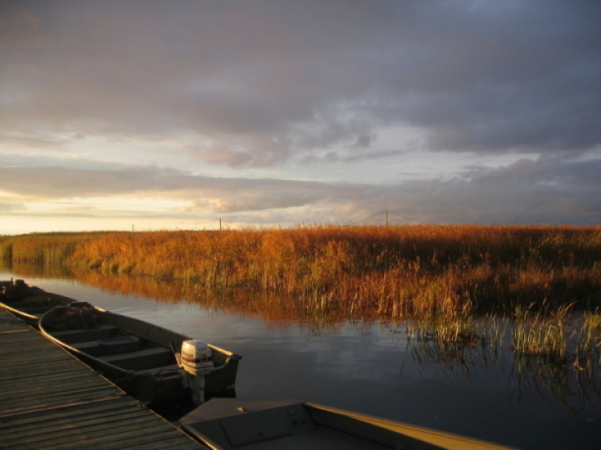
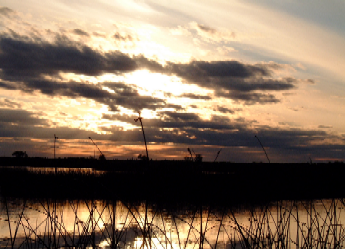 Sunrise on the marsh Sunrise on the marsh
The duck-hunter's view of the world.
Continue reading ""
Wednesday, October 12. 2005
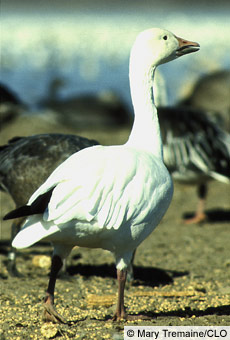 The Snow Goose, seemingly endangered in the 1970s, has now become a threat to itself, due to a population boom which threatens its arctic breeding habitat and might be caused by the abundant food which farmers leave on their fields after harvest, along the Mississippi and Central flyways. The Snow Goose, seemingly endangered in the 1970s, has now become a threat to itself, due to a population boom which threatens its arctic breeding habitat and might be caused by the abundant food which farmers leave on their fields after harvest, along the Mississippi and Central flyways.
In recent years, I have seen their flocks block out the sun in Canada. It's referred to as a "tornado" when they descend upon your decoys in a field in enormous numbers. There are no large numbers in the Northeast, but they do gather in the Chesapeake and I have seen them flying over ski slopes in Vermont in the winter, and loafing on potato fields on Long Island. This goose comes in a "blue" form, and various mixed-color versions, including the "eagle-head' - blue with white head. The blue version was once called a Blue Goose, but is now known to be just a color variant. The Canadian and US govts are doing all they can to encourage hunting Snow Geese, including a spring season and permitting electronic calls. They are fun to hunt, if they chose your field, and if you hit them they "go down like a prom dress," as the expression has it: easy to kill, compared to other geese. The deeply frustrating situation is when they chose a field adjacent to yours, and you end up standing there like a dope in your dorky camo hat with earflaps and an unused pile of ammo while hundreds or thousands of them land out of range. Daily limits of Snows are high in most areas. They are not exactly delicious like a Canada Goose, but there are ways to make them an enjoyable meal, and the rule is that if you kill it, you eat it. More about Snow Goose at CLO here.
Wetlands Litigation From Yahoo News: WASHINGTON (Reuters) - The U.S. Supreme Court said on Tuesday that it would decide the reach of the federal government's power to regulate wetlands, an issue pitting environmentalists against property-rights advocates. The justices agreed to decide a pair of Michigan cases, involving a shopping-center developer and a condominium builder, that will test whether the government's use of the 1972 Clean Water Act represented a permissible exercise of Congress' authority to regulate interstate commerce. The high court will consider whether federal regulators have gone too far by restricting development of wetlands that are not adjacent to navigable waters such as rivers or lakes. Read entire piece.
I hate cases like this in which strong ideas which I hold dear find themselves at war. Property rights? All for them - the foundation of economic freedom. Protection of the land? All for it. Trust states and localities to do the latter? Forget it. But is that right and principled? Maybe not. Are local, state and the federal govt corrupted by money? Yes - but it's not campaign contributions - it's tax money that corrupts them. They get to spend your hard-earned $ to buy re-election. Which is why a town govt will usually prefer a Walmart to a marsh.
Tuesday, October 11. 2005
Katrina's effects on LA wetlands An informal report from SW Louisiana, by Ducks Unlimited biologists:
Clay and I spent all day Tuesday in the Pecan Island area getting footage to show effects of the storm (Rita) related to the people in this devastating event and what they are trying to deal with.
Pictures and video can only show part of the devastation that we saw...homes washed away, dead animals and fish, decaying vegetation, mud, etc., etc. Miles and miles....
On Tuesday, most of our time was spent in Vermillion Parish. Hwy 82 runs along a Chenier ridge and through some great duck country. The water along Hwy 82, north and south is still high. Much of the vegetation is dead or dying. Effects of high water for this extended period will have significant effect on this marsh (hundreds of square miles). I am sure some areas will benefit and some will suffer and some areas will recover faster than others. Very difficult to tell at this time on specific areas. Water quality in much of this area is bad to worse. Not sure what effect water quality will have on recovery...if any???
On Wednesday, Clay and I spent the day near Gueydan. Clay took video of about 30 Mottled ducks at the NRCS WRP prairie restoration site.
Just west of Gueydan, we found several thousand Bluewinged Teal and a few Pintail in a fallow/idle field. Every duck we saw in two days was in flooded idle fields. Lots of water in the rice country...lots of unharvested second crop...Ag. dept. predict 95% of the ratoon crop was lost. Clay got some video of teal, mottled ducks, shorebirds, etc.
Read the rest on continuation page below:
Continue reading ""
Sunday, October 9. 2005

We are proud to say that we are among the rare and blessed few who have encountered the mythical duck hunter's cutie-pie while hunting last week in Manitoba - the famed and mysterious Maid of the Marsh, who, like a mermaid, or a unicorn, or a white whale, or Bigfoot, materializes like a vision out of the mist and rain and sleet, to present her magnificent self to distract and bother fortunate and intrepid fellows who are on a heroic quest - in this case, the quest for a limit of diver ducks on Manitoba big water. Yes, we were very lucky to get a photo of this charming creature as scientific proof of her existence, as she gave us her memorable trademark open-mouthed, invitingly seductive glance before she disappeared or dissolved into the fog and the bullrushes and the alcohol - a momentary vision who came to us in black and white. An illusion? A ghost? The fantasy of a lonely hunter far from home? Well, the photo tells it all. If you wonder about the make and model of the shotgun, your priorities are way off. No - we are not a porn site. Sorry to disappoint. This is science. We think the gun is a Win 42, a .410 and definitely no duck gun in anyone's hands, but a fine gun for shooting pigeons and starlings around the barn. And that is not cellulite - that is abundant health.
Friday, October 7. 2005
Posted on April 7, 2005 Maple Sugar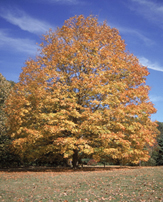 The LYF has been busy sugarin', so it's time for some info. We tend to think of Vermont maple syrup, but Canada is the major producer. We consume it abundantly in New England and do not approve of the cheap substitute goop in the supermarkets. Grading - lots of us like Grade B, but you won't find it in $ - We pay retail in the $20s/gallon, but the farmers get between $2-$3/gallon, usually. More in a "bad" year. Other uses: Put it on oatmeal like the Pilgrims did. Put it on pumpkin pie - great. Pour some into winter squash halves and bake, like my Indian ancestors probably did.
|