Sunday, February 5. 2012
"Any city gets what it admires, will pay for, and, ultimately, deserves. Even when we had Penn Station, we couldn't afford to keep it clean. We want and deserve tin-can architecture in a tinhorn culture. And we will probably be judged not by the monuments we build but by those we have destroyed."
"Farewell to Penn Station," New York Times editorial, October 30, 1963
There was a fervor for tearing down old buildings in urban American during the 1960s and early 70s. Many historic, but dilapidated, downtowns were bulldozed, as were countless wonderful "Union Stations" - and anything else that seemed "old".
Today, we cherish towns like Savannah which were left untouched by the government scourge of "urban renewal."
19th century housing was replaced by "modern" Soviet-style planned and government-subsidized housing projects (which finally are beginning to be dynamited themselves, for good reason). And the buildings were replaced with parking lots and sterile semi-high rises, and malls - that horrible concept which turns its back on the town in an effort to create an unreal, soul-less consumer paradise for the masses.
When you drive through downtown Bridgeport, CT, Hartford, or Nashville, you will be hard put to find an old building. Lucky towns escaped this frenzy of "modernization," which I term "dehumanization." Nobody wants to be in those sorts of downtowns.
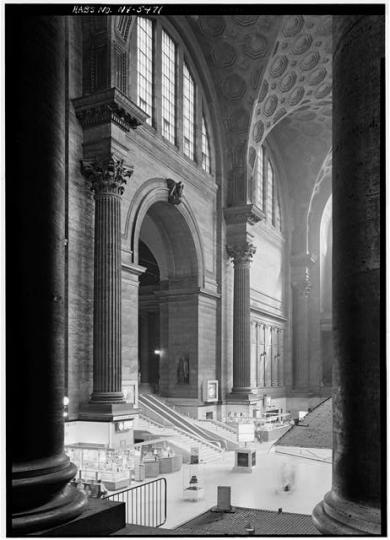
Pennsylvania Station on the West Side of Manhattan - one of the masterpieces of the beaux-art movement -did not escape the epidemic of destruction. Grand Central Station escaped - but only barely. Just tell me - where would you rather wait 40 minutes for a train to meet your girlfriend or boyfriend - the new Penn Station, or Grand Central?
Photo below of the 1910 McKim, Mead and White Penn Station, from this site of NYC architectural images. Who would have the nerve to knock this thing down and replace it with the new (and truly terrible in every way) Madison Square Garden?
Truth be told, this whole commentary was just an excuse to post this photo:
More photos of Penn Station here.
Friday, February 3. 2012
It's about bubbles - things with form but lacking in substance.
 Most "homeowners" have mortgages, if not second mortgages, or at least lines of credit against their homes. If you have a mortgage, you are essentially a renter - but a renter with the capital risk and the maintenance costs and risks. The ownership is an illusion and, if the place is paid off, you lose your interest deduction and so what have you gained by that process of eliminating your leverage? Well, if you are retired with lower income, you have gained the ability to remain in the house if you can cover the property tax. Most "homeowners" have mortgages, if not second mortgages, or at least lines of credit against their homes. If you have a mortgage, you are essentially a renter - but a renter with the capital risk and the maintenance costs and risks. The ownership is an illusion and, if the place is paid off, you lose your interest deduction and so what have you gained by that process of eliminating your leverage? Well, if you are retired with lower income, you have gained the ability to remain in the house if you can cover the property tax.
For economic reasons, more people are renting: Homeownership Rate Falls to Lowest Level Since 1997; The Homeownership Bubble Is Still Deflating.
The American Dream of home ownership is and has been a foolish ideal. However, it was an ideal which expert salesmen sold us since the 1950s. A sentimentality sales job, like cars. Chances are, you ain't buying no family estate that your grandkids would want to own.
Expert salesmen, again both in government and out, also sold us the college degree bubble. Once a meaningful social marker, it has become so diluted that it no longer means anything at all, or, I should say, can mean a lot or can mean nothing, depending on what was learned. I know, because I interview people for jobs. I have seen college grads who don't know what it means to graph a f(x), don't know the difference between RNA and DNA, and have never read Chaucer. Oh, I see. They have a BS in Business Administration. Is that "college"? Oh, somebody wrote a term paper about Virginia Woolf? Wow. I guess they can write a sentence. What is meaningful is a rigorous High School degree. From that, you have the foundation to learn anything you want to.
Is a college degree job training, a few additional High School years, a social marker, an expensive prolonged adolescence, a merit badge, a haven for dedicated scholars, or what? Nobody knows anymore, but it is widely sold as a necessary qualification. Hence a piece like this in the NYT: Why go to college at all?
My theory used to be that a college education should prepare you to understand, in depth, every page of the Sunday New York Times. I don't buy their paper any more, which is their loss. Mine also, to some extent.
Guys just say "You pissed me off." Women harbor grievances as precious possessions.
Anon.
Thursday, February 2. 2012
What don't "they" want to regulate? Call for Sugar to Be Regulated as a Toxin. That is not from The Onion. Well, I suppose if "they" want to regulate CO2, a basic and necessary ingredient of air, then why not sugar?
Why the sudden interest by the Food Nazis in regulating this most basic and appealing of carbohydrates? From this article: Sugar Should Be Regulated As Toxin, Researchers Say:
Some researchers argue that saturated fat, not sugar, is the root cause of obesity and chronic disease. Others argue that it is highly processed foods with simple carbohydrates. Still others argue that it is a lack of physical exercise. It could, of course, be a matter of all these issues.
Oh, so the scientists are not sure? So what? It's the precautionary principle, and we brain-dead masses can not be left alone with their own food. I can regulate my own sugar, thank you very much. And my own body, too. What do the Feminists say: "Government's hands off my body."
You can't make this stuff up.
Also, see this: Government regulation is one of the nation’s few growth industries, making a mockery of the assertions and predictions of the Obama administration.
"Give me Social Security and Medicare, or give me death."
Not Patrick Henry
One must wonder how people survived and thrived here in America for hundreds of years without food stamps, government benefits, or a maternal government. Perhaps they had a different mind-set.
Tuesday, January 31. 2012
Monday, January 30. 2012
We are considering putting up one of these Country Carpenters pre-fab post and beam barn/garages up at the top of the driveway, perhaps with a small apartment upstairs.
I was told they can be put up in a week, or less, once the slab is laid down. Installing a septic field would be an additional expense that I am not sure I want to take on right now. I think we will also need a well.
Every American needs a barn. Were I running for President, that would be my promise.
Here's a pleasant New England homestead they did:

Sunday, January 29. 2012
I'm with VDH on this: What We Do Not Want to Hear Anymore. By way of correcting the drivel many of us are tired of, he concludes:
Human nature and the laws of physics, not technocratic liberalism, are still the best guides to the madness around us. Money borrowed has to be paid back or the debt eaten by someone, period. Poverty is defined by a want of material necessities, not by lacking the appurtenances that someone else better off enjoys. Gas and oil are miracle fuels and it is very hard to find alternate energies at comparable costs and reliability. And as a rule, the green class of environmental elites usually uses more fossil fuels per capita than do the muscular classes who mine and drill them out of the ground — and who do not jet, drive, or live in the comparable fashion of their critics. The content of our character alone matters; those who are not so confident in their own, usually demand that their tribal affiliations be essential and not incidental to their personas. Most accept that culture, not race matters, but it matters still more not to say that. Most of the political class has no interest in history; dogma is their creed. They assume that everyone (far less noble than themselves) in the past would have agreed with them, or now can be postfacto made to agree with them.
Saturday, January 28. 2012
Listening to Bill Whittle's video we posted yesterday reminded me of his Katrina-era post titled Tribes.
As you may recall, it's about sheep, wolves, and sheepdogs - and about the Pink and Grey tribes.
In case readers didn't take the time to read the WSJ opinion piece this week by prominent scientists, here it is: No Need to Panic About Global Warming -There's no compelling scientific argument for drastic action to 'decarbonize' the world's economy.
The brief video interview with the Princeton Physics prof there is interesting too. He says they would have had many signatures if they had taken the time.
These fellows are saying what we have been saying here for years, but they have more street cred than we have. Indeed, the story of the AGW hysteria is a fascinating story of the politicization of scientific inquiry coupled with governmental and academic greed for money and power. It is a cautionary tale.
Furthermore, I think many of us would welcome a little global warming. I think it would improve the planet, overall. It certainly did so in the past. Watch, over the next year, more scientific organizations and agencies find the courage to publicize these politically-incorrect views.
At Maggie's Farm, most or all of us are Environmentalists and Conservationists. We want land and water and air to be protected. We do not even approve of urban sprawl because we may need all of our farmlands someday and, as pleasant as urban hiking can be, we need the woods too. But at the same time, we like to live in reality.
Friday, January 27. 2012
A propos yesterday's post on Fishtown: Apple's Jobs to Obama: "jobs aren't coming back" to U.S:
Apple's executives believe the vast scale of overseas factories as well as the flexibility, diligence and industrial skills of foreign workers have so outpaced their U.S. counterparts that "Made in the USA" is no longer a viable option for most Apple products.
Thursday, January 26. 2012
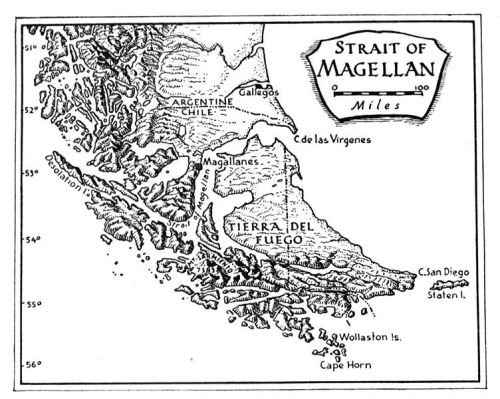
A friend of mine told me he is taking this trip this winter, with his two brothers through the Strait of Magellan and then up north along the coast of Chile.
He said they decided that they wanted to bond and reconnect before they get old. Sounds like a very cool trip, and cheap. He said he was going to take photos of Albatrosses. I warned him not to shoot one because nothing good comes of it.
Wednesday, January 25. 2012
 From Girl Meets Gun: From Girl Meets Gun:
Shooting a gun is like smoking a cigarette or drinking espresso in a café in Paris or having sex on a Caribbean beach: You’ve watched it so many times on-screen that you experience your own actions as an echo. It’s impossible not to feel like a cliché.
Tuesday, January 24. 2012
I have been asked by readers why I can sound so harsh about education and our current educational systems. The answer is that I care about learning so much. For me, learning new things is relaxing, recreational, and a gift (and does not need to be expensive), but I accept that not all feel the same way. I am a teacher at heart, even though I do not teach although I do help train our young associates. If I were as tough on students as I am on our associates, I'd be fired in a New York Minute.
Here's Walter Williams: Schools of education protect ignorance in the classroom. He concludes:
Schools of education represent the academic slums of most any college. American education can benefit from slum removal.
Sounds true, although those pathetic standards certainly do not apply to my town in CT where, unions aside, the public school teachers are well-educated, enthusiastic, demanding, and dedicated. However, our local school system avoids hiring teaching school graduates.
Monday, January 23. 2012
Is Algebra ll too difficult for most high schoolers? It's a big debate in California.
I honestly do not know the answer, but it seems basic to me. If you can't master Algebra and Trig, and use them to hone the brain, it's tough for me to figure out how you graduate from high school.
Somewhat related, The College-Degree Mania in Ohio. As Leef says:
Sorry, governor, but colleges don’t graduate students. Students graduate themselves if their efforts are sufficient, and the sad fact is that many who enroll are so academically weak and unmotivated that they don’t amass enough course credits to get their degrees within six years. That isn’t the fault of the institutions.
Maintaining standards is an endless and possibly a losing battle with today's credentialism. Someday, we'll have to admit that most people are not scholars (even to the level of Algebra ll), and that learning how to do something useful and practical might be more important. That view, however, runs right up against the Big Education lobbies.
There is no market for Sociology Majors, but there is a big market for Master Plumbers and Gunsmiths. They make more money, too. But they need to know some math to do their work.
Sunday, January 22. 2012
 We have rreported so many scientific frauds in the past couple of weeks, I thought I would highlight some commonly-used "data-management" tricks designed to dishonestly influence people. We have rreported so many scientific frauds in the past couple of weeks, I thought I would highlight some commonly-used "data-management" tricks designed to dishonestly influence people.
1. "Clustering." We have all heard about cancer clusters - Why does my town have triple the breast cancer of towns two miles away? There must be someone I can sue about this. Such claims have an emotional appeal, but they are nonsense. Random distribution is not even - it is uneven. Just try flipping a quarter, and you will get little runs of tails. Clustering is a natural effect of randomness, but trial lawyers are always busy trying to track them down: they can get rich before anyone figures out the game.
2. "Cherry-picking." Cherry-picking is a frankly dishonest form of data presentation, often used by newspapers to create alarmist stories about the economy, the environment, food safety, etc. It fools people without some decent science education. What it entails is combing through, say, 60 pieces of data, and then using the three points that support your argument, and ignoring the rest. Presenting random changes as meaningful facts is a lie. Environmentalists use this all of the time, as do other agenda-driven fact-handlers. A casual use of this fallacy is characteristic of The New York Times typical headline: Despite Good Economic Statistics, Some Are Left Behind - and then they scour NYC to find some single black mom in the Bronx who cannot support her kids - and she becomes the "story".
3. "Anectdotal evidence." The above example could also be termed "anectdotal evidence." If you look around, you can always find an exception, a story, and example - of ANYTHING. But anectdotes are compelling, and Reagan used them to the best effect. And how about those swimming Polar Bears! (I always thought they liked to swim.)
4. "Omitted evidence". You tell me how common this is! A first cousin of Cherry-picking, Omitted Evidence is also a lie. All you do is ignore the evidence and data that disagrees with your bias or your position. Simple.
5. "Confirmation bias". People tend to remember evidence which supports their opinion, belief, or bias, and to dismiss or forget evidence which does not. It's a human frailty. Humans have to struggle to be rational.
6. "Biased Data". "A poll at a local pre-school playground in Boston at 2 pm today indicated that 87% of likely voters will vote for Obama." Picking your data sources, like picking the questions you ask, can determine your results with great accuracy. As pollsters always say, "Tell me the answer you want, and I will design the question."
7. "Data mining." Data-mining is used by unscrupulous academics who need to publish. Because it is a retroactive search for non-hypothesized correlations, it does not meet criteria for the scientific method. Let's say you have 10,000 data points from a study which found no correlation for your hypothesis. Negative correlation studies are rarely published, but you spend a lot of time collecting it - so you ask your computer if it can find any other positive correlations in the data. Then you publish those, as if that was what you had studied in the first place.
Image: two good varieties of cherries for picking; Stella on the left, Lapins on the right, from Miller Nurseries
Friday, January 20. 2012
At UNC, The Diversity Mania
Why does this sound creepy to me?
Thursday, January 19. 2012
Confirmed: Charter Schools Beat the Daylights Out of Public Schools:
The cost of one bad teacher for one year on an average classroom of students is a whopping $266,000 in that class's collective lifetime earnings, which is over $2.6 million which that lousy teacher will cost society over ten years, or possibly $7.8 million over the teacher's tenure.
That's just one bad teacher. Multiply that by the possibly tens of thousands of wretchedly bad teachers whom the teachers' unions protect, and you realize the cost to society of our monopolistic public school system.
Tuesday, January 17. 2012
We linked this by Gelinas yesterday: A man’s home is the government’s castle
Also, American Thinker's Seizing the Wealth of Landlords, One District at a Time
Both cities' rent control laws began as emergencies to meet temporary housing crunches (you always need a "crisis" to create an opportunity for government control). Then your "emergency" action becomes permanent due to its newly-created constituency. That is how Leviathan grows.
If rent control were eliminated in NYC today, in short time there would be tons of new middle class rental housing built; supply up, prices down. The moral issue, though, is that these controls do constitute a form of government theft from the owners.
Monday, January 16. 2012
Did the Founding Fathers make an error? As much as anything else, this Robinson interview with Paul Rahe (that's #5 of 5)captured most of the key political issues with which we Maggie's Farmers are concerned today.
Some people desire to run other peoples' lives for their own good. I wish those Rahe interviews were on YouTube. They deserve to be.
On Martin Luther King Jr. Day, many are asking questions about how much freedom most people really want. How much freedom will the average person trade for a bowl of lentils? In other words, for security or for free money?
When I was in 6th Grade, our school had a speech contest, the title being "What Freedom means to me." Mine came in second. If I were doing that speech today, I'd probably come in last. Freedom from involuntary servitude - slavery - is of course basic, but freedom from government power is the beseiged freedom of today, just as it has always been.
At Vanderleun, Comment of the Week So Far: "You know how you can tell that 'everyone wants freedom' is baloney?"
Saturday, January 14. 2012
A good debate: Are Too Many People Going to College? (link fixed)
I tend to agree with George Leef in that debate, but of course I think anybody ought to go if they want to. Some of my points, as readers know, are these:
- college does not equal education
- very few people are natural scholars
- for many people, it is just an extended adolescence, with credential-buying, beer, and sleeping til noon
- many young people would rather work than study
and so on.
Friday, January 13. 2012
Rich girl explains poverty to the greedy and benighted.
In America, the poor do not stay poor, and the rich do not remain rich. Overall, in the US, both great wealth and difficult poverty seem to be transient. I am opposed to the death tax because it discourages people from building a secure and independent future for their kids and grandkids.
Of course, death taxes seem not to affect the very wealthy.
From the latter link:
...if upward mobility is so common, why are there still plenty of poor people in this country? In a recent video about income mobility hosted by the Institute for Humane Studies, economist Steven Horwitz of Saint Lawrence University explains:“Immigrants and young people entering the labor force come into that income distribution at low levels of income. They become the new poor when the old poor slowly move their way up.” Horwitz concludes that “even though a first glance at the data may make it seem as if the rich are getting richer and the poor are getting poorer, the reality of the United States in the early 21st century is that everyone is getting richer, poor and rich alike.”
Thursday, January 12. 2012
"Bullshit" is the title of a well-known 1986 essay by Princeton philosopher Harry Frankfurt, now expanded into a short book.
Two of Frankfurt's main points seem to be that, 1, the bullshitter is more motivated to create an impression of himself rather than to communicate substantial true material and 2. bullshit may be more insidious than lying. From a review of the book here:
...bullshitters seek to convey a certain impression of themselves without being concerned about whether anything at all is true. They quietly change the rules governing their end of the conversation so that claims about truth and falsity are irrelevant. Frankfurt concludes that although bullshit can take many innocent forms, excessive indulgence in it can eventually undermine the practitioner's capacity to tell the truth in a way that lying does not. Liars at least acknowledge that it matters what is true. By virtue of this, Frankfurt writes, bullshit is a greater enemy of the truth than lies are.
Besides being a very bright fellow, his life as an academic gives him unique experience with the world of bullshit. We are all bullshitters, to some extent, but some make a career of it.
Frankfurt's original 6-page essay can be read here. One quote:
It is impossible for someone to lie unless he thinks he knows the truth. Producing bullshit requires no such conviction. A person who lies is thereby responding to the truth, and he is to that extent respectful of it. When an honest man speaks, he says only what he believes to be true; and for the liar, it is correspondingly indispensable that he considers his statements to be false. For the bullshitter, however, all these bets are off: he is neither on the side of the true nor on the side of the false. His eye is not on the facts at all, as the eyes of the honest man and of the liar are, except insofar as they may be pertinent to his interest in getting away with what he says. He does not care whether the things he says describe reality correctly. He just picks them out, or makes them up, to suit his purpose.
Wednesday, January 11. 2012
"But, by an inference as false as it is unjust, do you know what the economists are now accused of? When we oppose subsidies, we are charged with opposing the very thing that it was proposed to subsidize and of being the enemies of all kinds of activity, because we want these activities to be voluntary and to seek their proper reward in themselves. Thus, if we ask that the state not intervene, by taxation, in religious matters, we are atheists. If we ask that the state not intervene, by taxation, in education, then we hate enlightenment. If we say that the state should not give, by taxation, an artificial value to land or to some branch of industry, then we are the enemies of property and of labor. If we think that the state should not subsidize artists, we are barbarians who judge the arts useless."
Frederic Bastiat, 1848 (h/t Coyote)
|