We are a commune of inquiring, skeptical, politically centrist, capitalist, anglophile, traditionalist New England Yankee humans, humanoids, and animals with many interests beyond and above politics. Each of us has had a high-school education (or GED), but all had ADD so didn't pay attention very well, especially the dogs. Each one of us does "try my best to be just like I am," and none of us enjoys working for others, including for Maggie, from whom we receive neither a nickel nor a dime. Freedom from nags, cranks, government, do-gooders, control-freaks and idiots is all that we ask for.
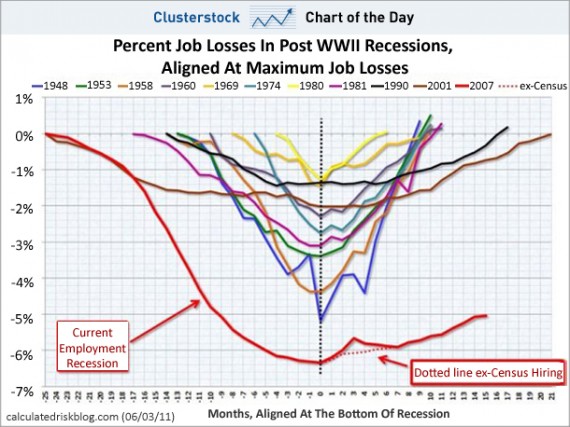
It's hard to avoid the conclusion that the threat of tax increases and increased regulatory burdens have produced something in the nature of a hiring strike.
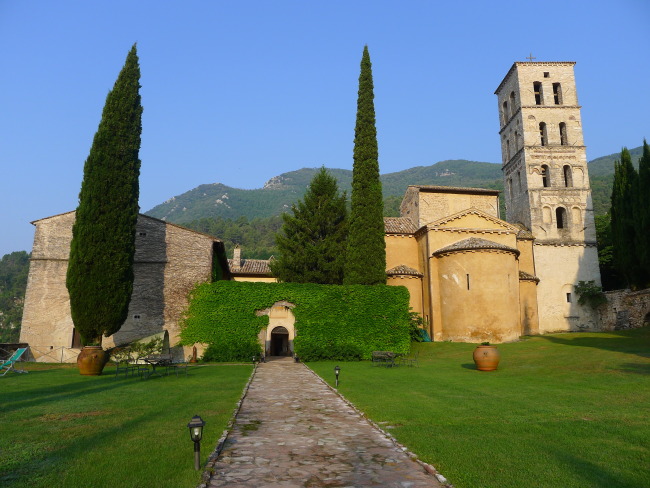
Actually, it is now a small hotel in the Valnerina (the Nera Valley in the Appennines). We stayed here last week. There is a cross hanging over every bed, and the rooms are (converted) monks' rooms (Yes, each room or suite has a bath). This is the Abazzia San Pietro in Valle. It began as a Benedictine monastery in the 5th C., established by converted Lombard invaders, the lords of Spoleto.
In fact, the Lombard Lord of Spoleto gave up his lordship to become one of the early humble monks there, and his bones rest in an old (recycled) and beautifully-carved pagan Roman sarcophagus next to the altar. I guess they threw out some old Roman's bones to make room for him.
Their chiesa is old, but, like most things in Italy that have been around for over a thousand years, things have been re-done and re-decorated. We were told that the cheisa, in some places, has five layers of frescoes on the walls. Sort of like old wallpaper, but, as Mrs. BD observed, any one of those layers would make for a blockbuster show at the Metropolitan Museum of Art.
This wealthy and politically-powerful monastery was sacked by the Saracens - the marauding Moslems who held parts of Europe in terror for hundreds of years during the Dark Ages, and who specialized in collecting infidels for the Middle Eastern slave trade - around the year 900, but it came back. It was abandoned by the Benedictines in the 1800s and was used as stables and sheep shelters until some rich guy from Rome bought it in the 1920s and began semi-converting it into his country villa. Mussolini himself visited the Abazzia to celebrate the restoration of Italian history and culture.
One of the most photogenic places I have ever been to. Impossible for even a lousy pic-taker like me to take a bad photo. Felt unreal to be staying there, stunned by the romance of history but mainly by the beauty and glory of creation, just like when you are on a horse in the Montana Rockies, or on skis at the top of Whistler in a snowstorm. The times when the glory of God gets so much in your face you cannot deny it no matter how much of a curmudgeon you might want to be.
See what I mean about Mrs. BD being a good trip-planner? She plans, I just do the driving and go where I am told - except when I don't... More pics from around there later in my ongoing travelogue.
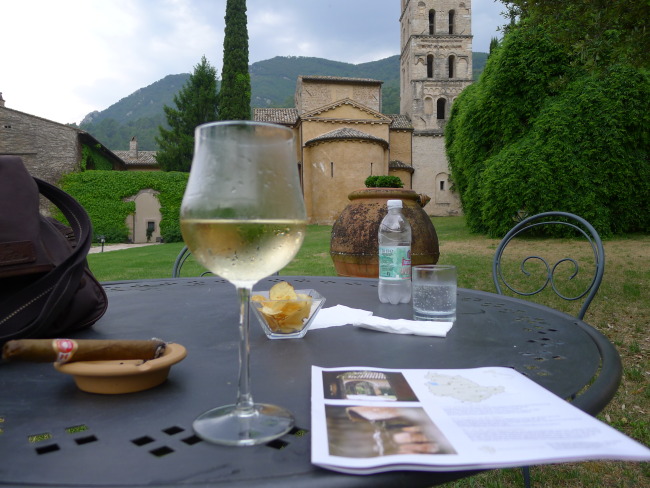
This is inside the walls, in the garden, facing the inner cloisters and the rear of the chiesa with its bell tower:
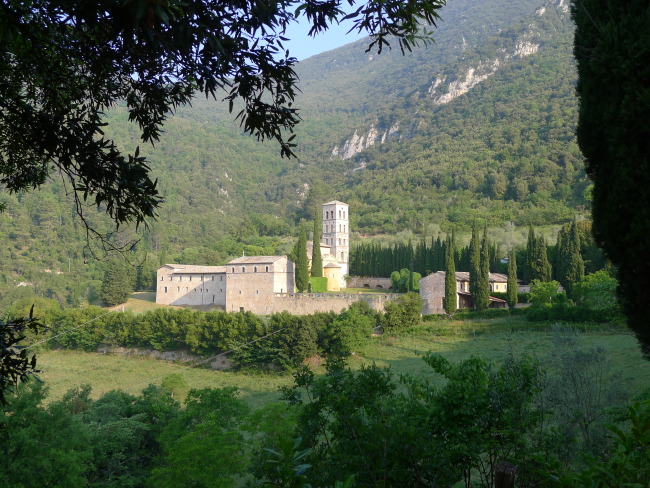
View from the long, steep dirt entry road, lined with small farms and olive groves. The place is halfway up the mountain. Everywhere, the tinkling of sheep bells, the occasional barking of the sheep dogs, and the crazy horn-like braying of mules. (I don't know why they keep mules, but I do know they make a popular sausage out of them, called "Mulo." Not kidding.)
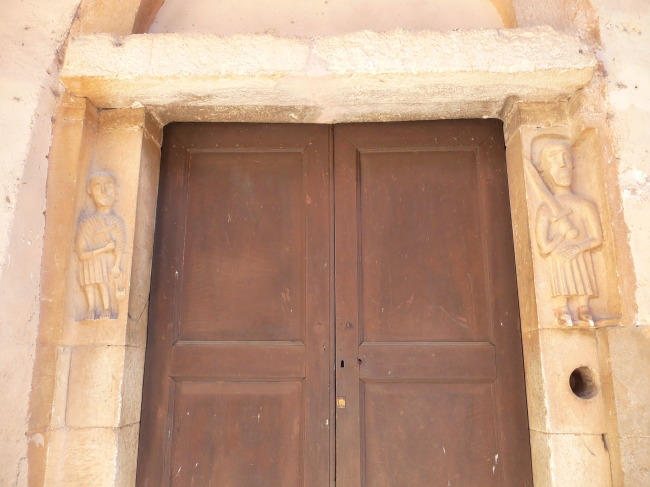
Lombard-era carvings of Peter and Paul (with the sword) at the monk's side entrance to their chiesa from the inner cloister. You could write a thesis on these "paleo-Christian" things if you wanted to:
Who was staying here? A group of jolly Aussies, and two delightful Dutch couples. The rest were from Rome on getaways with wives or girlfriends. (We had a good chat with a Roman fellow, a young 30s internet entrepreneur, who was there with his dazzling and seductive-looking fiance. They have a 4 year-old daughter. They were planning their honeymoon trip to NYC, San Francisco, and then Kauai, and wanted names of good NYC restaurants and shows to see. What a world! Except for their paranoia, the Italians can teach us all how to really live.)
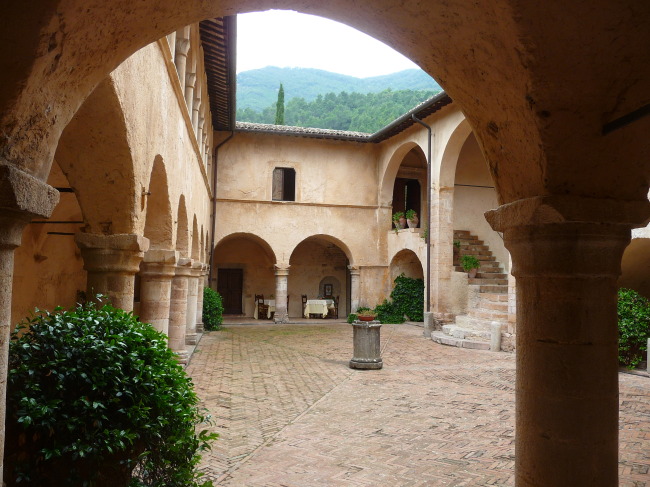
As I said to Mrs. BD, this ain't no Motel 6. The have only around 12 rooms and suites. The inner cloister, with a couple of outside breakfast tables:
Monks loved their wines. That's my refreshing post-mountain-hiking, pre-dinner Orvieto - the classic white wine of Umbria:
4:12 Beloved, do not be surprised at the fiery ordeal that is taking place among you to test you, as though something strange were happening to you.
4:13 But rejoice insofar as you are sharing Christ's sufferings, so that you may also be glad and shout for joy when his glory is revealed.
4:14 If you are reviled for the name of Christ, you are blessed, because the spirit of glory, which is the Spirit of God, is resting on you.
5:6 Humble yourselves therefore under the mighty hand of God, so that he may exalt you in due time.
5:7 Cast all your anxiety on him, because he cares for you.
5:8 Discipline yourselves, keep alert. Like a roaring lion your adversary the devil prowls around, looking for someone to devour.
5:9 Resist him, steadfast in your faith, for you know that your brothers and sisters in all the world are undergoing the same kinds of suffering.
5:10 And after you have suffered for a little while, the God of all grace, who has called you to his eternal glory in Christ, will himself restore, support, strengthen, and establish you.
Liberals just love hearing America denounced as "parochial." It makes them feel worldly and superior. This phony posture in part explains the tasteless joke we now have in the White House.
This saying good-bye on the edge of the dark And cold to an orchard so young in the bark Reminds me of all that can happen to harm An orchard away at the end of the farm All winter, cut off by a hill from the house. I don't want it girdled by rabbit and mouse, I don't want it dreamily nibbled for browse By deer, and I don't want it budded by grouse. (If certain it wouldn't be idle to call I'd summon grouse, rabbit, and deer to the wall And warn them away with a stick for a gun.) I don't want it stirred by the heat of the sun. (We made it secure against being, I hope, By setting it out on a northerly slope.) No orchard's the worse for the wintriest storm; But one thing about it, it mustn't get warm. "How often already you've had to be told, Keep cold, young orchard. Good-bye and keep cold. Dread fifty above more than fifty below." I have to be gone for a season or so. My business awhile is with different trees, Less carefully nourished, less fruitful than these, And such as is done to their wood with an axe-- Maples and birches and tamaracks. I wish I could promise to lie in the night And think of an orchard's arboreal plight When slowly (and nobody comes with a light) Its heart sinks lower under the sod. But something has to be left to God.
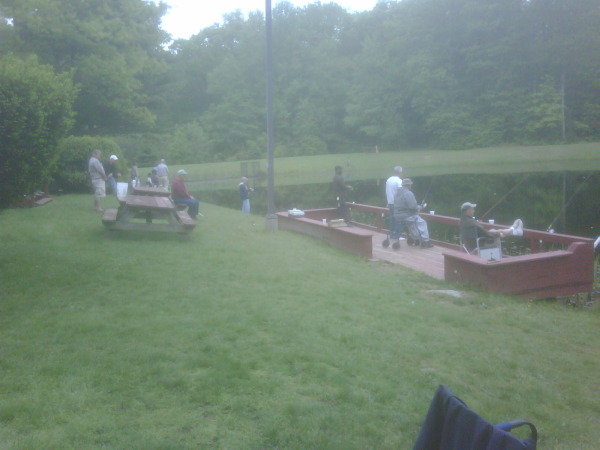
Better yet, let's take a WW 2 Vet fishing. A pal's hunting and fishing club had their annual Saturday Take a Vet Fishing Day last weekend, and he sent me this snap. Some guys in wheelchairs:
George Shearing died on Valentine's Day 2011. He was blind from birth and died at the age of 91. George started playing piano and accordion at age 5 and his only formal musical education consisted of four years of study at the Linden Lodge School for the Blind. Later, finances would force him to turn down university scholarships to play piano in a neighborhood pub for $5 a week.
Years later he became a prolific songwriter, known for expanding the boundaries of jazz by adding an orchestral sensibility and a mellow aesthetic to the music. In 1947, Mr. Shearing moved to America where he became one of the most popular performing and recording artists. He won earned many prestigious awards, honorary doctorate degrees, Grammy Awards, and three presidents have invited him to play at the White House.
In 2007, this once poor, blind kid from Battersea, the youngest of nine, whose father delivered coal and his mother cleaned trains at night after caring for the children during the day, travelled with his wife, Ellie, to London to be Knighted by Queen Elizabeth II in the Ballroom of Buckingham Palace.
After the ceremony he is quoted as saying, "The poor, blind kid from Battersea became Sir George Shearing. Now that's a fairy tale come true." He once introduced his composition "Lullaby of Birdland" by saying: "I have been credited with writing 300 songs. Two-hundred-ninety-nine enjoyed a bumpy ride from relative obscurity to total oblivion. Here is the other one".
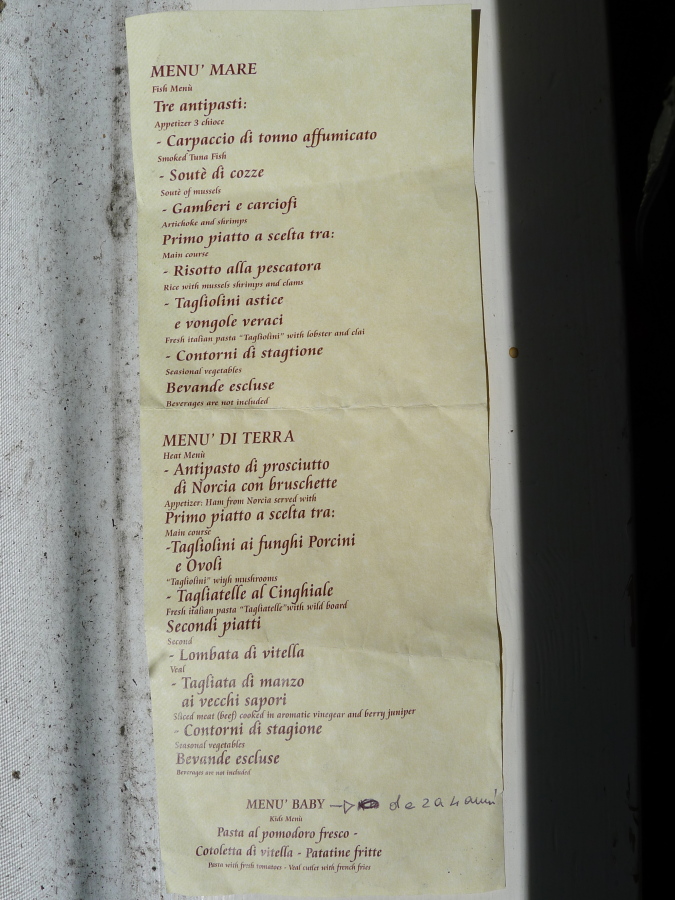
We stumbled by accident into a little ristorante in the dreary (and definitely not touristy) medieval hilltop village of Amelia around 2 pm, and found the place in the otherwise dead town packed with jolly Italians chowing down and drinking wine. We were the only foreigners there. The Hosteria dei Cansacchi. A simple neighborhood place with a simple menu: you order either the Mare or the Terra. I ordered the Mare, Mrs ordered the Terra, and halfway through lunch we had to "stop the menu." However delicious, it was just too much. That's when we decided we needed to share meals.
Here's their menu - no choices - they just bring it all, one course after another. The English translations in the fine print are imperfect, eg "Wild Board."
When you drive around the northeastern US in late May-early June, the blooming Black Locust trees are everywhere. Their white flower bunches put on a good show and stand out strongly from the green background - the locust trees are a big puff of white.
As a tree which is not native to the northeast, it is often considered a weed tree. An illegal alien, as it were. The are fast-growing, and tend to form stands which crowd out native trees. Pleasant glades, however.
Black Locust was transplanted to the north because locust makes the best, longest-lasting fence posts and fence rails. 50 years. It still does.
Snap above is on the country road in the hilly Tiber Valley driving from Todi to Montefalco, with the charming town of Todi in the distance, on the hill. Italy is good about having a sharp distinction between town and country. Little-to-no sprawl. Except in the big cities, you go from urban density directly to vineyards, olive groves, or forests full of deer, cinghiale, eagles, even wolves and, best of all, the ferocious and dangerously-expensive Wild Black Truffle. People like to live in towns, where they can walk to work and shop, and can say bon giorno to their neighbors.
Bit of history
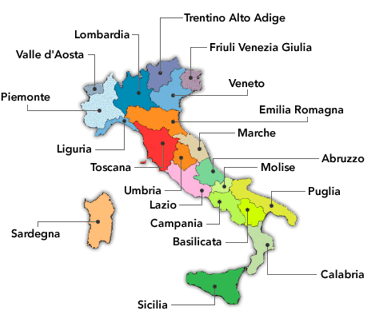
A quick history and geography of Umbria in central Italy, northeast of Rome, to put my forthcoming travel pics in context. It is generally similar to the history of the entire area we now term Italy.
Central Italy was the prehistoric land of the Etruscans (hence "Tuscany" - land of the Etruscans) and of the less-known Umbri. They were, relatively speaking, peaceful and prosperous farmers and traders. When Rome began its imperial expansion around 250 BC, Umbria up along the old trading route to the Adriatic (which the Romans later termed the Via Flaminia) seemed like an obvious target.
The Romans did their Roman thing there for 600 years until the empire began to unwind and Goths and Lombards moved into Tuscany and Umbria both by immigration and by arms in the 400s-500s. In many ways, these waves of invasion became sort of Romanized and Christianized, in time. The Byzantines were in the mix then, too.
Warring feudal duchys and kingdoms dominated the dark ages in this part of Italy, during a time when the declining Roman regions were also set upon by piratical Saracens (mainly seeking slaves for the Middle Eastern slave trade) and Normans (seeking adventure), until Papal power exerted itself and built an authoritarian, theocratic peace by the 1100s and 1200s. They were big on building castles with which to assert their powerful churchly presence, but from the days of the late empire people were building their own keeps and walls to defend themselves from foreigners and also from their neighboring towns. The Roman Legions had previously made walls and keeps unnecessary: the Roman armies had been the wall. The Pax Romana.
The Papal State pretty much controlled central Italy, perhaps to its detriment, until the Italian nation was invented 150 years ago. Roman Catholicism was pretty much corrupted by money and politics, during that era, including the Benedictines.
2011 is the 150th anniversary of that political event. Garibaldi, etc.
Geography
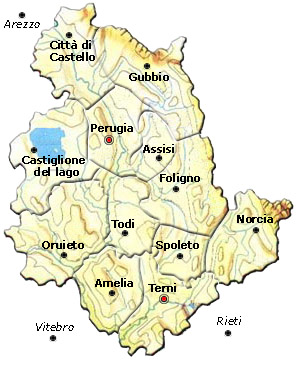
Geographically, southern Umbria divides itself into three regions: The north-south-running Tiber Valley where the Tiber flows south towards Rome, the fertile north-south running Valle Umbra which is like a mini version of California's Central Valley, and the eastern Valnerina which is the area in the majestic Appennines where the river Nera flows down to eventually join and magnify the Tiber.
We visited and stayed in incredible hotels in each of those three areas of Umbria. As in Roman times, rural and quaint Umbria is a popular Roman getaway place, full of bikers, motorcyclists, foodies, and hikers. It's only a 2 or 3 hour drive from Rome, and it is packed with "unspoiled gems."
Most of the towns were Umbrian first, Roman later, and then Medieval-Renaissance. Except for towns damaged by the war (like Terni) or by earthquakes (like Foligno), there is a lot of Renaissance, generally built on Medieval town footprints.
Except for Assisi with its bus-loads of pilgrims, we saw few non-Italian tourists and only one American couple - friendly folks from Montgomery, Alabama! Some Brits, Aussies, Austrians, and Dutch. We tend to meet people when we travel. That's part of the fun.
Todi, Amelia, Orvieto, Montefalco, and Perugia are on hills in the Tiber Valley. Towns in Umbria tended to be built on hills for defensive purposes, which is why exploring Italy is such a good physical workout. Assisi, Spoleto, Spello, and Terni are along the western edge of the Apennines where they rise from the plain. Norcia, and our monastery hotel, are in the mountains themselves near where the Nera emerges from the mountains.
Weather
Best times for Italy or any Mediterranean travel are Spring and Fall. May and October are perfect. Italy climate here.
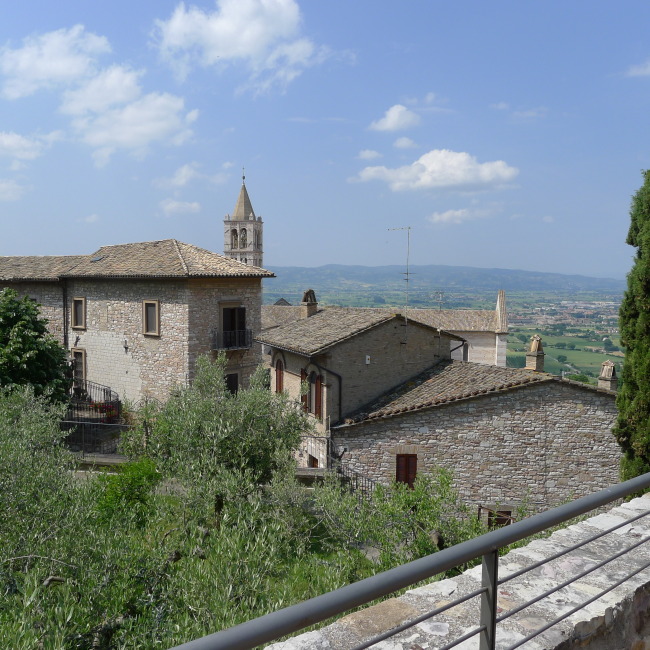
I will have lots more fun travel pics soon - Pic below of the Valle Umbra, looking west from the Assisi hillside:
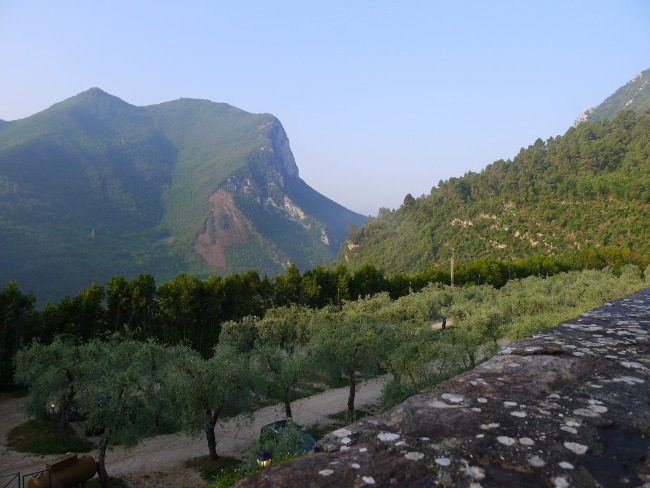
Pic below from the garden of our 6th C. Benedictine monastery hotel in the Valnerina in the Apennines, with a small hillside olive grove (doubling as parking area) below the wall. It is no wonder that people love to visit Italy: it has the food, the history, the scenery, the quaintness, the vino, the art and architecture, and the delightfully tough and fashionable Italian gals.
The President’s descriptions of the situation are comprehensive and urbane. He correctly identifies the forces at work. He develops interesting policy ideas and approaches that address important political and moral elements of the complex problems we face. He crafts approaches that might, with good will and deft management, bridge the gaps between the sides. He reads thoughtful speeches full of sensible reflections.
But the last few weeks have cast him as the least competent manager of America’s Middle East diplomatic portfolio in a very long time.
and, Mead continues,
Netanyahu beat Obama like a red-headed stepchild; he played him like a fiddle; he pounded him like a big brass drum. The Prime Minister of Israel danced rings around his arrogant, professorial opponent. It was like watching the Harlem Globetrotters go up against the junior squad from Miss Porter’s School; like watching Harvard play Texas A&M, like watching Bambi meet Godzilla — or Bill Clinton run against Bob Dole.
WILL AMERICA SEE EUROPE-STYLE RIOTS?Newsweek sounds hopeful, but in America, unlike Europe, it’s usually the taxpayers who are behind the revolutions, not the parasites.
Nobody knows what we should eat. I believe we should eat whatever the heck we want to, and ignore the experts and the nannies. We're all gonna die. Just take some Lipitor and hope for the best.
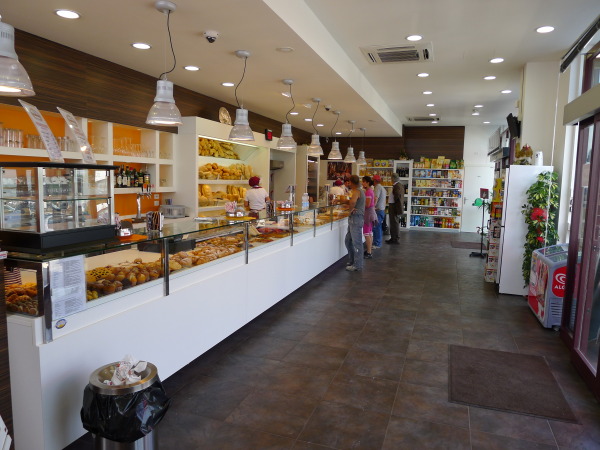
We stumbled onto this joint last week while taking a flyer down local roads en route from Bevegna to Spoleto. Wonderful drive on narrow winding roads through olive orchards, vineyards, small farms with patches of wheat, fava bean, and lentil, and tiny antique villages. But, of course, in Italy, when you stop for a coffee, a "coffee" means a 1/2 inch of intense espresso at the bottom of a tiny cup. A delicious half-mouthful if you add a bit of sugar, but nothing to linger over or to put in your car's cup holder.
If you request a cafe Americano, they just add some hot water to it.
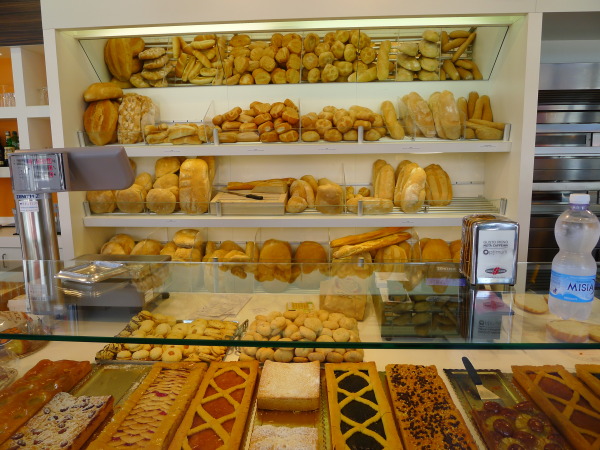
This roadside charmer, like most such places in Italy, offers Italian pastries, beer, wine, cocktails, breads, sandwiches made to order, rustic pizzas, etc., to go or to eat there on plastic chairs in the A/C. Yes, you can have a smoke inside. Everybody does. Often, the serving people fix up your order with a cigarette hanging out of their mouths like the good old days, and I do not think they care deeply about what the EU or anybody else thinks about that.
Dunkin Donuts does not offer beer or wine, and you cannot smoke in there. We stopped for some water (water with "gas" - always - that evil CO2) and a quick cafe.
Never order pizza in Italy - it's terrible stuff. It was the Neapolitan immigrants to America who made it into a tasty treat - and the Italians have little interest in learning about the gastronomic arts from Americans.
I would remind the Italians of these facts: Tomato, from the New World. Potato, from the New World. Squash, from the New World. Polenta, from the New World. Pasta, from China. Risotto, from China. What did they eat before all of that?
Watched this movie on my flight from Paris to the USA earlier today (or yesterday?). Not a great boxing movie, but it does capture elements of the Irish (or could just as easily be Italian) blue-collar world of New England.
The movie is set in Lowell, MA, a rough working-class town outside of Boston. My olde New England contains a disappearing old Yankee breed, a disappearing semi-old multi-ethnic farming contingent (especially Poles from the later 1800s), and, in urban and semi-urban areas, large Irish and Italian-origin populations which stick to many of their old ways. Increasing numbers of Mexicans are appearing, too - some in the illegal drug biz and the better ones are masons or in the army of unskilled laborers.
Mrs. BD and I have concluded that Umbria is a more varied and interesting place to visit than Tuscany. I have a well-travelled friend who agrees. Umbria is, except for the tourist magnets of Perugia and Assisi, off the beaten track. We have been around much of Italy in the past, and the Latin and Italian scholar lad has been literally everywhere there.We had not toured Umbria and the old Via Flaminia (which it is still called). Mrs. and I just returned home from our delightful adventure. As I get my thoughts and pics organized, I will go over some of it: History, food, geography, etc.
I do have some ideas about how to make it more interesting and educational than a totally dull photo slideshow for Maggie's. Will do my best with a multi-part series of my travel snapshot journal. Bear with me: I will try to make it interesting.
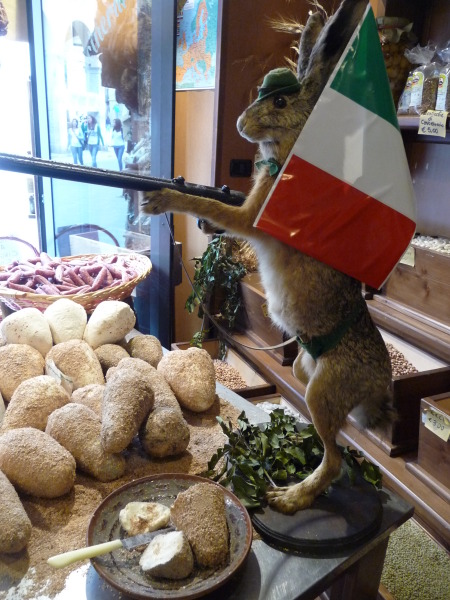
Too tired to begin that now, but here's one photo to maybe inspire some interest in my posts to come, from one of Norcia's (pronounced nor' - cha) famous pork, cheese, and Black Truffle shops. They love their aged Cinghiale meats and sausages in Umbria (Cinghiale is Wild Boar, not our American feral pig which is not too tasty). In much of Europe, wild game is sold in markets (which is illegal in the US).
The market shops always have samples of their own aged ricotta dura (a harder and delicious version of ricotta which is good for salads), their superb Pecorino from sheep milk, or of their sausages. I was tempted to smuggle a large wheel of Pecorino Dura, but decided not to test the mysterious customs laws on importation of foods.
They roll the aged ricotta in toasted wheat for a skin, as below:
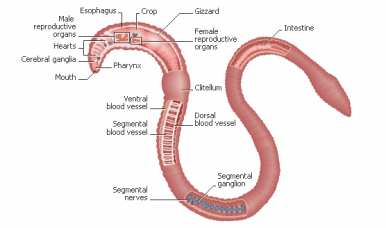
I was surprised to stumble upon the fact that the common earthworm, the gardener's friend, is not native to the US and Canada: most worm species are "invasive" introductions from Europe, and have been spread across the country in plant material.
A few more interesting facts:
- The earthworm has been very destructive to several types of forest habitat by consuming deep forest litter (leaves). Ecologists consider them invasive pests in some habitats.
- Earthworms are killed by most pesticides. Fertilizer doesn't seem to bother them.
- Darwin calculated that earthworms can recycle and refresh the surface soil to the tune of 10 tons of soil per acre per year. Count me as a skeptic on that number, but they do churn the soil.
- Yes, some species of earthworm can regenerate lost body segments. No need for tears when you chop one with the shovel.
- Worms need food. For a wormy lawn or garden, it needs to be top-dressed or mulched with organic material. I do a generous top-dressing of peat moss or well-rotted cow manure once or twice twice a year, and after the heavy spring lawn growth, I leave the grass clippings where they fall. I like to mulch up the early autumn fallen leaves with the mowers, too.
A green lawn treated with pesticides, nurtured solely with inorganic fertilizers, and with automatic irrigation, is little more than a corpse with make-up.


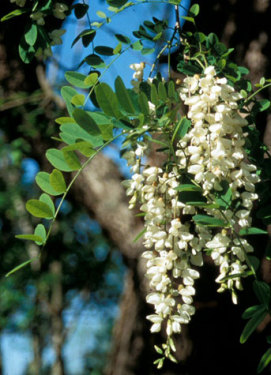 When you drive around the northeastern US in late May-early June, the blooming Black Locust trees are everywhere. Their white flower bunches put on a good show and stand out strongly from the green background - the locust trees are a big puff of white.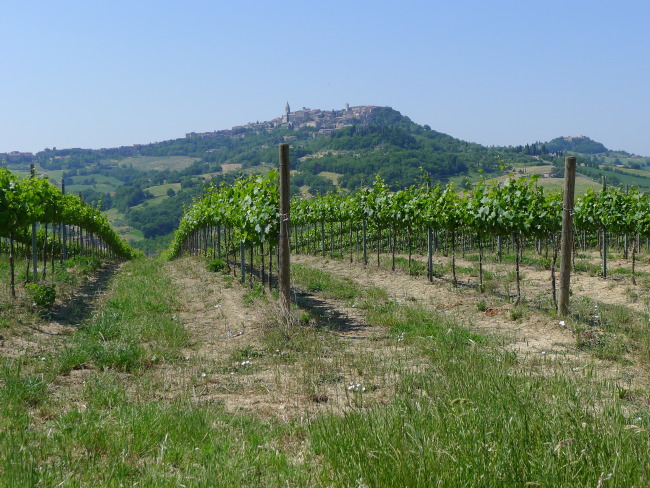
 Transportation in Bob Dylan's Music
 Classic newsreel: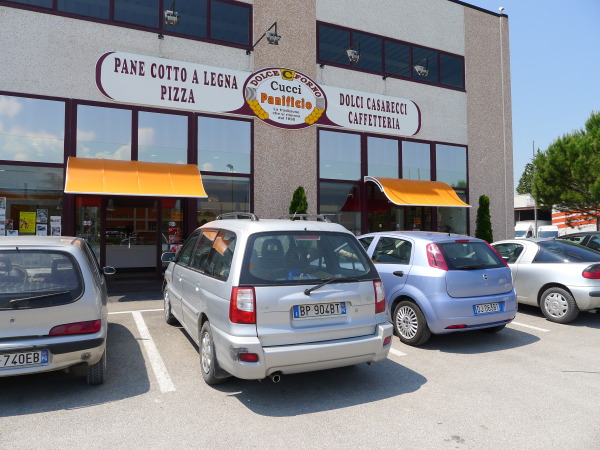
 I was surprised to stumble upon the fact that the common earthworm, the gardener's friend, is not native to the US and Canada: most worm species are "invasive" introductions from Europe, and have been spread across the country in plant material.