 Anyone who is familiar with the Occupy Wall Street movement knows that it has more or less 'settled' Zucotti Park. This is a very small area (roughly 33,300 square feet) down by the World Trade Center. It's a private park owned by Brookfield Partners. It has no habitable area, but the squatters are creating their own living conditions. They claim they will stay for as long as they have to.
Most of us doubt this is true. I'm willing to bet the minute the TV cameras leave, or the first large snowstorm blows through, most of them will leave. What if they don't, though? Could they stay forever?
It's possible. The potential is there. In fact, there is history supporting this kind of thing. So let's take a look at what might happen if these people never leave.
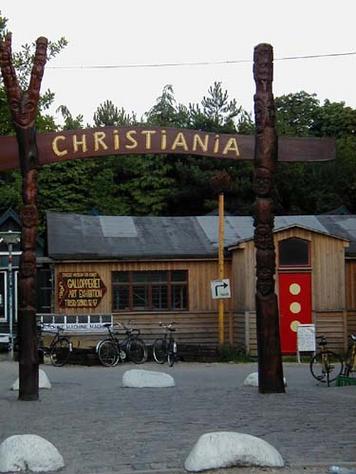
If you've ever been to Denmark, or Copenhagen specifically, you might be familiar with Freetown Christiana. Christiana is an old military barracks/base which was abandoned by 1970. In 1971, local residents broke down the fence to create a playground, and eventually many people began living in the facilities because housing in Copenhagen was hard to come by. It became a relatively autonomous commune. I found out about it as a teen, when I visited Copenhagen in 1976. At the time, I was deemed "too young" to see it. Seven years later, as a college student living abroad, I visited Copenhagen and this time I made three trips to Christiana. I will admit, it was a great party. But even then I realized it was no place to live. I was alternately impressed and repulsed. With each visit, I was less and less impressed.
As I said, Christiana is, or was when I was there, a great party. All kinds of mind altering goods were readily available, and on one of the first nights in Copenhagen I saw several bands in the renowned Loppen venue. This is an old hangar which was taken over and turned into a music/party hall. It's well established by now and hosts excellent music. And the night I was there was amazing. Well, what I remember of it was excellent. The details, as the night progressed, become quite hazy. I remember waking up and having to navigate my way through Copenhagen at 6am in order to get back to the apartment where I was staying. At the time, I considered this a great evening of partying and I was determined to revisit.
Revisit I did. Two more times with my college buddies. These visits, however, were about seeing the sights. And what we saw was not pretty. Considering this was 1983, and the people had settled there for about 11 years or so, one would have thought some kind of development or improvement had taken place. It hadn't, however. Sure, there were plenty of families, and there were plenty of 'businesses', but there was nothing substantial. It was an autonomous collective, but it was barely livable. There were rules, and part of the rules were that the residents tended to frown on people like me, gawking at their living space. We weren't treated poorly, but we certainly were not made to feel welcome. It was clear we were outsiders.
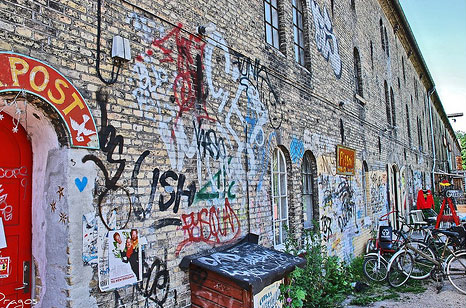
There were open markets that looked neither healthy or coordinated. There were 'chemists' who sold homeopathic remedies. Everything was non-commercial and the intrusion of commercial goods was considered a crime of sorts.
Dirt was everywhere, nothing appeared clean. By the time my second visit ended, I was still somewhat impressed that these people had pulled together and formed a community and were able to throw some outlandish parties. But I was already repulsed by the drug infestation, dirty children playing in hazardous conditions, and a general aimless atmosphere.
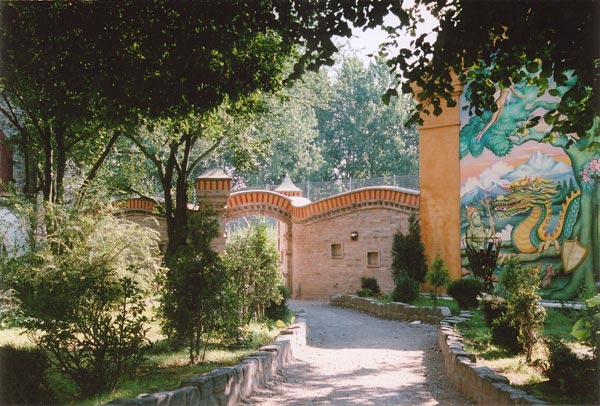
The third, and last, visit was worse. I really didn't feel welcome at all this time. As I walked through, it became apparent that my clothing was what set me apart. Clothing, and my general grooming, which was not impeccable, but was not nearly as disheveled as most of the locals. On this visit, I was looking at 'architecture' and art. I have to admit, the art was pretty impressive. The 'architecture' was not. The idea was that codifying rules for building or living was inconsistent with communal living and the advancement of a truly free society.
By the end of my time in Copenhagen, I had decided the autonomous collective movement is fine if you're willing to live a spare existence. If you believe that corporations and commercialization are 'bad', and you're willing to not have the wonderful things they bring, it's a great way to live. On the other hand, is it fair to assume others should or must live this way? Which is why Christiana is a good thing. It keeps the 'dream' of the autonomous collective alive, but acts as a sober reminder of the very shortcomings of this system for those who wish to live outside.
As a result, Zucotti Park could stick around for a long time. Its size clearly limits the impact it's likely to have - it could never be like the relatively huge Christiana. But there is staying power, and there is a model to which Zucotti denizens could point for continued existence.
Much has changed for Christiana, though. Many rules have been instituted, and public officials have cracked down many times in the last 28 years. There are several businesses which have since opened in Christiana, trying to adhere to the themes of the areas founding, but clearly altering these themes at the same time. As time went on, complaints about Christiana increased, even as the area worked to clean itself. The 'beauty' of a 'free zone' was consistently offset by the crime and hazards which accompanied the seemingly generous 'freedoms' left unmanaged by the collective. Despite recognizing their own shortcomings, the collective was unable to create a viable, safe, ongoing culture. In 2007, rights to the base were ceded back to the city over a 10 year period. The city's rights to the base have been upheld in court. Over time, Christiana will once again be a full and integrated part of Copenhagen.
Can Zucotti Park last forever? Sure, why not? But the prospects are dim. It's nowhere near as large as Christiana. But this is a benefit, too. Smaller collectives are easier to manage. The real issue is property rights. Since they do not have the right to occupy the space they are in, they must rely on the willingness of Brookfield Partners to allow them to remain. So far, this has not been a problem. At some point, if the occupiers begin to see complaints increase, the inevitable crackdown will come.
More likely, however, the TV cameras will leave. At that point, the OWS movement will cease to generate any organic interest and fade away. It lacks proper organization, it has no goals, no solutions, and no management. It is a grand party, however, and that will attract people for quite some time, just as Christiana did. Like Christiana, it's hard to call OWS illegitimate, because it's easy to sympathize with at least a few grievances which they have stated. However, in my experience, if you have a grievance you should not air it until you have a solution prepared to deal with that grievance. This is what creates a beneficial growth environment. Christiana survived for many years because its residents found short term solutions to keep it together. In the long run, they had no solutions to their worst problems.
Lacking in solutions, Zucotti Park will die. But it may take quite a bit of time, as the history of Christiana might suggest.