Tuesday, November 1. 2005
A wide-ranging interview with Harold Bloom The great Bloom discusses himself, aging, literature, wisdom, and, of course, Shakespeare: "He (Hamlet) is simply not the nicest guy in the world. He is as much a villain as he is a hero. He transcends these categories as he transcends any category. He knows too well, he understands too well, he has thought his way to the end of thought. As I read Shakespeare, even though he is humane, he has thought his way into the abyss, into nothingness. Even though Hamlet moves us because there are intimations of transcendence, nevertheless they are of... And I think Shakespeare knows it. I think it's the darkest literary work I have ever read and its implications are shattering." Read entire interview.
Our second installment of Nathan's diary: Click the Aliyah Diary category on upper left to learn what this is about. (Got to remind him to translate all of these Hebrew words into English, in parentheses, for us goyim.) Oct 14, 2005: Yom Kippur and Ariel
A seven year old's comment touches me and makes Yom kippur, although
I must wait until break-fast at her house to have the day fulfilled.
How to picture Yom Kippur in Ra'anana? the streets are empty of moving cars, instead filled with joyful children on bikes, rollerblading, playing. Some adults too are on wheels. I split my time between Kinor David and Shivtei Israel, sneaking off for a nap at 1 and missing the reading of Job (which I read by myself). Kinor David is nonstop praying from 730 am to a bit after 600 pm. At Kinor, they have put my Hebrew name on the white plastic chair I am to occupy: Naftali Sheinberg, in Hebrew. I do believe that for generations, my predecessors had prayed to see their names written like this in a land like this. But, a bit too much religion for me at least in one day. A bit more comfortable at Shivtei, despite the choir; Danny Beller the rabbi has an insouciant sense of humor, and I can slip out without being discovered. I recall being in a choir at age ten with Michael Osband's father; given a short solo, I warbled
the tears into it, singing to the women's section. Later, at break, Osband's pere dumps on me for stealing the show. I wasn't naive about this; I knew that I would sing into the hearts of the women. Perhaps like Amichai, I found the mehitza more enticing than foreboding.
I also thought about the Torah and one haftorah readings for these holidays: Rosh Hashanah starts with the birth of Isaac, and next reading is about Abraham's' near murder of his only son. The word's are short, powerful, Hebraic nomad language. I picture Sergio Leone, who did the Eastwood Spaghetti westerns, doing the laconic portrayal of these pre-cowboy laconic guys in desolate Beer-sheva. God: "Lech lecha", the same words he commands Abraham some 30 years earlier to leave his father's house, journey 1,000 or so "klicks" from fertile Crescent to desolate Beer-sheva basin, God now uses to command Abraham to kill his only son with Sarah (as he once told him to send his only, only soon, Ishmael into the wilderness with his mother). And Abraham's response: the obedient, "Hineni," a Steppin Fetchit kind
of, "Here I is, Boss." Then the reading on Yom Kippur: after God kills Aaron's two sons for the sin of ..... getting too close to God, He goes about business, telling Moses to tell Aaron how he needs to go into the mitbe'ach, the holy sanctuary, only after special cleansing of body and soul and the sacrifice of two rams (I think, rams); one to be butchered near the alter, the other sent into Azalzel, the wilderness which I believe shares a zipcode with where Ishmael was sent. Or at least the same ecosystem. Also, to sprinkle a dab of blood on the horns of the altar (Aaron shouldn't forget whom these two rams are a substitute for). I gather that some of the atmosphere of the mitbe'ach was a charnel house and the Cohanim, well, shochetim.
Continue reading "Guest Author: Aliyah Diary, Part 2"
Monday, October 31. 2005
 Miramichi Inn Miramichi Inn
A group of Maggie's Farm friends recently returned from a week at the above, with nothing but praise for the lodging and the sporting opportunities, despite having had lousy weather. It's a definite re-do for next October. They donated a spot for the conservation charity we support (Ducks Unlimited) too. Merci bien, Andre. Miramichi Inn.
Who is Alito? And a Powerline view here.
Bird Hunting Kevins has a fine catalog which focuses on high-quality Southern bird hunting gear. Also, never underestimate LL Bean's hunting gear - it's how the company got started. And to save money, it's a good idea to check Sierra Trading Post for your gear needs, first. You will make some impulse buys there, and keep the economy rolling. They have some good deals on Aigle wellies right now. Got to ask The Barrister to do a piece on wellies...he is the Wellie Maven.
Tamiflu Despite its possibly uncertain effectiveness, people are stocking up on anti-influenza medicine, as Maggie's Farm advises. So Roche is restricting the supply. Americans are smart: they view it like buying insurance. We will continue to follow the story of the avian flu closely.
| Two Wolves One evening an old Cherokee told his grandson about a
battle that goes on inside people. He said, "My son, the battle is between two
"wolves" inside us all. One is Evil. It is anger, envy, jealousy,sorrow, regret,
greed, arrogance, self-pity, guilt, resentment, inferiority, lies, false
pride, superiority, and ego. The other is Good. It is joy, peace, love, hope, serenity, humility,
kindness, benevolence, empathy, generosity, truth, compassion and faith." The grandson thought about it for a minute and then asked his grandfather:
"Which wolf wins?" The old Cherokee simply replied, "The one you feed." |
Saturday, October 29. 2005
Kubla Khan (1792) In Xanadu did Kubla Khan A stately pleasure-dome decree: Where Alph, the sacred river, ran Through caverns measureless to man Down to a sunless sea. So twice five miles of fertile ground With walls and towers were girdled round: And there were gardens bright with sinuous rills, Where blossomed many an incense-bearing tree; And here were forests ancient as the hills, Enfolding sunny spots of greenery.
Continue reading "Saturday Verse: Coleridge"
Friday, October 28. 2005
Making Music vs. Listening to Recordings It's about time that someone wrote a book about the effects of recorded music on music, and the way we listen to music, who makes the music, and the way music is performed. Robert Philip has done it: Performing Music in the Age of Recording. From a NYROB review by Rosen: "Before 1900 in Europe and America, it was at home that music was most often experienced, by family members who played some instrument or sang, and by, willingly or unwillingly, the rest of the family and friends. (In Western society among the lower middle class and upward, most music was made by women, who were generally expected to learn to cook, sew, and play the piano. The majority of professional musicians may have been male, like the majority of professional cooks, but most of the cooking and piano play-ing was the lot of women. Music, like breakfast and dinner, was part of life at home.) More exceptionally, music could be heard in some public places—concert hall, opera house, or church. The public realm was essentially a complement to the private. It set standards and added glamour. By the twenty-first century, all this has changed. Both private and public music are being displaced by recordings. Few people make music themselves at home anymore. Because of more cramped living space, it is now inconvenient to house a piano, a once indispensable piece of furniture for any household with even modest pretensions to culture and the instrument that for more than a century was the mainstay of classical music. Outside the big cities, live public music is disappearing as well. Most of the smaller towns that used to have a classical concert series have lost that, and if they are too insignificant to sponsor a popular rock group event, their public music must be confined to clubs. Even live symphony and opera broadcasts have been largely eliminated. At home today we play records. Classical and pop radio stations play records. And often ballet companies and theatrical productions play records in place of hiring musicians. Robert Philip's Performing Music in the Age of Recording is a brilliant analysis of how this has affected performance style. It is also incidentally, for much of the time, the best account I know of how musical life in general has changed since the introduction of vinyl and long-playing records in the 1950s, which made it possible for records to invade everyone's home." Read entire review here.
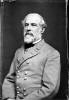 Whiskey - I like it, I always did, and that is the reason I never use it. Whiskey - I like it, I always did, and that is the reason I never use it.
Gen. Robert E. Lee
Thursday, October 27. 2005
Bell the Cat and Shock the Dog If you have an outdoor cat, please bell that cat. The domestic cat is the major destroyers of songbirds, and, since cats come from Egypt, our local birds aren't genetically prepared for them. I don't care whether they are natural hunters - they don't belong here. As far as turtles go, I use the training collar to train my dogs off turtles when I am tramping through the woods and marshes. This might sound just a little wierd to do, but domestic dogs, along with car tires, are the main killers of turtles like our endangered Box and Wood Turtles and, once again, these dog predators are not native to the northeast. A dog can kill a turtle with one bite. When they get near a turtle, I give them a good shock and a loud "Careful", and that seems to handle it fairly well. (Same procedure works for rattlesnakes in the south and west.) They learn after once or twice that reptiles are surrounded by a magic electromagnetic force field, and leave them alone. Training collars: Yes, we believe in them absolutely. Used correctly, they will save your dog's life, and help you raise a dog that you can live with easily, without harming your dog one bit. Who wants a disobedient dog? Nobody - an untrained dog is nothing but a burden, whether in suburbia, the city, or in the hunting fields. And a dog that is a burden gets neglected, while an obedient dog gets love and company. Some dog trainers refuse to use the training collars to reinforce obedience training, but I think that is silly and overly sentimental: you cannot reason with a dog, and obedience cannot be optional. Carrot and stick.
What a country! See the list of colleges who have offered to take in New Orleans students. The Miers story: bored with it The Plame-Wilson story: bored with it
 The Story of the Ford Edsel The Story of the Ford Edsel
Watching Ford and GM struggling today brings to mind the story of the Ford Edsel. The Edsel story is a case study in how not to develop and introduce a new product. That's not exactly the problem that the big American motor companies have today - it's bad contracts and their turning themselves into de-facto finance and healthcare corporations - but they have not been wise for many years. Detroit is suffering: Click here: RealClearPolitics - Commentary - Public Sector Unions Still Living in a Dream World by Tom Bray From a piece by A. Young: The early 1950s were a euphoric period for automakers. In 1955 Americans bought a record 7,169,908 new cars. This auto-buying frenzy was just one aspect of the postwar economy that Vance Packard described in The Status Seekers, published in 1959 1 In Packard's view, automobiles evolved from mere transportation vehicles just after World War II to symbols of middle-class affluence in the first half of the 1950s. The V-8 engine reigned supreme and horsepower was the watchword. In this heady market atmosphere Ford Motor Company conceived a new car that they hoped would help the company surpass General Motors in overall market share.
Read entire.
Sometimes I feel so low-down and disgusted
Can't help but wonder what's happenin to my companions
Are they lost or are they found
Have they counted the cost it'll take to bring down
All their earthly principles they're gonna have to abandon?
There's a slow, slow train comin' up round the bend. I had a woman down in Alabama
She was a backwoods girl but she sure was realistic
She said "Boy, without a doubt
Have to quit your mess and straighten out
You could die down here, be just another accident statistic"
There's a slow, slow train comin' up around the bend. From the song and the album Slow Train Coming.
Wednesday, October 26. 2005
Tomato vs. Vinegar, etc. To us in the Northeast, the barbecue wars of the South can seem like quaintly endearing rivalries - until you experience two things: 1. the true intensity and competitiveness of the regional barbecue wars (see Instapundit) and, 2. the total lusciousness of each one of these forms of commingled fat, smoke and meat. I hesitate to state that I prefer the Carolina-style pulled pork to the others, but I've never had a barbecue I didn't like. The pulled-pig I had in Kentucky may have been the best, a whole hog smoked in a freshly-dug hole in the ground for about 24 hours. You yank hunks of meat off the hog with your hands like a cave-man. Our red-state readers hardly need a basic lesson in the regional barbecues, and in pits vs. smokers, and dry rubs vs wet sauce, or even pork vs the blasphemous Texas beef brisket, but I needed a primer, especially after a conversation last week about vinegar-based sauce vs. tomato-based - North Carolina's famous east-west division. A barbecue primer here. Another piece with recipes here. Hungry already. Too bad this stuff is so scarce in the Northeast. I've had enough sushi for a lifetime, and the very thought of more of it is nauseating: from now on, I will call it "bait," not food. I think I just liked the wasabi and the ginger.
Arctic Char Everything you wanted to know about this delicious game fish.
He that is slow to anger is better than the mighty; and he that ruleth his spirit than he that taketh a city.
Proverbs (ch. XVI, v. 32)
Tuesday, October 25. 2005
His and Hers key holders Wild salmon vs. money: Env. Econ. A plug for Club ABC Tours: An affordable way to see the world
"He's mad that trusts in the tameness of a wolf, a horse's health, a boy's love, or a whore's oath." From King Lear (III, vi, 19-21)
Monday, October 24. 2005
Is Forgiveness good for your health? It is certainly good for the spirit and soul, but it's not an easy thing to do and most people need a little or a lot of God's help to achieve it. It might be good for one's health, too, thus supporting the idea that forgiveness is more of a gift to the forgiver than a gift to the forgiven.
Leaving the Left Front Page held a symposium for those who have had second thoughts about their Leftist beliefs. Symposium here.
Truth about Colleges From a review of several books, by Hacker, at NYReview of Books: "Higher education in America is no longer the preserve of a privileged elite, with more than seven million undergraduates now enrolled in the roughly 2,600 colleges and universities that grant bachelor or higher degrees. In 2002, the most recent year for which figures are available, 1,291,900 students received bachelors' diplomas and 606,958 completed graduate programs. The latter figure is worth noting, since it tells us that almost half of those who are completing college believe that a single degree won't suffice for what they want to do or be. A census study last year found that among adults aged thirty to thirty-four, only 41 percent had attended high school without going to college. These high school graduates, moreover, represent a dwindling part of the population. Another 32 percent had earned at least a bachelor's degree, while 27 percent had spent time on a campus, whether a community college or a four-year college, without finishing. Viewed one way, that figure shows a high attrition rate. Many of the colleges and community colleges, moreover, fail to provide more than perfunctory courses. The claim that almost six in ten Americans in their early thirties have had some kind of college experience thus needs further scrutiny. The experience can range from small seminars in philosophy at Colgate to lectures in motel management at Southwest Missouri State. Some colleges have rigorous core curriculums: students elsewhere must choose courses from huge catalogs in order to amass the 128 credits needed for a BA. Reed College in Oregon limits its enrollment to 1,312 students, while at Michigan State University an entering student would be one of 34,617. In fact, there are places open for anyone who wants to pursue a bachelor's degree and can pay for it, and many colleges must work hard to attract students. In a study published this year, James Fallows concluded that for all but the richest ten or twenty universities, an important part of managing enrollment is simply being sure that enough paying customers will show up each fall.[1] "
Read entire interesting review.
Sunday, October 23. 2005
For the next few weeks, and hopefully longer, we will post guest author Nathan Szajnberg M.D. each Tuesday, a medical pal and the son of an Auschwitz survivor, who moved to Israel from California two months ago and is doing his "aliyah" - the long path to becoming an Israeli citizen. I hope he makes his diary into a book, and I hope we can post a good bit of it here, first. It is casually written and not edited yet. Aliyah 10-7: Fri.
A very trying day and would like to tell you about the cab driver in Jerusalem who tried to teach me g'matria and David Vincent on the bus up to Jer., a 21 yo. oleh from England who is now in the army. Both of whom lifted my spirits and remind me of why I want to be here. To paraphrase Bill Clinton (of wayward putz-heit, have shlong, will
travel) , "It's the people, stupid.)
And even before this, got a call from Moishek of Glil Yam. Few of you (in fact none of you ) will know that for years I have had a photo of Moishek in my office from Oct. 2000, when I went to israel for a child psych conference and to interview soldiers for the first time, and ended up working on glil yam with Moishek (and interviewing
soldiers for the first time). Nu, Moishek is now perhaps in his late 60's and head of chakal'ut, agriculture. at kibbutz glil yam. a ben meshek, a true son of the kibbutz, born and raised there. At first, perhaps dubious of my fine hands, he has me removing sticker'im from the large fruit crates on pallets and putting new ones on as they are
harvesting (persimmons, the smooth-skinned, rosy fruit about the size of small grapefruit, from Asia, I think). When he returns, he comments that whereas he had tossed the first old label on the ground, I had collected the old ones in order to toss them out. I mumble something about honoring the earth, but really thought, "My father would have castigated me if I threw things on the ground." Next day, I get promoted to transferring the saplings in the nursery from one pot to the other, adding the wonderfully rich, moist earth and fertilizer. And by day three, I am way up the ladder, (only figuratively) pruning the fig trees in the natan. By the fourth day,
Moishek was teaching me about cambium layers and how to partially strip tree bark to control growth; and going with me to the hadar ochel to have coffee at 9 am (and lamenting how since the kibbutz decided to contract out the food services, they now have to eat kosher. Haval). When we drive to the natal, his five year old granddaughter is marching by with her nursery, perhaps to pick pecans from the ground. She waves. He explains how much she wanted a dog, and her mother unable to tolerate it, sends it over to Moishek. Who now cares for the girl's pup and gives her daily opportunities to come by after school to play with it, walk and feed it. This is the fellow, who until I moved was pinned on my office wall, standing astride (like
Hercules did to bear Atlas's burden temporarily), arms hanging awkwardly at his side, blue-shirted with sleeves rumpled up above the elbow, unpatched dirt-soiled jeans, gray, tightly curled gray hair; behind him a tractor, pails of dirt and the former macadamia nut nursery.
Continue reading "Guest Author: Aliyah Diary, No. 1"
Saturday, October 22. 2005
Beginning tomorrow Maggie's Farm will have the honor of publishing a weekly Tuesday feature from a guest author, our dear pal Nathan, a psychiatrist and psychoanalyst professor, co-author of Lives Across Time, the son of an Auschwitz survivor, who moved from San Francisco to Israel two months ago and who is undergoing "aliyah," the long path to becoming an Israeli citizen. He can write and he can observe detail, so it makes for a good and true tale. As Editor Dog in Chief, my only challenge is to teach him brevity, which is the soul of wit, as I believe Donald Duck famously said. At the same time, I must understand that many stories come from such adventures, and all stories must be told.
The NYT vs. Halliburton, 9/2004-9/2005 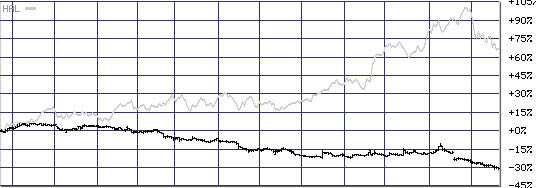 (NYT is the dark line)
|