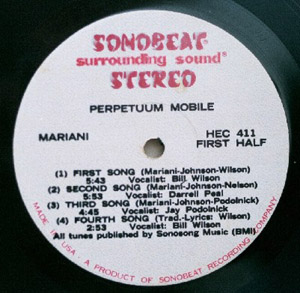
 I've given lots of discs as presents over the years, and there's no question having a customized label adds to the enjoyment. And especially when it's a kid and you've got their name right there on the disc in big bright neon
 lights fonts. And if they're discs of your home movies, how classy would it be to have small pics from the various vacations and birthdays printed on the disc?
If you've ever tried the stick-on labels, you know what a nightmare they are to work with. Get off by the tiniest bit while sticking it on and you're burning a new disc and printing a new label for Round 2.
And that 'LightScribe' routine, where it etches the text on the top of the disc, is seriously ridiculous. Like a lot of people, I got suckered into it — although I will admit that if you hold up the disc just so, and catch the light just right, you actually can read what's etched on the disc — kind of.
So what's the answer? Well, now that I've got you on the edge of your seat with this riveting question, you'll just have to...
(continue reading)
I was moseying around the Web this morning and saw an article on the Dymo DiscPainter:
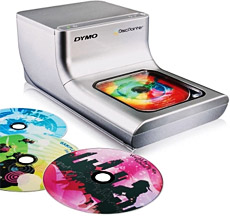
To make a long story short, it's rubbish. I read a couple of reviews and apparently even on the 'Best' setting (of 3 settings), the print quality is somewhat shoddy. Lots of pixelation and blotchies, to use a couple of graphics terms. Pixelation = what looks like goose bumps on people's skin, and blotchies = smooth backgrounds of one solid color looking a little, well, blotchy.
And the ink's a bit expensive. $40 for a cartridge. The promos say it'll do 100 discs per cartridge, but that's going to be on the 'Economy' setting, whereas we'd probably always use 'Best', and probably be lucky to get 30 discs out of it. And, being a multi-color cartridge (including black), if you used a lot of one main color, you'd run out even quicker than that. Plus, you'd have to make sure you kept a supply on hand as it's doubtful most places would carry such a specialty item.
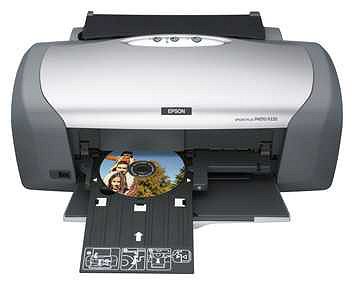
While I knew of the DiscPainter's existence, I'd never read up on it until this morning. What I didn't know (and found out in one of the reviews) is that Epson has incorporated disc-printing capabilities in some of its models:
And the kicker?
The DiscPainter is $249.
The Epson is $99 — and does twice the job.
The line of Epson ink jet printers is here. Two of them have "Direct CD/DVD printing" listed in the features but most of the better machines have disc-printing capabilities as well. You'll have to look over the individual pages.
Update: a commenter highly recommends the Epson 'Artisan 50', top of the page.
Where the monetary score evens out a tad is that you need a commercial disc labeling program to use with the printer. DiscPainter imports picture files and does the arranging for you using one of several templates. The Epson printer just prints, so you'd need a program like 'CD DVD Label Maker' to do the actual layout. Here's a page on disc label printing in general with some program suggestions at the bottom.
There might also be some 'open source' (free) disc-labeling programs around. Try a Google search for something like "open source disc label".
In both cases, the discs need to be "printable media." There are a number of brands that carry the type, and while it appears they're slightly more expensive than regular blank discs, you can always find them on sale somewhere on the Web.
And, while even more expensive, there are also print-ready discs with glossy surfaces for that extry-special look. We've all seen discs with photograph-quality labels, but I don't ever recall seeing one with a glossy label. It might be kind of surreal; a real crowd wow-er. The glossy Verbatims I saw on Amazon while researching this were normally $50 for a 50-pack (DVD), which is pretty steep, but they were on sale for $30, which isn't too bad for the occasional use.
On a personal note, I've owned an Epson for years and it's worked perfectly. I didn't like the individual color cartridges at first, but then I got into a big project printing tons of pictures full of blue sky and blue water — and that's when I started appreciating individual color cartridges.
I also like the way the Epson will let me drain the ink cartridges dry. I've heard that some brands just say "That's it!" and won't let you print until you change the supposedly empty cartridge, but the Epson just pops up with an "Ink almost out!" message which you can then shut off.
And no, ink cartridges aren't severely overpriced. The 'print head' is a small, finely-machined orifice or 'jet' built into the cartridge through which the ink is sprayed. Eventually, the friction from the ink starts wearing the jet wider, which causes blurry printing. If they'd put the print head inside the actual machine to save on cartridge costs, you'd be buying a new printer every 1,000 pages.
And don't forget the fancy ($$) electronic circuitry embedded in each cartridge so you get that ultra-fine photographic precision you so desire. While they may be 'pricey' (although I note that their price hasn't gone up a penny in over 10 years), the word "rip-off" would be incorrect.
However, with that said, it would be fair to say that they make the printer companies a lot more money over the long run than actual printer sales, which is why you'll occasionally see a printer on sale for basically nothing with the rebate. The company offers the big rebate because they want you to buy the printer so you'll then start buying ink cartridges, and I'd add that there's nothing inherently 'wrong' with this. Lots of products make more money off the support than the products, themselves. As they say in the optometry biz, "The money's in the frames."
If you like the idea of printing the occasional disc label but don't have any pressing need for it, wait for a local office superstore to have a holiday sale and hope one of the disc-printing Epsons is included. To note is that what the stores put on sale is different than the web site, and the employees, themselves, usually don't know what's going on sale until that morning. If the holiday falls on a Sunday (Mother's Day is a classic for outstanding deals), the sale will usually start when they open Saturday morning.


Do you know anyone who uses a computer? My guess is that you know a very special someone who uses a computer, and you'd like to give that special someone a really nice computer gift for Christmas. And who knows that special someone's tastes better than y
Tracked: Dec 05, 09:11
Programs AutoSizer — This has two great uses. It'll pop open the browser (or any program) in full-screen mode every time it opens, and for small programs that tend to open wherever they want (like Calculator), it will make them open righ
Tracked: Nov 29, 10:02
Here's an index of my Maggie's Computin' Tips. I can't guarantee all of these will work on every Windows operating system, but most should. Programs AutoSizer — This has two great uses. It'll pop open the browser (or any program) in full-s
Tracked: Jul 10, 11:22
Here's an index of my Maggie's Computin' Tips. I can't guarantee all of these will work on every Windows operating system, but most should. Programs AutoSizer — This has two great uses. It'll pop open the browser (or any program) in full-s
Tracked: Jul 10, 11:26
Here's an index of my Maggie's Computin' Tips. I can't guarantee all of these will work on every Windows operating system, but most should. Programs AutoSizer — This has two great uses. It'll pop open the browser (or any program) in full-scr
Tracked: Jul 22, 19:48
Here's an index of my Maggie's Computin' Tips. I can't guarantee all of these will work on every Windows operating system, but most should. Programs AutoSizer — This has two great uses. It'll pop open the browser (or any program) in full-scr
Tracked: Jul 22, 21:40
Here's an index of my Maggie's Computin' Tips. I can't guarantee all of these will work on every Windows operating system, but most should. Programs AutoSizer — This has two great uses. It'll pop open the browser (or any program) in full-s
Tracked: Jul 23, 13:07
This was first posted as a Christmas article, hence the references. Do you know anyone who uses a computer? My guess is that you know a very special someone who uses a computer. Someone who's using it right now, in fact, and you'd like to giv
Tracked: Aug 20, 23:05
Do you know anyone who uses a computer? My guess is that you know a very special someone who uses a computer. Someone who's using it right now, in fact, and you'd like to give that special someone a really nice computer gift for Christmas or a bir
Tracked: Aug 21, 08:44
Do you know anyone who uses a computer? My guess is that you know a very special someone who uses a computer. Someone who's using it right now, in fact, and you'd like to give that special someone a really nice computer gift for Christmas or a birt
Tracked: Aug 22, 17:21
Do you know anyone who uses a computer? My guess is that you know a very special someone who uses a computer. Someone who's using it right now, in fact, and you'd like to give that special someone a really nice computer gift for Christmas or a birt
Tracked: Aug 22, 17:22
Here's an index of my Maggie's Computin' Tips. I can't guarantee all of these will work on every Windows operating system, but most should. Programs AutoSizer — This has two great uses. It'll pop open the browser (or any program) in full-s
Tracked: Aug 28, 08:31
Do you know anyone who uses a computer? My guess is that you know a very special someone who uses a computer. Someone who's using it right now, in fact, and you'd like to give that special someone a really nice computer gift for Christmas or a birt
Tracked: Sep 05, 09:30
Here's an index of my Maggie's Computin' Tips. I can't guarantee all of these will work on every Windows operating system, but most should. Programs AutoSizer — This has two great uses. It'll pop open the browser (or any program) in full
Tracked: Jan 08, 20:00