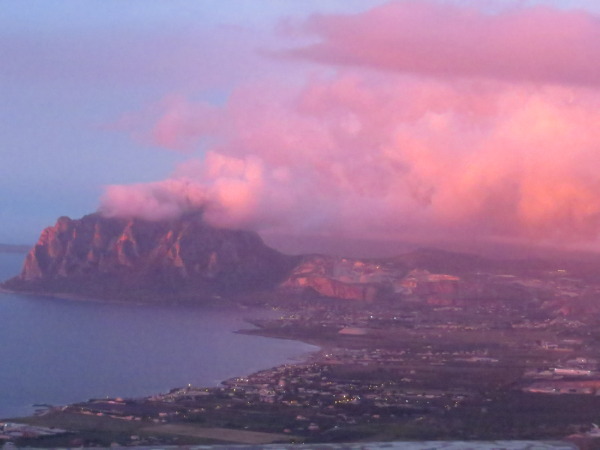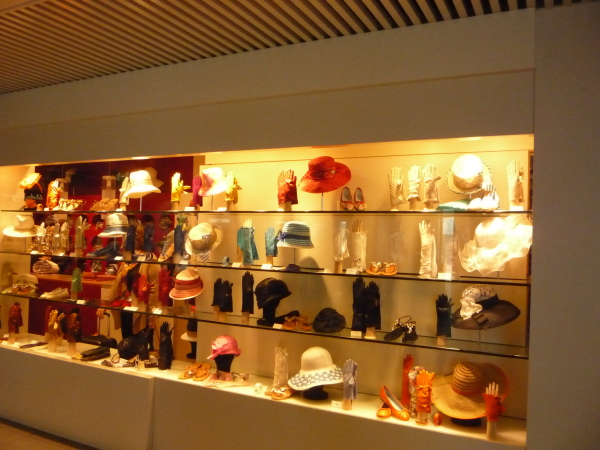
We seem unable to pass through the Rome airport without stopping to see our old friends at Sermoneta. Mrs. BD loves their gloves.
3. Oftentimes, the credit card machines "aren't working" for
tourists, especially at gas stations. "Machina no connectione" or
something like that. They want cash. Tax avoidance is just a wholesome
sport, as in Greece.
4. Related to the above, Sicily seems about as prosperous as Spain,
southern Italy, Greece - or Maine. Not dirt poor, and with its share of
quiet, unostentatious prosperity hidden behind gates. I think there are a
lot of cash transactions, and we were told that so many people refuse
to pay property taxes that the government ignores it. Also, there are
apparently substantial numbers of old aristocracy with large land
holdings and business interests around Europe. At one tenuta we stayed
at, the owner was an architect in Rome. Another was a marchese, a
businessman who lived in Palermo. Refined, elegant gents and old-time
feudalism with hundreds of years of family ownership and habitual estate
tax avoidance. Many laws seem optional - and especially speed limits.
Sheesh. Translated into mph, people leave you in their dust on the
highway going 90-100 mph in their Beemers, Mercedes, Porsches, and
Audis.
5. In 12 days, we encountered a total of 6 Americans. Our favorite
was a young USN crew chief from Atlanta, based somewhere in Sicily. A
fair number of adventurous Brits, Aussies, Germans but most of the
sightseers and vacationers were Italians.
6. I would not drive around Sicily without a GPS. It's not perfect
and can be slow and confusing on intersections and traffic circles, and
isn't too intelligent off-highway, but you need it anyway.
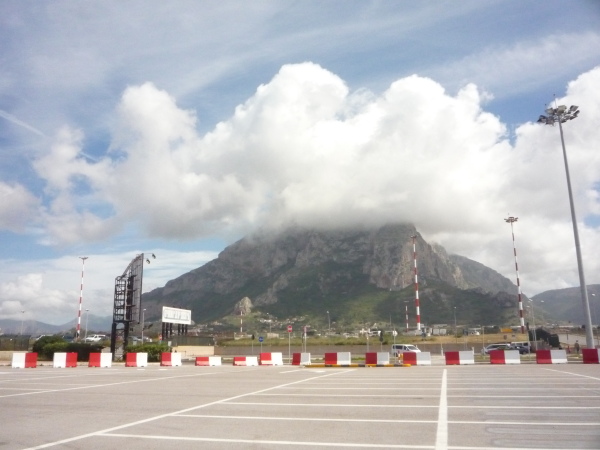
A pic from Palermo airport, waiting for our good Peugeot.
7. They tend to give you far too large helpings of food, and feel
hurt when you can't finish it. I tried to finish one tenuta dinner once
out of politeness, then gave up. Over the years, we have learned to
order one dinner in Italy (and Germany), and to share it. Even then, it
can be a lot. The volume can be unappetizing.
8. "What do all these people do?" We wondered that often.
9. On the whole, urban people seem friendly and want to be helpful,
but the rural and village people seem suspicious and brusque. On the
other hand, we twice got a bit lost trying to find rural tenutas on dirt
roads because these farm B&Bs do not have real addresses. One time,
a couple in a farm village said follow us in Italian, and he guided us
there. Another time, a cafe waiter offered to do that. They like
Americans.
10. Sicilian dialect is punchy and rough without the musicality of
northern Italian. Their ordinary conversations often sounded like angry
argumentation to me.
11. Almost everything is a little shabby and not up to American
expectations, but bathrooms are always clean as a whistle, there is zero
street litter, and the highways and secondary roads are excellent.
After that, it's dirt roads. As far as Michelin stars go, I'd charitably
say that you can translate 4 stars in Sicily to 3 stars in Florence or
Rome. For another example of how things are, we did not make our planned
ferry trip to Malta because it turned out that there would be no
ferries on Thursday. Why not? It's Sicily is why. Also, we missed seeing
Monreale, which was to be one of the high points of our trip, because the famous Norman cathedral is closed to visitors all day on Sundays. Believe me, we could not have passed as parishioners.
12. Sicilians, like other Italians, are a very social breed. They are
always together, and always talking. When alone, they jabber on their
cell phones. God only knows what they all have to say. Even their towns
are huddled together. There is almost no sprawl and no suburbia -
generally speaking you go from town to wheat field in one block. Men
double kiss their friends, as do women. If there is live music around,
guys dance with guys, gals with gals, and guys with gals. Doesn't seem
to matter. They say Italians, like Greeks, know how to live but don't
know how to work. That's one point of view, I guess.
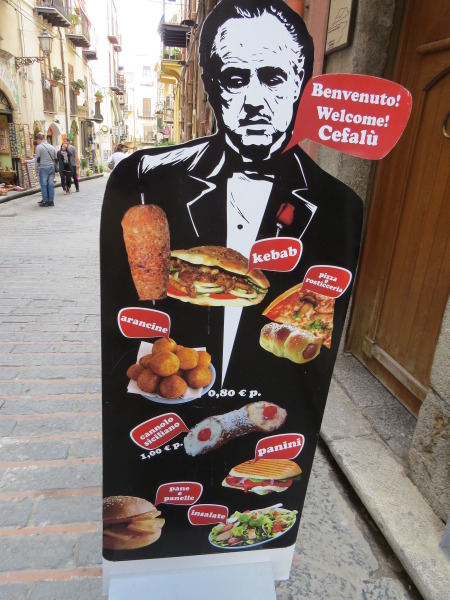
We tried Arancine for a lunch snack in Ragusa Ibla. It was OK, sort of like a corn dog. I like panini even less.
13. Except for the mountains (of which Sicily has many), the island
is intensively agricultural and all arable land is cultivated including
tiny patches. People don't have "front yards" or "back yards." They grow
grapes out front, and grow olives out back. The only woodlands are in
government parklands. Depending on the region, it's olive groves, wine
grapes, wheat, potato, cattle, sheep, vegetables, and, especially in
eastern Sicily, miles of citrus groves. They grow lemon, orange (and
especially their famously-sweet blood oranges), citron, lime, mandarin
orange, kumquat, pomelo.
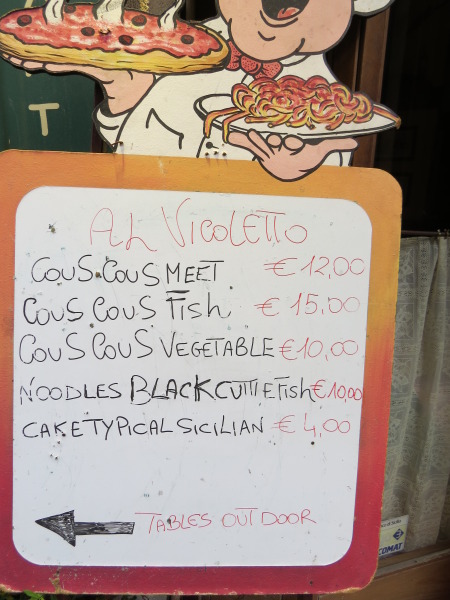
In western Sicily there is lots of couscous. The Arabs (Saracens) were there for a long time.
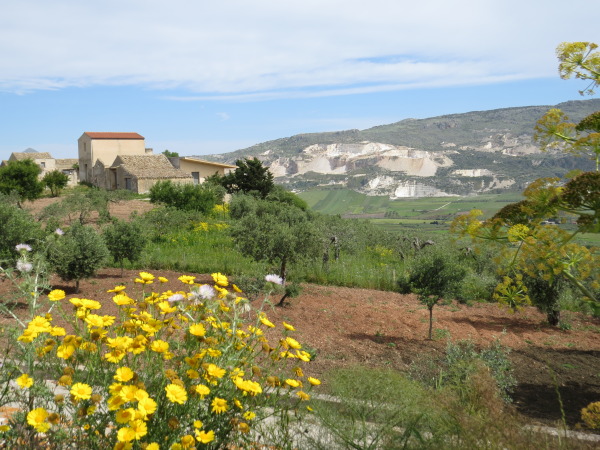
14. I'd recommend Sicily travel for late April/early May. The
wildflowers are in full bloom, it's sweater-weather at night and low-mid
70s during the day. In the Madonie Mountains, it was sweater weather at
midday and chilly at night. Tourist season is June-Sept - too many
tourists and too darn hot. We did that a few years ago, and everything
was brown and burnt.
15. Sometimes there will be a guy in a parking lot (parcheggio) who
will offer to keep an eye on your car for a couple of Euros. Nice car ya
got there, shame if anything happened to it. Give him the money. Those
guys speak all languages.
16. Unlike mainland Italy, Sicilians are breeding. Tons of kids
around. Beautiful, somewhat exotic-looking skinny women without any
American-type cuteness but good boobs plus Catholicism are the secret to
that breeding, I think.
17. Caffee. A thimbleful of Italian espresso with a dose of sugar is a
delightful treat, but oftentimes Americans want a real cup of coffee.
Cappuccino is fine for breakfast, but if you need a real cup of coffee,
be yourself and ask for a Caffee Americano. In touristy places and
hotels they will make real (and very good) regular coffee, and in other
places they just add hot water to an espresso. Decaf does not exist,
which is fine with me.
18. More on food: Italians are not big on breakfast. Generally, other
than in hotels, it's a quick caffee or cappuccino and maybe a breakfast
pastry. They don't do desserts either other than fruit. Delicious
delights like gelato, cannolli, and fine cakes and tortes are afternoon
snacks with a caffee. They do not do after-dinner coffee but instead do
after-dinner drinks like Limoncello or Grappa. They love those things,
but I do not care for either of those so I send them back and hurt their
feelings.
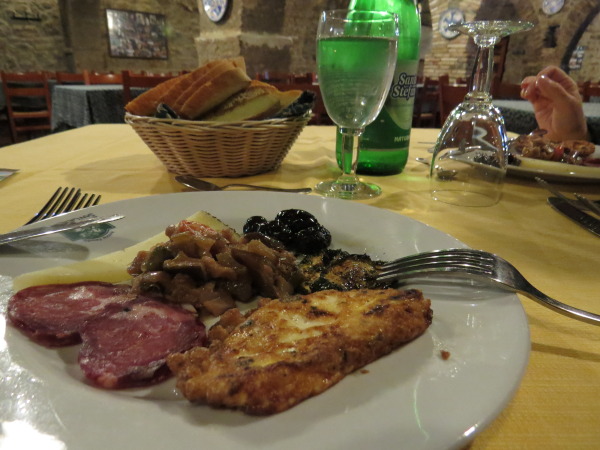
A tenuta antipasto would normally be a full meal for me, but there it is just a warm-up.
19. Do stores and restaurants still close from 1 or 2 pm to 3 or 4 pm? They sure do. Italians dine at 8 or 9 pm.
20. Does Sicilian - or Italian - food taste good without wine, or
pizza without beer? Not really. It's designed for the liquid
accompaniment. In Sicily, as in the rest of Italy, you can not get a
really tasty pizza but, at 2 pm, that's about what you're stuck with if
you are starving.
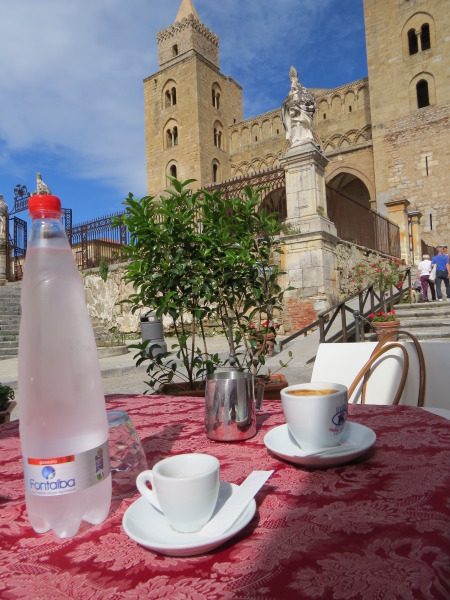
Pic is Roger the 2's Duomo in Cefalu - a real tourist town on the beach. Norman church.
21. In most places, an American cell phone and internet will not work. That's probably a good thing.
22. Everybody in Sicily has a brother, sister, child, or cousin in New York or New Jersey.
23. How do you pronounce Sicily in Italian? SEE - chilia. In Italian,
it's almost always the first syllable which is accented. It's difficult
to break the English habit of accenting later syllables. Ragusa is RA -
gusa. Cappuccino is CAP - uchino.
24. Some small towns you drive through are neat and clean, but there is nobody on the street
in midday. Nobody. Where are they? It feels weird. Best just to keep
driving. Of course, you always see a second-floor lace curtain move. Fat
old ladies sit and monitor the street from their rooms, always, in
Italy.
25. As in mainland Italy, urban Sicilians dress with flair and style.
That's how you can tell tourists from the locals. The tourists look
like slobs with cameras, except for Mrs. BD who has some Italian blood, a
Pucci scarf, and some nice dresses. She is therefore treated with
respect. La bella figura matters
a lot, as it does, I spose, everywhere to some extent. If you want respect, look respectable. Young men now
wear fashion scarves and tight jeans, which look gay to an American, but
they aren't gay.
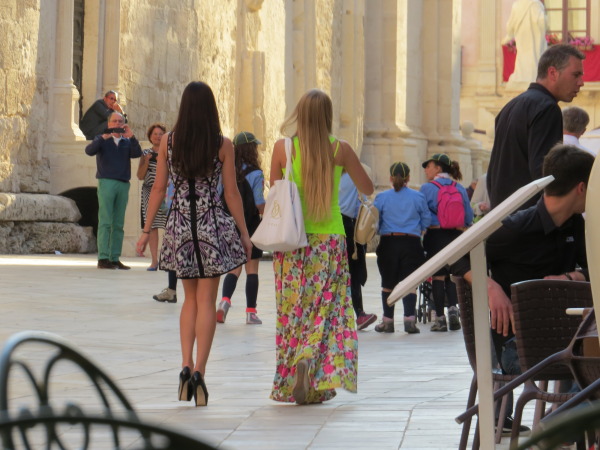
A pic from the evening passeggiata in Ortygia. Even the old folks dress up for the evening stroll, arm in arm. What a fine and civilized cultural tradition.
A travelogue with many mediocre pics and foodie items to come, if and when when I get organized.