What follows is a general theory of natural climate variation supported by observation of the changing temperature of the atmosphere and the sea between 1948 and September 2009. This work suggests that strong warming after 1978 is an entirely natural phenomenon.
“Mad dogs and Englishmen go out in the midday sun. The sun is much too sultry and one must avoid its ultry violet rays”. Noel Coward 1932.
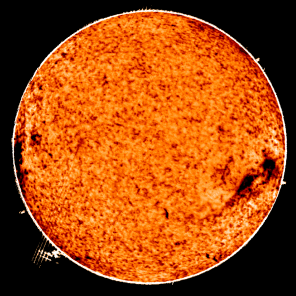
Perhaps Noel Coward’s observation is particularly pertinent in the southern hemisphere where there is less ozone to absorb UVB. During the warming mode, protective ice crystals evaporate, allowing the surface to warm. Most of the warming activity post 1978 has been in the southern hemisphere in late winter and spring. This warming activity is plainly driven by shifts in atmospheric pressure affecting vortex activity. There are two climate modes:
The Warming Mode:
There is a shift of the atmosphere from the poles towards mid and low latitudes under electromagnetic forcing of ionized air.
Weakening of the polar vortexes curtails the flow of ionized nitrogen into the upper stratosphere allowing the survival of oxygen ions and increased ozone formation.
Intermixing of ozone into the upper troposphere raises temperature in the ice cloud zone. Ice crystals evaporate.
More solar radiation reaches the surface which warms.
In the southern hemisphere 200hpa temperature rises much more than in the northern hemisphere exhibiting strong equinoctial maxima.
Peak anomalies in stratospheric temperature occur in September-October rather than March.
A southern spring deficit in ice cloud density promotes warming across all southern latitudes which promotes the El Nino pattern of sea surface temperature at the equator.
The Cooling Mode
Surface atmospheric pressure increases at the poles as the electromagnetic force in the ionosphere/thermosphere relaxes. This happens at solar minimum as the quantum of ionizing radiation falls to its lowest levels. It also tends to happen at solar maximum as the suns magnetic polarity reverses and magnetic fields emanating from the sun tend to be self cancelling. The manifestation in the Pacific Ocean is La Nina cooling.
Strengthening of the polar vortexes introduces ionized nitrogen into the stratosphere reducing the population of oxygen ions and ozone.
A loss of ozone in the ice cloud zone reduces temperature enhancing the formation of reflective ice crystals.
Less solar radiation reaches the surface which cools.
A generally low ozone level in the stratosphere results in high amplitude change in stratospheric temperature during the ENSO cycle. This is expressed in high amplitude variation in 20hpa temperature at the equator. At the surface the swing from El Nino warming to La Nina cooling is more violent and extreme.
Change is more extreme in the southern hemisphere where the polar vortex is generally cooler especially at the highest altitudes. In the cool mode stratospheric temperature exhibits a March maximum probably in line with enhancement of orbital rather than geomagnetic influences on stratospheric temperature. The earth is closest to the sun in January.
A cooler stratosphere and upper troposphere in southern spring promotes ice cloud formation reducing the flux of solar radiation to the surface establishing a La Nina dominant regime in the Pacific Ocean.
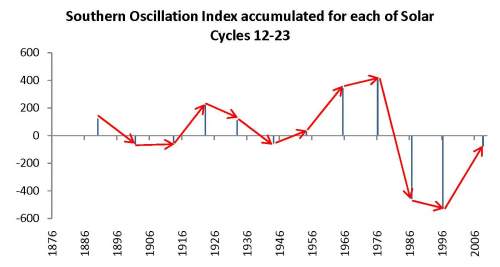
The pattern of change from the cool to the warm mode and back again is well expressed in figure 22 showing the pattern of change of the (Darwin ?Tahiti) Southern Oscillation Index when compartmentalized according to solar cycle time intervals. A fall in this index represents warming. A dramatic fall in the index occurred about 1978. With the end of solar cycle 23 the globe is emerging from the strongest period of warming in the period of the instrumental record. The Southern Oscillation Index, based on barometric pressure, is not affected by the distortions present in the temperature record.
The smoking gun for natural climate variation is an increase in the temperature of the southern stratosphere and troposphere increasing with latitude all the way to the southern pole with a marked variation in southern hemisphere temperature in winter/spring between cool and warm episodes. This determines the strength of El Nino warming events across the tropics.
The smoking gun for greenhouse effects should be a generalized warming at all latitudes without any marked seasonal bias. If there were to be a seasonal bias it should be present as an increase in temperature above the norm when outgoing long wave radiation is maximal in the summer season. There should be no great difference between the hemispheres. That is far from what is actually observed. The evidence suggests that natural variation rather than anthropogenic influences drives climate change.


 Erl Happ, via