Monday, April 21. 2008
...and other fun historical trivia from the Early Modern Carnivalisque
Sunday, April 20. 2008
I am ashamed that we were so distracted by April fishing that we missed Patriot's Day yesterday. Rick Moran covers Paul Revere, and Jules covered several first-person accounts of that first skirmish of the war. Wish I could say that my Yankee ancestors were among the rebels, but they probably were not. Best we can tell, approx. 1/3 of the colonies' population sympathised with the rebels, 1/3 were on the fence, and 1/3 were hard-core Tories. I am not aware of any Revolutionary War veteran ancestors. The Farm itself in Massachusetts, if you recall from earlier posts, was a land grant to my family from King George, and we remain thankful for that - but not ambivalent about our revolution because of its elevation of the idea of individual freedom from the power of The State.
Monday, April 14. 2008
Author A. J. David is doing a diary of his reading of Herodotus, the man who invented history. Here's his Travel Writing as History. Here's Herodotus and Bad Fate.
Friday, April 4. 2008
John Masterson Burke (1812-1909) led a long and successful life with many prominent friends and business associates, including Russell Sage and the Vanderbilts. He never married, had no close relatives, and lived in a spartan manner in Manhattan. He left his $4.5 million estate in the name of his mother "for the establishment of the Winifred Masterson Burke Foundation, which is to be a rest home for convalescents..." The inspiration for his idea is unknown. Today, The Burke Rehabilitation Center in the NYC suburb of White Plains, NY is the premier rehabilitation and rehabilitation research center in the world. A dear and close relation of mine is there right now, post hip-replacement and, if you have any doubts about American medicine, you will not after you see how this amazing place works. It's interesting to read Burke's 1909 New York Times obit. Annoyed distant relatives came out of the woodwork after he wrote his final will. Also wonderful to read the Victorian language (eg "will says he gave money to restore health, not for enjoyment") in this New York Times report on his bequest.
Thursday, March 20. 2008
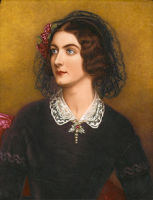 I became curious about the Irish beauty Mrs. Gilbert (1821-1861), aka Lola Montez, who was a world-travelling adventuress and dancer who broke many hearts during her short but exciting life. Even Sir Harry Flashman never forgot her, and that is saying something.
Wednesday, March 19. 2008
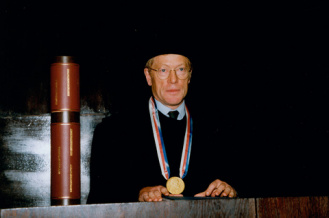 Roger Scruton's 2003 New Criterion essay on discovering Burke, which we re-post annually, begins thus: Roger Scruton's 2003 New Criterion essay on discovering Burke, which we re-post annually, begins thus:
I was brought up at a time when half the English people voted Conservative at national elections and almost all English intellectuals regarded the term “conservative” as a term of abuse. To be a conservative, I was told, was to be on the side of age against youth, the past against the future, authority against innovation, the “structures” against spontaneity and life. It was enough to understand this, to recognize that one had no choice, as a free-thinking intellectual, save to reject conservatism. The choice remaining was between reform and revolution. Do we improve society bit by bit, or do we rub it out and start again? On the whole my contemporaries favored the second option, and it was when witnessing what this meant, in May 1968 in Paris, that I discovered my vocation.
Read the whole thing.
Tuesday, March 18. 2008
This G.K. Chesterton essay seemed related to our piece on Deontological Ethics, and AVI touches on the same topic today: From a report of a talk titled "The Need for a Philosophy" by Chesterton in 1923, which is introduced thus: ...the sometimes lightly described 'Philosopher of fun' produces a powerful attack on two modern 'isms' that he accuses of being profoundly un-philosophical. If utilitarianism, ('brutaliarianism',) and relativism are allowed to become the modern way, "It means full steam in the darkness with lights out."
A quote: There was a famous American who said that England had no weather, only samples. That is true today of modern views about life. They are scrappy. Now what is excellent as regards weather is not excellent as regards the things of the mind. Modern England has no thinking, only thoughts. Thoughts can be brilliant and suggestive - journalism, literature and fiction are full of random thoughts on human life - but thinking is something different and it is extraordinarily rare. Some people, especially those who do not think, imagine that thinking is a painful process, but to my mind it is the best game in the world, and connected thinking of some kind - knowing what you mean and not following catchwords - is necessary for us all.
and ...what began as free thought has now developed into freedom from thought. All through history, there have been broad conceptions of the aims of life, tests of morality which masses of men have held and applied with certainty; but in the modern world these various systems have been abandoned and what is left of them is nothing but debris - a collection of broken bits, the ruins of past philosophies. There are some, like myself, who hold a mystical philosophy, a belief that behind human experience there are realities, powers of good and evil, and the final test for things is their influence for good or evil. The good power intends us to be happy and we are justified in being happy, but the real question is not whether we are happy, but whether, behind the things wherein we seek our happiness lies the, power of good. Are they parts of the good or of the evil?
Read the whole summary here.
Thursday, March 13. 2008
High school girls learn auto mechanics. Central High School, Washington, DC, 1927 (via Shorpy) 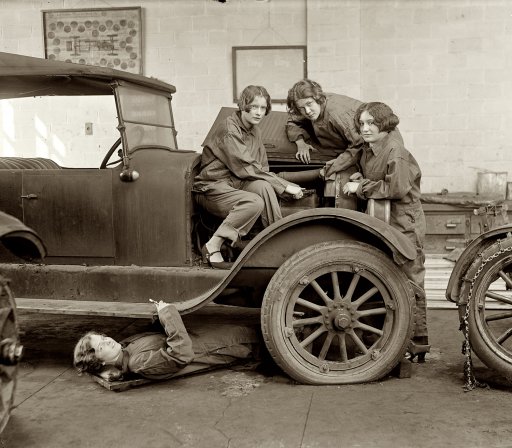
Tuesday, March 11. 2008
From "The River War," Vol. II, by Winston S. Churchill, pages 248-50 (Longmans, Green & Co., London, 1899):
How dreadful are the curses which Mohammedanism lays on its votaries! Besides the fanatical frenzy, which is as dangerous in a man as hydrophobia in a dog, there is this fearful fatalistic apathy.
The effects are apparent in many countries; improvident habits, slovenly systems of agriculture, sluggish methods of commerce, and insecurity of property exist wherever the followers of the Prophet rule or live.
A degraded sensualism deprives this life of its grace and refinement, the next of its dignity and sanctity. The fact that in Mohammedan law every woman must belong to some man as his absolute property, either as a child, a wife, or a concubine, must delay the final extinction of slavery until the faith of Islam has ceased to be a great power among men.
Individual Moslems may show splendid qualities, but the influence of the religion paralyses the social development of those who follow it.
No stronger retrograde force exists in the world. Far from being moribund, Mohammedanism is a militant and proselytizing faith. It has already spread throughout Central Africa, raising fearless warriors at every step; and were it not that Christianity is sheltered in the strong arms of science, the science against which it had vainly struggled, the civilization of modern Europe might fall, as fell the civilization of ancient Rome.
Erroll Flynn's rape trial. Scott at Powerline. A quote: Giesler later said that Flynn was the best witness he ever had. Flynn, in his autobiography, says, “Maybe he meant I made the most skillful liar under oath.”
Monday, March 10. 2008
Juke Joint and gas station, Melrose, LA, 1940, by Marion Post Wolcott (on loan from Dr. X) 
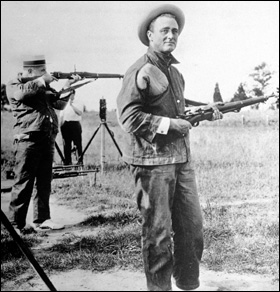 We have written several times about the destructive effect of the FDR presidency, most recently here, so there is no need to repeat ourselves. We have written several times about the destructive effect of the FDR presidency, most recently here, so there is no need to repeat ourselves.
However, it is good to see that Burt Prelutsky has come around. He begins: Growing up, as I did, in the home of Russian Jewish immigrants, it figures that I’d start out thinking that, by all rights, Franklin D. Roosevelt belonged on Mount Rushmore. But, all these years later, I have concluded that most of America’s woes can be traced back to his presidency, and that the best reason for him being up there along with Lincoln, Jefferson, Washington and Teddy Roosevelt, is that his head was already made of stone. Although FDR is often, mistakenly, credited with bringing the Great Depression to an end, as Amity Shlaes made clear in her book, The Forgotten Man, his policies, which can best be described as socialistic and anti-business, in reality prolonged America’s misery. The mere fact that he and his economic advisors thought it made perfect sense to keep raising taxes during the 1930s suggests that their primary motive wasn’t to lift the country out of its economic morass, but to take advantage of the situation to inflate the power of the federal government. The end result of his 12 years in the White House is a hodge-podge of Washington bureaucracies and an economy that finds the federal government being far and away the single largest employer in the U.S. Couple that with his personal fondness for Joseph Stalin, his filling his administration and the State Department with like-minded people, and you have a perfect blueprint for disaster. For as Thomas Jefferson recognized, “A government big enough to give you everything you want is strong enough to take everything you have.”
Burt sounds like a Maggie's Farm contributor. Read the whole thing. Photo: FDR around 1917.
Sunday, March 9. 2008
I am most of the way through Tim Blanning's The Pursuit of Glory: Europe 1648-1815. It's the most enjoyable history book I've read in years, packed with color, remarkable details, and insights into the recent route to the modern world. A page-turner, in fact. I was not surprised how much I had forgotten about Frederick the Great. As Publisher's Weekly says: Blanning, professor of modern history at the University of Cambridge, has performed the miracle of balancing and blending traditional political and diplomatic accounts with the newer fields of social, economic and intellectual history. A prime example of this is the author's treatment of the impact of the new "public sphere." As people discoursed through coffeehouses, Masonic organizations or periodicals, "a new source of authority emerged to challenge the opinion-makers of the old regime: public opinion."
Saturday, March 8. 2008
This piece by Major Shul came in over the transom: In April 1986, following an attack on American soldiers in a Berlin disco, President Reagan ordered the bombing of Muammar Qaddafi's terrorist camps in Libya. My duty was to fly over Libya and take photos recording the damage our F-111's had inflicted. Qaddafi had established a 'line of death,' a territorial marking across the Gulf of Sidra, swearing to shoot down any intruder that crossed the boundary. On the morning of April 15, I rocketed past the line at 2,125 mph. I was piloting the SR-71 spy plane, the world's fastest jet, accompanied by Maj Walter Watson, the aircraft's reconnaissance systems officer (RSO). We had crossed into Libya and were approaching our final turn over the bleak desert landscape when Walter informed me that he was receiving missile launch signals. I quickly increased our speed, calculating the time it would take for the weapons-most likely SA-2 and SA-4 surface-to-air missiles capable of Mach 5 - to reach our altitude. I estimated that we could beat the rocket-powered missiles to the turn and stayed our course, betting our lives on the plane's performance. 
After several agonizingly long seconds, we made the turn and blasted toward the Mediterranean. 'You might want to pull it back,' Walter suggested. It was then that I noticed I still had the throttles full forward. The plane was flying a mile every 1.6 seconds, well above our Mach 3.2 limit. It was the fastest we would ever fly. I pulled the throttles to idle just south of Sicily, but we still overran the refueling tanker awaiting us over Gibraltar. Scores of significant aircraft have been produced in the 100 years of flight, following the achievements of the Wright brothers, which we celebrate in December. Aircraft such as the Boeing 707, the F-86 Sabre Jet, and the P-51 Mustang are among the important machines that have flown our skies. But the SR-71, also known as the Blackbird, stands alone as a significant contributor to Cold War victory and as the fastest plane ever-and only 93 Air Force pilots ever steered the 'sled,' as we called our aircraft.
Continue reading "Major Brian Shul: "I loved that jet""
Wednesday, March 5. 2008
Main Street, Cascade, Idaho. July, 1941, from Shorpy 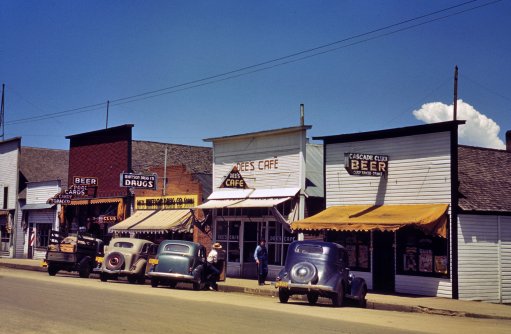
Tuesday, March 4. 2008
Buy the slaves to free them. Not a bad notion, with no lives lost and cheaper than war.
Saturday, March 1. 2008
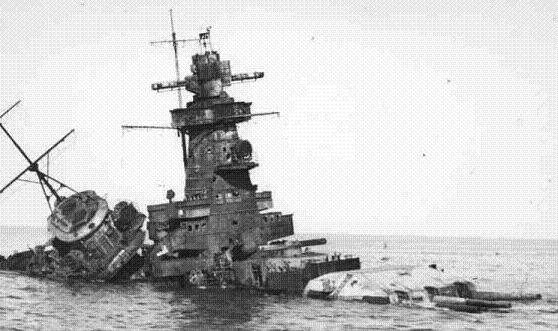
What happened to the Graf Spee after being scuttled in the River Plate? Ask Mr. Free Market.
Friday, February 29. 2008
Theodore Roosevelt speaking from his porch at Sagamore Hill, 1916. The man could talk...and talk and talk. People who travelled and camped with him said he would never shut up, but he was a great storyteller. In fact, in 1912 he was shot in the chest by an assassin in Milwaukee - but insisted on finishing his speech before going to the hospital. (His eyeglass case probably saved his life.) The guy needed no teleprompter.
The Petersburg Courthouse, 1865, from photos of the siege of Petersburg, via Shorpy: 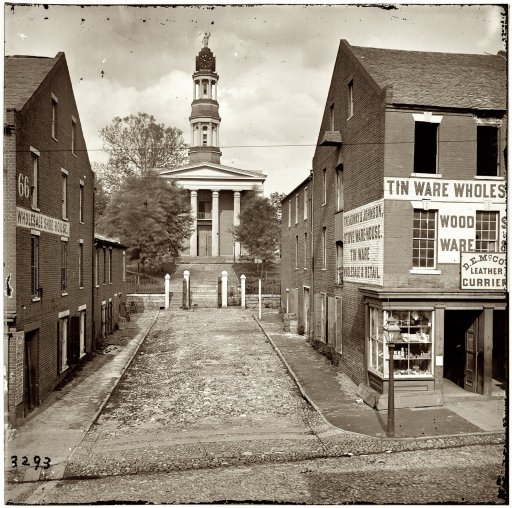
Thursday, February 28. 2008
"My God, that guy can do everything." Roger Kimball talks about his friend, Bill Buckley.
Wednesday, February 27. 2008
Gordontown, NC. Dorothea Lange, 1939 (h/t, Dr. X, who we trust does not mind the occasional theft from his remarkable photo stash) 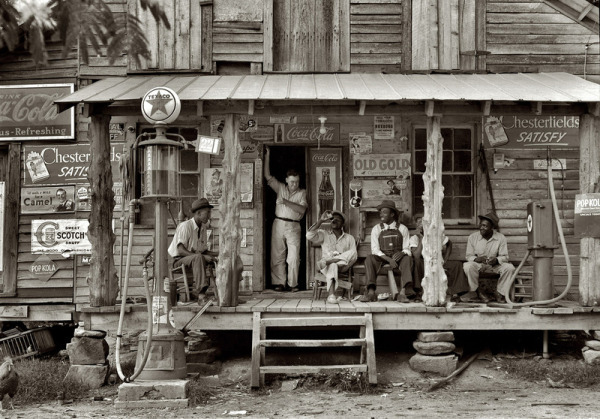
Monday, February 25. 2008
Quoted in a thoughtful discussion at David Thompson about the Left's internal conflict between internationalism and nationalism: The justification for giving priority to the interests of fellow citizens boils down to a pragmatic claim about the value of the nation-state. Without fellow-citizen favouritism, the nation-state ceases to have much meaning. And most of the things that liberals desire - democracy, redistribution, welfare states, human rights - only work when one can assume the shared norms and solidarities of national communities.
Read the whole thing.
Friday, February 22. 2008
As relevant today as it was then: A clip from a Reagan speech in support of Barry Goldwater. (h/t, No Pasaran)
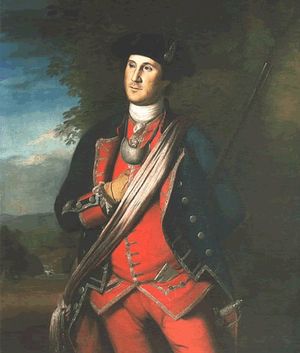 Feb. 22, 1732. Some quotes: Feb. 22, 1732. Some quotes:
I hope I shall always possess firmness and virtue enough to maintain what I consider the most enviable of all titles, the character of an Honest Man. The marvel of all history is the patience with which men and women submit to burdens unnecessarily laid upon them by their governments. There can be no greater error than to expect, or calculate, upon real favors from nation to nation. It is an illusion which experience must cure, which a just pride ought to discard. Be courteous to all, but intimate with few, and let those few be well tried before you give them your confidence. The very atmosphere of firearms anywhere and everywhere restrains evil interference - they deserve a place of honor with all that's good. It never hurts to review his Farewell Address delivered on September 17, 1796, at which time he voluntarily, despite much urging, decided that two terms of the Presidency was enough for one person. It concludes: Relying on its kindness in this as in other things, and actuated by that fervent love towards it, which is so natural to a man, who views it in the native soil of himself and his progenitors for several generations; I anticipate with pleasing expectation that retreat, in which I promise myself to realize, without alloy, the sweet enjoyment of partaking, in the midst of my fellow-citizens, the benign influence of good laws under a free government, the ever favorite object of my heart, and the happy reward, as I trust, of our mutual cares, labors, and dangers.
|